

Korean Funeral Etiquette: How to Light Incense & Show Respect Like a Local
Phase 1: Empathy (Welcome to the Real K-Culture)
안녕하세요! I’m the Lead Editor of Daily Hangul.
You’ve probably seen it in a K-Drama. The hero walks into a solemn room filled with white chrysanthemums. They wear a crisp black suit, step up to a portrait, and carefully light a stick of incense. The subtitles just say, “He pays his respects.” But… what exactly are they doing with their hands? Why are they bowing like that?
Imagine you get a message from your Korean colleague that their parent has passed away. You want to go and support them, but you are terrified of making a cultural mistake. Don’t panic. Today, we are going to learn exactly how to navigate a Korean funeral (장례식장, jangnyesikjang), specifically the most crucial part: lighting the incense (향 피우기, hyang piugi). This guide is built from the real, panicked questions of beginners I’ve taught over the years. Let’s make sure you look like a respectful insider!
Phase 2: Core Expressions You Need to Know
1. 삼가 고인의 명복을 빕니다
- Pronunciation: Samga goinui myeongbogeul bimnida [Sam-gah go-in-ey myung-bog-ull bim-nee-dah]
- Meaning: (Literal) I respectfully pray for the bliss of the deceased. / (Real nuance) Rest in peace.
- K-Culture Moment: You will see this written on envelopes for condolence money or in formal text messages. It’s the standard, most respectful way to express your condolences.
- Editor’s Insight: This phrase is extremely formal and quite long! As an A1 beginner, if you can’t memorize it, that is 100% okay. A silent, deep bow of the head is universally understood. But if you slowly say this to the grieving family, they will be deeply touched by your effort.
- Situation Spectrum:
[🚫 Never] ———— [⚠️ Be Careful] ———— [✅ Freely]- Close friends (Casual): ⚠️ (Too formal, usually friends just hug or hold hands)
- Co-workers (Semi-formal): ✅
- Elders/Superiors (Formal): ✅
- 🤔 Think About It: Notice how long and indirect this sentence is? Korean culture values showing respect through careful, elaborate words, especially in matters of life and death.
2. 얼마나 상심이 크십니까
- Pronunciation: Eolmana sangsimi keusimnikka [Ull-ma-na sang-sheem-ee koo-shim-nee-kka]
- Meaning: (Literal) How great must your heartbreak be? / (Real nuance) I am so sorry for your loss.
- K-Culture Moment: This is what you say softly to the family members after you finish bowing at the altar.
- Editor’s Insight: Instead of saying “I am sad,” Koreans focus on the other person’s feelings. It’s an empathetic question, not a statement about yourself.
- Situation Spectrum:
[🚫 Never] ———— [⚠️ Be Careful] ———— [✅ Freely]- Close friends (Casual): 🚫 (Too formal)
- Co-workers/Acquaintances: ✅
- Elders/Superiors: ✅
Phase 3: Textbook vs. Real Korean
| Situation | 📖 Textbook Korean | 🗣️ Real Korean | 💡 Why is it different? |
|---|---|---|---|
| Greeting the family | 안녕하세요 (Hello) | (Silent bow) | Saying “Hello/Good morning” is inappropriate when someone is grieving. Silence is golden. |
| Giving condolence money | 돈 여기 있습니다 (Here is the money) | (Just hand over the envelope silently) | Actions speak louder than words at a funeral. Let the gesture do the talking. |
| Comforting a close friend | 슬프겠다 (You must be sad) | 힘내 (Stay strong) | Casual friends use shorter, supportive phrases rather than formal condolences. |
Bottom Note: As a beginner, silence is your safest and most respectful tool. When in doubt, just bow your head slightly.
Phase 4: Cultural Context — K-Culture Deep Dive
4-1. The Non-Verbal Secret: Lighting the Incense
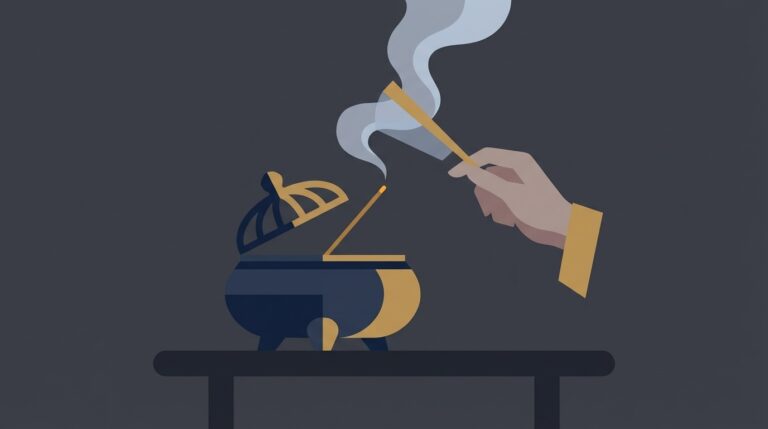
Language is only 10% of a Korean funeral. The other 90% is your body language, driven by 눈치 (Nunchi – the ability to read the room). Here is your step-by-step guide to lighting incense (향 피우기):
- Walk up to the altar. Pick up one stick of incense with your right hand.
- Light it using the candle provided.
- CRITICAL: Do NOT blow out the flame with your mouth! Gently wave it in the air or fan it with your left hand to put out the flame.
- Place it in the incense burner.
- While doing all this, your left hand should lightly touch your right wrist or forearm. This “two-handed” gesture is the ultimate sign of respect in Korea.
4-2. K-Drama Connection: The 3-Day Mourning
If you’ve watched dramas like My Mister, you’ve seen the funeral hall (장례식장) set up inside a hospital. Unlike many Western cultures where a funeral is a brief daytime ceremony, Korean funerals last for 3 days and nights. Family members stay awake the entire time, and guests come at all hours (often after work) to eat, drink soju, and keep them company so they don’t feel lonely in their grief. It’s a beautiful display of community.
Phase 5: Real-Life Roleplay Scenario
Setting: Friday, 9:00 PM. A funeral hall at a Seoul hospital. The air smells heavily of incense and spicy soup. Everyone is wearing black. You are here with your Korean coworker, Min-su, to pay respects to your boss’s father.
YOU: 민수 씨, 저 너무 긴장돼요. 😰
(Min-su ssi, jeo neomu ginjangdwaeyo.)
(Min-su, I’m so nervous.)
Min-su: 괜찮아요. 그냥 제 뒤에서 따라 하세요.
(Gwaenchanayo. Geunyang je dwieseo ttara haseyo.)
(It’s okay. Just follow behind me and copy what I do.)
(🎭 Stage Direction: You both walk up to the altar. Min-su hands you a stick of incense. You light it, but it catches a small flame.)
🔀 YOUR TURN! How do you put out the flame?
– A) 🌬️ Blow on it like a birthday candle!
– B) 🤏 Shake it gently or fan it with your other hand.
– C) 💧 Dip it in the nearby cup of water.✅ Best Choice: B — You must never blow on the incense. Shaking it gently or fanning it is the polite way!
⚠️ Choice A Analysis: Blowing on it is a huge cultural taboo. In Korean tradition, human breath is considered impure for the sacred spirits.
Min-su: (Whispering) 잘했어요. 이제 절합시다.
(Jalhaesseoyo. Ije jeolhapsida.)
(Good job. Now let’s bow.)
Phase 6: 10-Second Shadowing Drill
Practice this phrase with a very calm, solemn, and quiet voice. Don’t rush!
😔 삼가 / 고인의 / 명복을 / 빕니다.
(Sam-ga / go-in-ui / myeong-bog-eul / bim-ni-da.)
Tip: Lower your pitch slightly. Imagine you are speaking in a quiet library. ‘명’ (myeong) sounds like the ‘myoung’ in ‘young’ with an M.
Phase 7: K-Culture Mini Dictionary
| 한국어 | Romanization | English | Context |
|---|---|---|---|
| 장례식장 | jangnyesikjang | Funeral Hall | Usually located in the basement or annex of major hospitals. |
| 향 | hyang | Incense | Used to guide the spirit and purify the space. |
| 절 | jeol | Traditional Bow | At funerals, you bow deeply twice, then do one half-bow. |
| 조의금 | jouigeum | Condolence Money | Given in a white envelope. Usually 50,000 or 100,000 KRW. |
| 육개장 | yukgaejang | Spicy Beef Soup | The standard meal served to guests at a funeral. |
Phase 8: Traveler Survival Kit
Even if you aren’t attending a funeral, finding a specific hall in a massive Korean hospital can feel like a maze!
🆘 Survival Phrases for Finding Places
– 🇰🇷 “장례식장이 어디예요?” (jangnyesikjang-i eodiyeyo?)
– 🗣️ Sound Guide: [Jang-nye-shik-jang-ee uh-dee-yay-yo?]
– 📍 Use: Asking hospital receptionists or taxi drivers.
– 💡 Pro Tip: If you forgot to pack a black tie, don’t worry! Every convenience store (CU, GS25, 7-Eleven) near a hospital sells cheap black ties and white condolence envelopes. Korea is all about convenience!📌 Editor’s Travel Note
– Navigation Apps: Google Maps doesn’t work well for walking in Korea! Always use KakaoMap or Naver Map to find the exact hospital building.
– Dress Code: If you don’t have a black suit, dark navy or dark grey is acceptable. But NEVER wear brightly colored socks. You will be taking your shoes off, so wear plain black socks!
Phase 9: Critical Thinking — “한 발 더 깊이”
🧠 Think Deeper: Food & Identity (Why Spicy Soup at a Funeral?)
If you sit down at a Korean funeral, you will immediately be served a bowl of Yukgaejang (spicy red beef soup) and boiled pork. Why this specific, spicy food? In Korean culture, funerals are exhausting 3-day marathons. The spicy red soup is traditionally believed to ward off evil spirits, but practically, it gives the mourners and guests the energy and warmth to stay awake all night. Eating together is the ultimate form of comfort in Korea. It’s not just a meal; it’s a way of saying, “I am sharing your burden and staying by your side.”
💬 Your Turn: Does your culture have a specific food that is always served at funerals or gatherings of mourning? How do people show comfort? Share it in the comments!
Phase 10: FAQ & Avoiding Mistakes
- Q: Can I clink glasses when drinking soju at the funeral?
- A: Absolutely NOT. You can drink, but clinking glasses (건배 – Geonbae) is for celebrations. Just pour for each other and drink quietly.
- Q: Do I need to bring flowers?
- A: No. In Korea, you bring “조의금” (Condolence money) in a white envelope instead of flowers. Massive flower wreaths are usually sent by companies, not individuals.
❌ Common Mistake #1: Saying “안녕하세요 (Annyeong haseyo – Hello)” with a bright smile to the family.
✅ Do This Instead: Keep a solemn face, bow your head slightly, and remain silent. Your presence is enough.
Phase 11: Summary & Action Items
- One-Liner Summary: At a Korean funeral, silence is golden, always use two hands, and NEVER blow out the incense!
- Action Mission:
- 🥉 Bronze (Solo): Stand in front of a mirror and practice the two-handed gesture (left hand supporting right forearm).
- 🥈 Silver (Online): Write “삼가 고인의 명복을 빕니다” in your Korean study journal.
- 🥇 Gold (K-Culture Mission): Next time you watch a K-Drama with a funeral scene (like Goblin or My Mister), watch closely! Can you spot them using two hands to light the incense or eating Yukgaejang?
- Engagement: What part of Korean funeral etiquette surprised you the most? Let me know below!
Phase 12: Quiz — Interactive Challenge
1. You just lit the incense stick and it has a flame. What should you do?
A) Blow it out like a birthday candle.
B) Fan it with your hand to put it out.
C) Leave the flame burning and put it in the bowl.
2. True or False: It’s polite to cheerfully say “안녕하세요” (Hello) to the grieving family to cheer them up.
3. Fill in the blank: When placing the incense in the burner with your right hand, your left hand should lightly touch your _______.
A) Head
B) Pocket
C) Right wrist/forearm
(Answers: 1: B – Blowing it out is a big cultural no-no! / 2: False – A quiet bow is appropriate. / 3: C – This is the essential Korean “two-handed” gesture of respect.)
Frequently Asked Questions (FAQ)
Q: What does "삼가 고인의 명복을 빕니다" mean in Korean and how do you pronounce it?
A: In Korean, "삼가 고인의 명복을 빕니다" is pronounced [Samga goinui myeongbogeul bimnida [Sam-gah go-in-ey myung-bog-ull bim-nee-dah] and means: (Literal) I respectfully pray for the bliss of the deceased. / (Real nuance) Rest in peace.
Q: What does "얼마나 상심이 크십니까" mean in Korean and how do you pronounce it?
A: In Korean, "얼마나 상심이 크십니까" is pronounced [Eolmana sangsimi keusimnikka [Ull-ma-na sang-sheem-ee koo-shim-nee-kka] and means: (Literal) How great must your heartbreak be? / (Real nuance) I am so sorry for your loss.







