

Phase 1: Empathy (Immersive Opening)
Hello! I’m your Daily Hangul Editor.
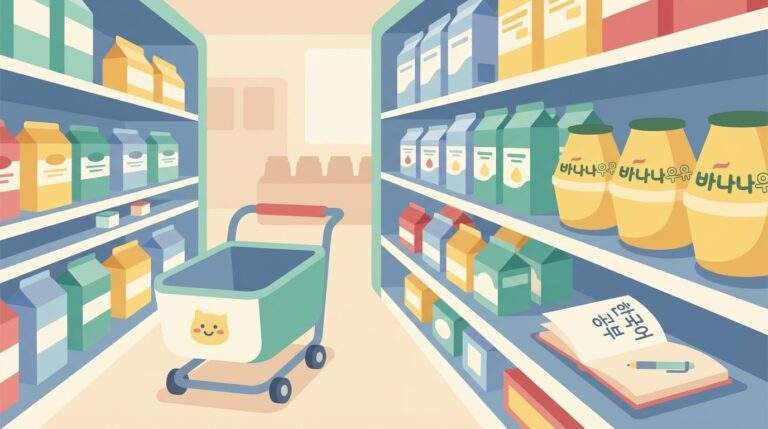
Picture this: You are standing in the middle of a massive Korean supermarket like E-Mart or Homeplus. You just want a simple carton of milk for your morning cereal, or perhaps you’re craving that iconic, yellow, bottle-shaped Banana Milk you saw your favorite K-Drama character drinking after a tough day.
But there’s a problem. The mart is the size of a stadium. You’ve walked past the ramen aisle, the kimchi fridges, and a mountain of snacks, but the milk is nowhere to be found. A friendly staff member in an apron is walking by, organizing shelves. Your mind goes blank. How do you ask them without sounding awkward?
If you don’t know how to ask, you might spend 30 minutes wandering around the store. But if you know these simple phrases, you’ll not only find your milk in seconds, but you’ll also sound like a true local.
Note: This guide is built from the real-life ‘lost in the supermarket’ moments of our Daily Hangul students!
Phase 2: Core Expressions Deep Dive
Let’s look at the absolute best ways to ask for milk or dairy products.
1. 우유 어디에 있어요?
- Pronunciation: u-yu eo-di-e is-seo-yo?
(Tip: ‘우유’ sounds like ‘Ooh! You!’. ‘어디에’ sounds like ‘oh-dee-eh’.)- Meaning: Where is the milk?
- K-Culture Moment: This is the most natural, everyday phrase. Imagine a scene in a K-Drama where a mom is sending her son on a quick grocery run to the neighborhood mart, and he has to shout this across the store to the cashier.
- Editor’s Insight: The word 있어요? (is-seo-yo?) literally means “Does it exist?” or “Is it there?”. In Korean, we don’t usually ask “Do you have…?”. We ask if the item exists in the store. It’s much simpler!
- Situation Spectrum:
[🚫 Do Not Use] ———— [⚠️ Caution] ———— [✅ Freely]
- Close Friends (Casual): ⚠️ (Drop the ‘요’ to make it ‘우유 어디 있어?’)
- Store Staff / Strangers (Polite): ✅
- 🤔 Think About It: Why does Korean use the concept of “existence” (있어요) instead of “possession” (having) when shopping? How do you ask for items in your native language?
2. 유제품 코너가 어디예요?
- Pronunciation: yu-je-pum ko-neo-ga eo-di-ye-yo?
- Meaning: Where is the dairy aisle? (Literal: Where is the dairy product corner?)
- K-Culture Moment: You’ll hear this in giant supermarkets. Korean marts love using the English word ‘corner’ (코너) to designate sections (e.g., 정육 코너 for the meat section, 해산물 코너 for seafood).
- Editor’s Insight: This sounds a bit more specific and “adult-like.” If you are looking for cheese, yogurt, or butter, asking for the ‘dairy corner’ is your safest bet.
- Situation Spectrum:
[🚫 Do Not Use] ———— [⚠️ Caution] ———— [✅ Freely]
- Convenience Store: ⚠️ (A convenience store is too small for ‘corners’)
- Large Supermarket Staff (Polite): ✅
- 🤔 Think About It: Koreans use many English loanwords like ‘코너’ (corner), but they often take on a slightly different, specific meaning. What other “Konglish” words have you noticed in Korea?
3. 바나나맛 우유 있어요?
- Pronunciation: ba-na-na-mat u-yu is-seo-yo?
- Meaning: Do you have banana-flavored milk?
- K-Culture Moment: In K-Pop V-Lives or variety shows, idols are often seen sipping this sweet drink. It’s a staple of Korean convenience store culture.
- Editor’s Insight: The syllable 맛 (mat) means ‘flavor’ or ‘taste’. You can put it after any fruit! 딸기맛 우유 (strawberry milk), 초코맛 우유 (chocolate milk).
- Situation Spectrum:
[🚫 Do Not Use] ———— [⚠️ Caution] ———— [✅ Freely]
- Convenience Store Worker: ✅
- Large Supermarket: ✅
Phase 3: Textbook vs. Real Korean
| Situation | 📖 Textbook Korean | 🗣️ Real Korean | 💡 Why is it different? |
|---|---|---|---|
| Asking a worker | 우유는 어디에 있습니까? (Where is the milk located?) | 저기요, 우유 어디 있어요? (Excuse me, where’s the milk?) | ‘있습니까’ is too formal for a quick shopping question. Adding ‘저기요’ (Excuse me) gets their attention politely. |
| Looking for cheese | 치즈를 사고 싶습니다. (I want to buy cheese.) | 치즈는 어디 코너예요? (Which corner is the cheese?) | Koreans focus on the location (where it is) rather than stating their personal desire to buy. |
| Getting attention | 실례합니다. (Excuse me.) | 사장님! / 저기요! (Boss! / Excuse me!) | ‘실례합니다’ is a direct translation but rarely used to call out to staff in real life. |
Bottom Note: As an A2 learner, stick to the “~있어요?” pattern. It’s polite, native-sounding, and works every single time!
Phase 4: Cultural Context — K-Culture Deep Dive
4-1. Non-Verbal Cues: The Art of Getting Attention
When asking for the milk’s location, do not wave your hands wildly or snap your fingers. In Korea, getting a staff member’s attention is all about the subtle voice. You approach them, make slight eye contact, and softly say, “저기요…” (Excuse me…). Also, when they point you in the right direction, a quick nod (a mini-bow) and a “감사합니다” (Thank you) is the standard Korean Nunchi (social grace).
4-2. K-Food Connection: The Banana Milk Phenomenon
If you’re asking for milk in Korea, we have to talk about Banana Milk (바나나맛 우유). Introduced in 1974, this sweet drink in the chubby plastic bottle is a cultural icon. Have you seen K-Dramas where characters go to a traditional Korean bathhouse (Jjimjilbang)? What do they always drink after sweating it out in the sauna? Ice-cold Banana Milk! It represents comfort, nostalgia, and a small reward. When you ask “바나나맛 우유 있어요?” at a convenience store, you are participating in a 50-year-old Korean ritual.
Phase 5: Real-life Roleplay Scenario
Scenario A: The Supermarket Maze
- Setting: Saturday afternoon at a massive Lotte Mart in Seoul. The store is bustling with families. Carts are everywhere. You’ve been searching for fresh milk for 10 minutes.
- Characters:
- YOU: An expat who just wants to make pancakes tomorrow morning.
- Staff Member (NPC): A busy employee wearing a red vest, currently stacking boxes of ramen.
YOU: (Approaching cautiously) 저기요…
(jeo-gi-yo…)
[Excuse me…]
(🎭 Stage Direction: The staff member turns around, holding a box of spicy ramen.)
Staff: 네, 손님. 찾으시는 거 있으세요?
(ne, son-nim. cha-jeu-si-neun geo is-seu-se-yo?)
[Yes, customer. Are you looking for something?]
YOU: 네, 우유 어디에 있어요?
(ne, u-yu eo-di-e is-seo-yo?)
[Yes, where is the milk?]
Staff: 아, 유제품 코너는 저쪽 끝에 7번 통로에 있어요.
(a, yu-je-pum ko-neo-neun jeo-jjok kkeu-te chil-beon tong-no-e is-seo-yo.)
[Ah, the dairy corner is at the far end over there, in aisle 7.]
🔀 Your Turn! How do you respond?
– A) (Stare blankly because you didn’t understand ‘Aisle 7’) “네?”
– B) “아, 네! 감사합니다!”
– C) “같이 가주세요.” (Please go with me.)✅ Best Choice: B — Even if you didn’t catch “Aisle 7”, they usually point! Say thank you, walk in that direction, and you’ll spot the refrigerators.
⚠️ Choice C Analysis: Asking them to guide you personally is a bit too demanding for a busy supermarket worker.
Scenario B: K-Culture Bonus Roleplay (The Convenience Store)
- Setting: A bright CU convenience store at 11 PM.
- YOU: “바나나맛 우유 있어요?” (Do you have banana milk?)
- Part-timer: “네, 저기 냉장고에 있어요. 지금 2+1 (투플러스원) 행사 중이에요.”
[Yes, in the fridge over there. It’s on a Buy 2 Get 1 Free promotion right now.] - YOU: “대박! 그럼 세 개 살게요!” (Awesome! I’ll buy three then!)
Phase 6: 10-Second Shadowing Drill
Practice out loud! Pay attention to the pauses (/) and the emotion tags.
- 🥺 (Politely asking for help) 저기요, / 우유 / 어디에 있어요?
(jeo-gi-yo, / u-yu / eo-di-e is-seo-yo?) - 😊 (Excited for a treat) 바나나맛 우유 / 있어요?
(ba-na-na-mat u-yu / is-seo-yo?) - 🧐 (Looking for specific cheese) 유제품 코너가 / 어디예요?
(yu-je-pum ko-neo-ga / eo-di-ye-yo?)
Phase 7: K-Culture Mini Dictionary
| Korean | Romanization | English | Context |
|---|---|---|---|
| 우유 | u-yu | Milk | Includes regular, low-fat (저지방), and flavored milks. |
| 유제품 | yu-je-pum | Dairy products | The formal word used for supermarket sections. |
| 편의점 | pyeon-ui-jeom | Convenience store | The magical 24/7 places like GS25, CU, 7-Eleven. |
| 1+1 / 2+1 | one-plus-one | BOGO (Buy 1 Get 1) | Pronounced “원플러스원” or “투플러스원”. Very common for milk! |
| 유통기한 | yu-tong-gi-han | Expiration date | Crucial to check when buying dairy in Korea! |
Phase 8: Traveler Survival Kit
Even if you aren’t grocery shopping, these phrases will save you in Korea!
🆘 Survival Expressions for Shopping
– 🇰🇷 “이거 얼마예요?” (i-geo eol-ma-ye-yo?) -> How much is this?
– 🇰🇷 “영수증 주세요.” (yeong-su-jeung ju-se-yo.) -> Receipt, please.
– 🇰🇷 “봉투 하나 주세요.” (bong-tu ha-na ju-se-yo.) -> Please give me a bag.
– 📍 Where to use: Convenience stores, supermarkets, local markets.
– 💡 Pro Tip: In Korea, you have to pay a small fee (about 50 won) for a plastic or paper bag, so cashiers will often ask “봉투 필요하세요?” (Do you need a bag?). Just nod and say “네” (Yes)!
📌 Editor’s Travel Note:
– Payment: Korea is a cashless society! Almost everywhere accepts credit cards, even for a single bottle of milk.
– Self-Checkout: Large marts usually have ‘셀프 계산대’ (Self-checkout counters). They always have an English menu option!
Phase 9: Critical Thinking — “One Step Deeper”
Food & Identity: Why is Banana Milk so special?
In the 1970s, fresh milk was expensive in Korea, and many Koreans didn’t enjoy the taste of plain white milk. The government wanted people to drink more milk for their health, so Binggrae introduced Banana-flavored milk. Because bananas were a rare, luxury fruit at the time, this drink gave ordinary people a taste of luxury. Today, it’s not just a drink; it’s a bridge between generations. Grandparents, parents, and children all share the same nostalgic memory of drinking it after a bath.
💬 Your Turn: Does your culture have a nostalgic childhood snack or drink that everyone still loves today? Share it in the comments!
Phase 10: FAQ & Mistake Prevention
Q: Can I use “어디에 있어요?” with anyone?
Yes! Adding “요” at the end makes it perfectly polite for store clerks, older people, or strangers on the street.
Q: What if they answer in super fast Korean and I don’t understand?
Don’t panic. Look at their hands. Koreans will almost always point or gesture in the direction of the item. Just follow the point!
❌ Common Mistake #1: Saying “우유 가져요?” (Do you have milk? – literal translation of ‘possession’).
✅ Do This Instead: “우유 있어요?” (Does milk exist here?)❌ Common Mistake #2: Yelling “야!” (Hey!) to get a worker’s attention.
✅ Do This Instead: Always use “저기요~” (Excuse me) with a soft, polite tone.
Phase 11: Summary & Action Items
One-Liner Summary: To find anything in a Korean store, just say the item name and add “어디에 있어요?” (Where is it?).
Action Mission:
– 🥉 Bronze (Solo): Stand in your kitchen, point to your fridge, and say “우유 어디에 있어요?” 3 times out loud.
– 🥈 Silver (Online): Write down your favorite Korean snack/drink + 있어요? in your study notebook.
– 🥇 Gold (Real Life): Next time you pass by a Korean convenience mart, go in and actually ask the clerk where the banana milk is!
K-Culture Mission:
Go to YouTube and search for “Korean Convenience Store ASMR” or “Jjimjilbang Banana Milk.” See if you can spot the iconic chubby yellow bottle!
Did you learn something new today? What item should we learn how to buy next? Let me know below! 👇
Phase 12: Quiz — Interactive Challenge
1. Situational Judgment: You are in a huge E-Mart and want to buy yogurt and cheese. What is the most natural thing to ask the staff?
A) 치즈 사고 싶어요. (I want to buy cheese.)
B) 유제품 코너가 어디예요? (Where is the dairy aisle?)
C) 저기요, 우유 있어요? (Excuse me, do you have milk?)
2. Fill in the Blank:
Excuse me, where is the milk?
______ , 우유 어디에 ________?
3. True or False — K-Culture Edition:
In Korea, it’s customary to tip the convenience store worker if they help you find your items. (T/F)
(Answers: 1. B is best for multiple dairy items. / 2. 저기요, 있어요 / 3. False! There is absolutely no tipping culture in Korea, and giving a tip might confuse them!)
Frequently Asked Questions (FAQ)
Q: What does "우유 어디에 있어요?" mean in Korean and how do you pronounce it?
A: In Korean, "우유 어디에 있어요?" is pronounced [u-yu eo-di-e is-seo-yo?] and means: Where is the milk?
Q: What does "유제품 코너가 어디예요?" mean in Korean and how do you pronounce it?
A: In Korean, "유제품 코너가 어디예요?" is pronounced [yu-je-pum ko-neo-ga eo-di-ye-yo?] and means: Where is the dairy aisle? (Literal: Where is the dairy product corner?)
Q: What does "바나나맛 우유 있어요?" mean in Korean and how do you pronounce it?
A: In Korean, "바나나맛 우유 있어요?" is pronounced [ba-na-na-mat u-yu is-seo-yo?] and means: Do you have banana-flavored milk?







