

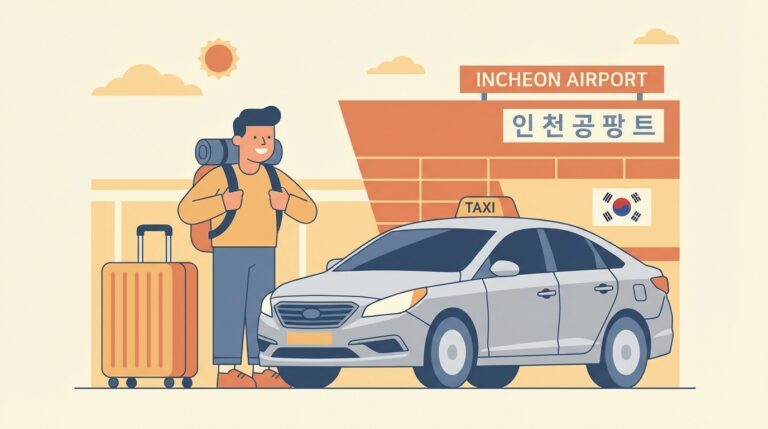
Phase 1: Empathy (The K-Culture Cold Open)
Hello! I’m your Daily Hangul Editor. Picture this: You’ve just arrived at Incheon International Airport. Your heart is pounding with excitement. You step outside, and there it is—a sleek Korean taxi. But wait… you have two massive suitcases filled with empty space for K-Beauty products and K-Pop merch. The driver is sitting inside, looking at you through the rearview mirror. You’re standing on the curb, awkwardly wrestling with your bags.
Like a scene from a K-Drama where the main character arrives in Seoul with big dreams, you need a dramatic entrance. But right now, you just need the trunk open!
Many beginners freeze in this exact moment. If you just stare, the driver might think you don’t need help. But don’t worry! By the end of this quick guide, you’ll know exactly how to ask for the trunk like a true local, avoiding the awkward silence and looking like an absolute insider. (Trust me, I’ve seen countless students struggle with this on their first day in Seoul!)
Phase 2: Core Expression Deep Dive
Let’s learn the magic phrase that will save your back and your pride.
1. 트렁크 좀 열어주세요. (Please open the trunk.)
- Pronunciation: [teu-reong-keu jom yeo-reo-ju-se-yo] / Sounds like: “Teu-rung-koo johm yuh-ruh-joo-seh-yo”
- Meaning: 직역(Literal): Please open the trunk a little. vs 의역(Real nuance): Could you please open the trunk for me?
- K-Culture Moment: You’ll hear this tone everywhere in Korea. Whether you’re at a busy taxi stand in Hongdae or asking a friend for a favor, slipping the word ‘좀’ (jom) into your request instantly makes you sound softer, polite, and very Korean.
- Editor’s Insight: Think of ‘좀’ (jom) as a verbal cushion. Without it, the sentence sounds like a robot giving a command. With it, you sound like a polite traveler asking for a small favor.
- Situation Spectrum:
[🚫 Never] ———— [⚠️ Be Careful] ———— [✅ Freely]
- To a taxi driver: ✅
- To a friend helping you move: ✅
- Shouting it aggressively: 🚫
- 🤔 Think About It: Why does Korean use the word ‘a little’ (좀) to say ‘please’? It reflects the culture of not wanting to burden others. By asking for “just a little” favor, you’re showing consideration for their effort. Does your language have a similar ‘cushion’ word?
Phase 3: Textbook vs. Real Korean
| Situation | 📖 Textbook Korean | 🗣️ Real Korean | 💡 Why the difference? |
|---|---|---|---|
| Asking to open the trunk | 트렁크를 열어 주시겠습니까? (teu-reong-keu-reul yeo-reo ju-si-get-seum-ni-kka?) | 트렁크 좀 열어주세요~ (teu-reong-keu jom yeo-reo-ju-se-yo) | The textbook is too formal (military/news anchor style). The real version is polite but natural! |
| Saying you have bags | 저는 수하물이 많습니다. (jeo-neun su-ha-mu-ri man-seum-ni-da.) | 짐이 좀 있어서요. (ji-mi jom i-sseo-seo-yo.) | ‘수하물’ is for airport announcements. ‘짐’ (jim) is the everyday word for luggage. |
Bottom Note: Stick to the “Real Korean” column! As an A1 beginner, you want to sound polite but approachable, not like a dictionary.
Phase 4: Cultural Context — K-Culture Deep Dive
4-1. Non-verbal Nunchi (눈치) at the Taxi Stand
When you say “트렁크 좀 열어주세요,” make eye contact through the passenger window and point a thumb toward the back of the car. Nunchi (the Korean art of reading the room) is key here. The driver will usually pop the trunk from inside using a button. Wait for the ‘click’ sound before you try to lift it!
4-2. The K-Travel Connection: The Automatic Door Myth
If you’ve traveled to Japan, you might expect taxi doors to open automatically. In Korea, they do not! You must pull the handle yourself. However, the trunk is usually controlled by the driver.
Also, don’t expect the driver to always get out and lift your heavy bags like a chauffeur in a K-Drama. Some kind older drivers will, but often, they just pop the trunk for you to load it yourself. It’s perfectly normal, so don’t feel offended!
Phase 5: Real-Life Roleplay Scenario
Let’s put you in the scene.
– Setting: Friday night. You are standing outside Seoul Station. It’s slightly drizzling. You have a heavy suitcase full of souvenirs.
– Characters:
– YOU: A tired but excited traveler.
– Mr. Kim (60s): A veteran Seoul taxi driver listening to trot music on the radio.
YOU: (Knocks lightly on the passenger window)
Mr. Kim: (Rolls down window) 네, 어디 가세요? 🚕
(Romanization) Ne, eodi gaseyo?
(English) Yes, where are you going?
YOU: 명동역이요.
(Romanization) Myeongdong-yeog-iyo.
(English) Myeongdong Station, please.
Mr. Kim: 타세요.
(Romanization) Taseyo.
(English) Get in.
🔀 Your Turn! What should you do next?
– A) Just get in the back seat and leave your suitcase on the sidewalk.
– B) Yank the trunk handle as hard as you can until it opens.
– C) Point to your bag and say, “기사님, 트렁크 좀 열어주세요!”✅ Best Choice: C!
Why? ‘기사님’ (Gi-sa-nim) is the polite title for driver. Always use this instead of “Ahjussi”! And never yank the trunk (Choice B)—you might break it!
YOU: 기사님, 트렁크 좀 열어주세요! 🧳
(Romanization) Gi-sa-nim, teu-reong-keu jom yeo-reo-ju-se-yo!
(English) Driver, please open the trunk!
Mr. Kim: 아, 네! (Click! The trunk pops open)
(Romanization) Ah, ne!
(English) Ah, okay!
(🎭 Stage Direction: You load your bag, get in, and enjoy the night view of Seoul!)
Phase 6: 10-Second Shadowing Drill
Let’s practice the rhythm! Pay attention to the pauses (/) and emotion.
😊 기사님, / 트렁크 좀 / 열어주세요~!
(Gi-sa-nim, / teu-reong-keu jom / yeo-reo-ju-se-yo~!)
Tip: Drag out the ‘yo~’ at the very end just a tiny bit. It makes you sound super friendly!
Phase 7: K-Culture Mini Dictionary
| Korean | Romanization | English | Context |
|---|---|---|---|
| 기사님 | gi-sa-nim | Driver (respectful) | Always call your driver this! It literally means “Master Engineer/Knight.” |
| 트렁크 | teu-reong-keu | Trunk | A Konglish (Korean-English) word! Very easy to remember. |
| 짐 | jim | Luggage / Bags | Used for anything you carry: backpacks, suitcases, shopping bags. |
| 카카오T | kakao-T | Kakao T app | The “Uber” of Korea. A must-have app for getting taxis easily. |
Phase 8: Traveler Survival Kit
🆘 Survival Phrase #1: Destination
– 🇰🇷 “[장소] 가주세요.” ([Place] ga-ju-se-yo.)
– 🗣️ Guide: Just add ‘ga-ju-se-yo’ (please go) to any location!
– 📍 Example: “Hongdae ga-ju-se-yo.”🆘 Survival Phrase #2: Dropping off
– 🇰🇷 “여기 세워주세요.” (yeo-gi se-wo-ju-se-yo.)
– 🗣️ Guide: “Yuh-gee seh-woh-joo-seh-yo.”
– 📍 Meaning: Please stop/pull over here.📌 Editor’s Travel Note
– The Best App: Download Kakao T before you arrive. You can type your destination in English, and the driver’s GPS will guide them perfectly.
– Payment: Korea is a cashless society! You can tap your T-Money card (transit card) or a foreign credit card on the terminal between the front seats.
– Tipping: 🚫 NO TIPPING! Giving a tip in a Korean taxi might confuse the driver. Just pay the exact meter fare.
Phase 9: Critical Thinking — “One Step Deeper”
Language & Power: Why “Gisa-nim”?
In English, you might just say “Excuse me” to a driver. But in Korea, titles are everything! We rarely use the word “you.” Instead, we call taxi drivers 기사님 (Gisa-nim), which adds the honorific suffix ‘-nim’ to the word for ‘engineer/skilled worker’.
Calling someone by their proper professional title shows deep respect for their hard work. Calling a driver “Ahjussi” (middle-aged man) used to be common, but today it can sound a bit rude or overly familiar.
💬 Your Turn: How do you address service workers in your culture? Do you use titles, or just say “Excuse me”? Share in the comments!
Phase 10: FAQ & Common Mistakes
Q: “If the driver helps me with my bags, should I tip them?”
A: No! Tipping is not part of Korean culture. A warm “감사합니다” (Gam-sa-ham-ni-da / Thank you) is the best tip you can give!
Q: “Can I sit in the front seat next to the driver?”
A: Unlike some countries, in Korea, passengers almost always sit in the back seat. Only sit in the front if you are a group of 4 people.
❌ Common Mistake #1: Forgetting to say “Please” (좀).
If you just say “트렁크 열어요” (Open the trunk), you sound like an angry boss. Always add 좀 (jom) and 주세요 (ju-se-yo)!
Phase 11: Summary & Action Items
- One-Liner Summary: To get the trunk open politely, say “기사님, 트렁크 좀 열어주세요!” (Gi-sa-nim, teu-reong-keu jom yeo-reo-ju-se-yo!).
Action Mission 3 Steps:
– 🥉 Bronze (Solo): Stand in front of a mirror with a bag and say the phrase out loud 3 times.
– 🥈 Silver (Online): Write “트렁크 좀 열어주세요” in the comments below to practice your spelling!
– 🥇 Gold (Real Life): Use this exact phrase on your next trip from Incheon Airport!
🎯 K-Culture Mission: Watch a K-Drama this week. When the main character gets into a taxi, listen closely. Can you hear them say “기사님” (Gisa-nim)?
Phase 12: Quiz — Interactive Challenge
1. You are standing outside a taxi with heavy luggage. What is the most natural thing to say?
– A) 아저씨, 트렁크 열어!
– B) 기사님, 트렁크 좀 열어주세요.
– C) 수하물이 많습니다.
(Answer: B! A is very rude, and C sounds like an airport robot.)
2. True or False: You should give the driver a $5 tip for helping with your heavy bags.
(Answer: False. Tipping is not expected in Korea. Just say thank you!)
3. Fill in the blank: To soften your request and sound more polite, Koreans insert the word ________ (meaning ‘a little’).
(Answer: 좀 / jom)
Great job today! You are now ready to conquer Korean taxis. See you in the next lesson! 🚖
Frequently Asked Questions (FAQ)
Q: What does "트렁크 좀 열어주세요. (Please open the trunk.)" mean in Korean and how do you pronounce it?
A: In Korean, "트렁크 좀 열어주세요. (Please open the trunk.)" is pronounced [teu-reong-keu jom yeo-reo-ju-se-yo] and means: 직역(Literal): Please open the trunk a little. vs 의역(Real nuance): Could you please open the trunk for me?






