

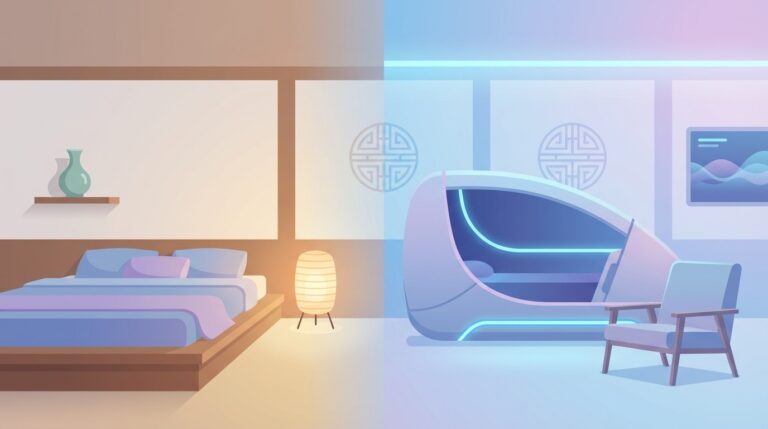
Phase 1: Empathy (The K-Culture Cold Open)
Hello! It’s your Daily Hangul Editor. Imagine this: You’re on a highly anticipated company MT (Membership Training) trip in Gapyeong. The K-BBQ dinner was fantastic, the soju flowed freely, and now it’s time to sleep in the massive shared ondol (heated floor) room. You close your eyes, completely exhausted. But the next morning, your Korean colleagues are looking at you with a mix of amusement and severe sleep deprivation. One of them gently taps your shoulder and jokes, ‘Wow, I thought a tractor was driving through the room!’
Whether it’s waking up a whole Jjimjilbang (Korean sauna), getting playful complaints from a partner, or just feeling chronically fatigued in the fast-paced ‘ppalli-ppalli’ society of Seoul, dealing with sleep apnea (수면 무호흡증) and snoring (코골이) is a reality for many. Navigating the Korean healthcare system to solve this, however, requires more than just basic survival Korean. At a C2 level, you aren’t just saying ‘I snore’; you are discussing medical referrals, CPAP machines, and National Health Insurance coverage.
This guide is crafted from the real experiences of expats navigating Korea’s top-tier, hyper-efficient ENT (Ear, Nose, and Throat) and sleep clinics. Let’s dive in and get you that perfect night’s sleep!
Phase 2: Core Expressions Deep Dive
1. 수면 다원 검사 의뢰서 부탁드립니다.
- Pronunciation: sumyeon dawon geomsa uiroeseo butakdeurimnida. (su-myeon sounds like ‘sue-myun’, dawon sounds like ‘da-won’, geomsa sounds like ‘gum-sa’.)
- Meaning: Literal: I am requesting a polysomnography referral. / Real nuance: I need a doctor’s referral for a sleep study.
- K-Culture Moment: Korea’s medical system is highly specialized. You often start at a local neighborhood clinic (동네 의원) to get a referral (의뢰서) for a larger university hospital or specialized sleep clinic (수면 클리닉) to get insurance benefits.
- Editor’s Insight: This is top-tier adulting in Korea. Using the exact medical term ‘수면 다원 검사’ (Polysomnography) instead of just ‘수면 검사’ (sleep test) instantly signals to the doctor that you are highly informed and ready for the official medical procedure.
- Situation Spectrum:
[🚫 절대 금지] ———— [⚠️ 주의] ———— [✅ 자유롭게]
- Casual with friends: 🚫 (Too medical)
- Clinic Reception/Doctor: ✅ (Perfectly formal and precise)
- 🤔 Think About It: Why does Korean rely so heavily on Sino-Korean (Hanja) vocabulary for medical terms, creating a stark difference between everyday words (잠 – sleep) and medical words (수면 – sleep)? How does this compare to Latin/Greek roots in English medical terminology?
2. 건강보험 급여 적용이 되나요?
- Pronunciation: geongang-boheom geubyeo jeogyong-i doenayo? (geu-byeo sounds like the disgusted ‘ugh’ + byuh.)
- Meaning: Literal: Is health insurance salary application possible? / Real nuance: Is this covered by the National Health Insurance?
- K-Culture Moment: Medical costs in Korea are famously affordable if covered by the NHIS (국민건강보험). For CPAP machines (양압기), the government covers a significant portion, but only if you meet strict diagnosis criteria. Asking this question is the ultimate expat survival skill.
- Editor’s Insight: The word ‘급여’ literally means ‘salary’ or ‘pay’, but in medical contexts, it means ‘covered by insurance’ (reimbursed by the state). Uncovered treatments are called ‘비급여’ (non-covered).
- Situation Spectrum:
[🚫 절대 금지] ———— [⚠️ 주의] ———— [✅ 자유롭게]
- Chatting with friends: ⚠️ (Only if discussing finances)
- Speaking with doctors/staff: ✅ (Crucial and expected)
- 🤔 Think About It: Korea has one of the best universal healthcare systems in the world. How does the concept of ‘급여’ (covered) reflect the society’s approach to public welfare versus private responsibility?
3. 각방을 써야 할 정도로 코골이가 심해요.
- Pronunciation: gakbang-eul sseoya hal jeongdoro kogorigasimhaeyo.
- Meaning: Literal: My snoring is so severe to the point we have to use separate rooms. / Real nuance: My snoring is driving my partner crazy, we might need to sleep in separate rooms.
- K-Culture Moment: In K-Dramas featuring middle-aged couples, moving to a separate room (각방 쓰다) is often a comedic trope for a marital fight or unbearable snoring. Using this idiom with a doctor adds a touch of native-level storytelling to your symptom description.
- Editor’s Insight: ‘각방을 쓰다’ is a highly cultural idiom. It shows you understand not just the medical issue, but the social/domestic impact in a Korean household context.
- Situation Spectrum:
[🚫 절대 금지] ———— [⚠️ 주의] ———— [✅ 자유롭게]
- Formal business meeting: 🚫 (Too personal)
- Friends/Doctor consultation: ✅ (Natural and expressive)
Phase 3: Textbook vs. Real Korean
| Situation | 📖 Textbook Korean | 🗣️ Real Korean | 💡 Why the difference? |
|---|---|---|---|
| Explaining symptoms | 저는 수면 무호흡증이 있습니다. (I have sleep apnea.) | 자다가 자꾸 숨이 넘어가요. / 코를 고느라 숨을 안 쉬어요. (I keep losing my breath while sleeping.) | ‘숨이 넘어가다’ vividly describes the terrifying pause in breathing, commonly used by native patients rather than clinical terms. |
| Asking for anti-snoring devices | 코골이 방지 기구를 사고 싶습니다. (I want to buy an anti-snoring device.) | 코골이 방지 밴드나 마우스피스 있나요? (Do you have anti-snoring strips or mouthpieces?) | Koreans usually ask for specific product types (밴드, 마우스피스) at the pharmacy rather than the broad category. |
| Discussing cost | 보험이 됩니까? (Does insurance work?) | 이거 실비 청구 되나요? / 급여 항목인가요? (Can I claim this on my private indemnity insurance? / Is it a covered item?) | Advanced C2 speakers distinguish between NHIS (급여) and private supplementary insurance (실비 – silbi), which 80% of Koreans have. |
Phase 4: Cultural Context — K-Culture Deep Dive
4-1. The Non-Verbal ‘Nunchi’ of Shared Spaces
In Korea, sleeping isn’t always a private affair. The culture of Jjimjilbangs (24-hour saunas), company MTs (work retreats), and traditional Hanok stays means communal sleeping is frequent. If you snore heavily, the Nunchi (눈치 – the subtle art of reading the room) kicks in hard. You might notice colleagues politely offering you the corner spot, or handing you earplugs with an awkward smile. Acknowledging your snoring beforehand (‘제가 코를 좀 골아서 죄송합니다’ – I apologize, I snore a bit) is a massive display of good Nunchi and social grace.
4-2. K-Drama Connection: The ‘Overworked Salaryman’ Trope
In K-Dramas like My Mister (나의 아저씨) or Misaeng (미생), you often see exhausted salarymen falling asleep on the subway or at their desks, snoring loudly. Historically, snoring was culturally viewed not as a disease, but as a badge of honor—proof that you worked yourself to the bone (‘피곤해서 그래’ – It’s because they are tired). However, modern Korea has embraced ‘Sleeponomics’ (슬리포노믹스). Sleep apnea is now aggressively treated as a serious medical condition at high-tech sleep clinics, reflecting a cultural shift from ‘working to death’ to ‘wellness and bio-hacking’.
Phase 5: Real-Life Roleplay Scenario
Setting: Tuesday afternoon, 2:30 PM. A pristine, high-tech ENT Clinic (이비인후과) in Gangnam. The hum of air purifiers fills the room. You are sitting across from Dr. Kim.
Characters:
– YOU: An expat professional living in Seoul, dealing with severe daytime fatigue.
– Dr. Kim: A sharp, efficient, yet friendly Korean doctor who speaks rapidly.
Dialogue:
Dr. Kim: 환자분, 밤에 주무실 때 코골이가 심하시다고요? 호흡이 멈추는 증상도 있으신가요?
(hwanjabun, bame jumusil ttae kogorigasimhasidagoyo? hoheubi meomchuneun jeungsangdo isseusingayo?)
[Patient, you mentioned your snoring is severe at night? Do you also experience symptoms where your breathing stops?]
YOU: 네, 원장님. 아내가 각방을 써야 할 정도로 심하다고 해서요. 자다가 숨이 자꾸 넘어간대요.
(ne, wonjangnim. anaega gakbang-eul sseoya hal jeongdoro simhadago haeseoyo. jadaga sumi jakku neomeogandaeyo.)
[Yes, Doctor. My wife says it’s so bad we might have to use separate rooms. She says I keep losing my breath in my sleep.]
Dr. Kim: 전형적인 수면 무호흡증 증상이네요. 정확한 진단을 위해 수면 다원 검사를 해보시는 게 좋겠습니다.
(jeonhyeongjeog-in sumyeon muhohoeupjeung jeungsang-ineyo. jeonghwakhan jindan-eul uihae sumyeon dawon geomsa-reul haebosineun ge jogetseumnida.)
[Those are classic sleep apnea symptoms. For an accurate diagnosis, it would be best to do a polysomnography (sleep study).]
🔀 Your Turn! How do you respond regarding the cost and procedure?
– A) “아, 알겠습니다. 예약해 주세요.” (Oh, understood. Please make a reservation.)
– B) “비쌀 것 같은데… 건강보험 급여 적용이 되나요? 양압기 처방도요?” (That sounds expensive… Is it covered by National Health Insurance? What about the CPAP prescription?)
– C) “대박! 수면 검사 재밌겠네요.” (Daebak! A sleep study sounds fun.)✅ Best Choice: B — At a C2 level, you must advocate for your healthcare rights. Asking about ‘건강보험 급여 적용’ (NHIS coverage) is exactly what a native Korean would do before agreeing to an expensive test.
⚠️ Choice C Analysis: ‘대박’ is completely inappropriate for a medical consultation. It ruins the formal C2 persona you are building.
Dr. Kim (Reacting to B): 네, 무호흡증 의심 소견이 있어서 건강보험 적용이 됩니다. 검사 후 양압기 처방이 필요하면 그것도 보험 혜택을 받으실 수 있어요.
(ne, muhohoeupjeung uisim sogyeon-i isseoseo geongang-boheom jeogyong-i doemnida. geomsa hu yang-apgi cheobang-i piryohamyeon geugeotdo boheom hyetaeg-eul badeusil su isseoyo.)
[Yes, since there is suspected sleep apnea, it is covered by health insurance. If you need a CPAP prescription after the test, you can receive insurance benefits for that too.]
(🎭 Stage Direction: You nod in relief and hand over your ARC to schedule the test.)
Phase 6: 10-Second Shadowing Drill
Master the confident, polite tone of a well-informed patient.
😤 단호하고 예의 바르게 (Firm and polite):
원장님, / 수면 다원 검사는 / 건강보험 적용이 / 되나요?
(wonjangnim, / sumyeon dawon geomsa-neun / geongang-boheom jeogyong-i / doenayo?)
Pro-tip: Slightly raise your pitch at ‘되나요?’ to sound inquisitive yet respectful.
Phase 7: K-Culture Mini Dictionary
| Korean | Romanization | English | Context/Meaning |
|---|---|---|---|
| 수면 클리닉 | sumyeon keullinig | Sleep Clinic | Specialized clinics treating insomnia and sleep apnea, booming in Korea. |
| 양압기 | yang-apgi | CPAP Machine | Continuous Positive Airway Pressure machine. Highly subsidized in Korea. |
| 실비 보험 | silbi boheom | Private Indemnity Insurance | Supplementary private insurance held by most Koreans to cover what NHIS doesn’t. |
| 이비인후과 | ibiinhugwa | ENT Clinic | Ear, Nose, and Throat clinic. Your first stop for snoring issues. |
| 민폐 | minpye | Nuisance / Inconvenience | What you become in a Jjimjilbang if you snore like a freight train without using an anti-snoring device. |
Phase 8: Traveler Survival Kit
Even if you aren’t living in Korea long enough to get a CPAP, tourists might desperately need quick anti-snoring fixes to save their travel companions’ sanity!
🆘 Survival Phrases at the Pharmacy (약국)
– 🇰🇷 “코골이 방지 밴드 있나요?” (kogori bangji baendeu innayo? – Do you have anti-snoring strips?)
– 🇰🇷 “수면 유도제 하나 주세요.” (sumyeon yudoje hana juseyo. – Please give me an over-the-counter sleep aid.)
– 📍 Where to use: Any local 약국 (Yakguk – Pharmacy). Look for the red ‘약’ sign.
– 💡 Pro Tip: In Korean pharmacies, you don’t usually browse aisles for these items. You must walk up to the counter and directly ask the pharmacist (약사님).📌 Editor’s Travel Note
– Medical Tourism: If you are visiting Korea specifically for medical procedures (like custom dental anti-snoring devices – 구강 내 장치), clinics in Gangnam and Apgujeong often have English-speaking coordinators.
– Remember that over-the-counter sleep aids (수면 유도제) are mild antihistamines. True sleeping pills (수면제) strictly require a doctor’s prescription and cannot be bought off the shelf.
Phase 9: Critical Thinking Corner — “One Step Deeper”
Language & Society: The Medicalization of Sleep in Korea
🧠 Think Deeper:
Historically, the Korean phrase “코를 골다” (to snore) was often followed by “얼마나 피곤했으면…” (they must have been so tired…). It was a linguistic reflection of a society that romanticized overwork and exhaustion. However, as Korea transitions into a hyper-modern global era, the language has shifted. We now use precise medical terminology like ‘수면 무호흡증’ (sleep apnea) and ‘수면 다원 검사’ (polysomnography). This linguistic shift mirrors a broader cultural phenomenon: the rise of ‘Sleeponomics’ (슬리포노믹스), where wellness, bio-hacking, and getting a scientifically perfect night’s sleep are viewed as the ultimate luxury and a sign of self-management in a highly competitive society.💬 Your Turn: How is snoring viewed in your culture? Is it treated strictly as a medical issue, or is it still considered a harmless (or annoying) habit? Let us know in the comments!
Phase 10: FAQ & Avoiding Misunderstandings
- Q: Can I just buy a CPAP machine online in Korea?
- A: Maybe, but don’t. While you might find imports, to get the massive National Health Insurance (NHIS) discount (usually renting it for less than $15 a month), you must have an official prescription (처방전) after a sleep study.
- Q: Are foreigners eligible for NHIS coverage for sleep apnea?
- A: YES! If you are an expat enrolled in the NHIS (which is mandatory for residents of 6+ months or employed workers), you get the exact same coverage for polysomnography and CPAP rentals as Korean citizens.
❌ Common Mistake #1: Saying “저 잠을 못 자요” (I can’t sleep) when you mean you have sleep apnea.
✅ Do this instead: “잠을 못 자요” implies Insomnia (불면증), which might lead the doctor to prescribe sleeping pills. You must specifically say “코를 심하게 골아요” (I snore severely) or “자다가 숨을 안 쉬어요” (I stop breathing in my sleep) to be directed to sleep apnea treatments.
Phase 11: Summary & Action Items
- One-Liner Summary: Mastering advanced medical terms like ‘수면 다원 검사’ (polysomnography) and ‘급여 적용’ (insurance coverage) empowers you to navigate Korea’s world-class sleep clinics like a true local.
-
Action Mission 3 Steps:
- 🥉 Bronze (Solo): Practice saying ‘건강보험 급여 적용이 되나요?’ 3 times in front of the mirror until it flows naturally.
- 🥈 Silver (Online): Look up a ‘수면 클리닉’ on Naver Maps and read a Korean review to see if you can spot the words ‘양압기’ or ‘검사’.
- 🥇 Gold (Real World): Visit an ENT or Pharmacy and successfully ask for a ‘코골이 방지 기구’ or book a consultation!
- K-Culture Mission: Next time you watch a K-Drama and see a character sleeping in a Jjimjilbang or at an office desk, observe the reactions of the people around them. Are they annoyed? Sympathetic? Notice the Nunchi!
-
Engagement: Have you ever experienced the Korean medical system? Was it faster or slower than your home country? Drop your story below!
Phase 12: Quiz — Interactive Challenge
1. Situational Judgment: You are at a pharmacy in Seoul to buy something for your snoring partner. What is the most natural thing to say to the pharmacist?
A) 수면 무호흡증 기계를 주십시오. (Please give me a sleep apnea machine.)
B) 코골이 방지 밴드 같은 거 있나요? (Do you have something like anti-snoring strips?)
C) 실비 보험이 되나요? (Does private insurance cover this?)
Hint: B is correct! A is too dramatic for a pharmacy, and C doesn’t apply to cheap over-the-counter strips.
2. True or False — K-Culture Edition:
“If you snore loudly in a Korean Jjimjilbang (public sauna), it is culturally acceptable and nobody will mind.”
Answer: False. While people tolerate it, it is considered a ‘민폐’ (nuisance), and people might click their tongues or move away from you.
3. Fill in the Blank (Advanced):
원장님, 이 검사는 국민________ 적용이 되나요?
(Doctor, is this test covered by National ________?)
Answer: 건강보험 (Health Insurance)
Frequently Asked Questions (FAQ)
Q: What does "수면 다원 검사 의뢰서 부탁드립니다." mean in Korean and how do you pronounce it?
A: In Korean, "수면 다원 검사 의뢰서 부탁드립니다." is pronounced [sumyeon dawon geomsa uiroeseo butakdeurimnida. (su-myeon sounds like 'sue-myun', dawon sounds like 'da-won', geomsa sounds like 'gum-sa'.] and means: Literal: I am requesting a polysomnography referral. / Real nuance: I need a doctor's referral for a sleep study.
Q: What does "건강보험 급여 적용이 되나요?" mean in Korean and how do you pronounce it?
A: In Korean, "건강보험 급여 적용이 되나요?" is pronounced [geongang-boheom geubyeo jeogyong-i doenayo? (geu-byeo sounds like the disgusted 'ugh' + byuh.] and means: Literal: Is health insurance salary application possible? / Real nuance: Is this covered by the National Health Insurance?
Q: What does "각방을 써야 할 정도로 코골이가 심해요." mean in Korean and how do you pronounce it?
A: In Korean, "각방을 써야 할 정도로 코골이가 심해요." is pronounced [gakbang-eul sseoya hal jeongdoro kogorigasimhaeyo.] and means: Literal: My snoring is so severe to the point we have to use separate rooms. / Real nuance: My snoring is driving my partner crazy, we might need to sleep in separate rooms.







