

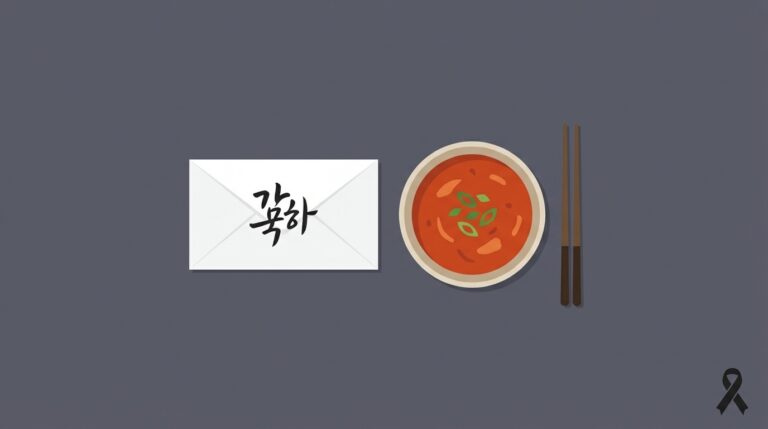
Phase 1: Empathy & Immersion (The Cold Open)
Hello! I’m the Lead Editor of Daily Hangul.
You’ve probably seen this scene in a K-Drama: The protagonist walks into a brightly lit hospital basement hall. People are dressed in stark black suits, some wearing black armbands. In one room, people are shedding tears in front of a portrait framed with white chrysanthemums. But right next door, guests are slurping spicy red soup and drinking soju.
If you ever find yourself attending a Korean funeral for a friend, coworker, or their family member, you might freeze. In many Western cultures, you hug the grieving person and say, ‘I’m so sorry for your loss.’ But if you translate that directly into Korean, it feels a bit awkward. Worse, if you use the standard beginner Korean greeting you learned on day one, you might make a huge cultural mistake.
Don’t worry. As your veteran tutor, I’m here to guide you through one of the most delicate and culturally rich moments in Korean society: greeting the Sangju (상주, Chief Mourner). Let’s learn how to show true Jeong (정, deep Korean empathy and connection) without saying the wrong thing.
Phase 2: Core Expressions Deep Dive
When you approach the grieving family, words are kept to an absolute minimum. Silence and a deep bow speak louder than words. But if you must speak, here are the most appropriate things to say.
1. 얼마나 상심이 크십니까
- Pronunciation: eol-ma-na sang-sim-i keu-sim-ni-kka (The ‘으/eu’ sounds like the disgusted sound you make when stepping in gum. Keep your teeth together!)
- Meaning: Literal: How great your sorrow must be. / Real nuance: I am so deeply sorry for your profound loss.
- K-Culture Moment: This is the most standard, respectful phrase you can say to the chief mourner after you finish your bows. It’s quiet, heavy, and deeply empathetic.
- Editor’s Insight: You don’t say this loudly. You murmur it softly, almost trailing off at the end, while looking down slightly or holding their hands (if you are close).
- Situation Spectrum:
[🚫 Never] ———— [⚠️ Caution] ———— [✅ Freely]
- Close Friends (Casual): ⚠️ (Friends usually just hug or cry together silently)
- Coworkers (Semi-formal): ✅
- Boss/Elders (Formal): ✅
- 🤔 Think About It: Notice how this phrase doesn’t say ‘I am sorry’? Instead, it focuses entirely on the other person’s feelings (‘How sad you must be’). Why do you think Korean empathy focuses outward rather than inward?
2. 삼가 고인의 명복을 빕니다
- Pronunciation: sam-ga go-in-ui myeong-bog-eul bim-ni-da
- Meaning: Literal: I reverently pray for the bliss of the deceased in the next world. / Real nuance: May they rest in peace.
- K-Culture Moment: You will see this exact phrase written on the white envelopes containing condolence money (Joeuigeum). You might also see it as a hashtag on K-Pop idols’ social media when a beloved celebrity passes away.
- Editor’s Insight: This is very formal. In real life, it’s actually used more often in writing (on envelopes or text messages) rather than spoken out loud to the family.
- Situation Spectrum:
- Spoken to close friends: 🚫 (Too stiff)
- Written on an envelope: ✅ (Perfect)
Phase 3: Textbook vs. Real Korean
| Situation | 📖 Textbook / Direct Translation | 🗣️ Real Korean | 💡 Why is it different? |
|---|---|---|---|
| Greeting the mourner | 슬프시겠어요 (You must be sad) | 얼마나 상심이 크십니까… (How great your sorrow must be…) | ‘Sad’ is too casual for a funeral. We use advanced vocabulary (‘sorrow/sang-sim’) to show utmost respect. |
| Apologizing for the loss | 내 잘못입니다 (It’s my fault – literally ‘I am sorry’) | (Silence & a slight head bow) | In Korea, saying ‘I’m sorry’ literally implies you caused the death! Silence is the safest and most respectful choice. |
| Entering the hall | 안녕하세요 (Hello) | (Absolutely nothing) | Annyeonghaseyo literally means ‘Are you in peace?’ The family is clearly NOT in peace, so saying hello is a huge taboo! |
Bottom Note: As an A2 learner, your safest bet is to simply bow your head, hand over the envelope, and say absolutely nothing. Your physical presence means everything.
Phase 4: Cultural Context — K-Culture Deep Dive
4-1. Non-Verbal Elements: The Nunchi of Bowing
When you enter the room with the portrait, you don’t just wave. You must perform Jeol (절, traditional bowing).
1. Burn a stick of incense or place a white chrysanthemum on the altar.
2. Step back and do two and a half bows (two full bows to the floor, followed by one half-standing bow) to the deceased.
3. Turn to the Chief Mourner (usually standing to the side) and do one full bow to the floor.
4. Never do two bows to a living person—two bows are strictly for the deceased!
4-2. K-Food Connection: Why the Red Soup?
Have you ever wondered why, in K-Dramas, people are eating Yukgaejang (육개장, Spicy Beef Soup) at funerals? Funerals in Korea traditionally last for 3 days, and the family stays awake the entire time. Guests come at all hours of the night to keep them company.
The red color of the spicy soup is traditionally believed to ward off evil spirits. More practically, it’s a hearty, easy-to-serve food that provides comfort and energy to exhausted mourners and guests. Eating the food provided is considered part of the condolence!
Phase 5: Real-Life Roleplay Scenario
Setting: Friday night, 9 PM. A hospital funeral hall in Seoul. You are wearing a dark suit. You’ve come to pay respects because your Korean coworker Min-su’s father has passed away. The air smells heavily of incense.
Characters:
– YOU: An expat working in Korea for 6 months.
– Min-su (32): Your usually cheerful Korean coworker, currently wearing a black suit with a dual-striped black armband, looking very exhausted.
Dialogue:
(You walk into the room, do your bows to the altar, and turn to Min-su.)
YOU: (Doing one deep bow to Min-su)
Min-su: (Bowing back) 와 주셔서 감사합니다…
(Wa jusyeoseo gamsahamnida…)
[Thank you for coming…]
🔀 YOUR TURN! How should you respond?
– A) “안녕하세요! 오랜만이에요!” (Hello! Long time no see!)
– B) “얼마나 상심이 크십니까…”
– C) “슬프시겠어요. 파이팅!”✅ Best Choice: B — This is the perfect, respectful phrase.
⚠️ Choice A & C Analysis: ‘안녕하세요’ is a massive taboo because it means ‘Are you in peace?’. And saying ‘Fighting!’ (Cheer up) is completely inappropriate at a funeral. Let them grieve.
(You chose B)
YOU: 얼마나 상심이 크십니까…
(Eolmana sangsimi keusimnikka…)
[How great your sorrow must be…]
Min-su: 바쁘실 텐데 와 주셔서 정말 감사해요. 저쪽에서 식사하고 가세요.
(Bappeusil tende wa jusyeoseo jeongmal gamsahaeyo. Jeojjogeseo siksahago gaseyo.)
[Thank you so much for coming even though you must be busy. Please have a meal over there before you go.]
YOU: 네, 감사합니다. 기운 내세요.
(Ne, gamsahamnida. Giun naeseyo.)
[Yes, thank you. Please stay strong.]
Phase 6: 10-Second Shadowing Drill
Let’s practice the tone. This should NOT be bright or loud. Speak slowly, with a slightly lower pitch, pausing where indicated by the slash.
🥺 얼마나 / 상심이 / 크십니까... (eolmana / sangsimi / keusimnikka...)
Phase 7: K-Culture Mini Dictionary
| Korean | Romanization | English | Context |
|---|---|---|---|
| 상주 | sangju | Chief Mourner | Usually the eldest son or closest family member. They wear an armband with stripes. |
| 조의금 | joeuigeum | Condolence Money | Given in a white envelope. Usually 50,000 to 100,000 KRW, depending on closeness. |
| 육개장 | yukgaejang | Spicy Beef Soup | The standard comfort food served to guests at a Korean funeral hall. |
| 절 | jeol | Traditional Bow | Kneeling and bowing to the floor. 2 bows for the dead, 1 for the living. |
Phase 8: Traveler’s Survival Kit
Even if you don’t attend a funeral, you might need to prepare condolence money for a Korean friend or colleague. Where do you get the special white envelope?
🆘 Survival Expression: At the Convenience Store
– 🇰🇷 “조의금 봉투 있어요?” (joeuigeum bongtu isseoyo?)
– 🗣️ Pronunciation: jo-eu-i-geum bong-tu iss-eo-yo?
– 📍 Where to use: Any convenience store (CU, GS25, 7-Eleven) or Daiso.
– 💡 Pro Tip: Convenience stores sell pre-printed envelopes for weddings (축의금) and funerals (조의금). Make sure you buy the right one! The funeral one usually has black Chinese characters saying 賻儀 (부의).📌 Editor’s Travel Note
– Dress Code: If you don’t have a black suit, a dark navy or dark grey suit with a black tie is acceptable. Avoid flashy jewelry, bright colors, or bare feet (always wear dark socks!).
– Drinking Etiquette: When drinking soju at a funeral, NEVER clink glasses (건배 – Geonbae). You just pour for each other and drink quietly.
Phase 9: Critical Thinking Corner — “One Step Deeper”
🧠 Think Deeper: Language & Power (Why we don’t say ‘Hello’)
In Korean, the everyday greeting ‘안녕하세요 (Annyeong-haseyo)’ literally translates to ‘Are you in peace?’. Language reflects the mindset of the people. Because Koreans deeply value Nunchi (reading the room) and empathy, asking a grieving person if they are ‘in peace’ is considered incredibly tone-deaf. Instead, Korean funeral language forces you to acknowledge their specific state of mind. It shows that in Korean culture, empathy isn’t about making yourself feel better by saying ‘I’m sorry’; it’s about holding space for the other person’s heavy emotions.💬 Your Turn: How does your culture express sympathy? Do you focus on your own apologies, or do you focus on the other person’s feelings? Share in the comments!
Phase 10: FAQ & Mistake Prevention
Q: Can I use “얼마나 상심이 크십니까” to my boss?
Yes! Because it uses formal vocabulary and the highly respectful ‘~(스)십니까’ ending, it is perfectly appropriate for elders and bosses.
Q: Do I have to eat the food at the funeral?
Yes, it is highly recommended. In Korea, eating the food provided by the family is a way of sharing their burden and keeping them company. Even if you just eat a few bites, sit down at a table for a while.
❌ Common Mistake #1: Saying “안녕하세요” (Hello) when entering the funeral hall or greeting the family.
✅ Do this instead: Give a silent, slight bow of the head.❌ Common Mistake #2: Clinking soju glasses at the dining table.
✅ Do this instead: Pour for your colleagues, let them pour for you, and drink silently.
Phase 11: Summary & Action Items
One-Liner Summary: At a Korean funeral, silence and bows speak the loudest, but if you must speak, say “얼마나 상심이 크십니까” (How great your sorrow must be).
Action Mission:
– 🥉 Bronze (Solo): Stand up and practice a slow, respectful bow while softly saying today’s phrase.
– 🥈 Silver (Online): Find an image of a Korean funeral envelope online and try to spot the word ‘부의’ or ‘조의’.
– 🥇 Gold (Action): The next time you watch a K-Drama featuring a funeral scene, look closely at the number of bows they do to the picture vs. the family!
K-Culture Mission:
Watch an episode of My Mister or Reply 1988—both feature deeply moving, realistic funeral scenes. Notice how the community comes together to eat, drink, and sometimes even warmly argue at the tables, turning grief into a shared community event.
Phase 12: Interactive Challenge Quiz
1. Situational Judgment: You just finished bowing to the deceased. You turn to your boss, who is the Chief Mourner. What should you say?
– A) “사장님, 슬프시겠어요.”
– B) “얼마나 상심이 크십니까…”
– C) “안녕하세요.”
(Answer: B. A is too casual, C is a taboo.)
2. True or False – K-Culture Edition: “It is rude to drink alcohol at a Korean funeral.”
(Answer: False! Drinking soju with other guests is a very common way to stay awake and keep the grieving family company. Just remember NOT to clink glasses!)
3. Fill in the Blank: At the convenience store, you need an envelope for condolence money. You ask: “_______ 봉투 있어요?”
(Answer: 조의금 – joeuigeum)
Frequently Asked Questions (FAQ)
Q: What does "얼마나 상심이 크십니까" mean in Korean and how do you pronounce it?
A: In Korean, "얼마나 상심이 크십니까" is pronounced [eol-ma-na sang-sim-i keu-sim-ni-kka (The '으/eu' sounds like the disgusted sound you make when stepping in gum. Keep your teeth together!] and means: Literal: How great your sorrow must be. / Real nuance: I am so deeply sorry for your profound loss.
Q: What does "삼가 고인의 명복을 빕니다" mean in Korean and how do you pronounce it?
A: In Korean, "삼가 고인의 명복을 빕니다" is pronounced [sam-ga go-in-ui myeong-bog-eul bim-ni-da] and means: Literal: I reverently pray for the bliss of the deceased in the next world. / Real nuance: May they rest in peace.







