

Hello there! I’m your Daily Hangul Editor.
If you’ve watched Korean variety shows like Running Man or Amazing Saturday (놀라운 토요일), you’ve probably seen celebrities fighting tooth and nail over mouth-watering traditional market foods—from sizzling bindaetteok (mung bean pancakes) to shiny, sweet dakgangjeong (fried chicken). And what do they usually use to buy them? A special government-issued currency called the Onnuri Gift Certificate (온누리 상품권).
Maybe you won some at a company raffle, or your local district office gave them to you. You walk into the vibrant, chaotic Gwangjang Market, ready to feast. The Amoni (vendor auntie) looks at you, expecting payment. But wait—how do you actually use this piece of paper or mobile app without holding up the line and looking completely lost?
As someone who has guided hundreds of expats through the narrow, delicious alleys of Seoul’s traditional markets, I know this is a massive pain point. Let’s upgrade your Korean to a C1 level so you can navigate market payments like a true local!
Phase 2: Deep Dive into Core Expressions
To survive and thrive with your Onnuri vouchers, you need to know more than just “How much is this?” Let’s master the advanced nuances.
1. 혹시 온누리 상품권 되나요?
- Pronunciation: [hok-shi on-nu-ri sang-pum-gweon dwe-na-yo?]
- Sound-alike guide: ‘dwe’ sounds like ‘dweh’, and ‘gweon’ rhymes with ‘yawn’ but starts with a ‘gw’.
- Meaning: Do you happen to accept Onnuri gift certificates? (Lit: By any chance, does Onnuri work?)
- K-Culture Moment: Even if there is a sticker on the stall saying they accept it, Korean etiquette dictates that you ask politely first. The word ‘혹시’ (by any chance) acts as a linguistic cushion. It shows you’re considerate of the vendor’s situation.
- Editor’s Insight: The verb ‘되다’ (to become/to work/to be available) is the MVP of Korean street Korean. Instead of saying “Can I pay with…”, Koreans simply ask “Does [payment method] work?”
- Situation Spectrum:
[🚫 Never] ———— [⚠️ Be Careful] ———— [✅ Freely]
- Close Friends (Casual): 🚫 (You wouldn’t ask a friend this)
- Market Vendors (Semi-formal/Polite): ✅
- Department Stores: 🚫 (They don’t accept them anyway!)
- 🤔 Think About It: Why do Koreans love using ‘혹시’ (by any chance)? How does this reflect the Korean culture of Nunchi (reading the room) and avoiding direct imposition?
2. 모바일 온누리로 결제할게요.
- Pronunciation: [mo-ba-il on-nu-ri-ro gyeol-jje-hal-kke-yo]
- Sound-alike guide: Hit the ‘jje’ in ‘gyeol-jje’ hard, like the ‘jj’ in ‘ajje’.
- Meaning: I’ll pay with the Mobile Onnuri app.
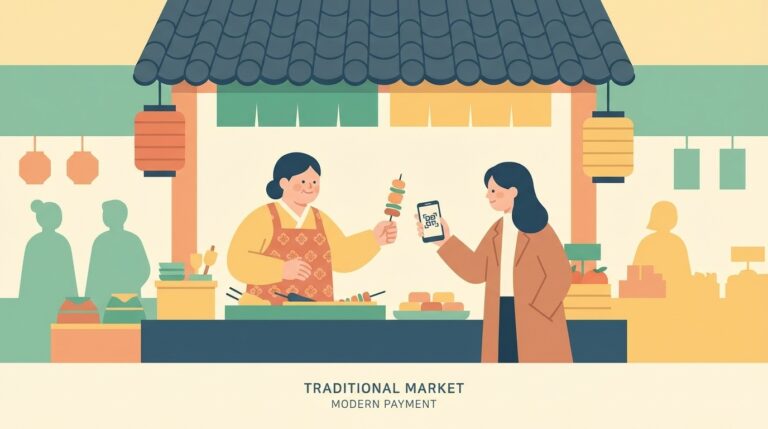
- K-Culture Moment: Korea is a hyper-digital society. Even grandmothers selling vegetables on the street often have a QR code hanging around their necks. Mobile Onnuri gives you a 10% discount when you charge it, so smart expats always use the app!
- Editor’s Insight: Saying ‘결제할게요’ (I will pay/process the payment) instead of ‘살게요’ (I will buy) immediately elevates your Korean from a textbook beginner to an integrated resident.
- Situation Spectrum:
[🚫 Never] ———— [⚠️ Be Careful] ———— [✅ Freely]
- Any affiliated store where you scan the QR: ✅
- 🤔 Think About It: Does your home country have digital payment methods specifically designed to save traditional, analog businesses?
3. 액면가의 60% 이상 쓰면 잔돈 주시죠?
- Pronunciation: [aeng-myeon-gga-e yuk-sship-peo-sen-teu i-sang sseu-myeon jan-don ju-shi-jo?]
- Meaning: If I spend over 60% of the face value, you give me the change in cash, right?
- K-Culture Moment: This is a crucial rule! If you hand a 10,000 won paper certificate for a 2,000 won skewer, they won’t give you 8,000 won back. By law, you must spend at least 60% of the paper voucher to get cash back. Knowing this makes you look incredibly street-smart.
- Editor’s Insight: ‘액면가’ (face value) is a high-level C1 vocabulary word. Using the ‘-죠?’ ending seeks confirmation and shows you already know the rules, preventing any potential misunderstandings.
- Situation Spectrum:
[🚫 Never] ———— [⚠️ Be Careful] ———— [✅ Freely]
- To a friendly vendor when confirming change: ✅
- Demanding it aggressively: ⚠️ (Always keep a warm tone!)
Phase 3: Textbook vs. Real Korean
| Situation | 📖 Textbook Korean | 🗣️ Real Korean | 💡 Why the difference? |
|---|---|---|---|
| Asking if they accept it | 온누리 상품권으로 지불할 수 있습니까? (Can I pay with Onnuri…) | 사장님, 이거 온누리 되죠? (Boss, Onnuri works here, right?) | “지불하다” is too formal for a market. “되다” is the go-to verb for availability. |
| Asking for cash back | 잔돈을 현금으로 받을 수 있나요? (Can I receive change in cash?) | 남은 건 현금으로 주시는 거죠? (You’re giving the rest in cash, right?) | Using “남은 건” (what’s left over) sounds much more conversational and natural. |
| Splitting the bill | 상품권과 카드로 나누어서 내겠습니다. (I will divide and pay…) | 상품권 먼저 하고, 나머지는 카드로 할게요. (I’ll do the voucher first, the rest on card.) | Koreans prefer the structure of “doing [A] first, then doing [B]” for split payments. |
Phase 4: Cultural Context — K-Culture Deep Dive
4-1. Non-Verbal Cues & “Nunchi”
When handing over a paper Onnuri certificate, always use two hands, or one hand with your other hand gently supporting your elbow. It’s a sign of respect, especially since market vendors are usually older than you. Also, read the Nunchi (room): if there’s a massive line of people paying with cards, fumbling with paper vouchers and demanding cash receipts might earn you a sigh. Have it ready!
4-2. The “Jeong” (정) of K-Food Markets
Traditional markets aren’t just places to buy things; they are the heart of Korean Jeong (warmth/connection). If you confidently use your Korean and pay with Onnuri (which vendors appreciate because it brings business), you might suddenly find an extra dumpling on your plate. This is called Service (서비스 – freebies on the house). A hearty “잘 먹겠습니다!” (I will eat well!) is the best way to repay them.
Phase 5: Real-Life Roleplay Scenario
Setting: Saturday afternoon at Mangwon Market. The air smells of freshly fried croquettes. You are buying a box of Dakgangjeong (sweet crispy chicken).
Characters:
– YOU: A savvy expat who just downloaded the Mobile Onnuri app to get that sweet 10% discount.
– Vendor Emo (이모 – Auntie): A friendly, fast-moving vendor in a red apron.
Dialogue:
이모: 어서 오세요! 닭강정 중(中)짜리 드릴까요?
(eoseo oseyo! dakgangjeong jung-jjari deurilkkayo?)
[Welcome! Shall I give you the medium-sized fried chicken?]
YOU: 네, 중간 사이즈로 하나 주세요. 혹시 모바일 온누리 되죠?
(ne, jung-gan sa-i-jeu-ro ha-na ju-se-yo. hok-shi mo-ba-il on-nu-ri dwe-jo?)
[Yes, one medium size please. Mobile Onnuri works here, right?]
이모: 그럼요~ 거기 앞에 QR 코드 찍으시면 돼요. 만 이천 원입니다.
(geu-reom-yo~ geo-gi a-pe QR ko-deu jji-geu-shi-myeon dwe-yo. man i-cheon won-im-ni-da.)
[Of course~ You can just scan the QR code in front of you. It’s 12,000 won.]
(🎭 Stage Direction: She starts packing the chicken into a box.)
YOU: (Scanning the code) 사장님, 결제 완료 화면 여기요!
(sa-jang-nim, gyeol-jje wal-lyo hwa-myeon yeo-gi-yo!)
[Boss, here’s the payment completion screen!]
이모: 네~ 확인했어요. 맛있게 드시고 또 오세요!
(ne~ hwa-gin-hae-sseo-yo. ma-shik-kke deu-shi-go tto o-se-yo!)
[Yes~ Confirmed. Enjoy your meal and come again!]
🔀 Your Turn! What if you only had a 10,000 won PAPER certificate? How would you handle the 12,000 won bill?
– A) “이모, 이천 원 깎아주세요!” (Auntie, give me a 2,000 won discount!)
– B) “만원은 온누리로, 이천 원은 현금으로 드릴게요.”
– C) Run away without the chicken.✅ Best Choice: B — “I’ll give you 10,000 won with Onnuri, and 2,000 won in cash.” Split payments are perfectly fine and common!
⚠️ Choice A Analysis: While haggling exists in markets, asking for a 2,000 won discount on a 12,000 won food item is considered slightly rude nowadays, especially for fixed-price foods.
Phase 6: 10-Second Shadowing Drill
Read this aloud to get the natural rhythm of a C1 Korean speaker!
😊 사장님, / 이거 / 모바일 온누리로 / 결제할게요!
(sa-jang-nim, / i-geo / mo-ba-il on-nu-ri-ro / gyeol-jje-hal-kke-yo!)
Phase 7: K-Culture Mini Dictionary
| Korean | Romanization | English | Context |
|---|---|---|---|
| 온누리 상품권 | on-nu-ri sang-pum-gweon | Onnuri Gift Certificate | Government vouchers strictly for traditional markets. |
| 가맹점 | ga-maeng-jeom | Affiliated Store | Stores that officially accept a specific payment method. |
| 현금 영수증 | hyeon-geum yeong-su-jeung | Cash Receipt | Essential for tax deductions. You can ask for this when paying with paper Onnuri! |
| 시장 인심 | shi-jang in-shim | Market Generosity | The warm-hearted, generous nature of traditional market vendors (often resulting in extra food). |
Phase 8: Traveler’s Survival Kit
Even if you’re just visiting Korea, you might buy these vouchers at a bank at a discount to save money on your street food tour!
🆘 Survival Expressions for the Market
– 🇰🇷 “여기 온누리 가맹점인가요?” (Are you an Onnuri affiliated store here?)
– 🇰🇷 “현금 영수증 해주세요.” (Please issue a cash receipt – for expats who live/work in Korea)
– 🇰🇷 “영수증은 버려주세요.” (Please throw away the receipt.)📌 Editor’s Travel Note
– App Alert: Download the “온누리상품권” (Onnuri) app or “비플페이” (B-Plus Pay) to buy mobile vouchers at a 10% discount!
– Where to use: Gwangjang Market, Namdaemun Market, Mangwon Market, and even some underground shopping malls (like Goto Mall).
– Tipping: Remember, DO NOT TIP the market vendors. Just smile and say “감사합니다!”
Phase 9: A Step Deeper — Critical Thinking
Media vs. Reality & Tradition vs. Modernity
🧠 Think Deeper:
If you look closely at a Korean traditional market, you’ll witness a fascinating contradiction. You have 70-year-old vendors selling ancient recipes of fermented kimchi, yet the transaction happens via a hyper-modern QR code system linked to a government app. The Korean government pushes these digital “Onnuri” vouchers with heavy discounts specifically to save these analog, traditional spaces from being wiped out by massive mega-marts and delivery apps. It’s a brilliant strategy where cutting-edge tech acts as the life support for traditional heritage.💬 Your Turn: Does your country use any modern technology to preserve traditional cultures or local businesses? Let us know in the comments!
Phase 10: FAQ & Avoiding Common Mistakes
Q: Can I use Onnuri certificates at a convenience store or E-mart?
No! This is the biggest mistake foreigners make. They are strictly for registered traditional markets and specific small business districts.
Q: If I use a paper certificate, can I ask for a cash receipt (현금 영수증) for my year-end tax settlement?
YES! Because it acts as cash, you are legally entitled to a cash receipt. Just say “현금 영수증 해주세요.”
❌ Common Mistake #1: Expecting full change.
If you buy a 1,000 won hotteok and hand over a 10,000 won paper Onnuri voucher, the vendor might refuse. You must spend at least 60% of the voucher’s face value to receive the remaining amount in cash.
Phase 11: Summary & Action Items
One-Liner Summary: To smoothly use Onnuri vouchers, ask “온누리 되나요?”, remember the 60% rule for change, and embrace the Mobile QR system!
Take Action:
– 🥉 Bronze: Stand in front of a mirror and practice saying “모바일 온누리로 결제할게요” 3 times naturally.
– 🥈 Silver: Check your Korean banking app or B-Plus Pay to see if you can buy a Mobile Onnuri voucher.
– 🥇 Gold: Go to a local traditional market this weekend, buy some street food, and pay using your Onnuri phrase!
K-Culture Mission: Next time you watch a Korean variety show featuring a market tour, keep your eyes peeled for the distinct Onnuri sticker on the vendor’s cart!
Phase 12: Interactive Quiz
1. You want to buy a 3,000 won pair of socks at Namdaemun Market. You only have a 10,000 won paper Onnuri certificate. What will likely happen?
A) The vendor gives you 7,000 won in cash.
B) The vendor tells you that you cannot get change because you didn’t spend over 60%.
C) The vendor gives you a 7,000 won Onnuri certificate back.
2. Fill in the blank: “사장님, 혹시 이거 ________ 되나요?” (Boss, does Onnuri work here by any chance?)
3. True or False: You should always leave a tip for market vendors if the food is good.
(Answers: 1. B – You must spend at least 6,000 won. / 2. 온누리 / 3. False – Tipping is not a part of Korean culture and may cause confusion!)
Frequently Asked Questions (FAQ)
Q: What does "혹시 온누리 상품권 되나요?" mean in Korean and how do you pronounce it?
A: In Korean, "혹시 온누리 상품권 되나요?" is pronounced [hok-shi on-nu-ri sang-pum-gweon dwe-na-yo?] and means: a key conversational Korean expression covered in this lesson.
Q: What does "모바일 온누리로 결제할게요." mean in Korean and how do you pronounce it?
A: In Korean, "모바일 온누리로 결제할게요." is pronounced [mo-ba-il on-nu-ri-ro gyeol-jje-hal-kke-yo] and means: a key conversational Korean expression covered in this lesson.
Q: What does "액면가의 60% 이상 쓰면 잔돈 주시죠?" mean in Korean and how do you pronounce it?
A: In Korean, "액면가의 60% 이상 쓰면 잔돈 주시죠?" is pronounced [aeng-myeon-gga-e yuk-sship-peo-sen-teu i-sang sseu-myeon jan-don ju-shi-jo?] and means: If I spend over 60% of the face value, you give me the change in cash, right?







