

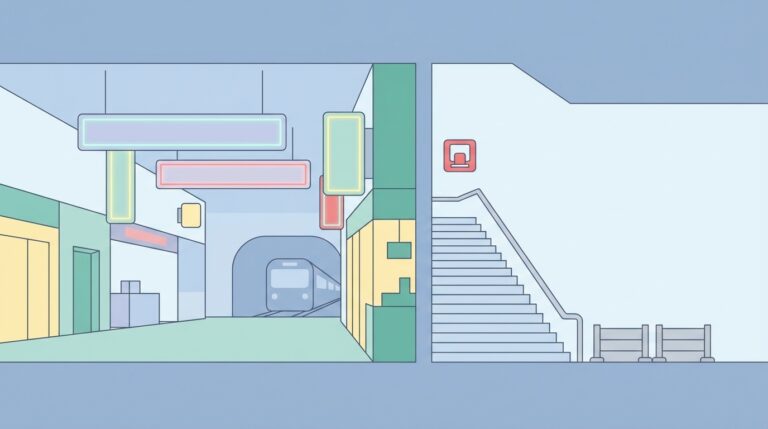
Phase 1: Empathy (Immersive Open)
Hello there! I’m your Daily Hangul Editor. 👋
Picture this: You are watching a sleek K-Drama, and the protagonist is effortlessly weaving through a brightly lit, seemingly endless underground city filled with cafes, clothing stores, and neon signs, all without ever stepping outside. Or perhaps you’ve experienced it yourself—you walked into COEX or the Gangnam Station subway entrance just to grab a quick coffee, and suddenly, you’ve lost your sense of time, direction, and daylight.
But then, you notice a heavy metal door, a stack of sandbags, or a bright red sign with a triangle pointing to a “Shelter.” Why does a country so technologically advanced have such intense safety features right next to a luxury makeup store?
As advanced (C2) learners of Korean, you are no longer just asking “Where is the bathroom?” You are looking at the why behind the words. Understanding Korea’s Urban Planning (도시 계획)—specifically the safety (안전성) and utilization (활용 방안) of its vast underground spaces—unlocks a completely different level of fluency. It explains the sociopolitical DNA of Seoul. Let’s dive into the subterranean world of Korea together. This guide is built on the real “Aha!” moments of expats who have navigated the literal and linguistic labyrinths of Seoul.
Phase 2: Core Expressions Deep Dive
To talk about Korea’s underground spaces like a true local, you need a mix of high-level urban planning terminology and the witty slang Koreans use to survive them.
1. 개미지옥 (Gaemijiok) / 던전 (Deonjeon)
- Pronunciation: [Gae-mi-ji-ok] (Sounds like: “Get-me-gee-oak”) / [Deon-jeon] (Konglish for “Dungeon”)
- Meaning: Literal: Ant hell / Dungeon. Real nuance: An incredibly complex, sprawling underground mall or transit center where it’s impossible to find the exit, but you keep getting distracted by shopping.
- K-Culture Moment: You are trying to meet a friend at Bupyeong Underground Shopping Mall (the largest in Korea). Your friend texts you, “어디야? 나 길 잃었어. 완전 개미지옥이야” (Where are you? I’m lost. It’s a total ant hell).
- Editor’s Insight: While urban planners call it a “지하 복합 환승 센터” (Underground complex transit center), locals use these words affectionately (and frustratingly) to describe the sheer scale of the utilization of underground space.
- Situation Spectrum:
[🚫 절대 금지] ———— [⚠️ 주의] ———— [✅ 자유롭게]
- Casual (Friends): ✅ (Very common)
- Semi-formal (Coworkers): ✅ (Good for a light joke)
- Formal (Seniors/Bosses): ⚠️ (Stick to ‘지하도 상가’ – underground shopping center)
- 🤔 Think About It: Why does Korea build “ant hells”? Due to extreme weather (freezing winters, humid monsoons) and ultra-high population density, building downward was a survival tactic that evolved into a lifestyle.
2. 침수 대비 (Chimsu daebi)
- Pronunciation: [Chim-su dae-bi] (Chim like chin with an m, soo like soup, dae-bi like day-bee)
- Meaning: Literal: Submergence preparation. Real nuance: Flood prevention/preparedness.
- K-Culture Moment: During the heavy summer monsoon (장마), news anchors constantly talk about “지하 공간 침수 대비” (flood prevention for underground spaces). You might see large waterproof barricades rising automatically at subway entrances.
- Editor’s Insight: This is a crucial C2-level term. It acknowledges the dual nature of underground development: its utility vs. its vulnerability to climate change.
- Situation Spectrum:
[🚫 절대 금지] ———— [⚠️ 주의] ———— [✅ 자유롭게]
- Casual: ✅
- Semi-formal: ✅
- Formal: ✅ (Highly appropriate for news, business, or safety discussions)
- 🤔 Think About It: Does your home country have specific infrastructure vocabulary that everyone knows due to local weather patterns?
3. 민방위 대피소 (Minbangwi daepiso)
- Pronunciation: [Min-bang-wi dae-pi-so] (The ‘의/위’ sound is tricky. Say “we” with a tight smile)
- Meaning: Literal: Civil defense shelter.
- K-Culture Moment: You are walking through an underground parking lot or a subway station, and you see a yellow and red sign. Once a year, sirens wail across the whole country, and people are guided into these underground spaces.
- Editor’s Insight: This represents the stark reality of Korea’s geopolitical situation. Underground spaces aren’t just for shopping; they are legally mandated survival infrastructure.
- Situation Spectrum:
[🚫 절대 금지] ———— [⚠️ 주의] ———— [✅ 자유롭게]
- Casual/Formal: ✅ (A standard infrastructural term used in all contexts.)
- 🤔 Think About It: How does living in a society where your daily commute route doubles as an emergency bunker affect the national psyche?
Phase 3: Textbook vs. Real Korean
| Situation | 📖 Textbook Korean | 🗣️ Real Korean | 💡 Why the difference? |
|---|---|---|---|
| Meeting at a complex underground mall | 이 지하 쇼핑몰은 너무 크고 복잡합니다. (This underground mall is too big and complex.) | 여기 완전 던전이야. 출구 번호 안 보면 못 나가. (This place is a total dungeon. If you don’t look at the exit numbers, you can’t get out.) | “던전” reflects the gaming culture deeply embedded in modern Korean slang. |
| Heavy rain warning for underground areas | 비가 많이 오면 지하에 물이 찰 수 있습니다. (If it rains a lot, water can fill the underground.) | 오늘 폭우 쏟아진대. 강남역 침수될라, 지하는 피하자. (They say torrential rain is pouring today. Gangnam Station might flood, let’s avoid the underground.) | Condenses complex safety concepts into quick, pragmatic survival decisions. |
| Asking about safety features | 이곳은 안전한 대피 장소입니까? (Is this a safe evacuation place?) | 여기 대피소 마크 있네. (There’s a shelter mark here.) | Koreans rely heavily on visual cues (marks/signs) rather than asking directly in public spaces. |
Bottom Note: As a C2 learner, using “침수 (flooding/submergence)” instead of “물이 차다 (water fills up)” instantly elevates your Korean to an educated, native-like proficiency.
Phase 4: Cultural Context — K-Culture Deep Dive
4-1. Non-Verbal Navigation: The Power of “Nunchi” & The Exit Number
When navigating Korea’s underground cities, words are only half the battle. Koreans rarely use street names underground. Everything revolves around the 출구 번호 (Exit Number). If a Korean says, “Let’s meet at Exit 9,” do not look for a store name; look up at the yellow signs. Furthermore, using Nunchi (눈치) during rush hour in a subway transfer tunnel is critical: walk on the right side, don’t stop abruptly, and move with the flow of the “ant hell.”
4-2. The Duality of the Underground: Parasite vs. COEX (Media vs. Reality)
If you’ve seen the Oscar-winning film Parasite (기생충), you know about 반지하 (Banjiha – semi-basement). This is a crucial aspect of urban planning. Originally built as bunkers during the tense 1970s for national security, they were later legalized as residential spaces due to explosive population growth in Seoul.
There is a profound contrast here. On one hand, you have the glittering, air-conditioned multi-cultural complexes (복합 문화 공간) like COEX or The Hyundai Seoul’s basement, featured in countless K-Pop MVs and Dramas. On the other hand, you have the Banjiha, vulnerable to 침수 (flooding) during monsoons, representing a harsh socio-economic divide. Understanding this duality is what separates a tourist from someone who truly comprehends Korean society.
Phase 5: Real-Life Roleplay Scenario
Setting: It’s 6:30 PM on a Friday in July. The notorious Korean monsoon (장마) has just unleashed a torrential downpour. You are at Gangnam Station with your Korean colleagues after work. The plan was to walk above ground to a famous BBQ spot, but the rain is intense.
Characters:
– YOU: An expat who has lived in Seoul for a few years, highly proficient in Korean, but still occasionally overwhelmed by Gangnam Station’s layout.
– Min-su (32): Your friendly, slightly dramatic Korean coworker.
– Ji-yoon (29): The logical, urban-savvy coworker.
Dialogue:
Min-su: 와, 비 미친 거 아니에요? 우산 써도 다 젖겠는데.
(Wa, bi michin geo anieyo? Usan sseodo da jeotgenneunde.)
[Wow, is this rain crazy or what? Even with an umbrella, we’ll get soaked.]
Ji-yoon: 그냥 지하상가로 뚫고 갈까요? 11번 출구 쪽으로 나가면 식당 바로 앞이잖아요.
(Geunyang jihasanggaro ttulgo galkkayo? Sibil-beon chulgu jjogeuro nagamyeon sikdang baro apijanayo.)
[Should we just cut through the underground mall? If we go out towards Exit 11, it’s right in front of the restaurant.]
Min-su: 아… 강남역 지하상가 금요일 저녁엔 완전 개미지옥인데. 사람 너무 많아요.
(Ah… Gangnam-yeok jihasangga geumyoil jeonyeogen wanjeon gaemijioginde. Saram neomu manayo.)
[Ah… Gangnam Station underground mall on a Friday evening is a total ant hell. There are too many people.]
Ji-yoon: 그래도 침수되는 것보단 낫죠. 작년에 강남대로 물바다 된 거 기억 안 나요?
(Geuraedo chimsudoeneun geotbodan natjyo. Jangnyeone Gangnam-daero mulbada doen geo gieok an nayo?)
[Still, it’s better than getting flooded. Don’t you remember Gangnam Boulevard turning into a sea of water last year?]
🔀 Your Turn! How do you respond?
– A) “비가 많이 오니까 조심합시다.” (Too textbook, a bit robotic.)
– B) “맞아요. 지하로 가요. 대신 출구 번호만 잘 보고 가죠, 던전에서 미아 되기 싫으니까요!” (Witty, uses slang correctly, addresses the navigation issue.)
– C) “여기 대피소로 도망갑시다!” (Too dramatic; civil defense shelters aren’t for rain.)✅ Best Choice: B — Why? You naturally adopt the “던전 (dungeon)” slang while acknowledging the practical strategy of sticking to the exit numbers. It shows top-tier cultural fluency!
Phase 6: 10-Second Shadowing Drill
Master the intonation of a seasoned Seoulite navigating the underground:
😤 여기 완전 / 던전이니까, / 출구 번호 / 꼬~옥 확인해!
(Yeogi wanjeon / deonjeoninikka, / chulgu beonho / kko~ok hwaginhae!)
[This place is a total dungeon, so make suuuure you check the exit number!]
Tip: Lengthen the “꼬~옥” (kko~ok) to emphasize how crucial this advice is.
Phase 7: K-Culture Mini Dictionary
| 한국어 | Romanization | English | Contextual Explanation |
|---|---|---|---|
| 장마 | jangma | Monsoon season | The intense rainy season in July/August that dictates urban flood planning. |
| 반지하 | banjiha | Semi-basement | A residential basement level, originally built as wartime bunkers, now a symbol of urban housing struggles. |
| 민방위 | minbangwi | Civil Defense | National emergency drills; look for the red triangle signs indicating underground shelters. |
| 환승역 | hwanseung-yeok | Transfer station | Stations where multiple subway lines intersect, often creating massive underground complexes. |
Phase 8: Traveler Survival Kit
Even as a C2 learner, getting lost underground happens to the best of us.
🆘 Survival Phrase #1 for the Underground
– 🇰🇷 “[11번] 출구로 나가려면 어디로 가야 돼요?” (Sibil-beon chulguro nagaryeomyeon eodiro gaya dwaeyo?)
– 🗣️ English Guide: “Which way should I go to get out at Exit [11]?”
– 📍 Where to use: Inside any massive subway station or underground mall.
– 💡 Pro Tip: Never ask for a street name. Always ask for the exit number. Locals map the underground entirely by these numbers.📌 Editor’s Travel Note
– GPS Underground: KakaoMap and Naver Map sometimes lose signal deep underground. Look up at the yellow ceiling signs—they are incredibly accurate and color-coded.
– Safe Zones: If you ever hear a siren on the 15th of the month, don’t panic. It’s likely a civil defense drill (민방위 훈련). Just follow the locals into the nearest subway station.
Phase 9: Critical Thinking Corner — “A Step Deeper”
Media vs Reality: The True Face of the Underground
When we consume K-Pop and K-Dramas, Korea’s underground spaces are often depicted as pristine, futuristic utopias—think of the aespa music videos or the dazzling Starfield Library in COEX. However, the reality of urban planning reveals a more complex narrative. The existence of the Banjiha (semi-basements) and the constant need for Chimsu daebi (flood preparedness) highlight a socio-economic divide. The glamorous underground malls are meticulously maintained to drive the economy, while older residential underground spaces face serious safety challenges during the era of climate change.
💬 Your Turn: Does your city utilize underground spaces? Are they seen as luxurious commercial hubs, or primarily as gritty transit/safety infrastructure? Share your thoughts below!
Phase 10: FAQ & Avoiding Misunderstandings
- Q: If I see a red “Shelter (대피소)” sign, can I just hang out there?
- A: Actually, most shelters are just normal subway stations or underground parking lots! They only serve as “shelters” during an emergency or a national drill. You are already “hanging out” in them every day.
- Q: Can I use the word “개미지옥” (Ant hell) with a store owner?
- A: It’s better not to. While it means “a place you can’t escape because it’s so great/complex” among friends, a store owner might take it as a criticism of their confusing layout. Use it only with peers!
❌ Common Mistake #1: Relying solely on Google Maps while underground.
✅ Do This Instead: Google Maps doesn’t work well in Korea, especially underground. Switch to Naver Map or KakaoMap, and physically look for the yellow “Way Out (나가는 곳)” signs.
Phase 11: Summary & Action Items
One-Liner Summary: Korea’s vast underground spaces are not just shopping “dungeons” (던전); they are complex urban feats requiring advanced flood preparedness (침수 대비) and functioning as vital civil defense shelters (대피소).
Action Mission 3-Step:
– 🥉 Bronze (Solo): Look at a map of a major Seoul station (like Express Bus Terminal) and trace the emergency exits.
– 🥈 Silver (Online): Read a Korean news article about “지하 공간 침수” (Underground space flooding) and try to summarize it in a Korean learning community.
– 🥇 Gold (Real-life): Next time you are in Korea, navigate from a subway line to a specific exit deep within a “개미지옥” without looking at your phone—only use the ceiling signs!
K-Culture Mission:
Watch the movie Parasite and notice the specific shots used to film the banjiha. Then, look up a vlog of the COEX Starfield Library. Compare the architectural and linguistic differences used to describe both “underground” spaces.
Phase 12: Quiz — Interactive Challenge
1. Situational Judgment: You are walking with your Korean boss in the Gangnam Station underground mall. It is incredibly crowded and confusing. What is the most C2-appropriate way to describe the situation without sounding overly casual?
– A) 부장님, 여기 완전 개미지옥이네요!
– B) 이 지하 복합 공간은 유동 인구가 정말 많네요.
– C) 아오, 던전 길 막혀요.
Answer: B. A and C use internet/slang terms (개미지옥, 던전) which are too casual for a boss. B uses the professional term “지하 복합 공간” (Underground multi-complex) and “유동 인구” (floating population/foot traffic).
2. True or False — K-Culture Edition:
The red “대피소” (Shelter) signs found in Korean subway stations are only for natural disasters like earthquakes.
– Answer: False. While they can be used for disasters, they are legally designated primarily as civil defense shelters (민방위 대피소) for national security emergencies.
3. Fill in the Blank:
이번 여름 장마철을 맞아, 서울시는 지하도 상가의 _________(flood preparedness)를 철저히 점검하고 있습니다.
– Answer: 침수 대비
Frequently Asked Questions (FAQ)
Q: What does "개미지옥 (Gaemijiok) / 던전 (Deonjeon)" mean in Korean and how do you pronounce it?
A: In Korean, "개미지옥 (Gaemijiok) / 던전 (Deonjeon)" is pronounced [Gae-mi-ji-ok] and means: Literal: Ant hell / Dungeon. Real nuance: An incredibly complex, sprawling underground mall or transit center where it's impossible to find the exit, but you keep getting distracted by shopping.
Q: What does "침수 대비 (Chimsu daebi)" mean in Korean and how do you pronounce it?
A: In Korean, "침수 대비 (Chimsu daebi)" is pronounced [Chim-su dae-bi] and means: Literal: Submergence preparation. Real nuance: Flood prevention/preparedness.
Q: What does "민방위 대피소 (Minbangwi daepiso)" mean in Korean and how do you pronounce it?
A: In Korean, "민방위 대피소 (Minbangwi daepiso)" is pronounced [Min-bang-wi dae-pi-so] and means: Literal: Civil defense shelter.







