

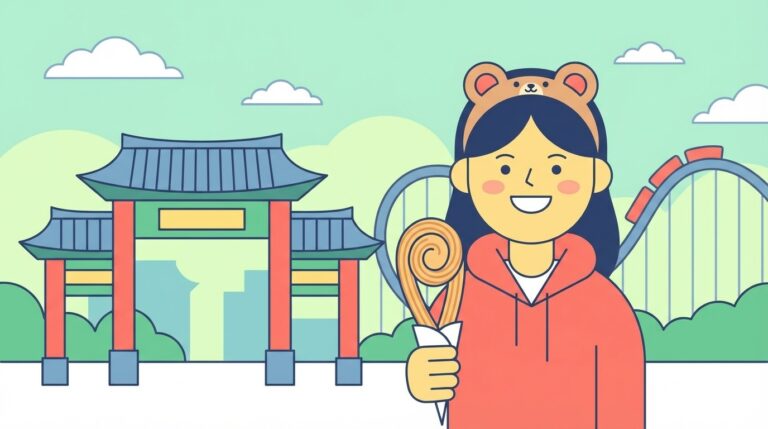
Phase 1: Empathy (The K-Culture Cold Open)\n\nHello! I’m your Daily Hangul Editor, your friendly neighborhood Korean tutor and local guide. 😊\n\nPicture this: You are watching a romantic K-Drama. The main couple goes on a date to Lotte World or Everland. They put on matching animal headbands, laugh, and walk toward a sweet-smelling snack cart to share a hot, crispy churro. Fast forward to today: You are finally in Korea, standing in front of that exact same churro cart. The smell of cinnamon and sugar is intoxicating. But suddenly, you realize the menu is in Korean, the staff is waiting, and the line behind you is getting longer.\n\nPanic mode? Not anymore!\n\nMany beginner learners freeze in these fast-paced, real-life moments because textbooks teach long, formal sentences that locals rarely use. Today, I’m going to give you the ultimate A1 (Beginner) cheat sheet for ordering a churro at a Korean amusement park. These are the exact phrases I teach my beginner students so they can order with confidence—and maybe even impress the local staff!\n\n—\n\n### Phase 2: Core Expressions Deep Dive\n\nLet’s look at the only 3 expressions you need to survive (and thrive) at the snack cart.\n\n> ### 1. 츄러스 하나 주세요. (One churro, please.)\n> \n> – Pronunciation: Chu-reo-seu ha-na ju-se-yo.\n> – Meaning: Literal: Churro one give me. / Real nuance: I’ll have one churro, please.\n> – Sound Guide for English Speakers: ‘ju’ sounds like the start of juice, ‘se’ like sell, ‘yo’ like a bouncy yo-yo.\n> – K-Culture Moment: This is the magic formula for ordering anything in Korea. Whether you’re at a theme park, a fancy restaurant, or a K-Pop merchandise booth, just say the item name + hana (one) + juseyo (please give me).\n> – Editor’s Insight: Think of juseyo as your magic wand. Just point at the picture on the menu and say “이거 하나 주세요 (Igeo hana juseyo – This one, please).” It works 100% of the time!\n> – Situation Spectrum: [🚫 Never] ———— [⚠️ Be Careful] ———— [✅ Freely]\n> – Close Friends (Casual): ⚠️ (Use ‘jwo’ instead of ‘juseyo’)\n> – Staff / Strangers (Polite): ✅ \n> – 🤔 Think About It: In English, we often ask softly, “Could I possibly have…?” But in Korean, we use a direct command smoothed out with polite endings (“Give it to me, please”). Why do you think Korean ordering culture is so direct yet polite?\n\n> ### 2. 진짜 맛있어요! (It’s really delicious!)\n> \n> – Pronunciation: Jin-jja ma-si-sseo-yo!\n> – Meaning: Literal: Really delicious! / Real nuance: Wow, this is so good!\n> – Sound Guide for English Speakers: ‘ma-shi-sseo-yo’. The ‘shi’ sounds a bit like she. \n> – K-Culture Moment: If you watch Korean variety shows or Idol vlogs, you will constantly see them taking a bite of food, opening their eyes wide, clapping, and yelling “Jinjja masisseoyo!” \n> – Editor’s Insight: Showing a big reaction to food is a huge part of Korean culture. If you say this to the snack cart vendor, they might give you the biggest smile!\n> – Situation Spectrum: [🚫 Never] ———— [⚠️ Be Careful] ———— [✅ Freely]\n> – Friends / Casual: ✅ (Just drop the ‘yo’ -> Jinjja masisseo!)\n> – Staff / Strangers: ✅\n\n> ### 3. 이거 얼마예요? (How much is this?)\n> \n> – Pronunciation: I-geo eol-ma-ye-yo?\n> – Meaning: Literal: This, how much is it? / Real nuance: How much is this?\n> – Sound Guide for English Speakers: ‘I-geo’ sounds like Ego, ‘eol’ sounds like all but shorter.\n> – K-Culture Moment: Very useful when the menu board is missing or confusing. It’s the ultimate survival phrase for shopping anywhere in Korea.\n> – Editor’s Insight: You can hold up the churro, point to it, and just ask this. It’s polite, standard, and natural.\n> – Situation Spectrum: [🚫 Never] ———— [⚠️ Be Careful] ———— [✅ Freely]\n> – Friends (Casual): ⚠️ (Friends don’t usually sell things to each other!)\n> – Staff / Strangers: ✅\n\n—\n\n### Phase 3: Textbook vs. Real Korean\n\nLet’s see why your textbook might get you weird looks at Everland.\n\n| Situation | 📖 Textbook Korean | 🗣️ Real Korean | 💡 Why is it different? |\n|—|—|—|—|\n| Asking the price | 이것은 얼마입니까? (I-geo-seun eol-ma-im-ni-kka?) | 이거 얼마예요? (I-geo eol-ma-ye-yo?) | ‘-입니다’ (formal) is too stiff for a theme park. Locals use ‘-예요’ (polite/friendly) for everyday life. |\n| Ordering food | 저는 츄러스를 원합니다. (Jeo-neun chu-reo-seu-reul won-ham-ni-da.) | 츄러스 하나 주세요. (Chu-reo-seu ha-na ju-se-yo.) | Koreans never say “I want” (원하다) for ordering. We say “Please give me” (주세요). |\n| Reacting to food | 맛이 아주 좋습니다. (Ma-si a-ju jot-seum-ni-da.) | 대박! 진짜 맛있어요. (Dae-bak! Jin-jja ma-si-sseo-yo.) | ‘대박’ (Dae-bak) means ‘Awesome/Jackpot’ and is the ultimate casual reaction word! |\n\nBottom Note: As an A1 learner, stick to the “Real Korean” column. It’s perfectly polite but sounds much more natural!\n\n—\n\n### Phase 4: Cultural Context — K-Culture Deep Dive\n\n#### 4-1. Non-verbal Cues: The ‘Two-Hand’ Rule\nWhen you hand your credit card to the churro staff, or when you take the churro from them, try to use two hands, or lightly support your right elbow with your left hand. In Korea, using two hands to give or receive things is a basic sign of respect. The staff will instantly notice your good manners!\n\n#### 4-2. K-Culture Connection: Theme Park Troupes & Snacks\nIf you follow K-Pop idols or watch K-Dramas, you’ve definitely seen the classic “Amusement Park Episode.” Whether it’s BTS on a variety show or a romantic couple in a drama, there are two strict rules for Korean theme parks:\n1. You MUST wear a 머리띠 (meo-ri-tti – animal headband). It doesn’t matter if you are a 40-year-old CEO or a tough K-Pop rapper; wearing cute fox or bear ears is mandatory.\n2. Snacking is half the fun. In Korea, theme parks aren’t just about rides; they are giant food tours. Sharing a churro, eating a giant turkey leg, or trying tornado potatoes (회오리 감자) are essential parts of the experience.\n\n—\n\n### Phase 5: Real-life Roleplay Scenario\n\nLet’s put you in the scene!\n\n- Setting: Friday afternoon. The sun is setting over the Magic Island at Lotte World. The fairy lights are turning on, and the sweet smell of cinnamon fills the air. \n- Characters:\n – YOU: A beginner Korean learner, excited to eat a Korean churro.\n – Minji (25): Your energetic Korean friend wearing a bunny headband.\n – Staff: The busy but friendly snack cart vendor.\n\nMinji: 헐, 츄러스 냄새 대박! 우리 하나 먹자! 🐰\n(Heol, chureoseu naemsae daebak! Uri hana meokja!)\n[English: Omg, the churro smell is amazing! Let’s eat one!]\n\nYOU: 좋아! 내가 주문해 볼게.\n(Joa! Naega jumunhae bolge.)\n[English: Sounds good! I will try ordering.]\n\n(🎭 Stage Direction: You confidently walk up to the cart)\n\nYOU: 안녕하세요! 츄러스 하나 주세요.\n(Annyeonghaseyo! Chureoseu hana juseyo.)\n[English: Hello! One churro, please.]\n\nStaff: 네, 3,500원입니다. 카드 결제이신가요?\n(Ne, sam-cheon-o-baek-won-imnida. Kadeu gyeolje-isingayo?)\n[English: Yes, it’s 3,500 won. Are you paying by card?]\n\nYOU: 네, 여기 카드요.\n(Ne, yeogi kadeuyo.)\n[English: Yes, here is my card.]\n\n(🎭 Stage Direction: You hand the card over with two hands. The staff smiles.)\n\nStaff: 감사합니다. 맛있게 드세요!\n(Gamsahamnida. Masitge deuseyo!)\n[English: Thank you. Enjoy your food!]\n\nYOU: 감사합니다!\n(Gamsahamnida!)\n[English: Thank you!]\n\n(🎭 Stage Direction: You take a bite. It’s warm, sweet, and perfectly crispy.)\n\nYOU: 와… 이거 진짜 맛있어요!\n(Wa… igeo jinjja masisseoyo!)\n[English: Wow… this is really delicious!]\n\nMinji: 그치? 놀이공원 츄러스가 최고야. 근데 나 안 샀는데…\n(Geuchi? Norigong-won chureoseu-ga choegoya. Geunde na an satneunde…)\n[English: Right? Theme park churros are the best. But I didn’t buy one…]\n\n> 🔀 Your Turn! How will you respond to Minji?\n> – A) “안 돼. 내 거야.” (No way. It’s mine.)\n> – B) “한입 먹을래?” (Do you want a bite?)\n> – C) “너도 하나 사.” (You go buy one too.)\n> \n> ✅ Best Choice: B — Reason: Sharing food (even a single churro!) is a huge part of Korean affection, known as Jeong (정). Offering a bite is the most culturally natural and friendly response!\n> ⚠️ Choice A & C Analysis: While grammatically correct and maybe funny between very close friends, it might come off a bit cold in Korean culture where sharing is caring!\n\n#### K-Culture Bonus Roleplay: The Napkin Emergency\n(You got sugar all over your mouth!)\nYOU: 저기요… 휴지 있어요?\n(Jeogiyo… hyuji isseoyo?)\n[English: Excuse me… do you have tissues?]\nStaff: 네, 여기 있습니다!\n(Ne, yeogi itseumnida!)\n[English: Yes, here you go!]\n\n—\n\n### Phase 6: 10-Second Shadowing Drill\n\nPractice these lines out loud. Pay attention to the pauses (/) and emotions!\n\n- 😊 밝게 (Brightly): 츄러스 / 하나 / 주세요! (chu-reo-seu / ha-na / ju-se-yo!)\n- 🥺 감탄하며 (With admiration): 와 / 진짜 / 맛있어요! (wa / jin-jja / ma-si-sseo-yo!)\n- 😳 조심스럽게 (Carefully): 저기요… / 이거 / 얼마예요? (jeo-gi-yo… / i-geo / eol-ma-ye-yo?)\n\n—\n\n### Phase 7: K-Culture Mini Dictionary\n\n| Korean | Romanization | English | Cultural Context |\n|—|—|—|—|\n| 간식 | gansik | Snack | Street food, cafe desserts, or theme park treats. Koreans love their gansik culture! |\n| 머리띠 | meoritti | Headband | The ultimate theme park fashion item. You will see couples matching their animal ears. |\n| 대박 | daebak | Awesome / Wow | A casual exclamation used when something is really good, shocking, or surprising. |\n| 한입만 | han-imman | Just one bite | A classic phrase. Koreans love asking for “just one bite” of your food to share the experience. |\n\n—\n\n### Phase 8: Traveler’s Survival Kit\n\nIf you are visiting a Korean theme park, market, or street food stall, keep these survival phrases on your phone!\n\n> 🆘 Survival Phrases TOP 3\n> 1. 🇰🇷 “이거 얼마예요?” (Igeo eolmayeyo?) – How much is this?\n> 2. 🇰🇷 “휴지 있어요?” (Hyuji isseoyo?) – Do you have tissues/napkins?\n> 3. 🇰🇷 “카드 돼요?” (Kadeu dwaeyo?) – Do you take cards?\n\n> 📌 Editor’s Travel Note\n> – Card vs Cash: Korea is a cashless society! Even small churro carts at amusement parks perfectly accept credit cards. Apple Pay is expanding, but physical cards or T-Money cards are safer.\n> – Tipping: 🚨 There is absolutely NO tipping in Korea. If you leave change on the churro counter, the staff will chase you down thinking you forgot your money!\n> – Trash: Finding trash cans (쓰레기통) in Korea can be hard, but amusement parks have plenty. Please don’t throw your churro wrappers on the ground!\n\n—\n\n### Phase 9: Critical Thinking — “One Step Deeper”\n\n> 🧠 Think Deeper: Food & Identity\n> In the roleplay, we chose to share our churro with our friend. Why is sharing food so critical in Korea? In many Western cultures, if you order a dish or a snack, it is “yours.” But in Korea, food is deeply tied to the concept of 정 (Jeong)—a feeling of collective bond, affection, and community. Offering someone a bite (한입만), sharing a big pot of stew, or grilling meat together isn’t just about eating; it’s how Koreans say, “We are close.” \n> \n> 💬 Your Turn: How does your culture handle sharing food? Do you prefer having your own separate plate, or do you love sharing everything? Let me know in the comments!\n\n—\n\n### Phase 10: FAQ & Avoiding Common Mistakes\n\nQ: Can I use “진짜 맛있어요” to an older person or my boss?\nA: Yes! It ends in ‘-요’ (yo), which makes it polite. However, if you are at a very formal business dinner with a CEO, you might want to use the slightly more formal “정말 맛있습니다” (Jeongmal masitseumnida).\n\nQ: How do I get the staff’s attention?\nA: Say “저기요!” (Jeogiyo! – Excuse me!). Don’t wave them over with your finger, which is considered rude.\n\n> ❌ Common Mistake #1: Saying “당신” (Dangsin – You) to the staff.\n> ✅ Do this instead: Never use the word “You” to strangers in Korea. If you need to refer to them, say “사장님” (Sajangnim – Boss/Owner) or simply say “저기요” (Jeogiyo – Excuse me) to get their attention.\n\n—\n\n### Phase 11: Summary & Action Items\n\n- One-Liner Summary: Remember your magic formula: Point to the food, smile, and say “주세요 (Juseyo – Please give me)!”\n\n🎯 Action Mission 3-Steps:\n- 🥉 Bronze (Solo): Stand in front of a mirror and say “츄러스 하나 주세요” three times with a confident smile.\n- 🥈 Silver (Online): Find a photo of your favorite Korean food and post it on social media or a language community with the caption “진짜 맛있어요!”\n- 🥇 Gold (Real-world): Go to a Korean cafe, restaurant, or snack shop and use “___ 하나 주세요” to order your food!\n\n🎡 K-Culture Mission: \nNext time you watch a K-Drama or a K-Pop Idol reality show, look out for the “Amusement Park” episode. See if you can spot them wearing the animal headbands (머리띠) and listen carefully to hear if they say “진짜 맛있어요!” when they eat a snack!\n\n—\n\n### Phase 12: Interactive Quiz Challenge\n\nLet’s test what you learned! \n\n1. Situational Judgment: You want to buy TWO churros. How should you change the phrase “츄러스 하나 주세요”?\n – A) 츄러스 진짜 주세요.\n – B) 츄러스 두 개 주세요.\n – C) 츄러스 얼마예요?\n (Hint: 하나 = 1, 두 개 = 2)\n\n2. True or False – K-Culture Edition: \n “You should leave a 10% tip at the churro cart if the staff is friendly.” (T / F)\n\n3. Fill in the Blank:\n You take a bite of the churro and it blows your mind. You turn to your friend and shout:\n “와! 이거 ( ____ ) 맛있어요!”\n\n(Answers: 1: B, 2: False – No tipping in Korea!, 3: 진짜)\n\nHow did you do? Are you ready for your Everland trip? Let me know in the comments below!
Frequently Asked Questions (FAQ)
Q: What does "정" mean in Korean and how do you pronounce it?
A: In Korean, "정" is pronounced [Jeong] and means: —a feeling of collective bond, affection, and community. Offering someone a bite (한입만), sharing a big pot of stew, or grilling meat together isn't just about eating; it's how Koreans say, "We are close." \n> \n>







