

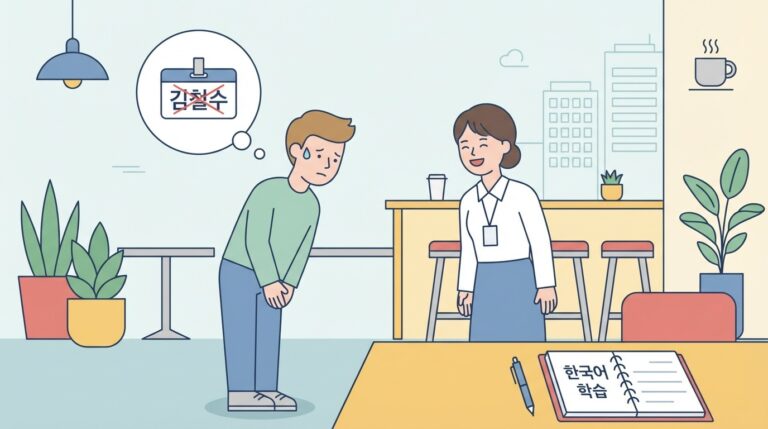
Phase 1: The ‘Freeze’ Moment
Hello! This is your Daily Hangul Editor.
Picture this: It is Friday night. You are at a bustling K-BBQ restaurant for a team hoesik (company dinner). The pork belly is sizzling, glasses are clinking, and you confidently pour Soju for your senior colleague. With a bright smile, you say, “Cheers, Manager Kim!”
He slowly lowers his glass. He looks at you. “…I’m Manager Lee.”
Suddenly, the restaurant feels freezing cold. The K-Drama background music in your head screeches to a halt. We have all been there! Calling someone the wrong name or title is a universal mistake, but in Korea—a society deeply rooted in hierarchy and respect—it can feel like a massive disaster. But do not panic! Today, we will learn exactly how to recover from this awkward situation like a true insider, smoothly and politely. Let us turn that mistake into a moment of connection!
Phase 2: Core Expressions for Smooth Apologies
Here are the top 3 lifesaver phrases when you accidentally call someone the wrong name.
1. 죄송합니다. 제가 이름을 착각했어요.
- Pronunciation: [joe-song-ham-ni-da. je-ga i-reum-eul chak-gak-hae-sseo-yo.]
Sound-alike guide: ‘joe’ sounds like ‘Joe’, ‘chak-gak’ sounds like a quick ‘chuck-guck’.- Meaning: I am sorry. I mistook your name.
- K-Culture Moment: This is your standard, polite go-to phrase. Imagine a scene in a K-Drama where a new employee mixes up two colleagues’ names on their first day. A quick bow of the head and this phrase will instantly clear the air.
- Editor’s Insight: The word ‘착각하다’ means ‘to be mistaken’ or ‘to have an illusion’. It shows that your brain just had a minor glitch, not that you do not care about them!
- Situation Spectrum:
[🚫 Never] ———— [⚠️ Be Careful] ———— [✅ Freely]
- Close Friends (Casual): ⚠️ (Too formal)
- Co-workers (Semi-formal): ✅
- Boss/Elders (Formal): ✅
- 🤔 Think About It: Why is it better to say “I was mistaken” rather than just “I am sorry” in Korean culture? Admitting the specific nature of your mistake shows accountability and respect!
2. 아이고, 제가 성함을 잘못 불렀네요.
- Pronunciation: [ai-go, je-ga seong-ham-eul jal-mot bul-leon-ne-yo.]
Sound-alike guide: ‘ai-go’ is the classic Korean sigh of realization. ‘seong-ham’ sounds like ‘sung-ham’.- Meaning: Oh my, I called your name (honorific) incorrectly.
- K-Culture Moment: Meeting your partner’s parents or dealing with VIP clients. Using ‘성함’ (seong-ham) instead of ‘이름’ (i-reum) for ‘name’ instantly elevates your politeness level to 100.
- Editor’s Insight: This phrase feels very empathetic. Adding the ‘-네요’ ending makes it sound like a soft realization rather than a robotic apology.
- Situation Spectrum:
[🚫 Never] ———— [⚠️ Be Careful] ———— [✅ Freely]
- Close Friends (Casual): 🚫 (Too stiff!)
- Co-workers (Semi-formal): ⚠️
- Boss/Elders (Formal): ✅
- 🤔 Think About It: In Korean, even nouns have honorific forms (이름 -> 성함, 나이 -> 연세). Does your native language change nouns based on who you are talking to?
3. 앗, 미안! 내가 다른 사람이랑 헷갈렸어.
- Pronunciation: [at, mi-an! nae-ga da-reun sa-ram-i-rang het-gal-lyeo-sseo.]
Sound-alike guide: ‘het-gal’ sounds like ‘het-gull’.- Meaning: Oops, sorry! I confused you with someone else.
- K-Culture Moment: You are at a K-Pop concert, and you accidentally call a fellow fan by the wrong Twitter handle. You laugh it off with this phrase.
- Editor’s Insight: ‘헷갈리다’ (to be confused/mixed up) is a must-know B1 vocabulary word! It is used constantly in daily life, not just for names, but for directions, menus, and dates.
- Situation Spectrum:
[🚫 Never] ———— [⚠️ Be Careful] ———— [✅ Freely]
- Close Friends (Casual): ✅
- Co-workers (Semi-formal): 🚫 (No banmal!)
- Boss/Elders (Formal): 🚫
Phase 3: Textbook vs. Real Korean
| Situation | 📖 Textbook Korean | 🗣️ Real Korean | 💡 Why is it different? |
|---|---|---|---|
| To a colleague | 이름을 잘못 말해서 죄송합니다. (I apologize for saying the wrong name.) | 아, 제가 이름을 착각했네요. 죄송해요! (Ah, I mistook your name. Sorry!) | Real Korean softens the mistake with ‘-네요’ (realization) rather than a rigid statement. |
| To an elder/boss | 귀하의 성함을 틀렸습니다. (I got your name wrong.) | 아이고, 제가 성함을 잘못 불렀습니다. (Oh my, I called your honorific-name incorrectly.) | ‘귀하’ is only for written documents. ‘아이고’ adds a human touch of genuine regret. |
| To a friend | 네 이름을 틀리게 불렀어. (I called your name incorrectly.) | 앗 미안! 내가 헷갈렸어~ (Oops sorry! I got mixed up~) | Friends focus on the “mix up” (헷갈리다) to keep the vibe light and casual. |
Phase 4: Cultural Context — K-Culture Deep Dive
4-1. Non-verbal Apologies & Nunchi
When you realize you used the wrong name, your body language speaks volumes.
– Do NOT: Stare directly into their eyes while apologizing. It can feel confrontational.
– DO: Give a slight bow of your head (about 15-30 degrees), use a soft, apologetic tone, and perhaps a slightly embarrassed smile.
– The Nunchi Check: If they laugh it off, smile with them. If they look slightly offended, make sure to use their correct title immediately in the next sentence to show you respect them.
4-2. The K-Drama Trope: Titles Over Names
In many K-Dramas, you will notice that people rarely use actual names in the workplace. It is always “대리님” (Assistant Manager), “팀장님” (Team Leader), or “대표님” (CEO).
Why? Because in Korea, your title is your identity in professional settings. Calling a Director by their first name (even with a polite “-ssi”) is a massive taboo that often appears in dramas when a character is trying to be rebellious or incredibly rude. If you mess up their title, you are essentially demoting them! That is why quickly saying “아이고, 제가 직급을 착각했네요” (Oh my, I mistook your job title) is a survival skill.
Phase 5: Interactive Roleplay Scenario
Setting: A Friday evening networking event for expats and locals in a trendy Hongdae cafe. You are holding a paper cup of Americano, feeling confident. You spot the organizer of the event.
Characters:
– YOU: An intermediate Korean learner, trying to make professional connections.
– Jihoon (35, Local): The friendly but professional event organizer.
Dialogue:
YOU: 안녕하세요, 민호 씨! 행사 준비하시느라 고생 많으셨어요. 😊
(an-nyeong-ha-se-yo, min-ho ssi! haeng-sa jun-bi-ha-si-neu-ra go-saeng man-eu-syeo-sseo-yo.)
[Hello, Minho! You worked hard preparing the event.]
Jihoon: 네? 아… 제 이름은 지훈인데요. 😅
(ne? a… je i-reum-eun ji-hun-in-de-yo.)
[Pardon? Ah… my name is Jihoon.]
(🎭 Stage Direction: Jihoon touches his name tag awkwardly. You feel your face turn red.)
🔀 YOUR TURN! How do you reply?
– A) “아, 당신은 민호가 아니군요!” (Ah, you are not Minho!)
– B) “헐! 대박 미안해요!” (Omg! Big time sorry!)
– C) “앗, 죄송합니다! 제가 다른 분이랑 이름을 착각했어요.”✅ Best Choice: C — This perfectly balances politeness and clearly explains it was a simple mix-up.
⚠️ Why not A? Using “당신” (You) is a HUGE mistake in spoken Korean. It sounds aggressive, like you are picking a fight!
⚠️ Why not B? “대박” (Daebak) is fun slang, but too casual for a professional networking event.
Bonus Scenario: The Fan Meeting Mix-up
(At a K-Pop Fan-sign event)
YOU: 정국 오빠! 사랑해요!
Idol: (Laughs) 저 지민인데요?
YOU: 앗, 미안해요! 너무 긴장해서 헷갈렸어요! (Oops, sorry! I got confused because I was too nervous!)
(This is cute, and the idol will definitely remember you!)
Phase 6: 10-Second Shadowing Drill
Practice this phrase with the right emotion and pauses. Remember, pacing is key!
🥺 앗, 죄송합니다! / 제가 성함을 / 잘못 불렀네요.
(at, joe-song-ham-ni-da! / je-ga seong-ham-eul / jal-mot bul-leon-ne-yo.)
[Oops, I am sorry! / I called your name / incorrectly.]
Phase 7: K-Culture Mini Dictionary
| Korean | Romanization | English | Cultural Context |
|---|---|---|---|
| 직급 | jik-geup | Job Rank/Title | In Korea, calling someone by their rank (e.g., Team Leader) is standard respect. |
| 성함 | seong-ham | Name (Honorific) | Always use this when asking for the name of an elder, customer, or superior. |
| 헷갈리다 | het-gal-li-da | To be confused | Used for everything from names to subway lines. “I’m mixed up!” |
| 눈치 | nun-chi | Social awareness | Reading the room. If you mess up a name, use your nunchi to apologize quickly! |
Phase 8: Traveler Survival Kit
Even as a traveler, you might need to use people’s names: your Airbnb host, a private tour guide, or a friendly local who helped you.
🆘 Survival Phrases for Travelers
– 🇰🇷 “죄송하지만, 성함이 어떻게 되시죠?” (joe-song-ha-ji-man, seong-ham-i eo-tteo-ke doe-si-jyo?)
– 🗣️ Meaning: I am sorry, but what was your name again?
– 📍 Where to use: Hotels, Tours, Meeting locals.
– 💡 Pro Tip: If you absolutely cannot remember someone’s name, you can always safely call them “선생님” (Teacher). In Korea, “Seonsaeng-nim” is a polite catch-all term for any respected adult, even if they don’t teach!📌 Editor’s Travel Note
– Do not point at people when asking their name.
– If a shop owner is older, avoid calling them “이모” (Auntie) unless it is a very casual, rustic restaurant. “사장님” (Boss/Owner) is always the safest bet!
Phase 9: Critical Thinking Corner — “One Step Deeper”
🧠 Think Deeper: Language & Power (The Name Game)
Why is calling someone by their first name such a sensitive issue in Korea? In Western cultures, moving to a “first-name basis” is a sign of friendliness and breaking the ice. However, in Korean culture, language strictly reflects the social hierarchy (age, rank, intimacy). Using a first name without permission, or using the wrong title, disrupts this social order. It is not just about the word itself; it is about acknowledging the other person’s hard-earned position in society.
💬 Your Turn:
In your culture, how long does it take before you can call your boss by their first name? Do you have specific titles you must use? Share in the comments!
Phase 10: FAQ & Avoiding Misunderstandings
Q: I forgot their name. Can I just say “당신” (You)?
NO! Absolutely not. In Korean, “당신” is only used between married couples, in poetic songs, or when you are aggressively fighting with a stranger on the street. Avoid it completely. Just drop the subject or use their title!
Q: Can I attach “-ssi” (씨) to their last name? Like “Kim-ssi”?
NO. Calling someone “Kim-ssi” sounds like you are addressing a subordinate or speaking in a very outdated, somewhat disrespectful manner. Always attach “-ssi” to their full name (Kim Min-su-ssi) or their first name (Min-su-ssi).
❌ Common Mistake: Saying “김매니저님” (Kim Manager-nim).
✅ Do this instead: Usually, titles stand alone (“매니저님”) or follow the full name. But for safety, just using the title is perfect!
Phase 11: Summary & Action Items
✨ One-Liner Summary:
When you say the wrong name, do not freeze—softly admit your mix-up by saying “제가 이름을 착각했어요” (I mistook your name) and move on gracefully!
🎯 Action Missions:
– 🥉 Bronze: Stand in front of a mirror and say “아이고, 제가 성함을 잘못 불렀네요” 3 times with a polite smile.
– 🥈 Silver: Leave a comment below using the word ‘헷갈리다’ (to be confused) in a sentence!
– 🥇 Gold: Next time you watch a K-Drama, count how many times they use a job title instead of a real name!
Phase 12: Pop Quiz — Interactive Challenge!
1. Situational Judgment: You are talking to your 50-year-old Korean boss, and you accidentally call him by the Assistant Manager’s name. What is the BEST response?
– A) 앗, 미안! 헷갈렸어.
– B) 아이고, 제가 성함을 착각했습니다. 죄송합니다.
– C) 당신 이름이 뭐였죠?
2. Fill in the Blank:
“아이고, 제가 ( ___ )을 잘못 불렀네요.” (Oh my, I called your honorific-name incorrectly.)
3. True or False (K-Culture Edition):
“It is polite to call an older stranger ‘당신’ (You) if you don’t know their name.”
(Answers: 1. B, 2. 성함 (seong-ham), 3. False! Never use 당신!)
How did you do? Remember, making mistakes is the best way to learn a language. Stay confident, and keep practicing your Daily Hangul! 😊
Frequently Asked Questions (FAQ)
Q: What does "죄송합니다. 제가 이름을 착각했어요." mean in Korean and how do you pronounce it?
A: In Korean, "죄송합니다. 제가 이름을 착각했어요." is pronounced [joe-song-ham-ni-da. je-ga i-reum-eul chak-gak-hae-sseo-yo.] and means: I am sorry. I mistook your name.
Q: What does "아이고, 제가 성함을 잘못 불렀네요." mean in Korean and how do you pronounce it?
A: In Korean, "아이고, 제가 성함을 잘못 불렀네요." is pronounced [ai-go, je-ga seong-ham-eul jal-mot bul-leon-ne-yo.] and means: Oh my, I called your name (honorific) incorrectly.
Q: What does "앗, 미안! 내가 다른 사람이랑 헷갈렸어." mean in Korean and how do you pronounce it?
A: In Korean, "앗, 미안! 내가 다른 사람이랑 헷갈렸어." is pronounced [at, mi-an! nae-ga da-reun sa-ram-i-rang het-gal-lyeo-sseo.] and means: Oops, sorry! I confused you with someone else.







