

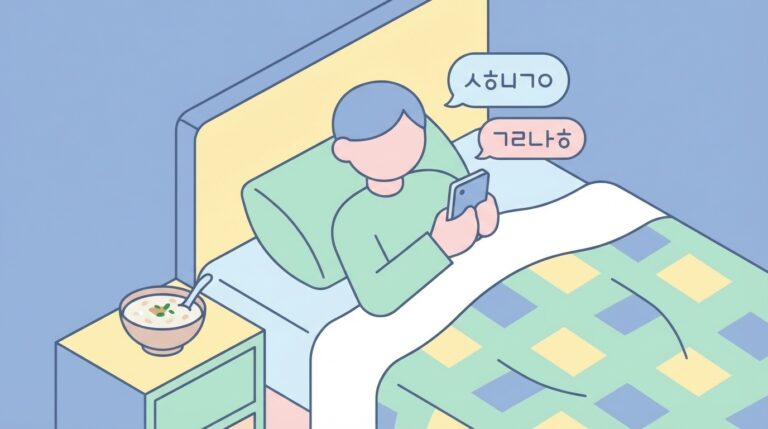
🤒 How to Cancel Plans in Korean Like a Pro When You’re Sick
Phase 1: Empathy & The K-Culture Connection
Hello! I’m your Daily Hangul Editor.
Picture this: You’re watching a K-Drama. The main character wakes up shivering, pale, with a wet towel on their forehead. They reach for their phone to text their friend or boss. The English subtitles simply read, “I can’t come, I’m sorry.” But if you listen closely to the Korean audio, they are saying a lot more than just “I’m sorry.”
Why? Because in Korea, a Yaksok (약속, appointment or promise) is a big deal. Canceling plans requires a delicate mix of politeness and Nunchi (reading the room). If you just say “I’m not going” (안 가요), your Korean friends might think you’re angry with them!
As a beginner (A2 level), you don’t need complex grammar to cancel politely. You just need the right “vibe.” Let’s learn how to tell someone you are sick without causing any awkward misunderstandings. This guide is based on real struggles my students have faced when trying to navigate Korean social etiquette!
Phase 2: Core Expressions Deep Dive
Here are the top 3 lifesaver phrases you need when you are feeling under the weather.
1. 몸이 안 좋아요 (I’m not feeling well)
- Pronunciation: [mo-mi an jo-a-yo] ‘mo-mi’ flows together smoothly, ‘an’ sounds like ‘ahn’, and ‘jo-a-yo’ sounds like ‘jo-ah-yo’.
- Meaning: (Literal) My body is not good. / (Real Nuance) I’m not feeling well.
- K-Culture Moment: You wake up with a sore throat on the day of your team’s Hoesik (company dinner). Texting this phrase to your coworker sets the perfect apologetic tone without oversharing your symptoms.
- Editor’s Insight: We rarely say “저는 아파요 (I am sick)” to cancel plans because it sounds a bit too direct, like a child complaining. “몸이 안 좋아요” sounds much more mature and polite.
- Situation Spectrum:
[🚫 Never] ———— [⚠️ Be Careful] ———— [✅ Freely]
- Casual (Friends): ✅
- Semi-formal (Coworkers): ✅
- Formal (Boss/Elders): ⚠️ (Better to use the formal version: 몸이 안 좋습니다)
- 🤔 Think About It: Why do Koreans say “My body is not good” instead of “I am sick”? By separating the self from the body, it sounds more objective and less dramatic. Does your native language have a similar way of softening the fact that you’re sick?
2. 오늘 못 갈 것 같아요 (I don’t think I can go today)
- Pronunciation: [o-neul mot gal geot ga-ta-yo] ‘mot’ has a sharp T stop. ‘ga-ta-yo’ sounds like ‘gah-tah-yo’.
- Meaning: (Literal) It seems like I cannot go today. / (Real Nuance) I can’t make it today.
- K-Culture Moment: You were supposed to grab Chimaek (chicken and beer) tonight, but your fever is rising. You send this phrase along with a crying emoji (ㅠㅠ).
- Editor’s Insight: Notice the “~것 같아요” (I think / it seems like). Koreans absolutely LOVE this grammar pattern. It magically softens any rejection!
- Situation Spectrum:
[🚫 Never] ———— [⚠️ Be Careful] ———— [✅ Freely]
- Casual (Friends): ✅
- Semi-formal (Coworkers): ✅
- Formal (Boss/Elders): 🚫 (Too vague. For a boss, use “오늘 참석하기 어렵습니다” – It is difficult to attend today).
- 🤔 Think About It: Why not just say “오늘 안 가요” (I’m not going today)? In Korean culture, a direct “no” can feel like a rejection of the person, not just the plan.
3. 다음에 봬요 / 다음에 봐요 (Let’s meet next time)
- Pronunciation: [da-eum-e bwae-yo / da-eum-e bwa-yo]
- Meaning: (Literal) Let’s see each other next time. / (Real Nuance) Let’s reschedule / Catch you later.
- K-Culture Moment: As you wrap up your cancellation phone call, you say this. It reassures your friend that you still want to hang out in the future.
- Editor’s Insight: You MUST add this after canceling. It’s the ultimate band-aid for any disappointment caused by canceling.
- Situation Spectrum:
[🚫 Never] ———— [⚠️ Be Careful] ———— [✅ Freely]
- Casual (Friends): ✅ (다음에 봐요 / 다음에 보자)
- Semi-formal (Coworkers): ✅ (다음에 봬요)
- Formal (Boss/Elders): ✅ (다음에 봬요)
Phase 3: Textbook vs. Real Korean
| Situation | 📖 Textbook Korean | 🗣️ Real Korean | 💡 Why is it different? |
|---|---|---|---|
| Canceling via text | 저는 아픕니다. 그래서 약속을 취소합니다. (I am sick. Therefore I cancel the appointment.) | 제가 몸이 좀 안 좋아서요 ㅠㅠ 오늘 못 갈 것 같아요. (I’m not feeling well ㅠㅠ I don’t think I can go today.) | Textbooks sound like robots. Ending a sentence with “~서요” (because…) leaves it trailing off, showing hesitation and regret. |
| Suggesting another time | 다음 시간에 만납시다. (Let us meet at the next time.) | 다음에 밥 한 번 먹어요! (Let’s grab a meal next time!) | Koreans use “Let’s eat together” as a friendly greeting and a promise to meet again. |
Phase 4: Cultural Context — A K-Culture Deep Dive
4-1. Non-Verbal Tips: The Power of “ㅠㅠ”
When texting a cancellation in Korea, emojis and emoticons are your best friends. A plain “못 갈 것 같아요.” looks cold. But “못 갈 것 같아요 ㅠㅠ” (crying eyes) or “죄송해요 🙏” instantly shows your guilt and sincerity. Also, if you have to call, speak with a slightly softer, weaker voice. It’s not acting; it’s showing your condition respectfully!
4-2. K-Food Connection: The “Juk” (Porridge) Culture
If you use the phrase “몸이 안 좋아요” to cancel plans with a Korean friend, be prepared for a K-Food intervention! A true Korean friend won’t just say “Get well soon.” They will ask, “밥은 먹었어요?” (Did you eat?) and might even send you a mobile gift card for Juk (죽, Korean rice porridge) via KakaoTalk.
In K-Dramas, you always see someone bringing a warm bowl of abalone porridge (전복죽) to their sick friend or crush. In Korea, eating well is culturally synonymous with healing. If someone sends you a porridge coupon, you have officially made a great Korean friend!
Phase 5: Interactive Roleplay Scenario
Setting: Friday, 5:00 PM. You are supposed to go to a famous Samgyeopsal (pork belly) restaurant in Gangnam tonight. However, your stomach hurts, and you feel terrible.
Characters:
– YOU: A foreign exchange student/worker whose stomach is staging a rebellion.
– Min-su: Your friendly 28-year-old Korean language partner who loves food.
Dialogue:
Min-su: 오늘 강남 삼겹살 콜? 🥩
(o-neul gang-nam sam-gyeop-sal kol?)
[Translation] Samgyeopsal in Gangnam tonight, cool?
(🎭 Stage Direction: Min-su sends a picture of a sizzling grill via KakaoTalk)
YOU: 민수 씨, 미안해요. 제가 오늘 배가 좀 아파서요.
(min-su ssi, mi-an-hae-yo. je-ga o-neul bae-ga jom a-pa-seo-yo.)
[Translation] Min-su, I’m sorry. My stomach hurts a bit today.
Min-su: 헉! 괜찮아요? 약은 먹었어요?
(heok! gwaen-cha-na-yo? ya-geun meo-geo-sseo-yo?)
[Translation] Gasp! Are you okay? Did you take medicine?
🔀 YOUR TURN! How should you reply?
– A) 아니요. 오늘 약속을 취소합니다. (No. I cancel the appointment today.)
– B) 네, 약 먹었어요. 오늘 못 갈 것 같아요. 미안해요 ㅠㅠ (Yes, I took medicine. I don’t think I can go today. I’m sorry ㅠㅠ)
– C) 대박 아파요. 안 가요. (It hurts awesome. I’m not going.)✅ Best Choice: B — It acknowledges his concern, politely states you can’t make it using “못 갈 것 같아요”, and uses the text etiquette (ㅠㅠ).
⚠️ Choice A & C Analysis: Choice A sounds like a military robot terminating a mission. Choice C uses “대박” (awesome/jackpot) which is slang and doesn’t fit the sad vibe of being sick!
Min-su: 당연히 쉬어야죠! 다음에 밥 먹어요! 죽 보내줄까요?
(dang-yeon-hi swi-eo-ya-jyo! da-eum-e bap meo-geo-yo! juk bo-nae-jul-kka-yo?)
[Translation] Of course you should rest! Let’s eat next time! Shall I send you some porridge?
Phase 6: 10-Second Shadowing Drill
Read these sentences out loud, paying attention to the pauses (/) and the emotion!
- 🥺 죄송해요… / 제가 오늘 / 몸이 좀 / 안 좋아서요.
(joe-song-hae-yo… / je-ga o-neul / mo-mi jom / an jo-a-seo-yo.)
Apologetic, soft voice -
😢 약은 먹었는데… / 오늘 못 갈 것 / 같아요.
(ya-geun meo-geon-neun-de… / o-neul mot gal geot / ga-ta-yo.)
Hesitant, sad voice -
😊 다 나으면… / 다음에 / 꼭 봬요!
(da na-eu-myeon… / da-eum-e / kkok bwae-yo!)
Bright, hopeful voice
Phase 7: K-Culture Mini Dictionary
| Korean | Romanization | English | Contextual Meaning |
|---|---|---|---|
| 눈치 | nunchi | Reading the room | The essential Korean social skill. Sensing someone’s mood. You need good Nunchi when canceling! |
| 약속 | yaksok | Appointment / Promise | Used for any plan, from a doctor’s visit to hanging out with friends. |
| 죽 | juk | Rice porridge | The ultimate Korean comfort food for the sick. |
| 핑계 | pinggye | Excuse | A reason given to avoid doing something. Avoid making up fake pinggyes! |
Phase 8: Traveler’s Survival Kit
What if you get sick while traveling in Korea and need to cancel your sightseeing plans? Here are essential phrases to use at a Korean pharmacy (약국 – Yakguk)!
🆘 Survival Phrases for the Pharmacy
– 🇰🇷 “머리가 아파요.” (meo-ri-ga a-pa-yo) = My head hurts. (Headache)
– 🇰🇷 “배가 아파요.” (bae-ga a-pa-yo) = My stomach hurts.
– 🇰🇷 “감기약 주세요.” (gam-gi-yak ju-se-yo) = Please give me cold medicine.📌 Editor’s Travel Note:
– Spotting a Pharmacy: Look for large signs that say “약” (Yak) in big bold letters, usually in red or green. They are everywhere!
– Weekend Sickness: Many pharmacies close early on Sundays. If it’s an emergency, Korean convenience stores (CU, GS25, 7-Eleven) sell basic medicines like Tylenol (타이레놀) and digestion pills (소화제). Just ask the cashier: “타이레놀 있어요?”
Phase 9: Critical Thinking — “A Step Deeper”
Language & Power: The Art of Indirectness
Have you ever wondered why Koreans rarely use a direct “No” (아니요 / 못 가요) when canceling plans? In Korean culture, language is deeply tied to Kibun (기분, feelings/mood). A direct refusal can be seen as damaging the other person’s Kibun. By using softening phrases like “I think I cannot go” (못 갈 것 같아요) and adding “because…” (~서요), the speaker takes the blame and shows humility. It’s not about being dishonest; it’s a linguistic hug to protect the relationship.
💬 Your Turn:
In your culture, is it better to be 100% direct when canceling plans, or do people also use “softeners” to protect feelings? Share your thoughts in the comments!
Phase 10: FAQ & Avoiding Common Mistakes
Q: Can I just text my boss “몸이 안 좋아요 ㅠㅠ”?
A: No! For a boss or professor, emojis are usually too casual. Use formal language: “부장님, 죄송합니다. 오늘 몸이 안 좋아서 출근하기 어려울 것 같습니다.” (Manager, I apologize. I am not feeling well today so it will be difficult to go to work.)
Q: What if I am just tired and not actually sick? Can I use this?
A: Yes! “몸이 안 좋아요” is a very versatile polite excuse. It can mean you have a flu, or it can mean you are just extremely exhausted. Koreans respect this boundary and usually won’t interrogate you.
❌ Common Mistake #1: Saying “약속을 취소합니다” (I cancel the appointment).
✅ Do This Instead: Say “오늘 못 갈 것 같아요” (I don’t think I can make it today). The word “cancel” (취소) sounds very business-like, like canceling a flight or a credit card!
Phase 11: Summary & Action Items
One-Liner Summary: To cancel gracefully in Korean, soften the blow with “몸이 안 좋아요” (I’m not feeling well) and always promise to meet next time with “다음에 봬요”!
Action Missions:
– 🥉 Bronze (Solo): Stand in front of a mirror, look sad, and say “오늘 못 갈 것 같아요” three times.
– 🥈 Silver (Online): Write a mock KakaoTalk cancellation message in Korean in your notebook or a language app.
– 🥇 Gold (Real Life): The next time you actually feel tired and need to cancel a language exchange meetup, try using these exact phrases!
– 🎬 K-Culture Mission: Watch a K-Drama tonight. Every time someone gets sick, look out for a bowl of Juk (porridge) appearing in the scene!
Phase 12: Interactive Challenge — Quiz!
1. Which phrase should you add at the end of a cancellation to keep a good relationship?
A) 수고하세요 (Keep up the good work)
B) 다음에 봬요 (Let’s meet next time)
C) 빨리 오세요 (Come quickly)
2. True or False: In Korea, it’s polite to be as direct as possible when breaking a promise so you don’t waste the other person’s time.
(T/F)
3. Fill in the blank:
제가 오늘 몸이 안 ____ 못 갈 것 같아요.
A) 좋아서요 (jo-a-seo-yo)
B) 먹어서요 (meo-geo-seo-yo)
(Answers: 1: B, 2: False – indirectness is preferred to protect feelings, 3: A)
Did you enjoy today’s lesson? Have you ever had a funny misunderstanding while canceling plans? Let me know in the comments below!
Frequently Asked Questions (FAQ)
Q: What does "몸이 안 좋아요 (I'm not feeling well)" mean in Korean and how do you pronounce it?
A: In Korean, "몸이 안 좋아요 (I'm not feeling well)" is pronounced [mo-mi an jo-a-yo] and means: (Literal) My body is not good. / (Real Nuance) I'm not feeling well.
Q: What does "오늘 못 갈 것 같아요 (I don't think I can go today)" mean in Korean and how do you pronounce it?
A: In Korean, "오늘 못 갈 것 같아요 (I don't think I can go today)" is pronounced [o-neul mot gal geot ga-ta-yo] and means: (Literal) It seems like I cannot go today. / (Real Nuance) I can't make it today.
Q: What does "다음에 봬요 / 다음에 봐요 (Let's meet next time)" mean in Korean and how do you pronounce it?
A: In Korean, "다음에 봬요 / 다음에 봐요 (Let's meet next time)" is pronounced [da-eum-e bwae-yo / da-eum-e bwa-yo] and means: (Literal) Let's see each other next time. / (Real Nuance) Let's reschedule / Catch you later.







