

Scream Your Stress Away: The Ultimate Guide to Korean Noraebang Culture
Hello there! It’s your Daily Hangul Editor.
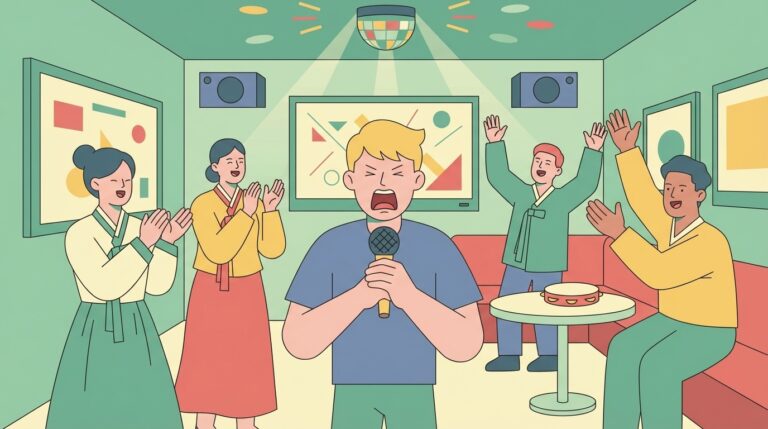
Imagine this: It’s 9 PM on a Friday in Seoul. You’ve just survived a grueling week at work, and you’ve successfully navigated round one of the Hoesik (company dinner) involving endless plates of pork belly and Soju. Suddenly, your Korean coworker grabs your arm. “Let’s go to round two!” Before you know it, you are pushed into a neon-lit, soundproof room. A tambourine is thrust into your left hand, a microphone into your right. The disco ball spins. Your boss yells something in Korean, and everyone goes wild.
Wait, what did they just say? And more importantly, what are you supposed to do?
If you’ve ever watched a K-Drama, you know the Noraebang (karaoke room) isn’t just a place to sing. It’s an emotional sanctuary. It’s where the shy intern turns into a rockstar, where broken hearts belt out 90s ballads, and where Korea’s intense societal pressure simply… melts away.
Today, we aren’t just learning textbook vocabulary. I’m going to teach you the authentic, high-energy Korean phrases you need to survive—and dominate—the Noraebang, specifically designed for B2 (Intermediate) learners. Let’s make some noise!
🎤 Phase 2: Core Expressions for Maximum Hype
1. 분위기 띄워볼까요?
- Pronunciation: bun-wi-gi tti-wo-bol-kka-yo? (Sound analogy: ‘tti’ sounds like a very sharp, tense ‘tee’, like a kettle whistling!)
- Meaning:
- Literal: Shall we float the atmosphere?
- Real Nuance: Let’s get this party started! / Shall we liven up the mood?
- K-Culture Moment: You’re in the Noraebang, but everyone is awkwardly sitting, looking at the song book. You grab the mic, say this phrase, and immediately queue up a high-energy K-Pop dance track. Instant hero status.
- Editor’s Insight: Koreans conceptualize ‘mood’ or ‘atmosphere’ (분위기) as something heavy that needs to be ‘lifted’ or ‘floated’ (띄우다). It’s a fantastic idiomatic expression that shows you really understand the language.
- Situation Spectrum:
[🚫 Formal] ———— [⚠️ Semi-formal] ———— [✅ Casual]- Friends (Casual): ✅ (Say: 분위기 좀 띄워보자!)
- Coworkers (Semi-formal): ✅
- Strict Boss/Elders (Formal): ⚠️ (Wait for them to initiate the fun!)
- 🤔 Think About It: Why does Korean use the word ‘float’ for the mood? Is mood considered a physical space in your native language as well?
2. 소리 질러!
- Pronunciation: so-ri jil-leo! (‘jil’ sounds like ‘chill’ but with a strong J, and ‘leo’ is a short, sharp ‘luh’)
- Meaning:
- Literal: Scream sound!
- Real Nuance: Make some noise!
- K-Culture Moment: You’ve definitely heard this at K-Pop concerts. When the beat is about to drop, the idol points the mic to the crowd and screams, “소리 질러!!!”
- Editor’s Insight: The verb 지르다 means to shout, yell, or commit an action boldly. In the Noraebang, this is the ultimate hype phrase. You don’t say it politely; you literally have to shout it.
- Situation Spectrum:
[🚫 Formal] ———— [⚠️ Semi-formal] ———— [✅ Casual]- Friends (Casual): ✅
- Coworkers (Semi-formal): ⚠️ (Only when you are holding the mic and the music is loud!)
- Strict Boss/Elders (Formal): 🚫
- 🤔 Think About It: In Korean, the verb 지르다 is also used for impulse shopping (지름신 – the god of impulse buying). Both screaming and impulse buying require you to let go of your inhibitions. Makes sense, right?
3. 스트레스가 싹 풀렸어요.
- Pronunciation: seu-teu-re-seu-ga ssak pul-lyeot-seo-yo. (‘ssak’ sounds like a sharp hissing ‘sock’)
- Meaning:
- Literal: The stress is completely untangled.
- Real Nuance: My stress is completely gone/relieved.
- K-Culture Moment: The two hours of Noraebang are over. You are walking out, your throat is a bit sore, and you are drinking a cold convenience store drink with your friends. You sigh happily and say this.
- Editor’s Insight: 싹 is a mimetic word (의태어) representing something being completely swept away. 풀리다 means ‘to be untangled.’ Koreans view stress as a knotted string in your mind. The Noraebang literally untangles your brain!
- Situation Spectrum:
[🚫 Formal] ———— [⚠️ Semi-formal] ———— [✅ Casual]- Friends (Casual): ✅ (스트레스 싹 풀렸다!)
- Coworkers (Semi-formal): ✅
- Strict Boss/Elders (Formal): ✅
📖 Phase 3: Textbook vs. Real Korean
| Situation | 📖 Textbook Korean | 🗣️ Real Korean | 💡 Why is it different? |
|---|---|---|---|
| Suggesting to sing | 저는 노래를 부르겠습니다. (I will sing a song.) | 제가 한 곡 뽑겠습니다! (I will pull out a song!) | ‘뽑다’ (to pull out) gives a folksy, confident vibe, as if you are drawing a sword for battle! |
| Making the room energetic | 즐겁게 놀아요. (Let’s play enjoyably.) | 신나게 놀아보자! (Let’s play excitingly!) | ‘신나다’ implies a physical, heart-pumping excitement, which fits the Noraebang vibe perfectly. |
| Asking for extra time | 시간을 더 주세요. (Please give more time.) | 사장님, 서비스 좀 주세요~ (Boss, please give us some ‘service’~) | ‘Service’ (서비스) in Korea means ‘free stuff/time’. It’s a staple of Korean hospitality culture. |
Editor’s Note for B2 Learners: Using “한 곡 뽑겠습니다” will immediately make Korean locals drop their jaws in awe of your cultural fluency.
🎧 Phase 4: Cultural Context — K-Culture Deep Dive
4-1. The Unspoken Rules of Noraebang (Non-verbal Nunchi)
In Korea, Nunchi (눈치 – the ability to read the room) doesn’t stop when the music starts.
1. The Tambourine Duty: If you aren’t singing, you are shaking the tambourine or clapping. Sitting quietly looking at your phone is a huge party foul.
2. The Remote Control Ninja: The music should never stop. A true Noraebang veteran uses the remote (리모컨) to queue up the next song (예약) while the current singer is hitting their final high note.
4-2. The K-Drama Trope: The Breakup Ballad
Have you ever watched a K-Drama where the main character gets dumped, gets drunk at a Pojangmacha (tent bar), and then goes to a Noraebang alone to cry while singing a tragic 90s ballad? This is a highly accurate reflection of reality. Noraebangs are uniquely designed to be soundproof confessionals. In fact, Korea popularized the “Coin Noraebang” (코인노래방) specifically for people who want to go alone, sing three sad songs for $1, and go home healed.
🎭 Phase 5: Interactive Roleplay Scenario
Setting: Friday evening, 9:30 PM. Gangnam Station. The air is thick with the smell of BBQ, but you are now in Room 5 of a flashy Noraebang. The disco ball is blinding. Your Korean coworker, Minsu, just finished a wild rap song.
Characters:
– YOU: The foreign employee who wants to impress the team but is secretly nervous.
– Minsu (32): Your outgoing Korean coworker who takes Hoesik very seriously.
Minsu: 와, 나 진짜 하얗게 불태웠어. (Panting) 자, 다음 누구야? OOO 씨, 이제 부르셔야죠! 🎤
(wa, na jinjja hayake bultaewosseo. ja, daeum nuguya? OOO ssi, ije bureusyeoyajyo!)
[Wow, I really burned myself out. Alright, who’s next? You have to sing now!]
(🎭 Stage Direction: Minsu aggressively pushes the microphone toward your chest.)
🔀 YOUR TURN! How do you respond?
– A) “아니에요, 저는 노래 못해요. 패스!” (No, I can’t sing. Pass!)
– B) “좋습니다! 제가 분위기 한 번 띄워보겠습니다!” (Great! Let me liven up the mood!)
– C) “소리 질러!!!” (Make some noise!!!)✅ Best Choice: B — This shows immense confidence and uses top-tier Korean phrasing. Even if you end up singing “Twinkle Twinkle Little Star,” they will love the hype.
⚠️ Choice A Analysis: While okay, it kills the momentum. In Korea, you should at least pretend to sing or suggest singing together.
⚠️ Choice C Analysis: A bit too aggressive for grabbing the mic initially. Save “소리 질러” for the middle of your song!
Minsu: 오오오!! 기대할게요! 무슨 곡 예약해 드릴까요?
(ooo!! gidaehalgeyo! museun gok yeyakhae deurilkkayo?)
[Oooo!! I’m looking forward to it! What song should I reserve for you?]
YOU: 신나는 댄스 곡으로 한 곡 뽑겠습니다!
(sinnaneun daenseu gogeuro han gok ppopgetseumnida!)
[I’ll belt out an exciting dance track!]
🗣️ Phase 6: 10-Second Shadowing Drill
Ready to sound like a native? Practice this crucial sentence when the time is almost up!
🥺 사장님! / 저희 / 서비스 시간 / 조~금만 더 / 주실 수 있나요?
(sa-jang-nim! / jeo-hui / seo-bi-seu si-gan / jo~geum-man deo / ju-sil su it-na-yo?)
Voice Acting Tip: Use an 애교 (cute/pleading) tone on “조~금만” (just a little bit). Extend the ‘jo’ to maximize the emotional effect. The owner will definitely give you an extra 20 minutes!
📚 Phase 7: K-Culture Mini Dictionary
| Korean | Romanization | English | Cultural Context |
|---|---|---|---|
| 노래방 | noraebang | Karaoke | Lit. “Song room”. The ultimate Korean stress-relief venue. |
| 회식 | hoesik | Company Dinner | Essential for team bonding; usually involves multiple rounds (BBQ -> Noraebang). |
| 서비스 | seobiseu | Service / On the house | Extra time or food given for free. In a Noraebang, it means bonus minutes added to the timer! |
| 떼창 | ttechang | Sing-along | When the whole crowd sings the lyrics together. The ultimate sign of a successful Noraebang session. |
| 눈치 | nunchi | Nunchi | The social sense of reading the room. Crucial for knowing when to hype up the crowd. |
🎒 Phase 8: Traveler’s Survival Kit
Are you traveling to Korea soon? You MUST visit a “Coin Noraebang” (코인노래방 or ‘코노’). It’s cheap, everywhere, and perfect for solo travelers!
🆘 Survival Phrases for Noraebang
– 🇰🇷 “여기 지폐 교환기 어디 있어요?” (yeogi jipye gyohwangi eodi isseoyo?)
– 🗣️ Meaning: Where is the bill exchanger here?
– 📍 Where to use: Coin Noraebangs (to break a 10,000 won bill into 1,000 won bills).
- 🇰🇷 “리모컨 좀 넘겨주세요.” (rimokeon jom neomgyeojuseyo.)
- 🗣️ Meaning: Please pass the remote.
- 📍 Where to use: When you want to queue your song.
📌 Editor’s Travel Note:
– Most Coin Noraebangs now accept credit cards! Just tap your card on the machine inside the booth.
– Don’t press ‘취소’ (Cancel) on the remote unless you want to abruptly stop the current singer’s song! To reserve your song quietly, type the number and press ‘예약’ (Reserve).
🧠 Phase 9: Critical Thinking — “A Step Deeper”
Language & Space: Why do Koreans need a soundproof room?
Have you ever wondered why Noraebangs are so central to Korean stress relief? Let’s think about the concept of space. Seoul is an incredibly dense city. Many young people live in small apartments with thin walls, where singing or shouting would result in noise complaints. Furthermore, Korean society has a strict hierarchical structure (나이 age, 직급 rank) where expressing raw emotions is often suppressed in daily life for the sake of harmony.
The Noraebang provides a socially sanctioned, soundproof box where the rules are temporarily suspended. Here, a junior employee can sing louder than the CEO. It’s not just about music; it’s a vital psychological pressure valve for a hard-working society.
💬 Your Turn: Does your culture have a designated “space” or “activity” where social rules are temporarily suspended so people can relieve stress? Share it in the comments!
🙋♂️ Phase 10: FAQ & Avoiding Mistakes
Q: “Can I sing English pop songs at a Korean Noraebang?”
Absolutely! The songbooks have massive international sections. However, if you are at a company dinner, singing a classic 90s K-Pop song or a Korean ‘Trot’ (트로트) song will instantly win over the older bosses. It’s the ultimate cheat code for promotion.
Q: “I literally cannot sing. Will they be mad?”
Not at all. In Korea, enthusiasm > talent. Just grab the tambourine, dance, and yell “소리 질러!” at the right times. You will be invited to every party.
❌ Common Mistake: Pressing “시작” (Start) when you meant to press “예약” (Reserve).
✅ How to fix it: If someone is singing, pressing “Start” cuts their song off and starts yours. It’s a massive buzzkill! ALWAYS make sure you are pressing “예약” (Reserve).
🏁 Phase 11: Summary & Action Items
One-Liner Summary: The Korean Noraebang is less about hitting the perfect notes and more about ‘floating the mood’ (분위기 띄우다) and untangling your stress (스트레스 풀다) together!
Your Action Missions for Today:
– 🥉 Bronze (Solo): Stand up, raise your arms, and shout “소리 질러!!!” in your room. Feel the stress leave your body!
– 🥈 Silver (Online): Go to YouTube, search for a K-Pop live concert, and comment: “분위기 진짜 좋다! 스트레스가 싹 풀려요!”
– 🥇 Gold (Real Life): Next time you hang out with Korean friends, suggest: “우리 노래방 가서 스트레스 좀 풀까요?” (Shall we go to Noraebang and relieve some stress?)
🌟 K-Culture Mission: Watch an episode of the K-Drama Hospital Playlist (슬기로운 의사생활). Spot the scene where the doctors go to the Noraebang. Pay attention to how they use the tambourines and the microphone!
Did you learn something new today? What’s your go-to karaoke song? Let me know in the comments below! 👇
🎯 Phase 12: Quiz — Interactive Challenge
Q1. You are at a company dinner. The mood is a bit boring. You want to suggest making it more exciting. What do you say?
1) 사장님, 서비스 주세요.
2) 분위기 띄워볼까요?
3) 저 집에 갈게요.
4) 눈치 좀 챙기세요.
Answer: 2. (1 is asking for free stuff, 3 is “I’m going home”, and 4 is “Read the room!” which is very rude to say to others!)
Q2. Fill in the blank: 스트레스가 싹 (____) ! (My stress is completely gone!)
Answer: 풀렸어요 (pul-lyeot-seo-yo). Remember, stress is a tangled knot in Korean!
Q3. True or False: If you sing perfectly at a company Noraebang, you are guaranteed to be the most popular person, even if you sit quietly afterward.
False! The Noraebang is about ‘Nunchi’. You must shake the tambourine, clap, and hype up others. Participation is more important than pure talent!
Frequently Asked Questions (FAQ)
Q: What does "분위기 띄워볼까요?" mean in Korean and how do you pronounce it?
A: In Korean, "분위기 띄워볼까요?" is pronounced [bun-wi-gi tti-wo-bol-kka-yo? (Sound analogy: 'tti' sounds like a very sharp, tense 'tee', like a kettle whistling!] and means: Literal: Shall we float the atmosphere?
Q: What does "소리 질러!" mean in Korean and how do you pronounce it?
A: In Korean, "소리 질러!" is pronounced [so-ri jil-leo! ('jil' sounds like 'chill' but with a strong J, and 'leo' is a short, sharp 'luh'] and means: Literal: Scream sound!
Q: What does "스트레스가 싹 풀렸어요." mean in Korean and how do you pronounce it?
A: In Korean, "스트레스가 싹 풀렸어요." is pronounced [seu-teu-re-seu-ga ssak pul-lyeot-seo-yo. ('ssak' sounds like a sharp hissing 'sock'] and means: Literal: The stress is completely untangled.







