

Hello! I am the Lead Editor of Daily Hangul.
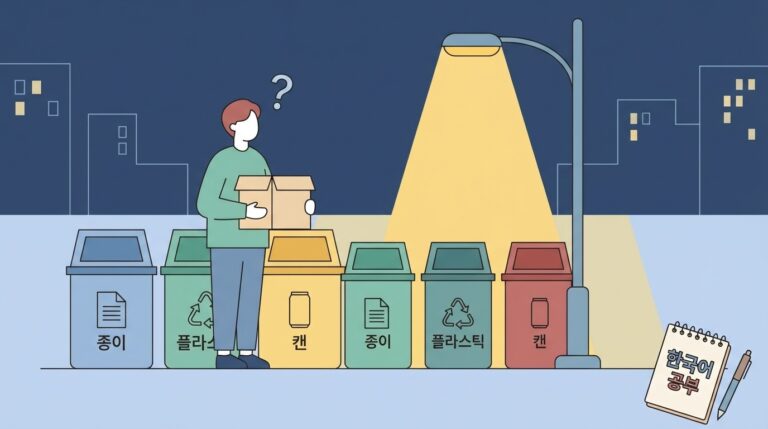
Picture this: It’s 11:30 PM on a Friday. You just finished an amazing K-Drama marathon while eating fiery Tteokbokki ordered through a delivery app. Now, you stand in front of your officetel’s recycling area, holding a mountain of plastic containers stained with red chili oil. The local security guard (Gyeongbi-ajeossi) approaches, eyeing your trash. You confidently drop the container into the ‘Plastic’ bin. Suddenly, he shouts, “학생! 그거 거기다 버리면 안 되지!” (Student! You can’t throw that there!).
You freeze. It’s plastic, right? Why are there tiny triangles with words like ‘PET’, ‘PP’, ‘비닐류’, and the dreaded ‘OTHER’?
Welcome to the ultimate boss level of living in Korea: 분리수거 (Bunri-sugeo, Waste Sorting). Korea has one of the strictest recycling systems in the world. As a C1-level learner, knowing how to say “plastic” isn’t enough. You need to navigate the complex vocabulary of materials, the social etiquette of communal living, and the intricate instructions printed on every package. Let’s dive into the authentic, advanced Korean you need to survive the recycling area and impress the locals.
🧬 Phase 2: Core Expressions Deep Dive
Let’s break down the expressions you’ll actually hear and use when dealing with those confusing recycling symbols.
1. “이거 라벨은 떼고, 물로 한 번 헹궈서 분리 배출하셔야 돼요.”
- Pronunciation: [igeo rabel-eun ttego, mul-lo han beon henggwoseo bunri baechulhasyeoya dwaeyo.]
- Sound-alike guide: ‘헹궈서 (heng-gwo-seo)’ sounds a bit like ‘hang-gwa-so’. Make sure to emphasize the ‘gwo’ with a round mouth.
- Meaning: (Literal) You must detach the label, rinse it once with water, and discharge it separately. / (Real nuance) Peel the label off, wash it, and recycle it properly.
- K-Culture Moment: You’ll hear this from your Korean roommates or the security guard. In Korea, throwing away a Coke bottle without removing the plastic wrapper is considered a cardinal sin. You have to literally deconstruct your trash.
- Editor’s Insight: The phrase
분리 배출하다(to separate and discharge) is the formal, technical term for recycling. In casual speech, people often just say분리수거 하다(to collect separated waste), even though technically, the city collects (수거) and you discharge (배출).- Situation Spectrum:
[🚫 절대 금지] ———— [⚠️ 주의] ———— [✅ 자유롭게]
- Casual (Roommates): ✅ (Just drop the ‘하셔야 돼요’ to ‘해야 돼’)
- Semi-formal (Neighbors): ✅
- Formal (Landlord/Guard): ✅
- 🤔 Think About It: Why is the responsibility of meticulously cleaning and separating trash placed entirely on the consumer in Korea? How does this reflect Korea’s transition into a highly organized, collective society?
2. “여기 ‘아더(OTHER)’라고 적힌 건 복합 재질이라서 일반 쓰레기예요.”
- Pronunciation: [yeogi ‘adeo(OTHER)’-rago jeokin geon bokhap jaejiriraseo ilban sseuregiyeyo.]
- Meaning: (Literal) The thing written as ‘OTHER’ here is a composite material, so it is general trash. / (Real nuance) If the symbol says ‘OTHER’, it’s mixed plastic, so just throw it in the regular trash bag.
- K-Culture Moment: You buy a beautiful K-Beauty cosmetic bottle or a fancy instant coffee cup. You look at the triangle, and it says ‘OTHER’. This is the most confusing symbol for foreigners. Because it’s a mix of different plastics (
복합 재질), many districts require you to throw it in the pay-as-you-go trash bag (종량제 봉투), not the recycling bin.- Editor’s Insight: Notice the use of
-라고 적힌 건(the thing that is written as). This is a vital C1 grammar point for quoting written text, especially useful when reading labels or instructions.- Situation Spectrum:
[🚫 절대 금지] ———— [⚠️ 주의] ———— [✅ 자유롭게]
- Casual: ✅
- Semi-formal: ✅
- Formal: ✅
- 🤔 Think About It: Does your home country have a category for “mixed materials”? How do environmental policies shape everyday language?
3. “페트병은 발로 꽉 밟아서 부피를 줄인 다음에 버려주세요.”
- Pronunciation: [peteubyeong-eun bal-lo kkwak balbaseo bupi-reul jurin da-eum-e beoryeojuseyo.]
- Meaning: (Literal) As for PET bottles, step on them tightly with your foot to reduce the volume, and then throw them away. / (Real nuance) Crush the water bottles flat before you toss them.
- K-Culture Moment: If you watch K-Dramas, you might see characters aggressively stomping on plastic water bottles outside convenience stores. It’s a great stress reliever and a mandatory civic duty.
- Editor’s Insight: The word
부피를 줄이다(to reduce volume) is a high-level expression often seen on public notice boards.꽉 밟다(to step firmly) provides a great visceral image.
📖 Phase 3: Textbook vs Real Korean
| Situation | 📖 Textbook Korean | 🗣️ Real Korean | 💡 Why is it different? |
|---|---|---|---|
| Confused about a plastic bag | 플라스틱 봉투는 어디에 버립니까? | 이거 비닐류에 버리면 되죠? | Koreans categorize plastic bags/wrappers as ‘비닐류’ (Vinyl), entirely separate from hard plastics. |
| Asking if you need to wash it | 깨끗하게 씻어야 합니까? | 이거 물로 대충 헹구면 돼요? | ‘대충 헹구다’ (roughly rinse) is the realistic action. No one uses soap on trash! |
| Dealing with a dirty container | 오염된 플라스틱은 어떻게 합니까? | 양념 묻은 건 종량제에 버려야 돼. | Food-stained (양념 묻은) plastic often goes straight to the paid general waste bag (종량제). |
Bottom Note: At the C1 level, replacing generic words like ‘쓰레기 봉투’ with specific terms like ‘종량제 봉투’ (volume-based waste fee bag) instantly elevates your Korean to native-like fluency.
🇰🇷 Phase 4: Cultural Context — K-Culture Deep Dive
4-1. Non-verbal Context & ‘Nunchi’
When you’re at the recycling station, Nunchi (눈치) is everything. If you see your neighbors diligently peeling the stickers off their delivery boxes, you shouldn’t just toss your box whole. If the security guard is watching, make a show of checking the recycling symbol (분리배출 마크) on the bottom of the plastic bottle before placing it in the bin. It signals: “I respect the rules of this community.”
4-2. The K-Drama Tropes & K-Food Paradox
The ‘Bunri-sugeo’ Date: In K-Dramas, taking out the recycling is a classic trope for neighbors or secretly dating couples to “accidentally” bump into each other in their sweatpants. It’s the ultimate casual setting. (Think of the rooftop neighbors in dramas like Because This Is My First Life).
The K-Food Delivery Paradox: Korea boasts an incredible delivery culture (Baedal). You can get iced coffee, soup, and side dishes delivered in 20 minutes. But this creates a paradox: massive amounts of plastic waste. As a result, the vocabulary around delivery containers (배달 용기) and recycling them has evolved rapidly. You’ll often hear Koreans sighing, “배달 음식은 다 좋은데 치우는 게 너무 일이야” (Delivery food is great, but cleaning it up is too much work), referring specifically to the tedious process of washing the chili oil out of the ‘PP’ (Polypropylene) plastic containers.
🎭 Phase 5: Interactive Roleplay Scenario
Setting: 11:00 PM. The dimly lit recycling area of your apartment complex. You are holding a plastic bag full of empty, unwashed yogurt bottles (PS material) and a greasy fried chicken container (OTHER material).
Characters:
– YOU: An expat who has lived in Korea for 2 years. You thought you knew the rules.
– 경비 아저씨 (Security Guard, 60s): The strict but well-meaning guardian of the apartment. He treats the recycling area like his personal kingdom.
Dialogue:
경비 아저씨: 어이구, 학생! 그거 그대로 버리려고? 잠깐만! ✋
(eoigu, haksaeng! geugeo geudaero beoryeoryeogo? jamkkanman!)
[Oh my, student! Are you going to throw that away just like that? Hold on!]
YOU: 네? 이거 다 플라스틱 마크 있는 건데요? 🤔
(ne? igeo da peullaseutik makeu inneun geondeyo?)
[Yes? These all have the plastic mark on them though?]
경비 아저씨: 마크만 있으면 뭐해! 이 치킨 박스 봐봐. ‘아더(OTHER)’라고 써있지? 게다가 기름이 이렇게 묻어있잖아.
(makeuman isseumyeon mwohae! i chikin bakseu bwabwa. ‘adeo’-rago sseo-itji? gedaga gireumi ireoke mudeoitjana.)
[What good is the mark! Look at this chicken box. It says ‘OTHER’, right? Plus, it’s covered in grease like this.]
YOU: 아, 아더 재질은 플라스틱에 버리면 안 되나요?
(a, adeo jaejir-eun peullaseutig-e beorimyeon an doenayo?)
[Ah, are we not supposed to throw ‘OTHER’ materials in the plastic bin?]
경비 아저씨: 재활용이 안 돼. 이런 복합 재질이나 양념 묻은 건 그냥 종량제 봉투에 넣어서 버려야지.
(jaehwaryong-i an dwae. ireon bokhap jaejirina yangnyeom mudeun geon geunyang jongnyangje bongtu-e neoeoseo beoryeoyaji.)
[It can’t be recycled. Composite materials like this, or things with seasoning on them, you just have to put them in the standard garbage bag and throw them away.]
YOU: 아… 몰랐어요. 그럼 이 요구르트병은요? 이건 ‘PS’라고 적혀 있는데요.
(a… mollasseoyo. geureom i yogureuteubyeong-eunyo? igeon ‘PS’-rago jeokhyeo indeyo.)
[Ah… I didn’t know. Then what about these yogurt bottles? These say ‘PS’.]
경비 아저씨: PS는 플라스틱 맞는데, 안에 내용물이 남았잖아. 물로 한 번 헹궈서 버려야지, 안 그러면 냄새 나서 다 망쳐.
(PS-neun peullaseutik manneunde, an-e naeyongmuri namatjana. mul-lo han beon henggwoseo beoryeoyaji, an geureomyeon naemsae naseo da mangchyeo.)
[PS is plastic, but there’s still contents left inside. You have to rinse it once with water before throwing it away, otherwise it smells and ruins everything else.]
🔀 Your Turn! How do you respond?
– A) “아, 너무 복잡하네요. 그냥 제가 알아서 할게요.” (Ah, this is too complicated. I’ll just figure it out myself.)
– B) “죄송합니다. 제가 다시 가지고 올라가서 깨끗하게 씻어올게요.” (I’m sorry. I’ll take them back upstairs and wash them clean.)
– C) “한국은 왜 이렇게 법이 까다로워요? 다른 나라는 안 이러는데.” (Why are the laws so strict in Korea? Other countries aren’t like this.)✅ Best Choice: B — Why: In Korean communal living, taking responsibility and showing effort is highly respected. The guard will instantly soften up.
⚠️ Choice A & C Analysis: Choice A is incredibly rude to an elder. Choice C is a cultural faux pas; criticizing Korean systems compared to your home country immediately makes you sound like an entitled expat (the dreaded “In my country…” syndrome).
YOU (Choosing B): 죄송합니다. 제가 다시 가지고 올라가서 깨끗하게 씻어올게요. 😅
(joesonghamnida. jaega dasi gajigo ollagaseo kkaekkeutage ssiseo-olgeyo.)
[I’m sorry. I’ll take them back upstairs and wash them clean.]
경비 아저씨: (Smiling warmly) 그래, 귀찮아도 다 같이 사는 아파트니까 서로 도와야지. 다음부턴 잘 보고 버려~
(geurae, gwichanado da gachi saneun apateunikka seoro dowayaji. da-eumbuteon jal bogo beoryeo~)
[Right, even if it’s annoying, we all live in this apartment together so we have to help each other out. Just check carefully next time~]
⏱️ Phase 6: 10-Second Shadowing Drill
Speak out loud like a frustrated but compliant Seoulite!
😤 아, 진짜 / 배달 용기는 / 라벨 떼고 / 헹구는 게 / 너무 귀찮아요!
(a, jinjja / baedal yonggineun / rabel ttego / hengguneun ge / neomu gwichanayo!)
“Ah, seriously, taking the labels off delivery containers and rinsing them is so annoying!”
Pro-tip: Put a heavy sigh before “아, 진짜” and emphasize the “너무” (too much) to sound perfectly native.
📖 Phase 7: K-Culture Mini Dictionary
| Korean | Romanization | English | Contextual Meaning |
|---|---|---|---|
| 종량제 봉투 | jongnyangje bongtu | Pay-as-you-throw trash bag | You must buy these specific bags at the local convenience store for general non-recyclable waste. |
| 비닐류 | binillyu | Vinyl / Plastic bags | In Korea, plastic wraps and bags are a separate recycling category from hard plastics. Look for the ‘비닐류’ symbol. |
| 이물질 | imuljil | Foreign substance | Any leftover food or dirt. The golden rule of recycling is “이물질을 제거하다” (remove foreign substances). |
| 투명 페트 | tumyeong pete | Clear PET bottles | Recently, Korea mandated that clear water/soda bottles must be recycled separately from colored plastics. |
| 자취생 | jachwisaeng | Independent student/single person living alone | The demographic that orders the most delivery and struggles the most with late-night recycling. |
🧳 Phase 8: Survival Kit (Living & Traveling)
Even if you are just staying in an Airbnb or a hotel, you will encounter the recycling bins. Don’t be the tourist who ruins the host’s recycling!
🆘 Survival Expressions for Waste Sorting
1. 🇰🇷 “이 플라스틱은 어디에 버려요?” (i peullaseutig-eun eodi-e beoryeoyo?)
– Meaning: Where do I throw this plastic away?
2. 🇰🇷 “이거 일반 쓰레기 맞나요?” (igeo ilban sseuregi mannayo?)
– Meaning: Is this right for general waste?
3. 🇰🇷 “종량제 봉투 제일 작은 거 하나 주세요.” (jongnyangje bongtu jeil jageun geo hana juseyo.)
– Meaning: Please give me one of the smallest general waste bags. (Say this at the convenience store!)📌 Editor’s Travel Note
– Public Trash Cans: You’ll notice there are very few trash cans on the streets in Korea. This is to prevent people from dumping their household trash! Carry a small bag for your wrappers.
– Convenience Stores: If you eat instant ramen at a CU or GS25, you MUST separate the leftover soup, the paper bowl, and the plastic wrapper into the specific bins provided inside the store.
🧠 Phase 9: Critical Thinking Corner — “A Step Deeper”
Food & Identity vs. Environmental Reality
Korea’s Jeong (정, affection/attachment) is heavily tied to sharing food. The boom of the Baedal (delivery) industry modernized this, allowing massive feasts to be delivered anywhere, anytime. However, this convenience collides with Korea’s dense population and lack of landfill space. The intense, almost militant recycling culture is not just about saving the earth; it’s a social contract. By meticulously washing a tteokbokki container, individuals participate in a collective duty to maintain order in a hyper-dense society. The language reflects this: we don’t just “throw away” (버리다); we “separate and discharge” (분리 배출하다).
💬 Your Turn: Does your culture value convenience over environmental regulations, or vice versa? How is the act of “taking out the trash” viewed in your society? Share in the comments!
🚫 Phase 10: FAQ & Common Mistakes
Q: “Do I really need to wash the plastic even if it’s going to be melted down anyway?”
Yes! If a plastic container is heavily contaminated (e.g., stained with red pepper paste that won’t come out), it cannot be recycled and will contaminate other plastics. Throw stained plastics in the general waste (종량제).
Q: “Can I use honorifics to the security guard when apologizing about trash?”
Absolutely. Always use 요/습니다 forms with the 경비 아저씨 (Security Guard) or 청소 여사님 (Cleaning Lady). They are older and work hard for the community. Respect is paramount.
❌ Common Mistake #1: Leaving the caps on and not crushing the bottles.
✅ Do this instead:뚜껑을 열고, 라벨을 뜯고, 찌그러뜨려서 버리세요.(Open the cap, tear off the label, crush it, and throw it away.) Note: Rules on caps vary by district, but crushing and label-removing are universal.
🎯 Phase 11: Summary & Action Items
One-Liner Summary: To master Korean plastic recycling, remember the Holy Trinity: 떼고 (peel), 헹궈서 (rinse), 분리하다 (separate)!
Action Mission:
– 🥉 Bronze (Solo): Look at any plastic bottle or container you have right now. Find the Korean recycling symbol and identify its material (PET, PP, PS, OTHER, 비닐류) out loud.
– 🥈 Silver (Online): Write a comment below in Korean about which item is the hardest to recycle in your daily life. (e.g., “저는 배달 용기 씻는 게 제일 힘들어요.”)
– 🥇 Gold (Real World): Next time you are at a Korean convenience store or in your apartment, confidently separate a clear PET bottle (투명 페트) from the colored plastics, completely label-free!
📝 Phase 12: Quiz — Interactive Challenge
1. Situational Judgment: You ordered Jajangmyeon in disposable plastic bowls. There is thick black bean sauce left inside. What is the CORRECT Korean thought process?
– A) “이거 플라스틱이니까 바로 재활용(Recycling)에 버려야지.”
– B) “물로 씻어도 양념이 안 지워지네. 그냥 종량제(General waste)에 버려야겠다.”
– C) “경비 아저씨한테 대신 버려달라고 부탁해야지.”
2. True or False – K-Culture Edition:
– In Korea, you can put plastic bags inside other plastic bags and throw them in the hard plastic (플라스틱) bin. (T/F)
🚨 Click here for the answers!
1. Answer: B. If the food stains (이물질) cannot be completely removed, the plastic loses its recycling value. It must go into the general waste bag (종량제 봉투).
2. Answer: False. Plastic bags and wrappers are classified as ‘비닐류’ (Vinyl) and have their own dedicated bin, completely separate from hard plastics like PP or PET.
Frequently Asked Questions (FAQ)
Q: What does ""이거 라벨은 떼고, 물로 한 번 헹궈서 분리 배출하셔야 돼요."" mean in Korean and how do you pronounce it?
A: In Korean, ""이거 라벨은 떼고, 물로 한 번 헹궈서 분리 배출하셔야 돼요."" is pronounced [igeo rabel-eun ttego, mul-lo han beon henggwoseo bunri baechulhasyeoya dwaeyo.] and means: (Literal) You must detach the label, rinse it once with water, and discharge it separately. / (Real nuance) Peel the label off, wash it, and recycle it properly.
Q: What does ""여기 '아더(OTHER)'라고 적힌 건 복합 재질이라서 일반 쓰레기예요."" mean in Korean and how do you pronounce it?
A: In Korean, ""여기 '아더(OTHER)'라고 적힌 건 복합 재질이라서 일반 쓰레기예요."" is pronounced [yeogi 'adeo(OTHER] and means: (Literal) The thing written as 'OTHER' here is a composite material, so it is general trash. / (Real nuance) If the symbol says 'OTHER', it's mixed plastic, so just throw it in the regular trash bag.
Q: What does ""페트병은 발로 꽉 밟아서 부피를 줄인 다음에 버려주세요."" mean in Korean and how do you pronounce it?
A: In Korean, ""페트병은 발로 꽉 밟아서 부피를 줄인 다음에 버려주세요."" is pronounced [peteubyeong-eun bal-lo kkwak balbaseo bupi-reul jurin da-eum-e beoryeojuseyo.] and means: (Literal) As for PET bottles, step on them tightly with your foot to reduce the volume, and then throw them away. / (Real nuance) Crush the water bottles flat before you toss them.







