

Phase 1: The ‘Uh-Oh’ Moment at the Salon
Hello there! This is your Senior Editor from Daily Hangul.
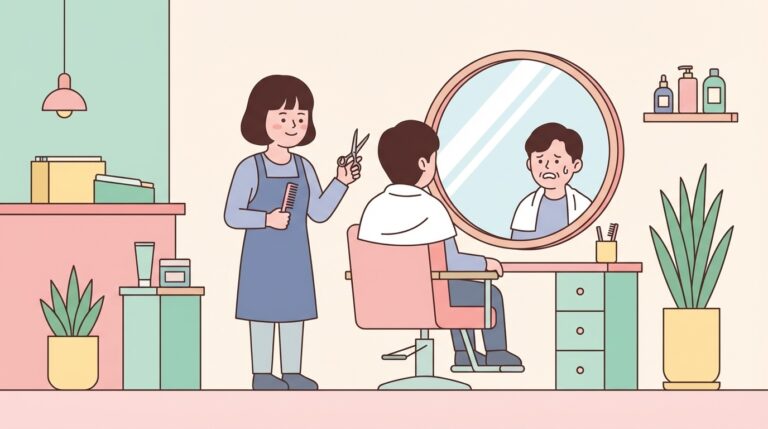
Picture this: You are sitting in a bright, aesthetic hair salon in the heart of Hongdae. The K-pop playlist is bumping in the background, and you’ve just showed the stylist a picture of your favorite idol’s gorgeous ash-blonde hair. The stylist gently runs their fingers through your hair, stops abruptly halfway down, makes a sympathetic eye contact with you through the giant mirror, and lets out a deep, quiet sigh.
“고객님… (Customer…)”
If you’ve watched enough K-Dramas or K-Vlogs, you know that sigh. It’s the universal sound of a professional diagnosing severely damaged hair. Panic sets in. You want to say, “I know it’s fried, but can we just trim it?” or “Is it too damaged to dye?” but the words won’t come out.
Visiting a Korean hair salon is a must-do K-Beauty experience, but it can be intimidating when you don’t know the specific vocabulary. Today, we are going to learn exactly how to talk about your hair’s condition, negotiate your style, and survive the dreaded ‘damaged hair’ diagnosis like a true local. This guide is based on real SOS messages from my students who ended up with expensive treatments they couldn’t say no to. Let’s dive in!
Phase 2: Core Expressions — Let’s Talk About Your Hair
Here are the top 3 expressions you need when your hair has seen better days.
1. 머릿결이 많이 상했어요. (My hair is very damaged.)
- Pronunciation: [meo-rit-gyeol-i man-i sang-hae-sseo-yo]
Sound guide: ‘eo’ sounds like the ‘u’ in ‘uh-oh’. ‘sang’ sounds like singing a song.- Meaning: (Literal) The texture of the hair has gone bad. / (Real nuance) My hair is heavily damaged/fried.
- K-Culture Moment: You will hear this a lot in K-Pop behind-the-scenes videos. Idols constantly bleach their hair, and they often joke that their hair is “holding on for dear life” (상해서 끊어져요 – it’s so damaged it’s breaking off).
- Editor’s Insight: We rarely use the word ‘손상’ (damage) in daily conversation unless we are reading a shampoo bottle. ‘상하다’ literally means ‘to spoil’ (like food), but we use it for hair and skin too!
- Situation Spectrum:
[🚫 절대 금지] ———— [⚠️ 주의] ———— [✅ 자유롭게]
- Casual with friends: ✅ (상했어)
- To a Hair Stylist (Semi-formal): ✅ (상했어요)
- Professional Business: ⚠️ (Not really applicable)
- 🤔 Think About It: Why do Koreans use the same word for “spoiled food” and “damaged hair”? It implies that hair, like food, needs ‘nutrition’ (영양) to stay fresh. Does your language have a unique metaphor for damaged hair?
2. 끝부분만 다듬어 주세요. (Please just trim the ends.)
- Pronunciation: [kkeut-bu-bun-man da-deum-eo ju-se-yo]
Sound guide: ‘kkeut’ sounds like ‘good’ but with a sharp, tense ‘kk’ sound. ‘da-deum’ sounds like ‘da-doom’.- Meaning: (Literal) Please only tidy up the end parts. / (Real nuance) Just a trim, please don’t chop it all off!
- K-Culture Moment: This is the ultimate defense mechanism when a stylist wants to cut off all your damaged hair. It’s polite but firm.
- Editor’s Insight: Never say “잘라 주세요” (Please cut it) if you only want a trim! In a Korean salon, ‘자르다’ (to cut) usually means a significant chop. ‘다듬다’ (to trim/tidy up) is the magic word you need to keep your length.
- Situation Spectrum:
[🚫 절대 금지] ———— [⚠️ 주의] ———— [✅ 자유롭게]
- To a Hair Stylist (Semi-formal): ✅
- 🤔 Think About It: Koreans love the concept of ‘단정함’ (neatness). ‘다듬다’ isn’t just about making it shorter; it’s about making it look neat and polished.
3. 영양 추가해 드릴까요? (Shall I add a hair treatment?)
- Pronunciation: [yeong-yang chu-ga-hae deu-ril-kka-yo?]
- Meaning: (Literal) Shall I add nutrition for you? / (Real nuance) Would you like to add a deep conditioning clinic? (Note: It costs extra!)
- K-Culture Moment: This is the classic upselling moment in a Korean salon. Because K-Beauty standards prioritize a healthy glow, stylists will heavily recommend “영양” (nutrition) or “클리닉” (clinic) if your hair is damaged.
- Editor’s Insight: If you don’t want it, you must politely decline. You can say, “아니요, 오늘은 괜찮아요” (No, I’m okay for today).
- Situation Spectrum:
[🚫 절대 금지] ———— [⚠️ 주의] ———— [✅ 자유롭게]
- Stylist to Customer: ✅
- 🤔 Think About It: The word ‘Service’ (서비스) in Korea means ‘free on the house’. But ‘추가’ (add) means you are paying for it. Always distinguish the two!
Phase 3: Textbook vs. Real Korean
Let’s see how textbook Korean differs from what you actually hear in a bustling Gangnam salon.
| Situation | 📖 Textbook Korean | 🗣️ Real Korean | 💡 Why is it different? |
|---|---|---|---|
| Explaining your hair | 제 머리카락이 손상되었습니다. (My hair is damaged.) | 제 머리가 완전 개털이에요 ㅠㅠ (My hair is completely dog fur.) | 개털 (Dog fur) is a very common, self-deprecating slang for frizzy, fried hair. |
| Asking for a trim | 머리를 조금 자르고 싶습니다. (I want to cut my hair a little.) | 상한 데만 쳐주세요. (Just cut off the damaged parts.) | 치다 (to strike/hit) is used in salons to mean ‘thinning out’ or ‘snipping off’. |
| Declining treatment | 저는 영양이 필요 없습니다. (I don’t need nutrition.) | 아, 오늘은 컷트만 할게요. (Ah, I’ll just do a cut today.) | Direct refusal is considered harsh. Stating what you will do is softer and more polite. |
Bottom Note: As a B1 learner, using “머리가 상했어요” is perfectly natural. Using “개털이에요” with a little laugh will definitely make the stylist smile and think you’re a local!
Phase 4: Cultural Context — K-Culture Deep Dive
4-1. The Non-Verbal ‘Nunchi’ Game at the Salon
When you sit in the salon chair, the communication often happens through the mirror. Maintaining slight eye contact through the mirror while discussing your hair builds trust. If the stylist touches your hair and pauses, read the room (Nunchi). It’s their polite way of showing concern without directly insulting your hair care routine.
4-2. The “Son-i-go” Phenomenon (K-Beauty & K-Drama)
Have you ever brought a photo of a K-Drama actress (like Han So-hee’s perfect waves) to the salon? You might hear the stylist say: “고객님, 이건 고데기예요.” (Customer, this is a curling iron.)
This phrase is so famous in Korea that it became an acronym: 손이고 (Son-i-go: 손님 이건 고데기입니다). It means the hairstyle in the photo cannot be achieved with a permanent perm; it was styled with a hot tool for a photoshoot. K-Drama hair is often the result of hours of daily styling, not a one-time perm. So, if your hair is damaged, the stylist will definitely give you the “Son-i-go” reality check to manage your expectations!
Phase 5: Real-Life Roleplay Scenario
Setting: Saturday afternoon at a trendy hair salon in Yeonnam-dong. You are wearing a silky salon gown, sipping on a complimentary iced Americano.
Characters:
– YOU: An expat who really wants an ash-grey perm, but you bleached your hair 6 months ago.
– Stylist Ji-ah (지아): A friendly, stylish Korean hairdresser who takes hair health very seriously.
Dialogue:
지아: 고객님, 오늘 어떤 스타일로 해드릴까요? 😊
(gogaengnim, oneul eotteon seutailleo haedeurilkkayo?)
[Customer, what kind of style would you like today?]
YOU: 저 이 사진처럼 파마하고 싶어요. 가능할까요?
(jeo i sajincheoreom pamahago sipeoyo. ganeunghalkkayo?)
[I want to get a perm like this picture. Is it possible?]
(🎭 Stage Direction: Ji-ah sprays water on your hair and combs it. The comb gets stuck.)
지아: 앗… 고객님, 예전에 탈색하셨어요? 머릿결이 많이 상했네요.
(at… gogaengnim, yejeone talsaekhasyeosseoyo? meoritgyeori mani sanghaenneyo.)
[Oops… Customer, did you bleach your hair before? Your hair is very damaged.]
YOU: 네, 작년에요. 파마 안 될까요? ㅠㅠ
(ne, jangnyeoneyo. pama an doelkkayo?)
[Yes, last year. Can’t I get a perm?]
지아: 지금 파마하면 머리가 다 녹아요. 다 잘라내야 할 수도 있어요.
(jigeum pamahamyeon meoriga da nogayo. da jallanaeya hal sudo isseoyo.)
[If we perm it now, your hair will melt. We might have to cut it all off.]
🔀 Your Turn! How should you respond to save your hair?
– A) “그냥 해주세요!” (Just do it!)
– B) “그럼 상한 부분만 다듬어 주세요.” (Then please just trim the damaged parts.)
– C) “아… 네. 그럼 다 잘라주세요.” (Ah… okay. Then cut it all off.)✅ Best Choice: B — This shows you understand the situation but still want to maintain control over your haircut.
⚠️ Choice A Analysis: The stylist will likely refuse. In K-Beauty culture, a stylist’s reputation is tied to the result. They won’t risk “melting” your hair!
YOU: 아… 그럼 오늘은 상한 부분만 다듬어 주세요.
(a… geureom oneureun sanghan bubunman dadeumeo juseyo.)
[Ah… Then please just trim the damaged parts today.]
지아: 네, 알겠습니다! 그럼 영양 클리닉도 같이 해드릴까요?
(ne, algetseumnida! geureom yeongyang keullinikdo gachi haedeurilkkayo?)
[Yes, understood! Then shall I also do a nutrition clinic treatment for you?]
YOU: 아니요, 오늘은 컷트만 할게요.
(aniyo, oneureun keotteuman halgeyo.)
[No, I’ll just get a cut today.]
지아: 네, 예쁘게 다듬어 드릴게요~
(ne, yeppeuge dadeumeo deurilgeyo~)
[Okay, I’ll trim it beautifully for you~]
Phase 6: 10-Second Shadowing Drill
Time to practice out loud! Pay attention to the pauses (/) and the emotion tags.
🥺 아… / 머릿결이 / 너무 상해서요. / 끝부분만 / 다듬어 주세요.
(Ah… / meo-rit-gyeol-i / neo-mu sang-hae-seo-yo. / kkeut-bu-bun-man / da-deum-eo ju-se-yo.)
“Ah… my hair is too damaged. Please just trim the ends.”
Pro Tip: Say the “아…” with a slight tone of sadness. It shows you are disappointed but accepting of the reality.
Phase 7: K-Culture Mini Dictionary
Here are some essential salon and K-beauty terms you won’t find in standard textbooks:
| Korean | Romanization | English | Context |
|---|---|---|---|
| 개털 | gaeteol | Dog fur | Slang for extremely dry, damaged, and frizzy hair. |
| 클리닉 | keullinik | Clinic | A deep conditioning hair treatment. Highly recommended in Korean salons. |
| 고데기 | godegi | Curling/Flat iron | The tool used to create the “unrealistic” K-Drama waves. |
| 탈색 | talsaek | Bleaching | Stripping color. The number one reason stylists will reject your perm request! |
| 다듬다 | dadeumda | To trim/tidy up | Trimming the hair to maintain the current style without losing much length. |
Phase 8: Traveler’s Survival Kit (Salon Edition)
Planning to get a K-Beauty makeover during your trip to Seoul? Here is what you need to know.
🆘 Survival Phrases TOP 3
– 🇰🇷 “얼마 정도 걸려요?” (eolma jeongdo geollyeoyo?)
– 🗣️ Meaning: How long will it take?
– 📍 Use when: You have a cafe date or flight to catch later.
– 🇰🇷 “총비용이 어떻게 되나요?” (chong-biyong-i eotteoke doenayo?)
– 🗣️ Meaning: What is the total cost?
– 📍 Use when: They suggest adding ‘clinics’ and you want to avoid sticker shock.
– 🇰🇷 “앞머리 내주세요.” (apmeori naejuseyo.)
– 🗣️ Meaning: Please give me bangs.
– 📍 Use when: You want the trendy Korean see-through bangs.📌 Editor’s Travel Note
– Booking Apps: Use Naver Map or Kakao Hairshop to book in advance. Walk-ins are often turned away in popular areas like Hongdae or Seongsu.
– No Tipping! There is absolutely no tipping culture in Korean hair salons. The price on the receipt is the final price. Tipping might actually confuse the staff!
Phase 9: Critical Thinking Corner — “A Step Deeper”
🧠 Think Deeper: Media vs. Reality in K-Beauty
When we watch K-Pop performances or K-Dramas, everyone has perfectly styled, glossy hair, even if it’s dyed platinum blonde. This media representation creates a massive demand for ‘perfect hair’ in Korea, driving the booming ‘Hair Clinic’ industry. The reality? Those idols undergo grueling, hours-long daily treatments, and often wear hairpieces to hide the severe damage. When a Korean stylist gasps at your damaged hair, they are measuring it against an incredibly high, media-driven standard of “healthy hair.”💬 Your Turn: Does media in your home culture dictate strict beauty standards for hair? How do people in your country deal with “bad hair days”? Share in the comments!
Phase 10: FAQ & Avoiding Mistakes
Q: Is it rude to say “no” when the stylist pushes for an expensive clinic treatment?
Yes and no. It’s not rude to decline, but how you say it matters. A flat “아니요” (No) can feel a bit cold. Instead, use the cushion phrase: “아, 오늘은 괜찮아요. (Ah, I’m okay for today).” It’s polite and clearly sets a boundary.
Q: Can I tell the stylist my hair is “개털” (dog fur)?
Maybe! If you are casually chatting and want to show off your native-like slang while making fun of your own hair, it’s hilarious. But if it’s a very high-end luxury salon in Cheongdam-dong, stick to “많이 상했어요” (It’s very damaged).
❌ Common Mistake #1: Saying “머리카락 자를게요” (I will cut my hair strands).
✅ Do this instead: Just say “머리 자를게요” (I will cut my hair). In everyday Korean, “머리” means both ‘head’ and ‘hair’. Using “머리카락” sounds like you are analyzing the DNA of a single strand of hair like a detective!
Phase 11: Summary & Action Items
- One-Liner Summary: When your hair is fried, politely say “머릿결이 많이 상했어요” and ask them to “다듬어 주세요” (trim) instead of “잘라 주세요” (cut) to save your length!
Action Mission 3 Steps:
– 🥉 Bronze (Solo): Stand in front of your bathroom mirror, touch your hair, and dramatically sigh, “아… 머릿결이 너무 상했어요.”
– 🥈 Silver (Online): Go to Naver Maps, search for a salon in Hongdae (홍대 미용실), look at the reviews, and try to spot the word “클리닉” (Clinic).
– 🥇 Gold (Real Life): Next time you visit a Korean hair salon, successfully decline an upsell using “오늘은 괜찮아요” and ask for a trim!
K-Culture Mission: Watch a behind-the-scenes K-pop vlog on YouTube. I guarantee you will hear an idol complaining about their “상한 머리” (damaged hair) within the first 10 minutes!
Have you ever had a funny or stressful experience at a hair salon abroad? Let me know in the comments below! 😊
Phase 12: Quiz — Interactive Challenge
Test your K-Beauty survival skills!
1. The stylist looks at your bleached hair and says, “고객님, 파마하시면 머리가 녹아요.” (Customer, if you perm it, your hair will melt). What is your best response?
– A) 영양 추가해 주세요. (Please add nutrition.)
– B) 그럼 상한 데만 쳐주세요. (Then just snip the damaged parts.)
– C) 네, 제 머리는 개털이에요. (Yes, my hair is dog fur.)
2. Fill in the blank: You only want to cut 1 inch off.
“자르지 말고 조금만 ________ 주세요.” (Don’t cut it, just ___ it please.)
3. True or False: You received amazing service from your stylist and want to leave a 15% tip. This is a common and appreciated practice in Korea.
(Answers: 1. B – A clinic won’t save melted hair, and C is funny but doesn’t solve the problem! 2. 다듬어 3. False – There is no tipping culture in Korea!)
Frequently Asked Questions (FAQ)
Q: What does "머릿결이 많이 상했어요. (My hair is very damaged.)" mean in Korean and how do you pronounce it?
A: In Korean, "머릿결이 많이 상했어요. (My hair is very damaged.)" is pronounced [meo-rit-gyeol-i man-i sang-hae-sseo-yo] and means: (Literal) The texture of the hair has gone bad. / (Real nuance) My hair is heavily damaged/fried.
Q: What does "끝부분만 다듬어 주세요. (Please just trim the ends.)" mean in Korean and how do you pronounce it?
A: In Korean, "끝부분만 다듬어 주세요. (Please just trim the ends.)" is pronounced [kkeut-bu-bun-man da-deum-eo ju-se-yo] and means: (Literal) Please only tidy up the end parts. / (Real nuance) Just a trim, please don't chop it all off!
Q: What does "영양 추가해 드릴까요? (Shall I add a hair treatment?)" mean in Korean and how do you pronounce it?
A: In Korean, "영양 추가해 드릴까요? (Shall I add a hair treatment?)" is pronounced [yeong-yang chu-ga-hae deu-ril-kka-yo?] and means: (Literal) Shall I add nutrition for you? / (Real nuance) Would you like to add a deep conditioning clinic? (Note: It costs extra!)







