

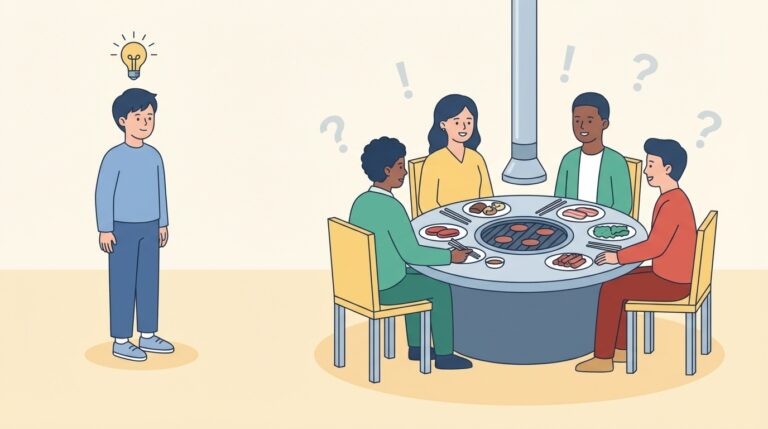
Phase 1: The Invisible Korean Superpower
Hello! I’m your Daily Hangul Editor, your personal veteran tutor and Seoul local guide.
Imagine this: You are watching a K-Drama. The team is at a Pocha (street food tent) drinking soju. The boss suddenly says, “You guys don’t have to stay if you’re tired. Go home!” The English subtitles say exactly that. But… nobody moves. In fact, they all pour another shot and laugh nervously.
What just happened? Why didn’t they leave?
The answer is 눈치 (Nunchi), and specifically, the ability to 분위기 파악하다 (read the room/grasp the atmosphere).
If you’ve ever felt like you’re missing a secret social cue in Korea, you are not alone! Many of my students say, “I know the vocabulary, but I don’t know the vibe.” In Korea, communication is highly high-context. What is not said is often more important than what is spoken aloud.
This guide is based on real questions from learners just like you. By the end of this post, you won’t just speak Korean; you’ll feel it. Let’s unlock the ultimate insider secret to surviving Korean social life!
Phase 2: Core Expressions Deep Dive
Here are the top 3 expressions you absolutely need to navigate the Korean social atmosphere.
1. 분위기 파악하다 (bunwigi paakada)
- Pronunciation: [bun-wi-gi pa-ak-ha-da] / The ‘기 (gi)’ sounds like the ‘gi’ in “give,” and ‘파 (pa)’ is a strong, airy ‘p’.
- Meaning:
- Literal: To grasp the atmosphere.
- Real nuance: To read the room, understand the vibe.
- K-Culture Moment: You know that scene in a K-Drama office where the manager is furious, slamming files on the desk? The clueless new employee suddenly asks, “Sir, can I take my vacation next week?” The senior colleagues will whisper to the newbie: “야, 분위기 파악 좀 해!” (Hey, read the room!)
- Editor’s Insight: This phrase isn’t just about knowing if people are happy or sad. It’s about adjusting your behavior to survive the situation. If you fail to do this, people will think you lack social awareness.
- Situation Spectrum:
[🚫 절대 금지] ———— [⚠️ 주의] ———— [✅ 자유롭게]- Friends (Casual): ✅ (You can jokingly tell a friend to read the room: 분위기 파악 좀 해라!)
- Coworkers (Semi-formal): ⚠️ (Only use with close colleagues of the same rank)
- Boss/Elders (Formal): 🚫 (Never tell an elder to read the room!)
- 🤔 Think About It: Why does Korean have a specific verb for “grasping the atmosphere”? In a collective society, maintaining group harmony (기분 – gibun) is more important than individual expression. Does your native language have a direct translation for this?
2. 눈치채다 (nunchichaeda)
- Pronunciation: [nun-chi-chae-da] / ‘눈 (nun)’ sounds like ‘noon’, and ‘채 (chae)’ sounds like ‘check’ without the ‘ck’.
- Meaning:
- Literal: To catch the eye-measure.
- Real nuance: To catch on, to realize what’s going on secretly.
- K-Culture Moment: Think of your favorite K-Pop idol’s V-Live. They try to hide a new hair color under a beanie because of an upcoming comeback, but a strand of pink hair peaks out. The fans flood the comments: “우리 이미 눈치챘어!” (We already caught on! / We already know!)
- Editor’s Insight: Use this when you’ve figured out a secret, a surprise, or a hidden dynamic between people without anyone directly telling you.
- Situation Spectrum:
[🚫 절대 금지] ———— [⚠️ 주의] ———— [✅ 자유롭게]- Friends (Casual): ✅
- Coworkers (Semi-formal): ✅
- Boss/Elders (Formal): ⚠️ (You can say “제가 눈치챘습니다” – “I caught on/realized”, but use it carefully.)
- 🤔 Think About It: “눈” means eye. “눈치” literally involves measuring with your eyes. What does this tell us about how Koreans observe the world around them?
3. 갑분싸 (gap-bun-ssa)
- Pronunciation: [gap-bun-ssa] / ‘싸 (ssa)’ requires a tight, strong ‘s’ sound, almost like a snake hissing briefly.
- Meaning:
- Literal: Acronym for “갑자기 분위기 싸해짐” (Suddenly the atmosphere turns icy).
- Real nuance: When someone says something that kills the mood completely.
- K-Culture Moment: You’re watching a K-Variety show (like Running Man). Someone tells a terrible “dad joke” (아재개그), and the background music stops. A crow sound plays (Caw~). The subtitle flashes: [갑분싸].
- Editor’s Insight: This is a fantastic slang term for B1 learners. It instantly makes you sound like a local. Just use it playfully!
- Situation Spectrum:
[🚫 절대 금지] ———— [⚠️ 주의] ———— [✅ 자유롭게]- Friends (Casual): ✅
- Coworkers (Semi-formal): ⚠️ (Okay during a casual coffee break, not in a meeting)
- Boss/Elders (Formal): 🚫
- 🤔 Think About It: Slang words often shorten long phrases. What does the popularity of “갑분싸” say about the Korean internet culture’s love for efficiency?
Phase 3: Textbook vs. Real Korean
Let’s see how the textbook differs from the vibrant streets of Seoul!
| Situation | 📖 Textbook Korean | 🗣️ Real Korean | 💡 Why is it different? |
|---|---|---|---|
| Realizing a secret | 저는 상황을 이해했습니다. (I understood the situation.) | 아, 대충 눈치챘어요. (Ah, I roughly caught on.) | Koreans rarely state things so formally; “눈치” adds the nuance of emotional intelligence. |
| Telling someone they are clueless | 당신은 상황을 모릅니다. (You do not know the situation.) | 눈치가 없네요. / 분위기 파악 못 하네. (You have no Nunchi / You can’t read the room.) | Direct confrontation is avoided. Blaming their “Nunchi” is a cultural way to point out social awkwardness. |
| An awkward silence falls | 분위기가 이상합니다. (The atmosphere is strange.) | 와, 갑분싸… (Wow, sudden mood kill…) | Younger generations use acronyms (줄임말) to quickly express relatable awkward moments. |
Bottom Note for B1 Learners: You don’t need to use heavy slang to sound natural. Simply swapping “이해했어요” (I understood) with “눈치챘어요” (I caught on) in social contexts will elevate your Korean instantly!
Phase 4: Cultural Context — K-Culture Deep Dive
4-1. The Unspoken Rules of Nunchi
Teaching Korean without non-verbal cues is like teaching someone to swim on dry land. When trying to ‘read the room’ in Korea:
* Silence speaks volumes: If you ask a question and a Korean sucks air through their teeth (“쓰으읍…”) and looks slightly away, that means NO, but they are too polite to say it directly.
* Eye Contact: If the atmosphere is tense (e.g., your boss is angry), do not maintain prolonged, defiant eye contact. Lower your gaze slightly to show respect and that you are ‘reading the room’.
4-2. Nunchi in Korean Dining Culture (K-Food)
Why do Koreans love to eat together? In Korea, eating isn’t just about fuel; it’s a team-building exercise. Let’s look at a Korean BBQ (삼겹살) restaurant.
If you are the youngest or newest member, Nunchi dictates that you should probably pick up the tongs (집게) and start grilling, or at least set the table with spoons and chopsticks (수저 세팅). If you just sit there waiting for someone to feed you, older colleagues might jokingly say, “우리 막내 눈치 없네~” (Our youngest has no Nunchi~). Food in Korea is deeply tied to collective care, and jumping in to help without being asked is the ultimate sign of good Nunchi!
Phase 5: Real-Life Roleplay Scenario
Get ready! You are the main character now.
- Setting: Friday night, 8 PM. A smoky Korean BBQ place in Gangnam. Empty soju bottles line the table. You are with your Korean team from work.
- Characters:
- YOU: A foreign employee in Korea for 6 months. Trying to survive Korean corporate culture.
- Min-su (32): Your friendly Korean coworker who always helps you out.
- Manager Kim (45): Your boss. Loves company dinners (회식), maybe a bit too much.
Manager Kim: 자자! 오늘 고생했고, 2차는 노래방 어때? 🎤
(Jaja! oneul gosaenghaetgo, ichaneun noraebang eottae?)
[Alright! Good job today, how about karaoke for round 2?]
(🎭 Stage Direction: Manager Kim stands up excitedly. But Min-su and the others look down at their empty plates, quietly sighing.)
Min-su (whispering to you): 아… 나 너무 피곤한데. 내일 주말이잖아.
(A… na neomu pigonhande. naeil jumarijana.)
[Ah… I’m so tired. Tomorrow is the weekend.]
Manager Kim: 거기 외국인 직원! OOO씨도 노래방 갈 거지?
(Geogi oegugin jigwon! OOO-ssido noraebang gal geoji?)
[Hey, our foreign employee! You’re coming to karaoke too, right?]
🔀 Your Turn! How do you reply?
* A) “아니요, 저는 집에 가겠습니다.” (No, I will go home.)
* B) “부장님, 분위기 파악 좀 하세요! 다들 피곤해해요.” (Manager, read the room! Everyone is tired.)
* C) “아… 저는 너무 가고 싶은데, 민수 대리님이 많이 피곤하신 것 같아요. 하하!” (Ah… I really want to go, but it looks like Min-su is really tired. Haha!)
✅ Best Choice: C — This is peak Nunchi! You express your own willingness (saving the boss’s face) but playfully shift the blame to Min-su, acknowledging the room’s tired vibe. Min-su might playfully glare at you, but the boss will likely laugh and say, “Ah, fine, let’s just go home.”
⚠️ Choice A Analysis: Grammatically perfect, but a bit too direct and cold for a Korean Hoesik.
🚫 Choice B Analysis: Absolute disaster! You never tell a superior to “read the room.” You might actually get fired (just kidding, but it would be a major 갑분싸).
Phase 6: 10-Second Shadowing Drill
Let’s practice the natural rhythm! Pay attention to the pauses (/) and the emotion.
😤 단호하게 (Firmly):
야! / 너 진짜 / 분위기 파악 / 못 하냐?
(Ya! / neo jinjja / bunwigi paak / mot hanya?)
(Hey! Can you really not read the room at all?)
🥺 애교 섞어서 (Cute/Apologetic):
아항~ / 제가 / 눈치가 / 좀 없었죠? / 죄송해요~
(Ahang~ / jega / nunchiga / jom eopseotjyo? / joesonghaeyo~)
(Aha~ I was a bit clueless, wasn’t I? Sorry~)
Phase 7: K-Culture Mini Dictionary
| Korean | Romanization | English | Cultural Context |
|---|---|---|---|
| 눈치 | nunchi | Social sense/Tact | The core Korean social skill. The art of sensing others’ moods and reading the room. |
| 회식 | hoesik | Company dinner | Not just eating, but an extension of work where Nunchi is highly evaluated. |
| 막내 | mangnae | The youngest | The youngest person in a group, often expected to do the “Nunchi work” (pouring water, getting napkins). |
| 눈빛 | nunbit | Gaze/Eye expression | Koreans communicate heavily through “nunbit” when they can’t speak out loud. |
Phase 8: Traveler’s Survival Kit
Even if you’re just traveling to Korea, you need Nunchi! Here is your quick survival kit for reading the room in public spaces like cafes, subways, and convenience stores.
🆘 Survival Expression #1: Testing the waters
* 🇰🇷 “저기… 혹시…” (jeogi… hoksi…)
* 🗣️ Sound guide: [jeo-gee… hoke-shee…]
* 📍 Where to use: Approaching a stranger, asking a question in a quiet cafe, or interrupting someone.
* 💡 Pro Tip: This translates to “Excuse me… by any chance…” It shows you have the Nunchi to know you are interrupting them. It instantly makes you sound polite and cautious!🆘 Survival Expression #2: Passing through a crowd
* 🇰🇷 “잠시만 지나갈게요~” (jamsiman jinagalgeyo~)
* 🗣️ Sound guide: [jam-shee-man jee-na-gal-ge-yo]
* 📍 Where to use: A crowded Seoul subway or a bustling traditional market.
* 💡 Pro Tip: Don’t just push! Saying this softly lets people part like the Red Sea for you.
📌 Editor’s Travel Note
* Cafe Seating Vibe: In Korea, leaving a phone or bag on a table means the seat is taken. Don’t move the bag! Have the Nunchi to find an empty table.
* Subway Rules: The pink seats are strictly for pregnant women, and the corner seats are for the elderly. Even if the train is packed, locals with good Nunchi leave these empty.
Phase 9: Critical Thinking — “One Step Deeper”
🧠 Think Deeper: Nunchi & Collective Harmony
Why is Nunchi so deeply ingrained in the Korean language? Historically, Korea has been an agricultural, deeply Confucian society where community survival depended on collective cooperation. Standing out or stating your personal needs too bluntly could disrupt the harmony of the village (or today, the office). Therefore, the burden of communication isn’t just on the speaker to explain themselves; it’s heavily on the listener to use their Nunchi to observe, anticipate, and act before a word is even spoken. It’s not about being fake; it’s about profound empathy.
💬 Your Turn: Does your culture value direct communication, or do you have a concept similar to Nunchi? How do you “read the room” in your country? Let me know in the comments!
Phase 10: FAQ & Avoiding Misunderstandings
Here are the most common questions I get from students regarding Nunchi and reading the room.
- Q: Can I tell my boss “부장님 눈치가 빠르시네요” (Boss, you are quick at catching on)?
- A: MAYBE, but be careful. While “눈치가 빠르다” is generally a compliment, using the word Nunchi toward a much older superior can sound a bit cheeky. It’s safer to say, “와, 어떻게 아셨어요? 대단하세요!” (Wow, how did you know? That’s amazing!)
- Q: Is having “no Nunchi” (눈치가 없다) a big insult?
- A: Yes and No. Between close friends, it’s a lighthearted joke. But in a professional setting, being labeled “눈치 없는 사람” (a clueless person) is a severe critique of your professional competence.
❌ Common Mistake #1: Trying to directly translate “Read the room” into Korean as “방을 읽어라” (Read the room literally). Koreans will have no idea what you mean! Always use “분위기 파악하다”.
Phase 11: Summary & Action Items
- One-Liner Summary: In Korea, don’t just listen to words; use your Nunchi to grasp the Bunwigi (atmosphere)!
🎯 Action Missions:
* 🥉 Bronze (Solo): Stand in front of a mirror, look slightly annoyed, and practice saying “분위기 파악 좀 해!” 3 times.
* 🥈 Silver (Online): Go to your favorite K-Pop idol’s latest video. If they did something surprising, comment “헐… 이미 눈치챘지~” (Heol… I already caught on~).
* 🥇 Gold (Real Life): Next time you are with Korean friends and the conversation dies, break the ice by saying, “와, 갑분싸…” and watch them burst into laughter!
🎬 K-Culture Special Mission:
Turn on a K-Drama today (like Misaeng or Hospital Playlist). Pay close attention to a scene where an employee or a junior member realizes they made a mistake just by looking at the senior’s eyes. You’ve just spotted Nunchi in the wild!
Phase 12: Quiz — Interactive Challenge
Let’s test your Nunchi!
1. Situational Judgment: You are at a team meeting. Your manager suggests a new marketing idea that is genuinely terrible. Everyone is silent and looking at their notebooks. What is the most Nunchi-appropriate response?
* A) “That’s a terrible idea, sir!”
* B) Look at your notebook, say “Ah… that’s an interesting perspective. Should we also consider…”
* C) “갑분싸!”
2. Fill in the Blank:
Friend A: “Hey, did you know Jin and Min-ji are secretly dating?”
You: “Yeah, obviously! The way they look at each other… I already _________!”
* A) 분위기 파악했어 (grasped the atmosphere)
* B) 눈치챘어 (caught on)
3. True or False — K-Culture Edition:
In a Korean restaurant, if you need a refill on side dishes (반찬), you should wait quietly until the waiter notices you using their Nunchi. (T / F)
(Scroll down slightly for answers…)
Answers:
1. B – Direct criticism kills harmony. ‘C’ will get you fired!
2. B – For realizing a specific secret, nunchichaeda is perfect.
3. False! – While Nunchi is important, Korean restaurants are fast-paced! You press the call button (벨) or raise your hand and confidently say, “이모님~ (Auntie~)!”
How did you do? Remember, having good Nunchi takes practice. Don’t stress too much—Koreans are very forgiving to foreigners who try their best. 화이팅! (You’ve got this!)
Frequently Asked Questions (FAQ)
Q: What does "분위기 파악하다 (bunwigi paakada)" mean in Korean and how do you pronounce it?
A: In Korean, "분위기 파악하다 (bunwigi paakada)" is pronounced [bun-wi-gi pa-ak-ha-da] and means: Literal: To grasp the atmosphere.
Q: What does "눈치채다 (nunchichaeda)" mean in Korean and how do you pronounce it?
A: In Korean, "눈치채다 (nunchichaeda)" is pronounced [nun-chi-chae-da] and means: Literal: To catch the eye-measure.
Q: What does "갑분싸 (gap-bun-ssa)" mean in Korean and how do you pronounce it?
A: In Korean, "갑분싸 (gap-bun-ssa)" is pronounced [gap-bun-ssa] and means: Literal: Acronym for "갑자기 분위기 싸해짐" (Suddenly the atmosphere turns icy).







