

Phase 1: Empathy (The K-Culture Cold Open)
Hello! It’s your Daily Hangul Editor. 😊
Picture this: You’ve just moved into your cozy Seoul Airbnb or officetel. It’s exactly like the room of your favorite K-Drama lead. You decide to live like a true local, so you order some fresh K-BBQ meat and strawberries on a Korean overnight delivery app. Ding! It arrives at 7 AM in a massive, sturdy white Styrofoam box.
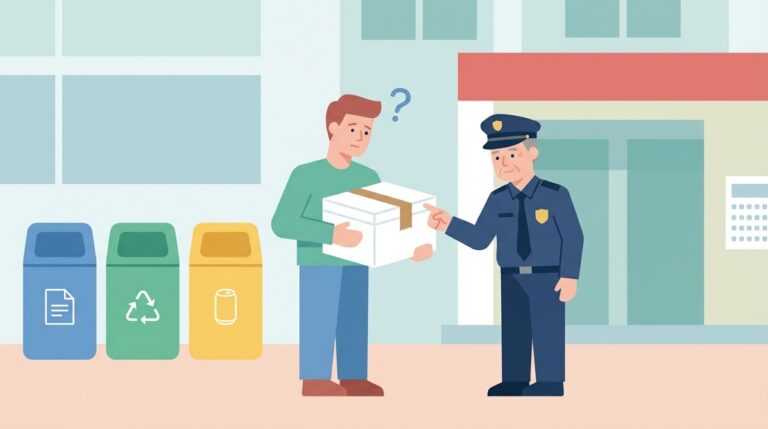
You enjoy your feast. But now… you have to throw the box away. You confidently carry it down to the recycling area (분리수거장). Suddenly, the building security guard (Ajeossi) rushes toward you, waving his hands and pointing at your box. Your mind goes blank. What did he just say? Are you in trouble?
Don’t worry! Korean recycling (분리수거) is famous worldwide for being incredibly strict. If you don’t know the rules, you might get a few scoldings. But once you know these simple A2-level survival phrases, you’ll be greeted with warm smiles and instantly treated like a true ‘Insider’ (인싸). Let’s dive into the art of throwing away Styrofoam!
Phase 2: Core Expressions Deep Dive
Here are the top three phrases you need to survive the recycling area.
1. 테이프 떼세요 (Remove the tape)
- Pronunciation: teipeu tteseyo [Sound-alike: “tay-peu ttay-say-yo” – ‘tte’ sounds like the sharp, tense ‘t’ in the word ‘step’.]
- Meaning: (Literal) Please detach the tape. / (Real nuance) “You can’t throw that away until you take ALL the shipping tape and stickers off!”
- K-Culture Moment: This is the #1 rule of Korean delivery culture. When you get a package from your favorite K-Pop merch store, you can’t just toss the box. Every piece of tape and the shipping label must be peeled off before recycling.
- Editor’s Insight: This is usually spoken as a gentle command. If you hear this, don’t panic! Just smile, say “Ah, ne!” (Ah, yes!), and start peeling.
- Situation Spectrum:
[🚫 절대 금지] ———— [⚠️ 주의] ———— [✅ 자유롭게]
- Friends (Casual): ✅ (테이프 떼! – teipeu tte!)
- Security Guard to you: ✅
- You to a boss: 🚫 (Too commanding)
- 🤔 Think About It: Why is Korea so strict about separating tape from Styrofoam? How does your home country handle packaging materials?
2. 이건 일반 쓰레기예요 (This is general waste)
- Pronunciation: igeon ilban sseuregiyeyo [Sound-alike: “ee-geon ill-ban ss-ray-gee-yay-yo”]
- Meaning: (Literal) This is general garbage. / (Real nuance) “This is too dirty to recycle. Put it in the paid trash bag!”
- K-Culture Moment: You ordered extra spicy Tteokbokki (떡볶이), and the red sauce stained the Styrofoam container. In Korea, stained Styrofoam cannot be recycled. It must go into the general waste bag (종량제 봉투).
- Editor’s Insight: ‘일반’ means general/normal, and ‘쓰레기’ means trash. If an item is rejected from the recycling bin, this is the bin it goes to!
- Situation Spectrum:
[🚫 절대 금지] ———— [⚠️ 주의] ———— [✅ 자유롭게]
- Strangers/Neighbors: ✅
- Building Guard: ✅
- 🤔 Think About It: In Korea, you must buy specific government-issued bags for “general waste.” How might this system change people’s habits when ordering food?
3. 저기에 버리세요 (Throw it away over there)
- Pronunciation: jeogie beoriseyo [Sound-alike: “jeo-gee-ay buh-ree-say-yo”]
- Meaning: (Literal) Please throw it there. / (Real nuance) “You’re at the wrong bin, go put it in that specific pile over there.”
- K-Culture Moment: Recycling areas have different sections for plastic, paper, glass, and Styrofoam. If you look lost, a kind neighbor will point and say this phrase to help you out.
- Editor’s Insight: ‘버리다’ means to throw away. Keep an ear out for this verb whenever you have trash in your hands!
- Situation Spectrum:
[🚫 절대 금지] ———— [⚠️ 주의] ———— [✅ 자유롭게]
- Polite instruction: ✅
Phase 3: Textbook vs Real Korean
Let’s see how the textbook differs from the real-life recycling center.
| Situation | 📖 Textbook Korean | 🗣️ Real Korean | 💡 Why is it different? |
|---|---|---|---|
| Guard asking you to remove tape | 스티로폼의 테이프를 제거해 주십시오. (Please remove the tape from the Styrofoam.) | 학생, 여기 테이프! (Student, the tape here!) | Real spoken Korean relies heavily on context. They skip verbs and just point at the problem! |
| Asking where to put it | 스티로폼은 어디에 버려야 합니까? (Where must I throw away the Styrofoam?) | 아저씨, 스티로폼 어디에요? (Ajeossi, where is Styrofoam?) | Using nouns + ‘어디에요?’ is the quickest, most natural survival method. |
| Realizing it’s dirty | 이것은 재활용이 불가능합니다. (This cannot be recycled.) | 이거 빨간 국물… 일반 쓰레기예요. (This red soup… it’s general waste.) | Koreans often mention the specific reason (like food stains) as a polite excuse before correcting you. |
Bottom Note: For A2 learners, simply asking “[Noun] 어디에요?” (Where is [Noun]?) is your ultimate cheat code. It’s polite enough and perfectly natural!
Phase 4: Cultural Context — K-Culture Deep Dive
4-1. The Non-Verbal ‘Nunchi’ (눈치) at the Recycling Bin
When you go to the recycling area, don’t just toss your item and run. Take a 3-second pause to read the room (use your Nunchi). Look at how the neighbors have stacked their Styrofoam boxes. Are they nested inside each other? Try to mimic them! Also, always give a slight bow (about 30 degrees) and say “안녕하세요” (Hello) to the security guard. Being polite will make them much more forgiving of your recycling mistakes.
4-2. The “Ajeossi” (아저씨) Character in Daily Life
In K-Dramas, you often see a gruff but warm-hearted older man managing the apartment building. This is the 경비 아저씨 (Security Guard Ajeossi). They are the absolute kings of the recycling area! While they might sound loud or strict at first, it’s usually just because they are passionate about keeping the building clean. If you smile, apologize when you make a mistake, and try your best, they will quickly become your best Korean friends, often bringing you extra boxes when you need them or saving you from trouble.
Phase 5: Real-Life Roleplay Scenario
Setting: Tuesday night, 8:00 PM. The designated recycling time at your Seoul officetel. You are carrying a huge, white Styrofoam box from your K-beauty haul.
Characters:
– YOU: A foreigner living in Korea for 3 months. You really want to do things right.
– Ajeossi (60s): The building security guard. Wearing a neat blue uniform. He spots you from across the yard.
Dialogue:
Ajeossi: 학생! 거기 스티로폼에 테이프! ✋
(Haksaeng! Geogi seutiropome teipeu!)
[Student! The tape on the Styrofoam there!]
(🎭 Stage Direction: Ajeossi points firmly at the clear shipping tape you forgot to remove)
YOU: 헉, 죄송합니다. 제가 뗄게요.
(Heok, joesonghamnida. Jega ttelgeyo.)
[Gasp, I’m sorry. I’ll take it off.]
Ajeossi: 응, 그거 다 떼고 저기 하얀 봉투에 넣어.
(Eung, geugeo da ttego jeogi hayan bongtue neoeo.)
[Yeah, take it all off and put it in that white bag over there.]
YOU: (Struggling to peel the tape) 아저씨, 이거 잘 안 떼져요…
(Ajeossi, igeo jal an ttejyeoyo…)
[Ajeossi, this isn’t peeling off well…]
Ajeossi: 아이구, 줘 봐. 내가 할게.
(Aigu, jwo bwa. Naega halge.)
[Oh my, give it here. I’ll do it.]
🔀 Your Turn! How should you respond while he helps you?
– A) “빨리 해주세요.” (Please do it quickly.)
– B) “우와, 아저씨 최고! 감사합니다!” (Wow, Ajeossi is the best! Thank you!)
– C) “얼마예요?” (How much is it?)✅ Best Choice: B — You will instantly win his heart. A little bit of bright energy and gratitude goes a long way in Korea.
⚠️ Choice A Analysis: This is incredibly rude to an elder. Never rush someone helping you!
Phase 6: 10-Second Shadowing Drill
Let’s practice exactly how to ask for help without sounding awkward. Follow the slashes for pausing, and match the emotion!
🥺 Slightly confused & polite:
아저씨, / 스티로폼은 / 어디에 / 버려요?
(ajeossi, / seutiropomeun / eodie / beoryeoyo?)
(Sir, / where / do I throw away / the Styrofoam?)
😊 Bright & thankful:
아! / 테이프 떼고 / 여기에 버릴게요. / 감사합니다!
(a! / teipeu ttego / yeogie beorilgeyo. / gamsahamnida!)
(Ah! / I’ll remove the tape / and throw it here. / Thank you!)
Phase 7: K-Culture Mini Dictionary
| Korean | Romanization | English | Context |
|---|---|---|---|
| 분리수거 | bunrisugeo | Recycling | The holy grail of Korean chores. Literally means “separate collection.” |
| 종량제 봉투 | jongnyangje bongtu | Volume-based garbage bag | The official colored bags you MUST buy at convenience stores for general trash. |
| 경비 아저씨 | gyeongbi ajeossi | Security Guard | The building manager. A key figure in Korean community living. |
| 택배 | taekbae | Parcel delivery | Korea’s insanely fast delivery service system. The main source of Styrofoam! |
Phase 8: Traveler Survival Kit
Even if you’re just visiting Korea for a week staying in an Airbnb, you will likely order K-Food delivery (Fried chicken, Bingsu, etc.). Here is your survival kit for handling delivery containers!
🆘 Survival Phrases for Airbnb Guests
– 🇰🇷 “이거 재활용 맞아요?” (igeo jaehwaryong majayo?)
– 🗣️ Sound: “ee-geo jae-hwa-ryong ma-ja-yo?”
– 📍 When to use: When you are holding a plastic/Styrofoam container and asking your host or a neighbor if it’s recyclable.
– 💡 Pro Tip: If a Styrofoam cup (like instant ramen) is stained with red soup, it is NO LONGER recyclable. Toss it in the general trash bag!📌 Editor’s Travel Note
– Where to throw trash in public? You won’t find many trash cans on Korean streets! Most locals carry their trash to the nearest subway station or back to their hotel.
– Convenience Stores: If you eat ramen at a CU or GS25, they have their own mini-recycling stations inside. Follow the pictures!
Phase 9: Critical Thinking Corner — “A Step Deeper”
Society vs Individual Convenience (The Global Era of Korean Recycling)
Why does Korea have one of the strictest recycling systems in the world? It comes down to geography and community mindset. South Korea is a relatively small peninsula with mountains covering 70% of the land, meaning there is very little space for landfills. Therefore, the burden of waste management is placed heavily on individual citizens rather than the government. The strict rules (like peeling tape off Styrofoam) show a cultural emphasis on “collective responsibility”—an idea deeply rooted in Korean society.
💬 Your Turn: Does your country prioritize individual convenience or collective rules when it comes to waste? Share your thoughts in the comments!
Phase 10: FAQ & Avoiding Misunderstandings
Q: Do I really have to wash the Styrofoam before recycling it?
Yes! If you ordered K-Food and the Styrofoam is covered in grease or red pepper paste (Gochujang), you must rinse it with water. If the stain doesn’t come out, it is general waste (일반 쓰레기).
Q: Can I use ‘Ajeossi’ for any man I see?
Be careful! ‘Ajeossi’ is great for older men doing service jobs (like guards or taxi drivers), but do not call a young man in his 20s or 30s Ajeossi. He might get offended!
❌ Common Mistake #1: Throwing away fruit nets with Styrofoam.
✅ Do this instead: The soft, stretchy nets covering fancy Korean apples or pears are usually NOT Styrofoam recycling. They go in general waste!
Phase 11: Summary & Action Items
One-Liner Summary: When recycling Styrofoam in Korea, always remove the tape (테이프 떼세요) and remember that dirty boxes are general waste (일반 쓰레기).
Action Mission 3 Steps:
– 🥉 Bronze: Look at a box in your house and say “테이프 떼세요” out loud 3 times.
– 🥈 Silver: Leave a comment below with a K-Food you’d love to order that might come in a Styrofoam box!
– 🥇 Gold: Next time you are in Korea, successfully peel the tape off your Coupang box and greet the security guard with a smile.
🎬 K-Culture Mission:
Watch an episode of the K-Drama Hospital Playlist or Reply 1988. Try to spot the characters eating delivery food—notice what kind of containers they use and how they clean up afterward!
Phase 12: Quiz — Interactive Challenge
1. You are at the recycling area. The guard says: “이거 일반 쓰레기예요!” What should you do?
A) Put it in the Styrofoam bin anyway.
B) Say “Thank you” and put it in the plastic bin.
C) Put it in the paid, government-issued trash bag.
2. True or False: If a Styrofoam ramen cup is stained bright orange from the soup, it goes into the recycling bin.
A) True
B) False
3. Fill in the blank: “아저씨, 스티로폼은 ______ 버려요?” (Sir, where do I throw away the Styrofoam?)
A) 언제 (when)
B) 어디에 (where)
C) 왜 (why)
(Answers: 1: C, 2: False – stained items are general waste, 3: B)
Frequently Asked Questions (FAQ)
Q: What does "테이프 떼세요 (Remove the tape)" mean in Korean and how do you pronounce it?
A: In Korean, "테이프 떼세요 (Remove the tape)" is pronounced [teipeu tteseyo [Sound-alike: "tay-peu ttay-say-yo" – 'tte' sounds like the sharp, tense 't' in the word 'step'.] and means: (Literal) Please detach the tape. / (Real nuance) "You can't throw that away until you take ALL the shipping tape and stickers off!"
Q: What does "이건 일반 쓰레기예요 (This is general waste)" mean in Korean and how do you pronounce it?
A: In Korean, "이건 일반 쓰레기예요 (This is general waste)" is pronounced [igeon ilban sseuregiyeyo [Sound-alike: "ee-geon ill-ban ss-ray-gee-yay-yo"] and means: (Literal) This is general garbage. / (Real nuance) "This is too dirty to recycle. Put it in the paid trash bag!"
Q: What does "저기에 버리세요 (Throw it away over there)" mean in Korean and how do you pronounce it?
A: In Korean, "저기에 버리세요 (Throw it away over there)" is pronounced [jeogie beoriseyo [Sound-alike: "jeo-gee-ay buh-ree-say-yo"] and means: (Literal) Please throw it there. / (Real nuance) "You're at the wrong bin, go put it in that specific pile over there."







