

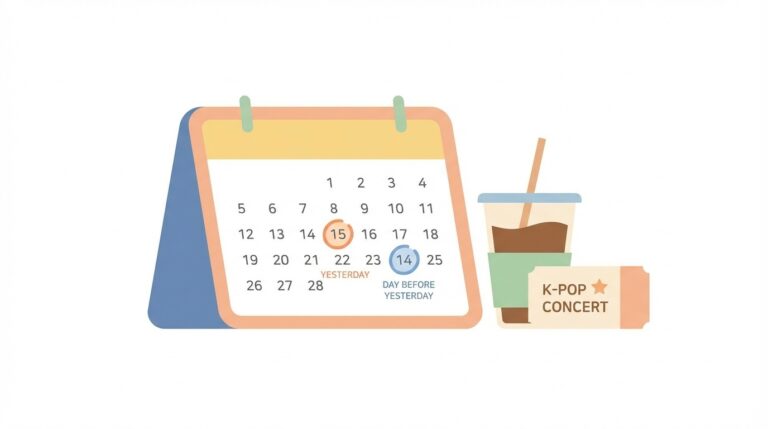
Phase 1: Empathy & The K-Culture Connection
Hello there! It’s your Daily Hangul Editor.
Picture this K-Drama scene: The female lead is standing in the rain, looking at the male lead with tears in her eyes. She asks, “Where were you… yesterday?” Or maybe you’re watching a thriller, and the intense detective slams his hands on the table: “What did you do the day before yesterday?!”
If you’re learning Korean, you’ve probably realized that building relationships here—whether it’s bonding with a Korean language exchange partner, chatting with a barista in Hongdae, or replying to a fellow K-Pop fan online—often starts with sharing what you did.
But to talk about the past, you need the time markers. Today, we are tackling two absolute essentials for A1 beginners: Yesterday and The day before yesterday.
I know, I know. Korean vowels can sound like a soup of “uh” and “oh” sounds to an English speaker. Don’t worry! I’ve seen hundreds of beginners struggle with this exact module, and I’m going to share the “tutor secrets” to help you master them instantly.
Phase 2: Core Expressions Deep Dive
Let’s break down the two magic words that will unlock your ability to tell stories in Korean.
1. 어제 (Yesterday)
- Pronunciation: eo-je [uh-jeh]
- Tutor Tip: The first syllable ‘어’ sounds like the “uh” in “uh-oh.”
- Meaning: Yesterday
- K-Culture Moment: You’re at a K-BBQ restaurant with coworkers. Someone asks why you look so tired. You sigh and say, “어제 회식…” (Yesterday, company dinner…). Everyone instantly nods in deep sympathy.
- Editor’s Insight: This word is the ultimate ice-breaker. In Korea, asking “What did you do yesterday?” is a standard way to show you care about someone’s daily life.
- Situation Spectrum:
[🚫 Never] ———— [⚠️ Be Careful] ———— [✅ Freely]
- Casual with friends: ✅
- Formal/Workplace: ✅ (Just make sure your verb at the end of the sentence is polite! The word ‘어제’ itself doesn’t change.)
- 🤔 Think About It: In many cultures, “small talk” is about the weather. In Korea, it’s often about what you ate yesterday or what you will eat today. Why do you think food and past meals are such a big deal in Korean relationship-building?
2. 그저께 / 그제 (The day before yesterday)
- Pronunciation: geu-jeok-ke / geu-je [geu-juh-kkay / geu-jeh]
- Tutor Tip: ‘그’ sounds like the disgusted sound you make when stepping in gum (ew!).
- Meaning: The day before yesterday
- K-Culture Moment: You’re talking to a fellow fan at a BTS cup-sleeve event in a cafe. They ask when you arrived in Seoul. You proudly say, “그저께 왔어요!” (I came the day before yesterday!).
- Editor’s Insight: English takes five words to say “the day before yesterday.” Korean has one word: 그저께. And because Koreans love efficiency (the famous Ppalli-Ppalli / hurry-hurry culture), we even shorten it to just two syllables: 그제 (geu-je).
- Situation Spectrum:
[🚫 Never] ———— [⚠️ Be Careful] ———— [✅ Freely]
- Casual with friends: ✅ (Usually use 그제)
- Formal/Workplace: ✅ (Usually use 그저께)
- 🤔 Think About It: Korean has specific, single words for “two days ago” and even “three days ago.” What does this tell you about how Koreans value time and detailed storytelling?
Phase 3: Textbook vs. Real Korean
Let’s see how these words actually look in the wild.
| Situation | 📖 Textbook Korean | 🗣️ Real Life Korean | 💡 Why is it different? |
|---|---|---|---|
| Two days ago | 그저께 (geu-jeok-ke) | 그제 (geu-je) | Efficiency! Koreans love shortening words to speak faster in casual settings. |
| Yesterday night | 어제 밤에 (eo-je bam-e) | 어젯밤에 (eo-jet-bam-e) | When two nouns combine, a ‘ㅅ’ (s) is often added to link them smoothly. |
| Saying “I was sick” | 저는 어제 아팠습니다. | 나 어제 아팠어 ㅠㅠ | Textbooks teach rigid formal endings. Real life uses emotion, dropped pronouns, and emojis! |
Bottom Note for A1: Don’t stress about the ‘ㅅ’ in 어젯밤 right now. Just remember that if you hear “eojet-bam,” they are just saying “yesterday night!”
Phase 4: Cultural Context — K-Culture Deep Dive
4-1. Non-Verbal Nuance: The “Nunchi” of Time
When Koreans talk about the past, especially to elders or bosses, body language matters. If you say “I did it yesterday,” you might lightly nod your head. It shows respect, not just in your words, but in your posture.
4-2. The K-Travel Connection: Surviving the Timeline
If you travel to Korea, “yesterday” and “the day before yesterday” become vital survival tools.
– At the hotel: “My room wasn’t cleaned yesterday.”
– At the department store: “I bought this the day before yesterday, can I exchange it?”
– In a taxi: “I arrived in Korea yesterday.”
In tourist areas like Myeongdong, shop owners love asking when you arrived. If you answer “어제 왔어요!” (I came yesterday!), they will immediately treat you with the warm, welcoming vibe reserved for fresh arrivals. They might even throw in some “Service” (free stuff)!
Phase 5: Real-Life Roleplay Scenario
Setting: A cozy, neon-lit cafe in Yeonnam-dong on a Saturday afternoon. You are having an iced Americano with your Korean language exchange partner, Min-ji (25, cheerful and loves taking food photos).
YOU: (Taking a sip of coffee) Wow, this is good.
Min-ji: 맞아요! 여기 커피 진짜 맛있어요. ☕
(ma-ja-yo! yeo-gi keo-pi jin-jja ma-si-sseo-yo.)
[Right! The coffee here is really delicious.]
YOU: Did you come here yesterday?
Min-ji: 아니요, 어제는 집에서 쉬었어요. 그저께 친구랑 왔어요.
(a-ni-yo, eo-je-neun ji-be-seo swi-eo-sseo-yo. geu-jeok-ke chin-gu-rang wa-sseo-yo.)
[No, I rested at home yesterday. I came with a friend the day before yesterday.]
(🎭 Stage Direction: Min-ji leans in curiously)
Min-ji: [Your Name] 씨는 어제 뭐 했어요?
([Your Name] ssi-neun eo-je mwo hae-sseo-yo?)
[What did you do yesterday, [Your Name]?]
🔀 Your Turn! How do you answer?
– A) 어제… 잤어요. (Yesterday… I slept.)
– B) 어제 K-Pop 콘서트 갔어요! (Yesterday, I went to a K-Pop concert!)
– C) 언제요? (When?)✅ Best Choice: B — Korean conversations thrive on shared energy! Telling them an exciting detail opens up a huge conversation.
⚠️ Choice C Analysis: This is a classic beginner mistake! You misheard “eo-je” (yesterday) as “eon-je” (when). Be careful, they sound very similar!
🎁 Bonus K-Drama Scenario
You are at the lost and found at Incheon Airport.
Staff: 언제 잃어버리셨어요? (When did you lose it?)
YOU: 음… 그저께요. (Um… the day before yesterday.)
Staff: 아, 그저께요. 확인해 보겠습니다. (Ah, the day before yesterday. I will check.)
Phase 6: 10-Second Shadowing Drill
Practice reading these out loud. Pay attention to the slashes for pausing and the emotions!
- 😊 밝게 (Brightly): 저는 / 어제 / 한국에 왔어요!
(jeo-neun / eo-je / han-gu-ge wa-sseo-yo!)
[I arrived in Korea yesterday!] -
😢 아쉽게 (Sadly): 그저께는 / 날씨가 / 진짜 좋았어요…
(geu-jeok-ke-neun / nal-ssi-ga / jin-jja jo-a-sseo-yo…)
[The weather was really nice the day before yesterday…] -
😤 단호하게 (Firmly): 저 / 어제 / 그거 / 샀어요!
(jeo / eo-je / geu-geo / sa-sseo-yo!)
[I bought that yesterday!]
Phase 7: K-Culture Mini Dictionary
| Korean | Romanization | English | Contextual Meaning |
|---|---|---|---|
| 어제 | eo-je | Yesterday | The most common past time marker. |
| 그저께 | geu-jeok-ke | The day before yesterday | Used to pinpoint exactly two days ago. |
| 엊그제 | eot-geu-je | A couple of days ago | A figurative term. Koreans use this to say “It feels like just a couple of days ago” when reminiscing. |
| 회식 | hoe-sik | Company dinner | The reason why Korean office workers are always tired “today” because of “yesterday.” |
Phase 8: Traveler Survival Kit
If you are traveling in Seoul, you will need to use “yesterday” when dealing with shopping or hotels.
🆘 Survival Expression #1: Exchanges/Returns
– 🇰🇷 “저 어제 이거 샀는데요…” (jeo eo-je i-geo san-neun-de-yo…)
– 🗣️ Meaning: “I bought this yesterday, and…” (trailing off politely)
– 📍 Where to use: Olive Young, clothing stores, convenience stores.
– 💡 Pro Tip: Leave the sentence unfinished! The “…neun-de-yo” ending implies “I bought this yesterday, so can you help me?” It’s much softer than demanding a refund.📌 Editor’s Travel Note
– Receipts (영수증 – yeong-su-jeung): If you try to return something you bought yesterday, they will always ask for the receipt. In Korea, paying by credit card is king. If you lose the paper receipt but used a card, they can look up your purchase using the exact time and your physical card from yesterday!
Phase 9: Critical Thinking — “One Step Deeper”
Language & Efficiency: The “Ppalli-Ppalli” Timeline
Korean culture is famous for its Ppalli-Ppalli (hurry up) mindset. This doesn’t just apply to internet speeds or food delivery; it reflects in the language. English relies on phrases like “the day before yesterday” or “three days ago.” Korean compresses these concepts into single, highly efficient words like 그저께 (two days ago) and 글피 (three days from now). Because trends, news, and plans move so quickly in Korea, being able to precisely and rapidly categorize the past and future is built right into the vocabulary.
💬 Your Turn: In your native language, do you have a single word for “the day before yesterday”? Or do you have to use a whole phrase? Share it in the comments below!
Phase 10: FAQ & Avoiding Common Mistakes
Q: Can I use ‘어제’ (eo-je) with a boss or an older person?
A: YES! The word ‘어제’ does not have a separate polite version (unlike “age” or “birthday”). Just ensure your sentence ends with a polite verb ending, like “~어/아요” or “~습니다.”
Q: I heard someone say ‘어제 밤’ and someone else say ‘어젯밤’. Which is right?
A: ‘어젯밤’ is grammatically correct when written, but in spoken Korean, A1 beginners will be perfectly understood if they just say “어제 밤.” Don’t stress the grammar rule yet!
❌ Common Mistake #1: Confusing 어제 (eo-je) with 언제 (eon-je).
✅ How to fix it: Remember that 어 (uh) is for the past (yesterday), and 언 (un) is for the question (when). If a Korean friend asks “언제 샀어요?” (When did you buy it?), don’t reply “Yes!” Reply with “어제요!” (Yesterday!).
Phase 11: Summary & Action Items
✨ One-Liner Summary: Remember eo-je for yesterday, and geu-jeok-ke for the day before yesterday to unlock your Korean storytelling skills!
🎬 Action Mission:
– 🥉 Bronze (Solo): Look at your calendar, point to yesterday, and say “어제” out loud 3 times.
– 🥈 Silver (Online): Post a comment below or on your social media saying “저는 어제 [_____] 먹었어요!” (I ate [_____] yesterday!).
– 🥇 Gold (Real Life): Next time you visit a Korean cafe or restaurant, if the staff asks if it’s your first time, confidently say, “아니요, 어제 왔어요!” (No, I came yesterday!).
🌟 K-Culture Mission:
Turn on a K-Drama today. I guarantee you will hear the word “어제 (eo-je)” within the first 20 minutes, usually when characters are gossiping or interrogating each other. When you hear it, point at the screen!
Phase 12: Interactive Quiz Challenge
Let’s test what you learned!
1. Situation Judgment: Your Korean friend texts you: “우리 언제 만날까요?” (When should we meet?). What is the WORST possible reply?
A) 내일요! (Tomorrow!)
B) 오늘 밤에요! (Tonight!)
C) 어제요! (Yesterday!)
2. True or False – K-Culture Edition:
If you bought a K-Pop album at a store yesterday but lost the physical receipt, it is impossible to exchange it in Korea today, even if you paid with a credit card.
(T/F)
(Scroll down for answers!)
Answers:
1. C is the worst! You can’t plan to meet yesterday. You confused 언제 (when) with 어제 (yesterday)!
2. False! Korea has a highly advanced digital payment system. If you used a card “eo-je”, they can easily find your transaction without the paper receipt.
Frequently Asked Questions (FAQ)
Q: What does "어제 (Yesterday)" mean in Korean and how do you pronounce it?
A: In Korean, "어제 (Yesterday)" is pronounced [eo-je [uh-jeh] and means: Yesterday
Q: What does "그저께 / 그제 (The day before yesterday)" mean in Korean and how do you pronounce it?
A: In Korean, "그저께 / 그제 (The day before yesterday)" is pronounced [geu-jeok-ke / geu-je [geu-juh-kkay / geu-jeh] and means: The day before yesterday







