

Conquer Korean Markets: Master the Onnuri Voucher Like a Local
Phase 1: 공감 (The Market Hesitation)
Hello! I’m your Daily Hangul Editor.
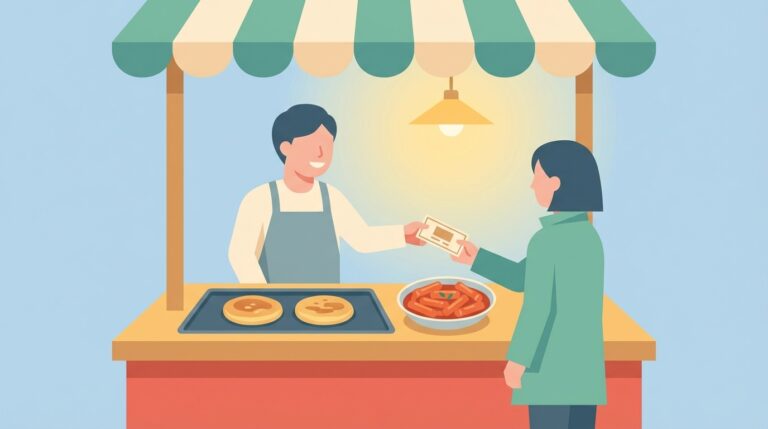
Imagine this: You’re standing in the middle of a bustling Korean traditional market, perhaps Gwangjang Market or Mangwon Market. The sizzle of bindaetteok (mung bean pancakes) is in the air, echoing scenes straight out of warm-hearted K-Dramas like Reply 1988. You’ve got a crisp paper voucher in your hand—an Onnuri Gift Certificate (온누리 상품권)—maybe given to you as a holiday bonus from your Korean company or bought at a bank for a discount.
You want to use it, but suddenly you freeze.
“Can I just hand this to them? Will they give me change? How do I even ask?”
If you’ve felt this hesitation, you’re not alone. The Onnuri voucher is a powerful key to experiencing the authentic insim (인심, generous heart) of Korean markets, but navigating its rules requires a bit of insider knowledge. If you only know textbook Korean, you might sound like a robot in a place where warmth and speed are everything. Today, let’s master the exact phrases you need to use Onnuri certificates confidently, like a true Seoul local!
Phase 2: 핵심 표현 심층 분석 (Core Expressions)
1. 이거 온누리로 결제되나요?
- Pronunciation: Igeo onnuri-ro gyeolje-doenayo? [ee-geo ohn-noo-ree-ro gyuhl-jeh-dweh-na-yo]
- Meaning: Can I pay with Onnuri? (Literal: Does this become paid by Onnuri?)
- K-Culture Moment: You’ll hear this exact phrasing in any busy shop. Koreans prefer the passive/intransitive ‘-되다’ (to become) over ‘-할 수 있다’ (can do) because it removes the direct pressure from the listener. It asks about the system’s capability, not the person’s willingness.
- Editor’s Insight: Drop the formal “상품권” (gift certificate) part. Locals just call it “온누리”. Also, using ‘-되나요?’ or ‘-되죠?’ sounds much more natural and experienced than textbook equivalents!
- Situation Spectrum:
[🚫 절대 금지] ———— [⚠️ 주의] ———— [✅ 자유롭게]
- Casual (Friends): 🚫 (You wouldn’t ask a friend this)
- Formal (Boss): 🚫
- Market Vendors/Staff: ✅
- 🤔 Think About It: Why does Korean use so many passive expressions when making requests? How does it relate to the concept of Nunchi (눈치) and avoiding direct confrontation?
2. 잔돈은 현금으로 주시나요?
- Pronunciation: Jandon-eun hyeongeum-euro jusinayo? [jahn-don-eun hyun-geum-eu-ro joo-she-na-yo?]
- Meaning: Do you give the change in cash?
- K-Culture Moment: The golden rule of Onnuri certificates is the “60% Rule.” You must spend at least 60% of the voucher’s face value to receive the remaining change in cash. This phrase is crucial to clarify before you hand over a 10,000 won voucher for a 2,000 won skewer!
- Editor’s Insight: ‘잔돈’ (Jandon) specifically means ‘change’ (small money returned to you). Use this instead of ‘거스름돈’ which sounds too formal and textbook-heavy.
- Situation Spectrum:
[🚫 절대 금지] ———— [⚠️ 주의] ———— [✅ 자유롭게]
- Market Vendors: ✅
- 🤔 Think About It: Why do you think the government enforces the 60% rule? (Hint: It prevents people from just cashing out the vouchers without actually supporting the market’s economy!)
3. 현금 영수증 해주세요.
- Pronunciation: Hyeongeum yeongsujeung haejuseyo. [hyun-geum young-soo-jeung heh-joo-seh-yo]
- Meaning: Please issue a cash receipt.
- K-Culture Moment: At the end of every K-Drama office worker’s year is the dreaded “Year-end Tax Settlement” (연말정산). Since Onnuri certificates are treated like cash, expat workers in Korea can claim a high tax deduction rate for using them!
- Editor’s Insight: Say this as you are handing over the voucher, not after the transaction is completely finished, as the vendor needs to input your phone number into the card terminal before finalizing.
- Situation Spectrum:
[🚫 절대 금지] ———— [⚠️ 주의] ———— [✅ 자유롭게]
- All Vendors: ✅ (Note: Very small street stalls without a card reader might not be able to do this, so assess the stall size first).
Phase 3: 교과서 vs 진짜 한국어
| 상황 | 📖 교과서 한국어 | 🗣️ 진짜 한국어 | 💡 왜 다를까? |
|---|---|---|---|
| Asking if accepted | “온누리 상품권을 사용할 수 있습니까?” | “사장님, 온누리 되죠?” | Dropping words and using ‘-되죠?’ assumes a positive, friendly vibe. |
| Asking for change | “거스름돈을 현금으로 주십시오.” | “잔돈은 현금이죠?” | ‘잔돈’ is preferred over ‘거스름돈’ in daily spoken Korean. |
| Tax receipt | “현금 영수증을 발급해 주시겠습니까?” | “현금 영수증 해주세요.” | Markets are fast-paced; brevity is politeness. |
Phase 4: 문화적 맥락 — K-Culture 딥다이브
4-1. Non-Verbal Nunchi (눈치)
In traditional markets, things move fast. The best way to show respect isn’t just through formal words, but through your actions. Hand the voucher with both hands (or one hand supporting your other elbow). Also, be mindful of the vendor’s nunchi—if there’s a massive line behind you for popular hotteok, have your voucher ready before it’s your turn.
4-2. Food, Jeong, and Deom (K-Food Connection)
Traditional markets are the heart of K-Food. When you use your Onnuri voucher smoothly and chat with the Ahjumma (auntie/vendor), you tap into the culture of Jeong (정, emotional connection). Often, this leads to Deom (덤)—an extra piece of fried squid or an extra scoop of tteokbokki just because they like your vibe!
Phase 5: 실전 롤플레이 시나리오
Setting: Friday 6:30 PM, Mangwon Market. The narrow alleys are packed with people. You are standing in front of a famous Dakgangjeong (sweet crispy fried chicken) stall. The smell is irresistible.
Characters:
– YOU: An expat living in Korea, trying to use an Onnuri voucher you received from your company.
– 사장님 (Owner – Ahjumma): 50s, friendly but moving at lightning speed.
사장님: 어서 오세요! 닭강정 드시게? (Eoseo oseyo! Dakgangjeong deusige?)
[Welcome! Getting some Dakgangjeong?]
YOU: 네! 중간 사이즈 하나 주세요. (Ne! Junggan saijeu hana juseyo.)
[Yes! One medium size, please.]
사장님: 네~ 8,000원입니다! (Ne~ pal-cheon-won-imnida!)
[Okay~ That’s 8,000 won!]
(🎭 Stage Direction: You pull out a 10,000 won Onnuri voucher, slightly nervous.)
YOU: 사장님, 이거 온누리 되죠? (Sajangnim, igeo onnuri doejyo?)
[Ma’am, you take Onnuri, right?]
사장님: 아유, 당근이지! 온누리 좋아~ (Ayu, danggeun-iji! Onnuri joa~)
[Oh, of course! I like Onnuri~]
YOU: 여기요. 현금 영수증도 해주세요! (Yeogiyo. Hyeongeum yeongsujeung-do haejuseyo!)
[Here you go. Please issue a cash receipt too!]
사장님: (단말기를 누르며) 번호 찍어줘요~ (Beonho jjigeojwoyo~)
[(Pressing the terminal) Please type in your number~]
YOU: (번호를 입력하며) 네, 다 했어요. 잔돈은 2,000원 맞죠? (Ne, da haesseoyo. Jandon-eun i-cheon-won majjyo?)
[Yes, all done. The change is 2,000 won, right?]
🔀 Decision Point! Your 10,000 won voucher covers the 8,000 won chicken. The change is 2,000 won. But what if you ordered a 5,000 won small size instead?
– A) “잔돈 5,000원 주세요!” (Give me 5,000 won change!)
– B) “아, 60%가 안 넘네요. 그냥 꽈배기 하나 더 주셔서 6,000원 맞춰주세요!” (Ah, it’s under 60%. Just give me a twisted donut too to make it 6,000 won!)
– C) “그럼 카드로 할게요.” (Then I’ll just pay by card.)✅ Best Choice: B. Since you must spend 60% of the voucher (6,000 won out of 10,000 won) to get cash change, buying an extra snack to hit the limit is a total pro move. It supports the vendor and gets you more delicious food! C is okay, but A will get you rejected due to the government rules.
Phase 6: 10초 섀도잉 드릴
😊 사장님~ / 이거 / 온누리 되죠? (sajangnim~ / igeo / onnuri doejyo?)
🥺 아, / 잔돈은 / 현금으로 주시나요? (a, / jandon-eun / hyeongeum-euro jusinayo?)
😤 현금 영수증 / 꼭 / 해주세요! (hyeongeum yeongsujeung / kkok / haejuseyo!)
Phase 7: K-Culture 미니 사전
| 한국어 | Romanization | English | 맥락 설명 |
|---|---|---|---|
| 온누리 상품권 | onnuri sangpumgwon | Onnuri Voucher | Government-backed voucher to stimulate local traditional market economies. |
| 인심 | insim | Generosity / Heart | The collective warm-heartedness, especially prominent in Korean markets. |
| 덤 | deom | Extra / Bonus | A little extra given for free by market vendors as a sign of affection. |
| 상생 | sangsaeng | Co-existence | The economic philosophy behind Onnuri: big corporations and small merchants living together. |
| 단골 | dangol | Regular customer | Become a dangol, and the deom increases exponentially! |
Phase 8: 여행자 서바이벌 키트
🆘 Market Survival Expressions TOP 3
1. 🇰🇷 “이거 온누리 돼요?” (igeo onnuri dwaeyo?) – Can I use Onnuri?
2. 🇰🇷 “조금만 깎아주세요~” (jogeum-man kkakka-juseyo~) – Please give me a small discount~ (Use with a smile!)
3. 🇰🇷 “먹고 갈게요.” (meokgo galgeyo) – I will eat here. (vs. 포장해주세요 – Please pack it to go).📌 Editor’s Travel Note
– App Tip: Use the “Z-Map” (지맵) app to find exactly which stores accept Onnuri. Not all stalls do!
– Look for the Sticker: Look for the ‘온누리상품권 가맹점’ sticker at the stall front.
– Mobile vs. Paper: Nowadays, you can buy “Mobile Onnuri” at a 10% discount through Korean banking apps. If you live in Korea, it’s a massive money-saver!
Phase 9: 비판적 사고 코너 — “한 발 더 깊이”
🧠 Think Deeper: Economics & Community (상생)
Why does Korea go through the trouble of creating a separate currency just for traditional markets? In the global era of hyper-convenience and mega-supermarkets (like E-mart or Homeplus run by Chaebols), traditional markets face an existential threat. The Onnuri system isn’t just a discount coupon; it’s a reflection of the Korean societal value of Sangsaeng (상생) – co-existence. It’s an active effort by the government and society to protect local merchants and preserve the historic identity of Korean communities against aggressive modernization.💬 Your Turn: Does your home country have specific systems or vouchers to protect local traditional markets from giant corporations? Let us know in the comments!
Phase 10: FAQ & 오해 방지
- Q: Can I use Onnuri certificates at convenience stores like CU or GS25?
A: Generally, NO. They are strictly for registered traditional markets and specific underground shopping centers to protect small businesses. - Q: Do I have to speak formally to the market vendors?
A: Yes! Use ‘-요’ endings. Even though they might call you ‘학생’ (student) or use casual language warmly, you should maintain polite form (존댓말).
> ❌ Common Mistake: Handing over a 50,000 won Onnuri voucher to buy a 3,000 won pair of socks and expecting 47,000 won in cash.
> ✅ Do This Instead: Remember the 60% rule! You must spend at least 30,000 won to get the remaining 20,000 won in cash. Keep smaller denomination vouchers (5,000 / 10,000 won) handy!
Phase 11: 요약 및 액션 아이템
- One-Liner Summary: Use “-되죠?” to naturally ask if Onnuri is accepted, and always remember the 60% spending rule to get your cash change!
- Action Mission 3단계:
- 🥉 Bronze (Solo): Say “사장님, 이거 온누리 되죠?” out loud 3 times right now.
- 🥈 Silver (Online): Download a map app and find the closest traditional market to your location in Korea.
- 🥇 Gold (Real-world): Visit a traditional market this weekend, buy some hot street food, and use an Onnuri voucher!
- K-Culture Mission: Watch an episode of a K-Variety show like Amazing Saturday (놀라운 토요일) where they feature traditional market food. Notice how the merchants interact and hand over the food!
Phase 12: 퀴즈 — 인터랙티브 챌린지
Q1. You buy a bowl of noodles for 7,000 won. You give the owner a 10,000 won Onnuri voucher. Will you get 3,000 won change in cash?
A) Yes, because 7,000 won is more than 60% of 10,000 won.
B) No, you must spend 80%.
(Answer: A! 60% of 10,000 is 6,000 won. Since you spent 7,000 won, you get your change!)
Q2. Fill in the blank: “사장님, 이거 온누리 _______?” (Ma’am, does this take Onnuri?)
A) 합니까?
B) 되죠?
C) 먹어요?
(Answer: B! ‘-되죠?’ is the most natural, native-sounding way to ask.)
Q3. True or False: You should tip the market vendor if the food is exceptionally good.
(Answer: False! Korea is a strict no-tip culture. Tipping will cause confusion. Instead, say “진짜 맛있어요! 다음에 또 올게요!” (It’s really delicious! I’ll come again next time!).)
Frequently Asked Questions (FAQ)
Q: What does "이거 온누리로 결제되나요?" mean in Korean and how do you pronounce it?
A: In Korean, "이거 온누리로 결제되나요?" is pronounced [Igeo onnuri-ro gyeolje-doenayo? [ee-geo ohn-noo-ree-ro gyuhl-jeh-dweh-na-yo] and means: Can I pay with Onnuri? (Literal: Does this become paid by Onnuri?)
Q: What does "잔돈은 현금으로 주시나요?" mean in Korean and how do you pronounce it?
A: In Korean, "잔돈은 현금으로 주시나요?" is pronounced [Jandon-eun hyeongeum-euro jusinayo? [jahn-don-eun hyun-geum-eu-ro joo-she-na-yo?] and means: Do you give the change in cash?
Q: What does "현금 영수증 해주세요." mean in Korean and how do you pronounce it?
A: In Korean, "현금 영수증 해주세요." is pronounced [Hyeongeum yeongsujeung haejuseyo. [hyun-geum young-soo-jeung heh-joo-seh-yo] and means: Please issue a cash receipt.







