

Phase 1: Empathy (The “Aesthetic” Illusion)
Hello, language enthusiasts! This is your Lead Editor at Daily Hangul.
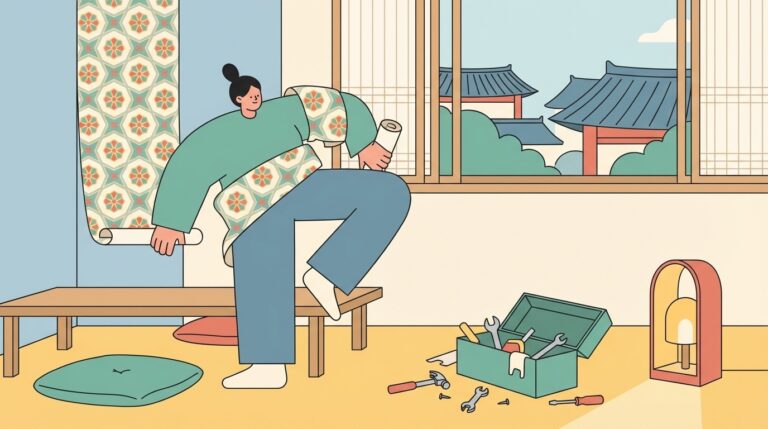
Let me paint a picture for you. You’ve been binge-watching K-Dramas where the protagonist lives in a perfectly curated O-neul-ui-jip (Today’s House) style studio apartment. You think, “I can do that!” You order some peel-and-stick wallpaper, a flat-pack wooden shelf, and aesthetic warm-toned lights. Fast forward three hours: your fingers are superglued together, the wallpaper is bubbling like a pizza crust, and you have three “extra” screws left after building the shelf.
In K-Dramas, this is usually the moment a handsome neighbor steps in to help. In reality? You’re sitting in a pile of cardboard, questioning your life choices.
At the C2 level, you already know how to say “I made a mistake” (실수했어요). But how do Koreans really express the absolute chaos of a DIY interior project gone wrong? To truly sound like a local, you need idioms and slang that capture the frustration, the self-deprecation, and the hidden costs of “doing it yourself.”
This guide is crafted from the actual tear-stained experiences of expats who tried to turn their Seoul One-room into a Pinterest board. Let’s dive in!
Phase 2: Core Expressions — Deep Dive
1. 똥손 (Ttongson)
- Pronunciation: [ttong-son] — ‘Ttong’ sounds like a sharp, tense “thong” (but with a hard ‘T’ and short ‘O’, like the thud of dropping a heavy box), and ‘son’ is like “sone.”
- Meaning: (Literal) Poop hands / (Real nuance) Someone who is incredibly clumsy or terrible at making/fixing things.
- K-Culture Moment: You’ll see this everywhere in K-Pop variety shows. When an idol tries to assemble a piece of Ikea furniture or cook a meal and utterly ruins it, the editors will slap a giant “똥손” caption on the screen with a sad trombone sound.
- Editor’s Insight: This is the ultimate self-deprecating tool. It’s much more natural than saying “저는 손재주가 없어요” (I have no manual dexterity). The opposite is 금손 (Geumson) — “Gold hands” (someone who is a DIY master).
- Situation Spectrum:
[🚫 절대 금지] ———— [⚠️ 주의] ———— [✅ 자유롭게]
- Casual (Friends): ✅ (Perfect for complaining about your DIY fail)
- Semi-formal (Co-workers): ✅ (Acceptable as a humble joke about yourself)
- Formal (Boss/Elders): ⚠️ (A bit too slangy, stick to “제가 이런 걸 잘 못해서요”)
- 🤔 Think About It: Why does Korean use body parts (hands, feet) to describe skill levels? Do you have an equivalent idiom in your language (like “all thumbs” in English)?
2. 배보다 배꼽이 더 크다 (Baeboda baekkobi deo keuda)
- Pronunciation: [bae-bo-da baek-ko-bi deo keu-da] — ‘Bae’ sounds like “bay”, ‘baek’ like “back” but cut short.
- Meaning: (Literal) The belly button is bigger than the belly. / (Real nuance) The secondary costs (tools, fixing the mistake) outweigh the primary cost (the DIY materials).
- K-Culture Moment: You tried to save 50,000 KRW by painting the walls yourself. But you ruined the floor, so you had to hire a professional cleaner for 150,000 KRW. Your Korean friend shakes their head and drops this idiom.
- Editor’s Insight: A crucial C2 proverb. It perfectly encapsulates the irony of trying to save money through DIY but ending up spending more on damage control.
- Situation Spectrum:
[🚫 절대 금지] ———— [⚠️ 주의] ———— [✅ 자유롭게]
- Casual (Friends): ✅
- Semi-formal (Co-workers): ✅
- Formal (Boss/Elders): ✅ (Proverbs are universally respected in Korean discourse)
- 🤔 Think About It: Does your culture value DIY as a money-saving tactic, or is it seen as a hobby? In Korea’s fast-paced society, why might paying a professional often be considered the “cheaper” route in the long run?
3. 사서 고생하다 (Saseo gosaenghada)
- Pronunciation: [sa-seo go-saeng-ha-da] — ‘Saseo’ sounds like “sah-suh”.
- Meaning: (Literal) To buy hardship. / (Real nuance) To bring unnecessary trouble upon oneself.
- K-Culture Moment: You tell your Korean colleagues that you spent your entire weekend sanding and re-varnishing a thrifted table instead of resting. They will look at you with a mix of pity and confusion and say this phrase.
- Editor’s Insight: Koreans value efficiency immensely (the Pali-Pali culture). Doing grueling manual labor when you could have bought a cheap new table is seen as “buying suffering.” Use this to lament your own DIY choices!
- Situation Spectrum:
[🚫 절대 금지] ———— [⚠️ 주의] ———— [✅ 자유롭게]
- Casual (Friends): ✅
- Semi-formal (Co-workers): ✅
- Formal (Boss/Elders): ✅ (Often used affectionately by elders scolding you for working too hard on something trivial)
- 🤔 Think About It: How does the concept of “efficiency” shape the language we use to describe manual hobbies?
Phase 3: Textbook vs. Real Korean
Let’s see how a C2 learner can transition from grammatically correct (but stiff) sentences to native-level fluency.
| Situation | 📖 Textbook Korean | 🗣️ Real Korean | 💡 Why the difference? |
|---|---|---|---|
| Realizing your DIY project is ruined | 저는 셀프 인테리어를 완전히 망쳤어요. | 아, 셀프 인테리어 폭망했어요. 나 완전 똥손인가 봐. | ‘폭망하다’ (폭싹 망하다 – to fail explosively) is widely used internet slang that has entered daily speech. |
| Realizing you spent too much on tools | 재료비보다 도구 비용이 더 비쌉니다. | 이거 완전 배보다 배꼽이 더 크네. 장비발 세우려다 파산하겠어. | ‘장비발’ (relying on expensive gear) highlights the modern consumer trend of buying pro-tools for amateur hobbies. |
| Regretting the DIY decision | 그냥 전문가를 부르는 것이 좋았을 텐데요. | 돈 아끼려다 사서 고생했네. 그냥 사람 부를걸. | ‘사람 부를걸’ (Should have called a person) implies hiring a professional. Dropping ‘전문가’ (expert) for ‘사람’ (person) is highly colloquial. |
Bottom Note: As a C2 learner, mixing high-level proverbs (배보다 배꼽이 더 크다) with mild slang (똥손) shows a deep, nuanced command of the language.
Phase 4: Cultural Context — K-Culture Deep Dive
4-1. Non-Verbal Nuance
When using “사서 고생했어” (I bought suffering), it must be accompanied by the “Korean Sigh” (휴~). It’s a deep exhalation, often paired with wiping imaginary sweat from your brow or massaging your neck. In Korea, showing physical exhaustion validates your hard work, even if it was a failure.
4-2. The “O-neul-ui-Jip” Syndrome & Jeonse Reality
If K-Dramas show chaebols living in mansions, apps like 오늘의집 (Today’s House) show how regular millennials live. The app triggered a massive DIY boom. However, there’s a catch: the Jeonse (전세) and Wolse (월세) housing systems.
Because most young people rent, they are strictly forbidden from altering the property (no drilling, no painting). This birthed a unique “damage-free” DIY culture. When you fail at DIY in Korea, the panic isn’t just about the ugly wallpaper; it’s about the fear of losing your housing deposit because you violated the “원상복구” (restoration to original state) clause.
Phase 5: Real-Life Roleplay Scenario
Setting: A humid Saturday afternoon. You’ve just moved into a Wolse studio in Mangwon-dong. You and your Korean friend, Min-ji, are trying to install “removable” aesthetic tiles in your kitchen.
Characters:
– YOU (The Reader): An ambitious expat who watched too many DIY YouTube videos.
– Min-ji (28): Your pragmatic, brutally honest Korean friend who was bribed with pizza to help.
Dialogue:
Min-ji: 야, 이거 스티커가 왜 이래? 벽지에 다 늘어붙는데?
(Ya, igeo seutikeoga wae irae? Byeokjie da neureobunneunde?)
[Hey, what’s wrong with these stickers? They’re sticking all over the wallpaper!]
(🎭 Stage Direction: Min-ji furiously tries to peel a crooked tile off, but the original wallpaper starts tearing)
YOU: 헐, 안 돼! 그거 찢어지면 집주인한테 물어줘야 한단 말이야.
(Heol, an dwae! Geugeo jjijeojimyeon jipjuinhante mureojwoya handan mariya.)
[OMG, no! If that tears, I have to pay the landlord for it.]
Min-ji: 그러니까 내가 뭐랬어. 우리 같은 똥손들은 이런 거 하는 거 아니야.
(Geureonikka naega mworaesseo. Uri gateun ttongsondeureun ireon geo haneun geo aniya.)
[That’s why I told you. “Poop hands” like us shouldn’t be doing this.]
YOU: 유튜브에서는 5분이면 한다고 했단 말이야…
(Yutyubeueseoneun obunimyeon handago haetdan mariya…)
[But YouTube said it only takes 5 minutes…]
Min-ji: 야, 스크래퍼 사러 다이소 가자. 이거 도구 없이는 절대 못 떼.
(Ya, seukeuraepeo sareo daiso gaja. Igeo dogu eopsineun jeoldae mot tte.)
[Hey, let’s go to Daiso to buy a scraper. We absolutely can’t peel this off without tools.]
🔀 Your Turn! How do you respond to the unfolding disaster?
– A) “그래, 그냥 전문가를 부르자. 수리비가 더 나오겠어.” (Textbook, safe, but a bit dry)
– B) “하아… 돈 아끼려다 완전 사서 고생하네. 배보다 배꼽이 더 크겠어.” (Idiomatic, highly natural)
– C) “집주인한테 비밀로 하자. 티 안 나!” (Rebellious, but legally risky!)✅ Best Choice: B — Why? You are perfectly capturing the essence of a DIY fail by combining two high-level idioms. It shows you understand the irony of the situation.
⚠️ Choice C Analysis: While funny among friends, remember the Nunchi needed with Korean landlords. They will notice when you move out!
Phase 6: 10-Second Shadowing Drill
Master the intonation to sound like a native who is utterly done with their DIY project.
😤 돈 아끼려다가 / 완전 / 사~~~서 고생했어!
(don akkiryeodaga / wanjeon / sa~~~seo gosaenghaesseo!)
[I tried to save money / and totally / bought myself hardship!]
Tip: Drag out the “사 (sa)” to emphasize how much you regret it.
😢 나 완전 / 똥손인가 봐. / 이거 / 배보다 배꼽이 / 더 큰 거 아니야?
(na wanjeon / ttongsoninga bwa. / igeo / baeboda baekkobi / deo keun geo aniya?)
[I must be totally / clumsy. / Isn’t this / a case of the belly button / being bigger than the belly?]
Phase 7: K-Culture Mini Dictionary (Interior Edition)
| Korean | Romanization | English | Context |
|---|---|---|---|
| 오늘의집 | O-neul-ui-jip | Today’s House | The most popular interior app in Korea. Used almost as an adjective for “aesthetic/trendy.” |
| 꼭꼬핀 | kkok-kko-pin | Kkok-kko pin | A life-saving multi-pronged pin that slides behind wallpaper to hang frames without drilling. A renter’s best friend. |
| 가벽 | ga-byeok | Fake/Partition wall | Temporary walls built without nails to divide studio apartments. A peak Korean DIY trend. |
| 원상복구 | won-sang-bok-gu | Restoration to original state | The dreaded clause in your lease. If you paint a wall pink, you must return it to white before moving out. |
| 못질 | mot-jil | Hammering a nail | Strictly prohibited in 99% of Korean rentals without explicit landlord permission. |
Phase 8: Traveler Survival Kit (Hardware & Fix-its)
Even if you’re just traveling or staying in an Airbnb/short-term rental, you might break something or need a quick fix. Your destination? Daiso (다이소) or the local hardware store (철물점).
🆘 Survival Phrases for DIY Disasters
– 🇰🇷 “이거 끈적임 없이 떨어지는 테이프 맞나요?”
(igeo kkeunjeogim eopsi tteoreojineun teipeu mannayo?)
– English: Is this tape really removable without leaving a sticky residue?
– 🇰🇷 “벽지에 얼룩 지우는 약 있나요?”
(byeokjie eolluk jiuneun yak innayo?)
– English: Do you have a chemical/cleaner to remove stains from wallpaper?
– 🇰🇷 “못질 안 해도 되는 꼭꼬핀 어디 있어요?”
(motjil an haedo doeneun kkokkkopin eodi isseoyo?)
– English: Where are the Kkok-kko pins that don’t require hammering nails?📌 Editor’s Travel Note
– App Tip: If you utterly destroy an appliance or plumbing during a DIY fix, download the app 숨고 (Soomgo). It connects you with local professionals (experts/handymen) for literally anything.
– The Local Ironmonger: Every neighborhood has a small, messy-looking hardware store called Cheol-mul-jeom (철물점). The grandpas running them are usually DIY wizards and can solve your problem if Daiso can’t.
Phase 9: Critical Thinking — “One Step Deeper”
Option 2: Media vs Reality (The Romanticization of Spaces)
🧠 Think Deeper:
K-Dramas and Instagram have heavily romanticized the “Seoul studio” aesthetic—crisp white sheets, beam projectors, and mid-century modern furniture. However, this aesthetic boom masks a harsher reality: the lack of permanent homeownership among Korean youth. Because buying a home in Seoul is astronomically expensive, young people channel their desire for homeownership into “micro-decorating” their temporary, rented spaces. The rise of non-destructive DIY (like tension-rod shelves and removable tiles) isn’t just a design trend; it’s a socio-economic adaptation to the rigid Jeonse system, allowing renters to exert some control over a space they don’t own.💬 Your Turn: Does your home country have strict rules for renters regarding DIY? How do young people in your culture personalize their living spaces?
Phase 10: FAQ & Avoiding Misunderstandings
Q: Can I use ‘똥손’ to describe someone else?
A: Only if you are very close friends, and even then, playfully. If you tell a co-worker “대리님은 참 똥손이시네요” (Assistant Manager, you have poop hands), you will be creating a very awkward office environment. Reserve it for yourself!
Q: If I rent an apartment in Korea, can I just do whatever DIY I want if I fix it later?
A: NO. Always ask the landlord (집주인) first. Even a single nail hole (못질) can result in a massive deduction from your deposit.
❌ Common Mistake #1: Translating “Do it yourself” literally to “네가 직접 해” when talking about interior design.
✅ Do This Instead: Koreans use the Konglish term “셀프 인테리어” (Self-interior) to describe DIY home projects.
Phase 11: Summary & Action Items
- One-Liner Summary: When your Korean DIY project fails, embrace your inner Ttongson (똥손) and lament that you bought suffering (사서 고생하다) because the belly button is now bigger than the belly (배보다 배꼽이 더 크다).
Action Mission:
– 🥉 Bronze: Stand in front of your mirror and practice the “Korean Sigh” followed by “하아, 사서 고생했네…”
– 🥈 Silver: Leave a comment below using “똥손” to describe a recent time you failed at making or fixing something.
– 🥇 Gold: Next time a Korean friend shows you something they messed up making, comfort them by saying “괜찮아요, 원래 셀프 인테리어는 배보다 배꼽이 더 큰 법이에요!” (It’s okay, DIY always ends up costing more anyway!)
K-Culture Mission:
Download the 오늘의집 (O-neul-ui-jip) app or browse their website. Search for “원룸 꾸미기” (Decorating a studio) and try to spot how many “damage-free” DIY methods (like Kkok-kko pins or tension rods) you can find!
Phase 12: Quiz — Interactive Challenge
1. Situational Judgment: You decided to assemble a complex gaming chair yourself. You broke a vital piece, and buying the replacement part costs more than the chair itself. What is the most natural thing to say?
– A) 의자가 배보다 배꼽이 더 커요.
– B) 나 완전 금손인가 봐.
– C) 수리비가 저렴하네요.
2. True or False (K-Culture Edition):
If you live in a Jeonse (전세) apartment in Korea, it is culturally and legally acceptable to paint your bedroom walls a dark color without asking, as long as you plan to live there for 2 years. (T/F)
3. Fill in the blank:
친구: 너 주말에 왜 이렇게 피곤해 보여?
나: 어, 방 도배 혼자 하려다가 완전 ( ______ ). 온몸이 다 아파.
– A) 장비발 세웠어
– B) 원상복구 했어
– C) 사서 고생했어
👉 Click to see answers
- A – The replacement part (belly button) costs more than the chair (belly).
- False – The ‘원상복구’ (restoration) clause requires you to return the house exactly as you found it. Most landlords explicitly forbid painting. Always ask!
- C – “사서 고생했어” (Bought suffering) perfectly explains why you are exhausted from unnecessary hard work.
Frequently Asked Questions (FAQ)
Q: What does "똥손 (Ttongson)" mean in Korean and how do you pronounce it?
A: In Korean, "똥손 (Ttongson)" is pronounced [ttong-son] and means: (Literal) Poop hands / (Real nuance) Someone who is incredibly clumsy or terrible at making/fixing things.
Q: What does "배보다 배꼽이 더 크다 (Baeboda baekkobi deo keuda)" mean in Korean and how do you pronounce it?
A: In Korean, "배보다 배꼽이 더 크다 (Baeboda baekkobi deo keuda)" is pronounced [bae-bo-da baek-ko-bi deo keu-da] and means: (Literal) The belly button is bigger than the belly. / (Real nuance) The secondary costs (tools, fixing the mistake) outweigh the primary cost (the DIY materials).
Q: What does "사서 고생하다 (Saseo gosaenghada)" mean in Korean and how do you pronounce it?
A: In Korean, "사서 고생하다 (Saseo gosaenghada)" is pronounced [sa-seo go-saeng-ha-da] and means: (Literal) To buy hardship. / (Real nuance) To bring unnecessary trouble upon oneself.






