Phase 1: Immersive Hook
Hello! I’m your Lead Editor at Daily Hangul.
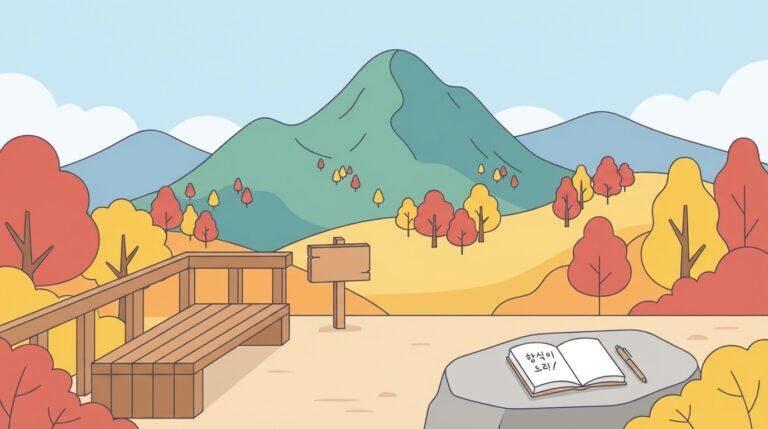
Picture this: It’s late October. You’re standing at the entrance of Seoraksan National Park. The crisp autumn air fills your lungs, and a breathtaking canvas of crimson, burnt orange, and golden leaves stretches across the jagged peaks. But as you look around, you realize you’re not alone. You are surrounded by a sea of enthusiastic Korean hikers in vibrant, neon-colored outdoor gear. Suddenly, a friendly middle-aged woman (ajumma) approaches you, smiles warmly, and hands you a perfectly peeled cucumber and says something that sounds completely different from the textbook Korean you’ve studied.
If you’ve watched K-Dramas featuring mountain getaways or variety shows like 2 Days & 1 Night, you know that hiking in Korea isn’t just a physical activity—it’s a deeply ingrained social ritual, especially during the fall foliage (danpung) season. For C2-level learners, simply saying “가을이 아름답네요” (Autumn is beautiful) just won’t cut it. To truly blend in at Seoraksan or Naejangsan, you need to speak the language of the trail.
This guide is built from the real experiences of my advanced students who ventured into Korea’s spectacular autumn mountains, only to find themselves lost in translation amidst the lively chatter of local hikers. Let’s gear up and dive in!
Phase 2: Deep Dive into Key Expressions
At the C2 level, we’re moving past basic vocabulary and stepping into advanced idioms, Sino-Korean words (한자어), and native slang that will make you sound like a local who has hiked these trails for years.
1. 단풍이 절정에 달했어요
- Pronunciation: danpungi jeoljeonge dalhaesseoyo [dan-poong-ee jul-jung-eh dal-haet-suh-yo]
- Meaning: (Literal) The autumn foliage has reached its zenith. / (Real nuance) The fall colors are at their absolute peak right now.
- K-Culture Moment: You’ll hear news anchors use this exact phrase on the 9 PM news when reporting on the Seoraksan hiking conditions. On the trail, hikers use it to validate that they picked the perfect weekend to suffer through the traffic.
- Editor’s Insight: “절정” (jeoljeong) means peak or climax. Using this instead of “가장 예뻐요” (it’s the prettiest) instantly elevates your Korean to a sophisticated, native-like level.
- Situation Spectrum:
[🚫 Taboo] ———— [⚠️ Careful] ———— [✅ Freely Use]
- Close Friends (Casual): ✅ (단풍 완전 절정이야!)
- Colleagues (Semi-formal): ✅
- Elders/Strangers (Formal): ✅
- 🤔 Think About It: Korea has four distinct seasons, and Koreans are deeply attuned to the micro-changes in nature. Why do you think national news broadcasts dedicate so much airtime to tracking the exact geographical progression of the “fall foliage front” moving down the peninsula?
2. 완전 인산인해네요, 눈치게임 실패!
- Pronunciation: wanjeon insaninhaeneyo, nunchigeim silpae! [wan-jun in-san-in-hae-ne-yo, noon-chi-game shil-pae!]
- Meaning: (Literal) It’s a mountain of people and a sea of people, failed the nunchi game! / (Real nuance) It’s ridiculously crowded, we totally failed at picking a quiet day!
- K-Culture Moment: You arrive at Naejangsan’s famous maple tree tunnel, only to find you’re walking shoulder-to-shoulder with thousands of others. You take a selfie, and 50 strangers are in your background.
- Editor’s Insight: “인산인해” (A four-character idiom or Saja-seongeo) literally translates to “people mountain, people sea.” Paired with “눈치게임 실패” (failing the game of guessing what others will do, thus ending up where everyone else is), this is the ultimate C2-level witty complaint.
- Situation Spectrum:
[🚫 Taboo] ———— [⚠️ Careful] ———— [✅ Freely Use]
- Close Friends (Casual): ✅
- Colleagues (Semi-formal): ✅
- Elders/Strangers (Formal): ⚠️ (Skip the “눈치게임” part with older strangers; just use 인산인해)
- 🤔 Think About It: The concept of the “Nunchi Game” is heavily used in modern Korean culture regarding theme parks, popular cafes, and travel spots. How does this reflect the reality of living in a densely populated, highly trend-driven society?
3. 하산하고 파전에 막걸리 콜?
- Pronunciation: hasanhago pajeone makgeolli kol? [ha-san-ha-go pa-jeon-eh mak-guhl-lee call?]
- Meaning: (Literal) After descending, green onion pancake and rice wine, call? / (Real nuance) Are we getting pajeon and makgeolli after we get down the mountain? You in?
- K-Culture Moment: You’re exhausted, your knees are shaking on the way down Seoraksan’s Ulsanbawi. This is the magical phrase your friend uses to give you the mental strength to survive the last 2 kilometers.
- Editor’s Insight: Hiking in Korea is only 50% about the mountain; the other 50% is about the dwit-puri (뒷풀이), the after-party. “하산” (hasan) is the formal word for descending a mountain, contrasting beautifully with the slangy “콜?” (Deal?).
- Situation Spectrum:
[🚫 Taboo] ———— [⚠️ Careful] ———— [✅ Freely Use]
- Close Friends (Casual): ✅
- Colleagues (Semi-formal): ⚠️ (Use “콜?” only if you’re close; otherwise, “막걸리 어떠세요?”)
- Elders/Strangers (Formal): 🚫
- 🤔 Think About It: Why is 막걸리 (Makgeolli) the undisputed champion of post-hike drinks in Korea? (Hint: It relates to its history as an agricultural worker’s energy drink!)
Phase 3: Textbook vs Real Life
| Situation | 📖 Textbook Korean | 🗣️ Real Korean | 💡 Why the difference? |
|---|---|---|---|
| Suggesting a hike | 이번 주말에 등산 갈까요? | 주말에 단풍놀이 갈까? | “단풍놀이” (fall foliage viewing) captures the festive, leisurely spirit rather than just physical exercise. |
| Complaining about crowds | 등산객이 너무 많습니다. | 와, 사람 진짜 미터진다. | “미터진다” (bursting/exploding) is a highly evocative, colloquial way to express extreme crowding. |
| Greeting strangers on trail | 안녕하세요. | 수고하십니다! / 조금만 더 가면 돼요! | “수고하십니다” acknowledges their physical effort. “You’re almost there!” is the universal white lie told by descending hikers. |
Bottom Note for C2 Learners: While “사람 미터진다” is incredibly natural among friends, make sure to revert to “발 디딜 틈이 없네요” (No room to step) or “인산인해” when speaking in more formal contexts to showcase your advanced vocabulary.
Phase 4: Cultural Deep Dive
4-1. Non-verbal Communication on the Trail
When hiking in Korea, eye contact with strangers is generally avoided in the city, but the mountain trail is a rare exception. It operates under a “village” mentality. If you stop at a resting spot (쉼터), older hikers might suddenly hand you cherry tomatoes, cucumbers, or kimbap.
How to react: Do not refuse aggressively. A polite “아이고, 감사합니다!” with a slight bow of the head is perfect. Taking the food is accepting their Jeong (정, affection/bonding).
4-2. K-Culture Connection: The K-Hiking Phenomenon
If you’ve watched K-Dramas like Jirisan, you might have noticed the intense gear. In Korea, hiking fashion (등산복) is practically a subculture. Even for a 2-hour, relatively flat walk at Naejangsan, you will see people equipped as if they are tackling Mount Everest. It’s a fascinating blend of Korea’s love for premium outdoor brands, the importance of outward appearance (체면), and group belonging. When you reach the peak, you’ll witness the ultimate K-Food ritual: people pulling out thermos flasks of hot water to make Cup Noodles (컵라면). Eating Shin Ramyun at the peak of Seoraksan while looking at the red leaves is considered a bucket-list K-Experience.
Phase 5: Immersive Roleplay
Scenario A: The Negotiation at the Rest Stop
Setting: It’s 1:00 PM. You are halfway down Seoraksan’s Daedeokbong. The autumn leaves are stunning, but your legs feel like jelly. You are with your Korean friend, Minsu.
Characters:
– YOU: An expat who loves Korean culture but is currently regretting their life choices due to physical exhaustion.
– Minsu (32): Your energetic Korean friend, wearing head-to-toe neon Arc’teryx gear.
Minsu: 아, 단풍 진짜 예술이다! 그치? 사진 하나 찍어줄게, 서 봐!
(A, danpung jinjja yesurida! geuchi? sajin hana jjigeojulge, seo bwa!)
(English: Ah, the foliage is absolute art! Right? I’ll take a picture of you, stand there!)
(🎭 Stage Direction: Minsu squats down enthusiastically to get the perfect low-angle shot)
YOU: 야, 내 다리가 지금 예술로 후들거려…
(Ya, nae dariga jigeum yesullo hudeulgeoryeo…)
(English: Hey, my legs are shaking like art right now…)
Minsu: 에이, 엄살은! 거의 다 왔어. 한 30분만 더 내려가면 돼.
(Ei, eomsareun! geoui da wasseo. han samsipbunman deo naeryeogamyeon dwae.)
(English: Oh, stop exaggerating! We’re almost there. Just 30 more minutes down.)
🔀 Your Turn! How do you reply?
– A) “거짓말하지 마. 아까도 30분 남았다고 했잖아!” (Don’t lie. You said 30 minutes ago too!)
– B) “진짜요? 감사합니다. 힘낼게요!” (Really? Thank you. I’ll cheer up!)
– C) “알았어. 대신 하산하고 파전에 막걸리 네가 쏘는 거 콜?”✅ Best Choice for C2: C — Reason: This is the ultimate native-level banter. By using the “하산하고 파전에 막걸리 콜?” phrase, you are negotiating your suffering for a reward, which is precisely how Korean friends motivate each other on trails.
⚠️ Choice A Analysis: Grammatically flawless and definitely true (Korean hikers notoriously lie about how much time is left), but C is much more culturally integrated and witty.
⚠️ Choice B Analysis: Way too polite and unnatural for a close friend.
Scenario B: The Unexpected Ajumma Encounter
Setting: A narrow trail at Naejangsan. An older woman is resting on a rock.
Ajumma: 학생~ 이것 좀 먹고 가. 산에서는 굶으면 안 돼.
(Student~ Eat this before you go. You shouldn’t starve in the mountains.)
(🎭 Stage Direction: She thrusts a handful of cherry tomatoes into your hands)
YOU: 앗, 괜찮은데… 아이고, 감사합니다. 잘 먹겠습니다!
(Ah, it’s fine… Oh my, thank you. I will eat it well!)
Ajumma: 단풍 구경 왔어? 사람 진짜 많지?
(Came to see the leaves? So many people, right?)
YOU: 네, 완전 인산인해네요! 그래도 단풍이 절정이라 너무 예뻐요.
(Yes, it’s a total sea of people! Still, the foliage is at its peak, so it’s so beautiful.)
Phase 6: 10-Second Shadowing Drill
Let’s perfect that advanced intonation. Remember to stretch out the highlighted parts to sound totally authentic!
😤 와, / 오늘 눈치게임 / 완~~~전 실패네! (wa, / oneul nunchigeim / wan~~~jeon silpaene!)
(Wow, we completely failed the Nunchi game today!)
😊 그래도 / 단풍이 절정이라 / 올 만하네요! (geuraedo / danpungi jeoljeongira / ol manhaneyo!)
(Still, the foliage is at its peak, so it’s worth the trip!)
🥺 야... / 우리 하산하면 / 무조건 막걸리다? 콜? (ya... / uri hasanhamyeon / mujogeon makgeollida? kol?)
(Hey… when we get down, we are absolutely having makgeolli, okay? Deal?)
Phase 7: K-Culture Glossary
| 한국어 (Korean) | Romanization | English Meaning | Cultural Context |
|---|---|---|---|
| 단풍놀이 | danpungnori | Fall foliage viewing trip | Adding “놀이” (play) to nature events (like 벚꽃놀이 for cherry blossoms) shows how Koreans turn seasonal changes into festive outings. |
| 등산복 | deungsanbok | Hiking clothes/gear | A multi-million dollar industry in Korea. Wearing full-gear even for small hills is a distinct cultural quirk. |
| 눈치게임 | nunchigeim | Nunchi game (Mind game) | The act of guessing what the masses will do to avoid crowds, e.g., “If everyone goes Saturday, I’ll go Sunday.” |
| 뒷풀이 | dwit-puri | After-party / Post-event gathering | Essential for team building. Hiking without a dwit-puri is considered an incomplete trip. |
| 하산 | hasan | Descending the mountain | A formal Sino-Korean word. Using it playfully in casual contexts adds a humorous, dramatic flair. |
Phase 8: Traveler’s Survival Kit
Heading to Seoraksan or Naejangsan? You need more than just language; you need logistics.
🆘 Survival Phrases for the Mountain
– 🇰🇷 “대피소가 어디에 있나요?” (daepisoga eodie innayo?)
– 🗣️ Sound-alike: [dae-pee-so-ga uh-dee-eh in-na-yo?]
– 📍 Use: Asking for the mountain shelter (crucial for bathroom breaks or buying water).
– 🇰🇷 “막차 시간이 몇 시예요?” (makcha sigani myeot siyeyo?)
– 📍 Use: Asking for the last bus time at the terminal. Miss this, and you’re stranded!
– 🇰🇷 “여기서 매표소까지 얼마나 걸려요?” (yeogiseo maepyosokkaji eolmana geollyeoyo?)
– 📍 Use: Asking descending hikers how long until the ticket office (exit).📌 Editor’s Travel Note
– App Tip: Google Maps doesn’t work well for hiking trails in Korea. Use Naver Map or KakaoMap. Naver Map specifically shows detailed hiking trail lines and elevations!
– Mountain Food: Many national park shelters no longer sell cup noodles to protect the environment. Buy your snacks at the convenience store before you enter the park.
– Bus Booking: Autumn weekends sell out fast. Use the ‘Tmoney GO’ or ‘Bustago’ app to book your intercity buses weeks in advance.
Phase 9: Think Deeper — “One Step Deeper”
🧠 Think Deeper: Food & Identity (음식과 정체성)
Have you ever wondered why Koreans carry heavy cucumbers, kimbap, and thermoses of hot water up a steep mountain? In many Western cultures, hiking is a solitary or purely athletic pursuit focused on efficiency (think: protein bars and hydration packs). But in Korea, the mountain is merely an elevated dining table. Sharing food at the peak is the ultimate expression of Jeong (정, deep connection). The effort it takes to carry the food up makes the act of sharing it with your group—and even strangers—a profound gesture of community. You aren’t just sharing calories; you are sharing the sweat it took to bring them there.💬 Your Turn: How does your culture view hiking? Is it a solitary athletic challenge, or a communal picnic? Share your thoughts in the comments!
Phase 10: FAQ & Troubleshooting
- Q: If an older hiker says “조금만 더 가면 돼” (You’re almost there), can I trust them?
- A: Absolutely not. This is a national inside joke. “Almost there” in Korean hiking terms could mean another hour of grueling stairs. It’s meant to be encouraging, not factually accurate!
- Q: Can I use “수고하십니다” (Good job/Keep up the good work) to older hikers?
- A: Normally, saying this to an elder at work is a faux pas (it sounds like you are evaluating them). However, on a hiking trail, it is universally accepted as a polite greeting of solidarity between hikers of all ages.
❌ Common Mistake #1: Going to Seoraksan in sneakers (운동화) during autumn.
✅ Do This Instead: Autumn trails are covered in fallen leaves, which become incredibly slippery (especially in the morning dew). Hiking boots (등산화) are strongly recommended for safety.
Phase 11: Wrap-up & Action Items
One-Liner Summary: To master Korean autumn hiking, you must embrace the crowds (인산인해), the dramatic peaks (절정), and the mandatory post-hike makgeolli (뒷풀이)!
Your 3-Step Action Mission:
– 🥉 Bronze (Solo): Stand in front of a mirror and dramatically sigh, “아, 눈치게임 완전 실패!”
– 🥈 Silver (Online): Find a photo of a crowded place you recently visited and post it on social media with the caption: “인산인해 ㅠㅠ (A sea of people ㅠㅠ)”
– 🥇 Gold (Real-world): Next time you finish a difficult task with a Korean friend or colleague, boldly suggest: “끝나고 막걸리 콜?”
🍁 Special K-Culture Mission:
Go to YouTube and search “설악산 단풍 인산인해” (Seoraksan autumn foliage sea of people). Watch the news clips and see if you can spot the neon deungsanbok (hiking gear) and hear the reporter use the word “절정” (peak)!
Ready to conquer the mountain? Leave a comment below with your favorite autumn destination in Korea!
Phase 12: Interactive Quiz
1. Fill in the Blank:
You finally reach the peak of Naejangsan. It’s incredibly beautiful, exactly at the right time of year. You turn to your friend and say:
“와, 단풍이 완전 [ ________ ]이네!”
(A) 인산인해
(B) 절정
(C) 하산
2. Situational Judgment:
You are walking down the mountain, and a 60-year-old hiker walking up looks exhausted. What is the most culturally appropriate thing to say?
(A) “안녕히 계세요!” (Goodbye!)
(B) “할아버지 파이팅!” (Grandpa fighting!)
(C) “수고하십니다!” (Keep up the good work!)
3. True or False — K-Culture Edition:
It is considered rude to accept food from a stranger on a Korean hiking trail. (T/F)
🚨 Click here for the answers!
- (B) 절정 – The leaves are at their “peak.”
- (C) 수고하십니다! – It acknowledges their effort. (B) might sound condescending to an elder!
- False! – It’s a sign of Jeong. Refusing too harshly is actually considered ruder than taking it with a polite “Thank you!”
Frequently Asked Questions (FAQ)
Q: What does "단풍이 절정에 달했어요" mean in Korean and how do you pronounce it?
A: In Korean, "단풍이 절정에 달했어요" is pronounced [danpungi jeoljeonge dalhaesseoyo [dan-poong-ee jul-jung-eh dal-haet-suh-yo] and means: (Literal) The autumn foliage has reached its zenith. / (Real nuance) The fall colors are at their absolute peak right now.
Q: What does "완전 인산인해네요, 눈치게임 실패!" mean in Korean and how do you pronounce it?
A: In Korean, "완전 인산인해네요, 눈치게임 실패!" is pronounced [wanjeon insaninhaeneyo, nunchigeim silpae! [wan-jun in-san-in-hae-ne-yo, noon-chi-game shil-pae!] and means: (Literal) It's a mountain of people and a sea of people, failed the nunchi game! / (Real nuance) It's ridiculously crowded, we totally failed at picking a quiet day!
Q: What does "하산하고 파전에 막걸리 콜?" mean in Korean and how do you pronounce it?
A: In Korean, "하산하고 파전에 막걸리 콜?" is pronounced [hasanhago pajeone makgeolli kol? [ha-san-ha-go pa-jeon-eh mak-guhl-lee call?] and means: (Literal) After descending, green onion pancake and rice wine, call? / (Real nuance) Are we getting pajeon and makgeolli after we get down the mountain? You in?