

Cracking the Code of Korean Delivery: Late-Night ‘Ggul-johap’ (Perfect Combos) Like a True Local 🍗🛵
Phase 1: Immersive Hook — The Late-Night Dilemma
Hello! It’s your Daily Hangul Editor.
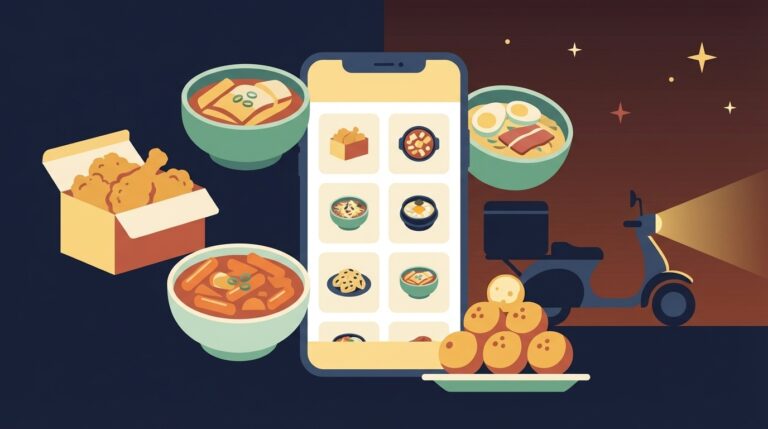
Picture this: You’re watching your 200th K-Drama. The main character just had a terrible day at work, or maybe they just confessed their love and got rejected. They go home, aggressively tap their smartphone, and boom—30 minutes later, a plastic-wrapped feast arrives at their door.
But look closely at what they’re eating. It’s never just Tteokbokki (spicy rice cakes). It’s Tteokbokki topped with a blanket of mozzarella cheese, accompanied by crispy fried hotdogs, and a side of cool, sweet peach juice (Cool-pis).
This isn’t just a random assortment of food; this is a scientifically calculated, culturally mandated 꿀조합 (Ggul-johap / Honey Combination).
If you’re living in or visiting Korea, opening a delivery app like Baedal Minjok (Baemin) or Yogiyo is a rite of passage. But navigating the endless menus and knowing exactly what sides to pair with your main dish? That’s what separates the tourists from the true locals.
Today, we aren’t just learning how to say “I want to order food.” We’re going to learn how to order like an absolute boss, mix flavors like a Michelin chef, and understand the cultural obsession behind Korean delivery combinations. This guide is crafted from the real tears of my past students who accidentally ordered spicy chicken feet without the life-saving steamed egg! Let’s dive in.
Phase 2: Deep Dive — Essential Slang for the Perfect Order
As a C1 learner, you already know basic food terms. Now, let’s upgrade your vocabulary to native-level slang used constantly in daily life, KakaoTalk chats, and YouTube Mukbangs.
1. 꿀조합 (Honey Combination)
- Pronunciation: [ggul-jo-hap] + [‘Ggul’ sounds like the tense, tight sound you make in your throat right before you cough. ‘Jo-hap’ sounds like ‘Joe hop’.]
- Meaning: (Literal) Honey combination vs. (Real nuance) The absolute perfect pairing of items (usually food, but can be used for anything).
- K-Culture Moment: You’re scrolling through YouTube, and a famous Mukbang creator titles their video: “엽떡 + 허니콤보 꿀조합 먹방!” (Yeoptteok + Honey Combo Chicken perfect pairing Mukbang!). It’s the ultimate guide to maximum flavor.
- Editor’s Insight: The word ‘꿀’ (honey) is used as a prefix in Korean slang to mean ‘awesome,’ ‘sweet,’ or ‘perfect’ (e.g., 꿀팁 = great tip, 꿀잼 = super fun). When you call a food pairing a 꿀조합, you’re signaling that you have sophisticated taste.
- Situation Spectrum:
[🚫 Formal] ———— [⚠️ Semi-formal] ———— [✅ Casual]
- Close Friends (Casual): ✅ “야, 이 조합 꿀조합이다!” (Hey, this combo is elite!)
- Coworkers (Semi-formal): ⚠️ (Fine during casual team lunches, but avoid in serious reports)
- Boss/Elders (Formal): 🚫 (Stick to “궁합이 좋습니다” – The pairing is good)
- 🤔 Think About It: Why does Korean slang use ‘honey’ (꿀) to denote something highly desirable or perfect? Historically, honey was a rare and precious sweetener in Korea. Does your native language use a specific food to describe something perfect?
2. 단짠단짠 (Sweet and Salty)
- Pronunciation: [dan-jjan-dan-jjan] + [‘Dan’ like ‘Don’, ‘Jjan’ sounds like ‘John’ but with a sharp, tense ‘J’—like the buzzer sound on a game show.]
- Meaning: (Literal) Sweet-salty-sweet-salty vs. (Real nuance) The addictive flavor loop of eating something sweet, followed by something salty, and repeating endlessly.
- K-Culture Moment: You’re at a chicken place. Your Korean friend orders spicy, salty soy garlic chicken, and immediately insists on ordering sweet cheese balls. Why? “단짠단짠 해야지!” (We have to do sweet and salty!)
- Editor’s Insight: This isn’t just a flavor profile; it’s a Korean dietary philosophy. It explains why Koreans love garlic bread with sugar on it, or salted butter rolls with sweet red bean paste.
- Situation Spectrum:
[🚫 Formal] ———— [⚠️ Semi-formal] ———— [✅ Casual]- 🤔 Think About It: The concept of ‘단짠단짠’ normalizes eating massive amounts of food because the contrasting flavors “reset” your palate. How does this reflect the Korean “Mukbang” culture’s focus on volume and variety?
3. 국룰 (National Rule)
- Pronunciation: [gung-nul] + [Sounds like ‘Goong-nool’. Note the nasal assimilation rule: 국 (guk) + 룰 (rul) becomes 궁눌 (gung-nul)!]
- Meaning: (Literal) National rule vs. (Real nuance) An unspoken, universally agreed-upon standard or trend that everyone follows.
- K-Culture Moment: When a foreigner asks, “Should we get fried rice at the end of our K-BBQ?” The entire table of Koreans will gasp and say, “K-디저트로 볶음밥은 국룰이죠!” (Fried rice as a K-dessert is a national rule!)
- Editor’s Insight: Using this word makes you sound incredibly fluent. It shows you don’t just know the language; you know the social consensus of Korean society.
- Situation Spectrum:
[🚫 Formal] ———— [⚠️ Semi-formal] ———— [✅ Casual]
Phase 3: Textbook vs Real Life (App Edition)
When you use Korean delivery apps, the language is highly contextual and abbreviation-heavy. Here is how textbook Korean compares to what you actually type in the “Requests for the Rider/Restaurant” box.
| Situation | 📖 Textbook Korean | 🗣️ Real App/Slang Korean | 💡 Why is it different? |
|---|---|---|---|
| Ordering food | 치킨과 피자를 주문할게요. (I will order chicken and pizza.) | 피나치공 시키자. (Let’s order Pi-Na-Chi-Gong.) | Koreans love extreme abbreviations for popular franchise combos (Pizza Nara Chicken Gongju). |
| Asking for extra sides | 반찬을 조금 더 주실 수 있나요? (Could you give a little more side dishes?) | 사장님~ 무 많이 부탁드려요! (Boss~ Lots of radish please!) | Delivery requests are casual, cute, and direct to save typing time. |
| Promising a review | 리뷰를 작성하겠습니다. 서비스 부탁드립니다. (I will write a review. Please give me service.) | 리뷰 이벤트 참여할게요! 닉네임: 매일한글 (I’ll participate in the review event! Nickname: Daily Hangul) | The “Review Event” is a formalized barter system in Korean apps: 5 stars for a free cheese ball. |
Phase 4: Cultural Deep Dive — The Art of Korean Delivery
4-1. Non-verbal Communication: The “Review Event” Etiquette
If you select a “Review Event” (리뷰 이벤트) item when ordering, you are making an unspoken blood oath with the restaurant owner (사장님). You get a free side dish (like a cheese ball or extra fries), but you must leave a 5-star review with a photo. If you take the free food and don’t leave a review, or leave a 3-star review, it’s considered extremely bad nunchi (눈치) and a breach of social trust. It’s a fascinating look into Korea’s high-context, relationship-based commerce.
4-2. K-Food Connection: The Architecture of a Meal
Korean food culture is fundamentally communal. Even when ordering delivery at home alone, the menu is structured as if you are sharing. This is why “Side menus” (사이드 메뉴) are so crucial. You don’t just eat the main dish; you orchestrate a symphony of textures.
For example, the ultimate spicy Tteokbokki (엽기떡볶이) is too spicy to eat alone. The Gung-nul (국룰) combo is:
1. Tteokbokki (Spicy, Chewy)
2. Chinese Glass Noodles (중국당면) – (Slurpy texture)
3. Fried Seaweed Rolls (김말이) – (Crispy, dipped in the sauce)
4. Steamed Egg (계란찜) – (Soft, neutralizes the spice)
5. Cool-pis (쿨피스) – (Sweet, washes it down)
This isn’t just eating; it’s a curated culinary event.
Phase 5: Immersive Roleplay — The Friday Night Debate
Setting: It’s 10:30 PM on a rainy Friday. You are at your Korean coworker Min-su’s apartment in Mapo-gu. The TV is playing a variety show. You both just cracked open a can of beer, but your stomachs are growling. It’s time to open Baemin.
Characters:
– YOU: A foreign professional working in Seoul, desperate for some good late-night food.
– Min-su (32): Your friendly, slightly food-obsessed Korean coworker who takes delivery combinations very seriously.
Dialogue:
Min-su: 아, 출출한데 배달이나 시킬까? 앱 켜봐. 📱
(a, chulchulhande baedarina sikilkka? aep kyeobwa.)
[Ah, I’m feeling a bit peckish, should we order delivery? Open the app.]
(🎭 Stage Direction: Min-su tosses his phone onto the table.)
YOU: 좋아요! 비도 오는데 파전 어때요?
(joayo! bido oneunde pajeon eottaeyo?)
[Sounds good! It’s raining, how about Pajeon (scallion pancake)?]
Min-su: 에이, 파전은 식어서 오면 별로야. 오늘 같은 날은 매콤한 떡볶이지!
(ei, pajeoneun sigeoseo omyeon byeolloya. oneul gateun nareun maekomhan tteokbokkiji!)
[Nah, Pajeon isn’t great if it arrives cold. On a day like today, spicy Tteokbokki is the way to go!]
YOU: 오, 콜! 그럼 제가 떡볶이 고를게요.
(o, kol! geureom jega tteokbokki goreulgeyo.)
[Oh, deal! Then I’ll pick the Tteokbokki.]
Min-su: 잠깐! 떡볶이만 시키면 안 되지. 튀김이랑 주먹밥도 무조건 추가해.
(jamkkan! tteokbokkiman sikimyeon an doeji. twigimirang jumeokbapdo mujogeon chugahae.)
[Wait! We can’t just order Tteokbokki. You have to add fried foods and rice balls unconditionally.]
🔀 Your Turn! How do you respond to Min-su’s strict food rules?
– A) “너무 많은 거 아니에요? 다 못 먹을 것 같은데…” (Isn’t that too much? I don’t think we can finish it…)
– B) “역시 민수 씨! 떡볶이에 주먹밥은 국룰이죠!” (As expected of Min-su! Tteokbokki and rice balls are the national rule!)
– C) “저는 매운 거 못 먹어서 그냥 치킨 시키면 안 돼요?” (I can’t eat spicy food, can we just order chicken instead?)✅ Best Choice: B — You hit him with the “국룰”! By validating his food philosophy with native slang, you elevate yourself from a foreign guest to a true cultural insider.
⚠️ Choice A Analysis: While logical, Korean delivery is all about abundance (푸짐함). Worrying about leftovers kills the vibe! They usually save leftovers for the next day anyway.
Min-su: (Grinning proudly) 그렇지! 네가 한국 문화를 좀 아네. 단짠단짠으로 쿨피스도 하나 추가하자.
(geureochi! nega hanguk munhwareul jom ane. danjjandanjjaneuro kulpiseudo hana chugahaja.)
[Exactly! You know a bit about Korean culture. Let’s add a Cool-pis for the sweet-and-salty balance.]
YOU: 완벽한 꿀조합이네요. 아, 리뷰 이벤트로 치즈볼도 받을까요?
(wanbyeokan gguljohabineyo. a, ribyu ibenteuro chijeuboldo badeulkkayo?)
[That’s a perfect honey combo. Oh, should we get cheese balls through the review event?]
Min-su: 대박. 너 한국인 다 됐구나? 주문 버튼 눌러!
(daebak. neo hangugin da dwaetguna? jumun beoteun nulleo!)
[Awesome. You’ve basically become Korean, huh? Hit the order button!]
Phase 6: 10-Second Shadowing Drill
Practice making your delivery requests sound completely natural. Pay attention to the pauses (/) and the emotional tags!
😊 사장님~ / 저희 / 리뷰 이벤트 참여할게요! (sajangnim~ / jeohui / ribyu ibenteu chamyeohalgeyo!)
🤤 치즈볼로 / 부탁드립니다! / 너무 기대돼요! (chijeubollo / butakdeurimnida! / neomu gidaedwaeyo!)
😤 아, / 그리고 떡볶이에 / 중국당면 추가는 / 국.룰.이죠! (a, / geurigo tteokbokkie / junggukdangmyeon chuganeun / gung.nu.ri.jo!)
Phase 7: K-Culture Glossary — Delivery App Master
| 한국어 (Korean) | Romanization | English | Context / Nuance |
|---|---|---|---|
| 배달팁 | baedaltip | Delivery Fee | Not a gratuity ‘tip’ for the driver, but the literal delivery fee added to your cart. |
| 최소주문금액 | choesojumungeumaek | Minimum Order Amount | You must meet this price to even be allowed to check out. |
| 별점 테러 | byeoljeom tereo | Star-rating Terrorism | Maliciously leaving 1-star reviews for minor issues, ruining a restaurant’s reputation. |
| 찜 | jjim | Wishlist / Like | Tapping the heart icon on a restaurant. “찜 많은 순” (Sort by most likes) is a great way to find good places. |
| 비대면 배달 | bidaemyeon baedal | Contactless Delivery | Standard post-COVID. The rider leaves the food at your door and sends a photo. |
Phase 8: Traveler’s Survival Kit 🧳
Visiting Korea? Getting delivery as a tourist can be frustrating because Korean apps usually require a Korean phone number and a local credit card. But don’t worry, here are your workarounds and essential phrases.
🆘 Traveler Survival Phrases: Delivery Edition
– 🇰🇷 “문 앞에 두고 벨 눌러주세요.” (mun ape dugo bel nulleojuseyo.)
– 🗣️ Meaning: Please leave it at the door and ring the bell. (The most common delivery request).
– 🇰🇷 “기사님, 로비에 도착하시면 전화주세요.” (gisanim, robie dochakasimyeon jeonhwajuseyo.)
– 🗣️ Meaning: Driver, please call me when you arrive at the lobby. (Crucial if you’re in a hotel where riders can’t go up).📌 Editor’s Travel Note
– The App Barrier: Apps like Baemin (배달의민족) or Yogiyo (요기요) are hard for tourists to verify.
– The Solution: Use the “Shuttle” (셔틀) delivery app! It’s fully in English, accepts foreign credit cards, and caters to tourists and expats.
– Hotel Trick: You can also politely ask your hotel front desk to order for you and pay them in cash. They do this all the time for K-Fried Chicken! Just say: “혹시 배달 주문 좀 도와주실 수 있나요?” (Could you possibly help me order delivery?)
Phase 9: Think Deeper — “한 발 더 깊이” 🧠
음식과 정체성 (Food & Identity): The Communal ‘Jeong’ of Delivery
In many Western cultures, when ordering delivery, everyone picks their own individual dish. “I’ll have the burger, you have the salad.” But in Korea, delivery is an exercise in communal harmony.
When ordering a “꿀조합” (perfect combo) like Jokbal (braised pig’s trotters) and Makguksu (spicy buckwheat noodles), the food arrives in massive, shared containers. You mix the noodles together, wrap the meat in lettuce for each other, and share the side dishes. This isn’t just about efficiency; it’s a modern manifestation of 정 (Jeong)—the Korean concept of collective bonding and affection. By agreeing on a Gung-nul combo and sharing it from the center of the table, you aren’t just sharing calories; you are reaffirming your social bond.
💬 Your Turn:
How does your culture handle food delivery? Do you share large plates, or does everyone strictly eat their own order? Let me know in the comments!
Phase 10: FAQ & Troubleshooting
Q: Can I use “국룰 (Gung-nul)” in a business presentation?
No! 🚫 While it’s incredibly common in daily life, it is still internet slang. If you are doing a formal presentation, use standard expressions like “가장 보편적인 규칙입니다” (It is the most universal rule) or “정석입니다” (It is the standard).
Q: I didn’t like the food, but I got the Review Event freebie. Do I still give 5 stars?
Welcome to the moral dilemma of modern Korea! Culturally, if the food is just “okay,” people still leave 5 stars because they received the free item. If it’s truly terrible, people usually just don’t write a review at all rather than leaving a 1-star review (별점 테러), which can devastate a small business.
❌ Common Mistake #1: Trying to tip the delivery rider in cash.
✅ Do this instead: Korea has a strict NO TIPPING culture. The ‘배달팁’ (Delivery tip/fee) is already paid inside the app. If you try to hand the rider cash, they will look confused and politely refuse. Just a cheerful “수고하세요!” (Thank you for your hard work!) is all they need.
Phase 11: Wrap-up & Action Items
🔥 One-Liner Summary:
Mastering Korean delivery isn’t just about getting food; it’s about engineering the ultimate “꿀조합” (perfect combo) and experiencing communal dining right in your living room!
Action Mission:
– 🥉 Bronze: Say “이건 국룰이지!” (This is the national rule!) out loud 3 times with absolute confidence.
– 🥈 Silver: Go to a Korean restaurant (or a Korean grocery store) in your city and try to create your own 단짠단짠 (Sweet & Salty) combination.
– 🥇 Gold: Next time you order food (any food!) with a Korean friend, ask them: “여기 꿀조합이 뭐예요?” (What’s the perfect combo here?)
📺 K-Culture Mission:
Watch an episode of a Korean variety show (like I Live Alone or Running Man) or a Mukbang on YouTube. Count how many times they say “조합” (combo) or “단짠” (sweet and salty) when eating!
Phase 12: Interactive Quiz — Test Your ‘Nunchi’ 🧩
Q1. (Situational) You are eating spicy ramen. Your Korean friend wants to add a side dish. What is the most culturally accurate “단짠단짠” or balancing choice?
1) A cup of hot black coffee
2) Sweet banana milk (바나나 우유)
3) Extra spicy kimchi
👀 Click for the Answer!
Answer: 2! Spicy (which acts like salty/savory here) ramen pairs perfectly with sweet, cooling banana milk. It resets your tongue so you can eat more! Coffee or more spice breaks the ‘Ggul-johap’ rule.
Q2. (True/False) If you check the “리뷰 이벤트 (Review Event)” box on Baemin, you must tip the driver an extra $2 in cash.
👀 Click for the Answer!
Answer: False! The review event is an agreement between you and the restaurant owner (free food for a 5-star review). It has nothing to do with the driver, and there is absolutely no tipping in Korea!
Q3. Fill in the blank:
“비 오는 날 파전에 막걸리는 ( )이지!”
(Pajeon and Makgeolli on a rainy day is a ______!)
👀 Click for the Answer!
Answer: 국룰 (Gung-nul)! It is the unspoken national rule that you must eat scallion pancakes and rice wine when it rains in Korea.
Did you survive the late-night cravings while reading this? Drop your favorite food ‘Ggul-johap’ in the comments below! 🍕+🍻=❤️
Frequently Asked Questions (FAQ)
Q: What does "꿀조합 (Honey Combination)" mean in Korean and how do you pronounce it?
A: In Korean, "꿀조합 (Honey Combination)" is pronounced [ggul-jo-hap] and means: (Literal) Honey combination vs. (Real nuance) The absolute perfect pairing of items (usually food, but can be used for anything).
Q: What does "단짠단짠 (Sweet and Salty)" mean in Korean and how do you pronounce it?
A: In Korean, "단짠단짠 (Sweet and Salty)" is pronounced [dan-jjan-dan-jjan] and means: (Literal) Sweet-salty-sweet-salty vs. (Real nuance) The addictive flavor loop of eating something sweet, followed by something salty, and repeating endlessly.
Q: What does "국룰 (National Rule)" mean in Korean and how do you pronounce it?
A: In Korean, "국룰 (National Rule)" is pronounced [gung-nul] and means: (Literal) National rule vs. (Real nuance) An unspoken, universally agreed-upon standard or trend that everyone follows.







