

Phase 1: Immersive Hook
Hello! I’m your Daily Hangul Editor. 👋
Imagine this: You are watching your favorite slice-of-life K-Drama. The main characters, exhausted office workers, are sighing at their desks on a Friday afternoon. Suddenly, one of them looks at the desk calendar, gasps, and shouts, “Wait! Next Monday is a red day!” The whole office erupts in cheers. They start booking KTX train tickets to Busan on their phones.
You check the subtitles… Red day? What does color have to do with days off?
Or picture yourself traveling in Seoul. You planned to visit a famous museum on a Monday because it’s usually less crowded. But when you arrive, the line is miles long, and families are everywhere. You check your phone, and it says today is a “Substitute Holiday.”
If you don’t understand how holidays work in Korea, you might find yourself standing in front of a closed bank or missing out on the joy of a surprise long weekend! Today, we are going to decode the magic of 대체공휴일 (Substitute Holidays) and how to talk about them like a true local.
(Note: This guide is based on real moments my A2-level students experienced when trying to navigate Korean calendars!)
Phase 2: Deep Dive into Key Expressions
Let’s look at the 3 most important phrases you need to survive (and enjoy!) Korean holidays.
1. 빨간 날
- Pronunciation: ppalgan nal [Bbal-gan nahl]
(The ‘ㅃ’ sounds tense, like the ‘p’ in ‘spot’, not a breathy ‘p’.)- Meaning: Literal = Red day / Real nuance = Public holiday / Day off
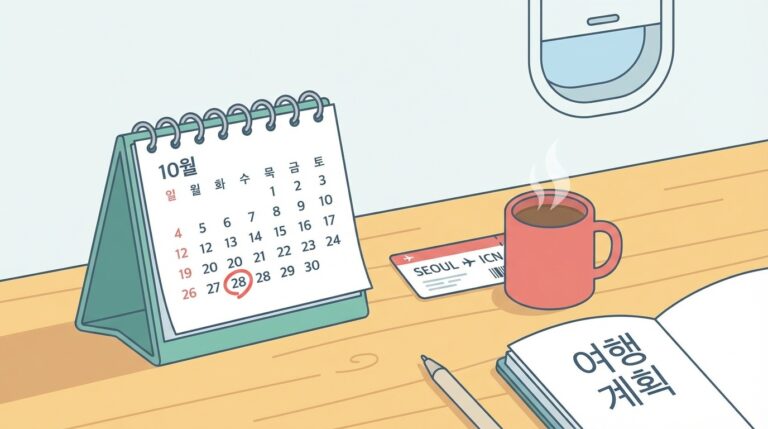
- K-Culture Moment: Why “red”? In Korea, printed wall and desk calendars are still very popular. On these calendars, Sundays and national holidays are printed in red ink. So, “red day” naturally became the everyday slang for a holiday! If an idol writes on Weverse, “Are you resting well on this red day?”, this is exactly what they mean.
- Editor’s Insight: This is the absolute most common way Koreans refer to a holiday in casual conversation. It feels exciting and relieving.
- Situation Spectrum:
[🚫 절대 금지] ———— [⚠️ 주의] ———— [✅ 자유롭게]
- Friends (Casual): ✅
- Coworkers (Semi-formal): ✅
- Boss/Elders (Formal): ⚠️ (Better to use the formal word “공휴일” in strict business settings)
- 🤔 Think About It: Does your language have a color associated with holidays or resting? Why do you think visual cues like calendars shape the way we speak?
2. 대체공휴일
- Pronunciation: daeche gonghyuil [dae-che gong-hyoo-il]
- Meaning: Substitute public holiday
- K-Culture Moment: When a major holiday (like Seollal, Chuseok, or Children’s Day) falls on a weekend, the government designates the following Monday as a “substitute holiday” so people still get their days off. The news will announce this, and the whole country celebrates the unexpected three-day weekend.
- Editor’s Insight: This is a bit of a formal, dictionary word. You’ll hear it on the news or see it on official notices taped to cafe doors.
- Situation Spectrum:
[🚫 절대 금지] ———— [⚠️ 주의] ———— [✅ 자유롭게]
- Friends (Casual): ✅ (Often shortened or just referred to as “쉬는 날”)
- Coworkers (Semi-formal): ✅
- Boss/Elders (Formal): ✅
3. 연휴
- Pronunciation: yeonhyu [yuhn-hyoo]
- Meaning: Consecutive holidays / Long weekend
- K-Culture Moment: Whenever a “대체공휴일” happens, it creates a “연휴”. This is when the “Nunchi Game” (눈치게임 – trying to guess what others will do) begins! Everyone tries to guess which highway will have less traffic or which theme park will be less crowded.
- Editor’s Insight: Use this word to ask your Korean friends about their plans. “연휴에 뭐 해요?” (What are you doing over the long weekend?)
- Situation Spectrum:
[🚫 절대 금지] ———— [⚠️ 주의] ———— [✅ 자유롭게]
- Friends (Casual): ✅
- Coworkers (Semi-formal): ✅
- Boss/Elders (Formal): ✅
Phase 3: Textbook vs Real Life
How does a textbook teach holidays vs. how Koreans actually speak?
| Situation | 📖 Textbook Korean | 🗣️ Real Korean | 💡 Why is it different? |
|---|---|---|---|
| Realizing it’s a holiday | 내일은 공휴일입니다. (Tomorrow is a public holiday.) | 우와, 내일 빨간 날이다! (Wow, tomorrow is a red day!) | Koreans prefer visual, emotional slang over legal terms in daily life. |
| Asking if a shop is open | 내일 영업하십니까? (Do you do business tomorrow?) | 내일 문 열어요? (Do you open the door tomorrow?) | “Opening the door” is the natural, conversational way to ask if a place is operating. |
| Talking about resting | 내일은 대체공휴일이라서 쉽니다. (I rest because tomorrow is a substitute holiday.) | 낼 쉬는 날이에요! (Tomorrow is a resting day!) | “쉬는 날” (resting day) focuses on the action of resting, which is what actually matters! |
Phase 4: Cultural Deep Dive
4-1. Non-verbal Communication
When Koreans realize a “Substitute Holiday” is coming, you’ll often see them immediately pull out their phones to check the Naver Map or Korail (Train) app. Time is of the essence! If you want to travel, you have to book immediately. Also, when talking about days off, Koreans often smile brightly—it’s a universal feeling of relief.
4-2. K-Travel Connection: The “Red Day” Paradox
If you are traveling in Korea during a 대체공휴일 (Substitute Holiday) or 연휴 (Long weekend), you need to know the “Red Day Paradox.”
While banks, post offices, and corporate offices are closed, cafes, restaurants, amusement parks, and shopping malls are overwhelmingly OPEN. In fact, it’s their busiest time!
However, small independent cafes or mom-and-pop restaurants might decide to take a rest. That’s why you must know how to check if they are open!
Critical View: While it’s great for tourists that shops are open, it also means service workers (알바생 – part-timers) are working their hardest during these “resting days.” When you visit a bustling cafe on a red day, a warm “감사합니다” (Thank you) goes a long way for the tired staff!
Phase 5: Immersive Roleplay Scenario
Setting: A cozy cafe in Hongdae on a Sunday evening. You are having coffee with your Korean friend, Minsoo (32, humorous and always looking for fun). You thought tomorrow was just a regular Monday.
Minsoo: 하아… 주말이 너무 짧아요. ☕️
(Haa… jumari neomu jjalbayo.)
[Sigh… the weekend is too short.]
(🎭 Stage Direction: Minsoo takes a dramatic sip of his Americano)
YOU: 맞아요. 내일 또 월요일이네요.
(Majayo. Naeil tto woryoirineyo.)
[Right. Tomorrow is Monday again.]
Minsoo: 잠깐만! 휴대폰 달력 좀 봐요!
(Jamkkanman! Hyudaepon dallyeok jom bwayo!)
[Wait a minute! Look at the phone calendar!]
YOU: 달력이요? 왜요?
(Dallyeogiyo? Waeyo?)
[The calendar? Why?]
Minsoo: 대박! 내일 대체공휴일이에요!
(Daebak! Naeil daechegonghyuirieyo!)
[Jackpot! Tomorrow is a substitute holiday!]
YOU: 대체공휴일? 그럼 내일 회사 안 가요?
(Daechegonghyuil? Geureom naeil hoesa an gayo?)
[Substitute holiday? Then you don’t go to work tomorrow?]
Minsoo: 네! 내일 빨간 날이에요! 😆
(Ne! Naeil ppalgan narieyo!)
[Yes! Tomorrow is a red day!]
YOU: 와, 진짜 좋겠다!
(Wa, jinjja joketda!)
[Wow, that must be really nice!]
Minsoo: 우리 내일 맛있는 거 먹으러 갈까요? 연휴인데!
(Uri naeil masinneun geo meogeureo galkkayo? Yeonhyuinde!)
[Should we go eat something delicious tomorrow? It’s a long weekend!]
🔀 Your Turn! How should you respond?
– A) “아니요, 내일은 공휴일입니다.” (No, tomorrow is a public holiday.)
– B) “좋아요! 근데 식당들 내일 문 열어요?” (Sounds good! But are restaurants open tomorrow?)
– C) “대체공휴일의 역사가 어떻게 되나요?” (What is the history of substitute holidays?)✅ Best Choice: B — This is the most natural, practical response. It shows enthusiasm but also practical travel sense!
⚠️ Choice A Analysis: You are stating a fact like a robot. It completely kills the excited vibe.
Phase 6: 10-Second Shadowing Drill
Let’s practice saying our key phrases with the right emotion! Repeat after me:
😆 우와! / 내일은 / 빨간 날이에요!
(Uwa! / naeil-eun / ppalgan nar-ieyo!)
[Wow! / Tomorrow is / a red day!]
🤔 혹시... / 내일 / 문 열어요?
(Hoksi… / naeil / mun yeoreoyo?)
[By any chance… / tomorrow / do you open the door (are you open)?]
Phase 7: K-Culture Glossary
| Korean | Romanization | English | Context |
|---|---|---|---|
| 빨간 날 | ppalgan nal | Red day | Everyday slang for public holidays. |
| 달력 | dallyeok | Calendar | Printed calendars are culturally significant in Korea. |
| 연휴 | yeonhyu | Long weekend | Consecutive days off. Prime time for domestic travel. |
| 워라밸 | worabael | Work-life balance | A popular modern buzzword. The reason “red days” are so celebrated! |
| 눈치게임 | nunchi geim | Nunchi game | Trying to guess where the crowds won’t be during a holiday. |
Phase 8: Traveler’s Survival Kit
If you are traveling in Korea, “Red Days” can be tricky. Here are the survival phrases you need to check if your favorite spots are open!
🆘 Survival Phrase #1: Asking if they are open
– 🇰🇷 “내일 문 열어요?” (naeil mun yeoreoyo?)
– 🗣️ English pronunciation: [nae-il moon yuh-ruh-yo?]
– 📍 Where to use: Calling a restaurant, asking a cafe owner the day before.
– 💡 Pro Tip: Literally means “Do you open the door tomorrow?”🆘 Survival Phrase #2: Asking if they are resting
– 🇰🇷 “오늘 쉬어요?” (oneul swieoyo?)
– 🗣️ English pronunciation: [oh-neul shwi-uh-yo?]
– 📍 Where to use: If the lights look dim and you want to double-check.
📌 Editor’s Travel Note:
– Check Apps First: Don’t just walk to the restaurant! Open Naver Map or Kakao Map. If it’s a holiday, places will often update their status to “공휴일 영업시간” (Holiday business hours) or “휴무” (Closed).
– Instagram is King: Many trendy cafes in Seongsu or Hongdae only announce their holiday schedules via Instagram. Check their profile before visiting!
Phase 9: Think Deeper — “One Step Further”
🧠 Think Deeper: Work-Life Balance and the Rise of “Red Days”
For a long time, South Korea was known for its intense work culture and incredibly long hours (often depicted in older K-Dramas). However, modern Korean society is rapidly changing to value 워라밸 (Work-Life Balance). The expansion of the “대체공휴일” (Substitute Holiday) system in recent years is a direct result of the government and society recognizing the need for workers to genuinely rest. When you hear young Koreans cheering for a “빨간 날”, you aren’t just hearing excitement for a day off; you are witnessing a cultural shift towards valuing personal time and mental health.
💬 Your Turn: Does your country have “substitute holidays” when a holiday falls on a weekend? How does your culture view taking days off? Let us know in the comments!
Phase 10: FAQ & Troubleshooting
Q: Can I say “빨간 날” to my boss or professor?
A: Maybe, but be careful. It’s slightly informal. It’s safer to use “쉬는 날” (resting day) or “공휴일” (public holiday) in formal emails. For example: “교수님, 내일 공휴일인데 수업하시나요?” (Professor, tomorrow is a public holiday, do we have class?)
Q: Are hospitals and pharmacies open on substitute holidays?
A: Usually NO. Most local clinics and pharmacies close. However, large university hospitals operate emergency rooms. Travel Tip: Convenience stores carry basic medicine (painkillers, cold medicine) 24/7!
❌ Common Mistake #1: Assuming EVERY weekend holiday gets a substitute day.
✅ Do this instead: Not all holidays get substitute days (though the list is growing). Always double-check your Korean calendar app to see if the Monday is actually red!
Phase 11: Wrap-up & Action Items
One-Liner Summary: When a Korean holiday lands on a weekend, the magical 대체공휴일 gives you a Monday off, and you can casually call this beautiful day a 빨간 날 (Red Day)!
Action Mission 3 Steps:
– 🥉 Bronze (Solo): Look at your own calendar. Point to a Sunday and say, “빨간 날이에요!” out loud.
– 🥈 Silver (Online): Go to a K-Pop idol’s social media. If a Korean holiday is coming up, comment: “연휴 잘 보내세요!” (Have a great long weekend!)
– 🥇 Gold (Real Life): Next time you visit a Korean cafe right before a holiday, try asking the barista, “내일 문 열어요?”
K-Culture Mission:
Open Naver Map (or Kakao Map) on your phone. Search for a popular tourist spot in Seoul (like Gyeongbokgung Palace or a famous cafe). Look for the section that shows their business hours, and see if you can spot the words “공휴일” or “휴무”!
Phase 12: Interactive Quiz
Test your new knowledge!
1. You want to ask a popular bakery if they are operating tomorrow (a public holiday). What is the most natural way to ask?
A) 내일 공휴일입니다.
B) 내일 문 열어요?
C) 내일 빨간 날 좋아해요?
2. Fill in the blank:
Tomorrow is a public holiday! “우와, 내일 [ ______ ] 날이다!”
A) 파란 (Blue)
B) 하얀 (White)
C) 빨간 (Red)
3. True or False – K-Culture Edition:
“On a substitute holiday (대체공휴일), all cafes and amusement parks in Korea will be closed so the workers can rest.”
(Scroll down for answers!)
(Answers: 1: B, 2: C, 3: False – Entertainment and dining venues are usually open and very busy!)
Frequently Asked Questions (FAQ)
Q: What does "빨간 날" mean in Korean and how do you pronounce it?
A: In Korean, "빨간 날" is pronounced [ppalgan nal [Bbal-gan nahl] and means: Literal = Red day / Real nuance = Public holiday / Day off
Q: What does "대체공휴일" mean in Korean and how do you pronounce it?
A: In Korean, "대체공휴일" is pronounced [daeche gonghyuil [dae-che gong-hyoo-il] and means: Substitute public holiday
Q: What does "연휴" mean in Korean and how do you pronounce it?
A: In Korean, "연휴" is pronounced [yeonhyu [yuhn-hyoo] and means: Consecutive holidays / Long weekend






