

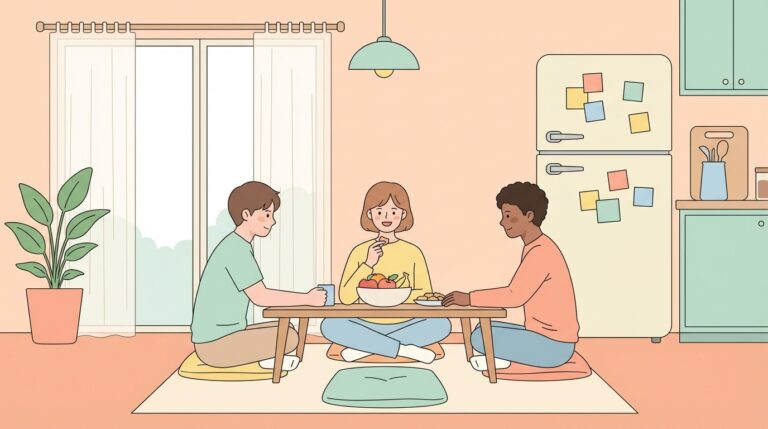
Phase 1: 공감 — 몰입형 오프닝 (Immersive Hook)
Hello! I’m the Lead Editor at Daily Hangul.
Picture this: You are watching a popular K-Drama like Age of Youth (청춘시대). The camera pans to a shared fridge covered in colorful Post-it notes. Someone opens the fridge, gasps, and yells because their carefully labeled strawberry milk is gone. The culprit awkwardly laughs in the living room while the others sip beer, trying not to make eye contact.
Welcome to the reality of the Korean 셰어하우스 (Sharehouse)!
As the number of 1인 가구 (Single Households) skyrockets in Korea, soaring rent prices (especially Jeonse and Wolse) have made sharehouses incredibly popular among university students, young professionals, and expats. But living together in Korea isn’t just about paying half the rent. It’s a delicate dance of Nunchi (reading the room), indirect communication, and sharing costs seamlessly.
If you don’t know the right expressions, you might come off as rude when asking your roommate to quiet down, or you might end up paying for everyone’s toilet paper without knowing how to ask for their share! This guide is built from the real struggles of expats living in Seoul’s sharehouses. Let’s dive in!
Phase 2: 핵심 표현 심층 분석 (Deep Dive)
Here are the top 3 expressions you absolutely need when navigating shared living spaces.
1. N분의 1 하자 (Let’s split the cost)
- Pronunciation: [en-bun-ui-il ha-ja] (‘en’ like the English letter N, ‘bun’ sounds like a hamburger bun, ‘ui’ is a quick ‘oo-ee’)
- Meaning: Let’s divide it by N (Let’s split the bill equally)
- K-Culture Moment: You and your three housemates just ordered late-night fried chicken and beer (치맥) through a delivery app. Only one person can pay on the app. After the food arrives, the person who paid will casually say, “애들아, 이거 N분의 1 하자.”
- Editor’s Insight: This comes from the mathematical concept of dividing 1 by ‘n’ (the number of people). It’s the most standard, neat way to say “Let’s go Dutch” for shared expenses like groceries or delivery food.
- Situation Spectrum:
[🚫 절대 금지] ———— [⚠️ 주의] ———— [✅ 자유롭게]
- Casual with housemates: ✅
- Semi-formal coworkers: ✅ (using N분의 1 해요)
- Formal/Elders: 🚫 (Older people usually prefer to treat the younger ones; suggesting splitting can seem stingy to them.)
- 🤔 Think About It: Why use a mathematical formula instead of just saying “pay your share”? It emphasizes absolute fairness, which is highly valued among the younger Korean generation (MZ generation) when it comes to money.
2. 방음이 잘 안 되다 (The soundproofing is poor)
- Pronunciation: [bang-eum-i jal an dwe-da]
- Meaning: (Literal) The soundproofing doesn’t work well -> (Real Nuance) “You’re being too loud, but I’m blaming the walls instead of you.”
- K-Culture Moment: Your housemate is loudly chatting on the phone with their partner at 1 AM. Instead of knocking and saying “Shut up,” you gently say, “저기… 우리 집이 방음이 좀 안 돼서요…” (Excuse me… our house doesn’t have good soundproofing…)
- Editor’s Insight: Koreans hate direct confrontation in shared living spaces. Blaming the architecture (the walls) saves the other person’s face while delivering a clear message to quiet down.
- Situation Spectrum:
[🚫 절대 금지] ———— [⚠️ 주의] ———— [✅ 자유롭게]
- Casual (Friends): ✅
- Strangers/Neighbors: ✅ (Highly recommended for polite complaints)
- Formal: ⚠️
- 🤔 Think About It: How do you complain about noise in your home country? Is it more direct? This indirect method reflects the Korean desire to maintain harmony (Kibun) even when frustrated.
3. 눈치(가) 보이다 (To feel self-conscious / walking on eggshells)
- Pronunciation: [nun-chi-ga bo-i-da]
- Meaning: To feel others’ eyes on you; to feel bad/awkward about doing something because it might bother others.
- K-Culture Moment: You want to fry a smelly fish in the shared kitchen, but your roommate is studying in the adjacent living room. You text your friend: “생선 굽고 싶은데 룸메이트 눈치 보여.” (I want to fry fish, but I’m self-conscious of my roommate.)
- Editor’s Insight: As a B2 learner, mastering the word Nunchi elevates your Korean immensely. In a sharehouse, being a good roommate means having “quick nunchi” (눈치가 빠르다) to know when to give people space.
- Situation Spectrum:
[🚫 절대 금지] ———— [⚠️ 주의] ———— [✅ 자유롭게]
- Casual: ✅
- Semi-formal: ✅
- Formal: ✅
- 🤔 Think About It: Sharehouses force you to develop Nunchi. Do you think having to constantly “read the room” is exhausting, or is it a necessary empathy for communal living?
Phase 3: 교과서 vs 진짜 한국어 (Textbook vs Real Life)
Let’s see how these concepts evolve from your B2 textbook into real-life sharehouse slang.
| 상황 (Situation) | 📖 교과서 한국어 (Textbook) | 🗣️ 진짜 한국어 (Real Life) | 💡 왜 다를까? (Why the difference?) |
|---|---|---|---|
| Splitting the utility bills | 공과금을 나누어서 냅시다. | 이번 달 가스비 엔빵(N빵) 하자. | ‘엔빵’ is a highly common slang combining ‘N’ and ‘빵’ (piece/share) used by young people for speed and casualness. |
| Complaining about a mess | 거실을 깨끗하게 써 주세요. | 공용 공간은 쓴 다음에 바로바로 치워주세요~ | Using “바로바로” (right away) and “~주세요~” with a soft tone avoids sounding like a strict parent. |
| Telling someone to be quiet | 조용히 해 주세요. 너무 시끄러워요. | 방음이 약해서 소리가 다 들리네요 ㅠㅠ | Direct criticism is frowned upon; blaming the environment prevents emotional arguments. |
Bottom Note: While “엔빵” (N-bbang) is very popular, stick to “N분의 1” if you aren’t very close to your housemates yet. It sounds a bit more polite while keeping the exact same meaning!
Phase 4: 문화적 맥락 — K-Culture 딥다이브 (Cultural Deep Dive)
4-1. 비언어적 요소 (Non-verbal Communication: The Post-it Passive Aggressiveness)
In a Korean sharehouse, silence is golden. If someone consistently leaves unwashed dishes, you might not get a text. Instead, you’ll wake up to a brightly colored Post-it note stuck to the sink with a smiley face: “사용한 그릇은 바로 설거지 부탁드려요~ ^^” (Please wash dishes right after using them~ ^^).
That “^^” emoticon is crucial. It’s the digital/written equivalent of a polite smile that softens the demand. Also, when talking about sensitive topics like money (bills), Koreans tend to look slightly apologetic and use softening filler words like “저기… (excuse me)” or “그… (well…)”.
4-2. K-Culture 연결 고리 (K-Drama & K-Food)
The K-Drama Trope: The Shared Living Room
In dramas like Age of Youth or Because This Is My First Life, the living room (거실) and the dining table are where the magic happens. It’s where roommates gather at 11 PM to share their daily struggles over a can of Cass beer and spicy Tteokbokki. However, the drama often romanticizes this. In reality, aligning schedules to eat together is rare, and the fridge is a battleground of name-labeled Tupperware!
K-Food Rules in a Sharehouse
If you order delivery (배달) and eat it in the common area, there is an unspoken rule: you must ventilate the room afterward (환기시키다). Korean food can have strong smells (garlic, fermented pastes). If you leave your spicy Jjamppong bowls out overnight without cleaning up, you will definitely face the dreaded Post-it note the next morning.
Phase 5: 실전 롤플레이 시나리오 (Immersive Roleplay)
시나리오 A: 메인 롤플레이 (The Monthly Utility Bill)
- Setting: Sunday evening, the kitchen of a sharehouse in Mangwon-dong. You are pouring a glass of water when the house manager/roommate approaches you with a piece of paper.
- Characters:
- YOU: A foreign exchange student who moved in 2 months ago.
- Min-ji (25): Your Korean housemate who manages the bills. She’s friendly but likes things organized.
Dialogue:
민지: (Holding a bill) OO씨, 이번 달 공과금 나왔어요. 날씨가 추워서 가스비가 좀 많이 나왔네요.
(OO-ssi, ibeon dal gonggwageum nawa-sseoyo. Nalssi-ga chu-wo-seo gaseu-bi-ga jom mani nawa-nneyo.)
[OO, this month’s utility bills are out. The gas bill came out a bit high because it’s been cold.]
(🎭 Stage Direction: Min-ji looks a bit apologetic about the high price.)
YOU: 아, 정말요? 총 얼마 나왔어요?
(A, jeongmal-yo? Chong eolma nawa-sseoyo?)
[Oh, really? How much is it in total?]
민지: 다 합쳐서 12만 원이요. 저희 네 명이니까 N분의 1 하면 각자 3만 원씩 내면 될 것 같아요.
(Da hap-chyeo-seo sim-i-man won-i-yo. Jeo-hui ne myeong-i-ni-kka N-bun-ui-il ha-myeon gak-ja sam-man won-ssik nae-myeon doel geot gata-yo.)
[It’s 120,000 won in total. Since there are four of us, if we split it, I think we can each pay 30,000 won.]
YOU: 네, 알겠습니다. 민지 씨 계좌로 보낼까요?
(Ne, alge-sseumnida. Min-ji-ssi gyejwa-ro bonael-kka-yo?)
[Yes, understood. Should I send it to your account?]
민지: 네! 그리고 저기… 화장지랑 주방 세제도 다 떨어져 가는데, 제가 내일 마트 가서 사 올까요?
(Ne! Geurigo jeogi… hwajang-ji-rang jubang seje-do da tteoreojyeo ga-neunde, je-ga naeil mateu ga-seo sa ol-kka-yo?)
[Yes! And um… we are running out of toilet paper and dish soap. Should I go to the mart and buy some tomorrow?]
🔀 당신의 차례! 어떻게 대답할까요? (Decision Point)
– A) “네, 부탁드려요!” (Yes, please!)
– B) “네, 영수증 주시면 그것도 N분의 1 해서 같이 보낼게요.”
– C) “아, 공용 물건은 각자 사서 쓰는 거 아니었어요?”✅ Best Choice: B — “Yes, if you give me the receipt, I’ll split that too and send it together.” This shows you understand communal living and are proactively offering to pay your share (눈치가 빠르다!).
⚠️ Choice A 분석: If you just say “Yes, please” and don’t mention the money, Min-ji might feel awkward asking you for it later.
⚠️ Choice C 분석: Unless specifically stated in the house rules, basic supplies are usually shared. Questioning it bluntly can ruin the mood.
시나리오 B: K-Culture 보너스 롤플레이 (The Midnight Delivery)
- Setting: 11:30 PM. You are craving spicy food and order chicken. It arrives, and you bump into a housemate in the hallway.
YOU: 아, 야식 시켰는데 같이 드실래요?
(A, yasik si-kyeon-neunde gat-i deu-sil-lae-yo?)
[Oh, I ordered a late-night snack. Would you like to join me?]
Housemate: 헉, 치킨이네요! 냄새 대박… 근데 저 내일 일찍 출근해야 해서요. 맛있게 드세요!
(Heok, chikin-i-ne-yo! Naemsae daebak… Geunde jeo naeil il-jjik chulgeun-hae-ya hae-seo-yo. Masi-kke deu-se-yo!)
[Gasp, it’s chicken! The smell is amazing… But I have to go to work early tomorrow. Enjoy!]
YOU: 아쉽네요. 냄새 안 나게 먹고 바로 환기시킬게요!
(A-swim-ne-yo. Naemsae an na-ge meok-go baro hwangi-si-kil-ge-yo!)
[That’s a shame. I’ll make sure to ventilate the room right away so it doesn’t smell!]
(Your housemate will silently appreciate your amazing Nunchi and consideration!)
Phase 6: 10초 섀도잉 드릴 (Shadowing Drill)
Practice these lines with the right emotion and pauses!
- 😊 밝고 명확하게 (Brightly & Clearly):
“저희 / 배달 음식 / N분의 1 해요!”
(Jeo-hui / baedal eum-sik / en-bun-ui-il hae-yo!) -
🥺 조심스럽고 미안한 톤으로 (Carefully & Apologetically):
“저기… / 이 방이 / 방음이 좀 안 돼서요…”
(Jeo-gi… / i bang-i / bang-eum-i jom an dwae-seo-yo…)
Phase 7: K-Culture 미니 사전 (K-Culture Glossary)
| 한국어 | Romanization | English | 맥락 설명 (Context) |
|---|---|---|---|
| 공과금 | gonggwageum | Utility bills | Includes water, electricity, gas, and internet. Usually split among sharehouse tenants. |
| 분리수거 | bullisugeo | Separate garbage recycling | Korea has extremely strict recycling laws. Messing this up in a sharehouse is a major offense! |
| 보증금 | bojeunggeum | Housing Deposit | A large lump sum paid before moving in. Sharehouses usually have lower deposits than regular apartments. |
| 월세 | wolse | Monthly rent | The rent paid every month. |
| 자취(하다) | jachwi(-hada) | Living independently | The act of living away from one’s family, cooking and caring for oneself. |
Phase 8: 여행자 서바이벌 키트 (Traveler’s Survival Kit)
Even if you aren’t living in a sharehouse long-term, you will likely encounter these situations if you stay in a Guesthouse or Airbnb in Korea!
🆘 서바이벌 표현 TOP 3 (For Guesthouses & Shared Airbnbs)
– 🇰🇷 “공용 공간은 몇 시까지 쓸 수 있나요?”
– (Gong-yong gong-gan-eun myeot si-kka-ji sseul su in-na-yo?)
– [Until what time can we use the common area?]
– 🇰🇷 “쓰레기는 어디에 버려요?”
– (Sseuregi-neun eodi-e beoryeo-yo?)
– [Where do I throw away the trash/recycling?]
– 🇰🇷 “방이 너무 추운데/더운데 온도를 조절해도 되나요?”
– (Bang-i neomu chu-un-de / deo-un-de ondo-reul jojeol-hae-do doe-na-yo?)
– [The room is too cold/hot, can I adjust the temperature?]📌 Editor’s Travel Note
– Ondol (온돌) System: Korean heating comes from the floor! In shared spaces, the thermostat (보일러) is usually controlled centrally. Always ask before touching the Boiler settings, as gas bills (가스비) in winter can be incredibly high!
Phase 9: 비판적 사고 코너 — “한 발 더 깊이” (Think Deeper)
언어와 권력 & 정체성 (Language, Power & Identity)
🧠 Think Deeper:
Traditionally, young Koreans lived in 하숙집 (Hasukjib – Boarding houses). In a Hasukjib, an older host mother (하숙집 아주머니) cooked meals for everyone, creating a family-like, collective bond based on the deep Korean sentiment of 정 (Jeong – emotional connection/affection).Today’s 셰어하우스 (Sharehouse) reflects a shift towards modern individualism. People want their own private space and strictly split bills (N분의 1), avoiding the heavy emotional obligations of the past. Yet, the existence of common areas and the constant need for Nunchi shows that Koreans still deeply value harmony and being mindful of the collective. It’s a fascinating bridge between traditional community and modern independence.
💬 Your Turn: Does your culture have a concept similar to “Nunchi” when living with others? Do young people in your country prefer living completely alone, or do they share houses? Share in the comments!
Phase 10: FAQ & 오해 방지 (Troubleshooting)
- Q: If my housemate is older than me, can I say “우리 N분의 1 하자”?
- A: NO. “~하자” is informal (반말). If they are older, say “저희 N분의 1 해요” (Let’s split it). Also, traditionally, older people might offer to pay for the whole meal. If they do, thank them politely, but still offer to pay your share once as a courtesy!
- Q: Can I just tell my roommate “시끄러워요” (It’s noisy)?
- A: Maybe, but it’s risky. It sounds very direct and a bit aggressive. Using the indirect “방음이 안 돼서 소리가 들려요” (The soundproofing is bad, so I can hear the noise) is the B2-level way to handle conflict gracefully.
❌ 흔한 실수 (Common Mistake): Leaving your personal belongings in the shared living room for days.
✅ 이렇게 하세요: A sharehouse is not a Hasukjib. Your personal mess will quickly drain your housemates’ Nunchi tolerance. Treat the common area like a public cafe.
Phase 11: 요약 및 액션 아이템 (Wrap-up)
One-Liner Summary: To survive a Korean sharehouse, master the art of “N분의 1” for bills, and use “방음” (soundproofing) as your polite shield against noise!
Action Mission 3단계:
– 🥉 Bronze: Stand in front of a mirror and practice saying, “방음이 좀 안 돼서요…” with an apologetic face.
– 🥈 Silver: Write a mock Post-it note in Korean asking your roommate to wash the dishes, and post it in your study group or comments!
– 🥇 Gold: Next time you eat out with your Korean friends, confidently say “제가 계산할게요. 나중에 N분의 1 해요!” (I’ll pay first. Let’s split it later!).
K-Culture Mission:
Watch an episode of Age of Youth (청춘시대). Pay close attention to how the girls leave passive-aggressive notes for each other and how they sit in the living room together. Can you spot anyone using Nunchi?
Phase 12: 퀴즈 — 인터랙티브 챌린지 (Interactive Quiz)
1. Situational Judgment:
Your roommate’s alarm has been ringing for 10 minutes, but they aren’t waking up. You are getting a headache. What is the most culturally appropriate B2-level response when they finally wake up?
– A) “알람 좀 꺼! 귀 아파.” (Turn off the alarm! My ears hurt.)
– B) “저기… 방음이 잘 안 돼서 알람 소리가 다 들리네요. ㅠㅠ”
– C) “내일부터 알람 맞추지 마세요.”
2. Fill in the Blank:
We bought 50,000 won worth of groceries for the house. There are 5 people.
“우리 이거 ____________ 하자. 한 사람당 만 원씩 보내줘!”
3. True or False:
In a Korean sharehouse, it’s totally fine to fry smelly food in the kitchen at 2 AM as long as you clean the pan.
👀 정답 확인하기 (Click to see answers)
- B – Blaming the soundproofing is the most polite, face-saving way to ask someone to manage their noise.
- N분의 1 (or 엔빵) – Let’s split it equally.
- False – Remember Nunchi and K-Food rules! Smells linger, and cooking at 2 AM is a huge disturbance in a shared space without excellent ventilation.
Frequently Asked Questions (FAQ)
Q: What does "N분의 1 하자 (Let's split the cost)" mean in Korean and how do you pronounce it?
A: In Korean, "N분의 1 하자 (Let's split the cost)" is pronounced [en-bun-ui-il ha-ja] and means: Let's divide it by N (Let's split the bill equally)
Q: What does "방음이 잘 안 되다 (The soundproofing is poor)" mean in Korean and how do you pronounce it?
A: In Korean, "방음이 잘 안 되다 (The soundproofing is poor)" is pronounced [bang-eum-i jal an dwe-da] and means: (Literal) The soundproofing doesn't work well -> (Real Nuance) "You're being too loud, but I'm blaming the walls instead of you."
Q: What does "눈치(가) 보이다 (To feel self-conscious / walking on eggshells)" mean in Korean and how do you pronounce it?
A: In Korean, "눈치(가) 보이다 (To feel self-conscious / walking on eggshells)" is pronounced [nun-chi-ga bo-i-da] and means: To feel others' eyes on you; to feel bad/awkward about doing something because it might bother others.







