

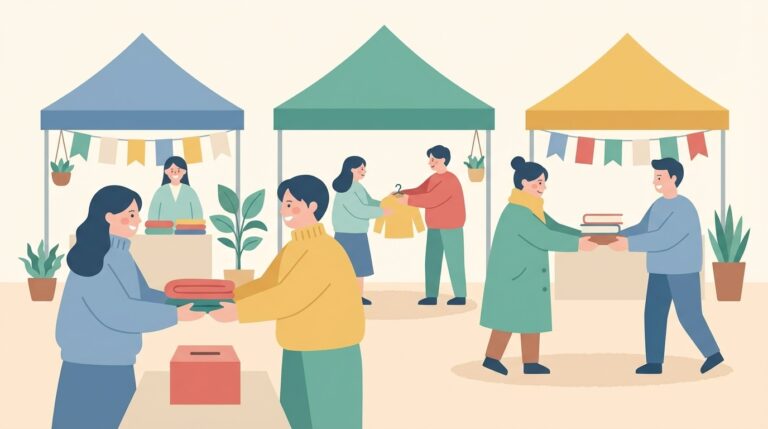
Hello there! I’m the Lead Editor of Daily Hangul. If you’ve ever wandered around Seoul on a sunny weekend, you might have stumbled upon colorful tents along the Han River or in a local park. People are selling clothes, vintage items, and books, all while laughing and chatting. Or perhaps you’ve seen K-Pop idols like RM of BTS sharing photos of their vintage thrift finds. Welcome to the world of 나눔 장터 (Nanum Jangteo – Charity Flea Markets) and 아름다운 가게 (Beautiful Store), Korea’s most iconic charity shop!
You might think, “Oh, I know how to buy things in Korean! Igeo eolmayeyo? (How much is this?)” But wait—charity shops and flea markets in Korea operate on a completely different set of social rules and vocabulary. If you try to aggressively haggle at a charity event, or use the wrong word for “donation,” you might get some confused (or slightly disappointed) looks.
Today, we are diving into C1-level advanced Korean. We’ll learn how to sound like a culturally aware, warm-hearted local when participating in Korea’s beautiful culture of giving back. Let’s get started!
Phase 2: Deep Dive into Core Expressions
Here are three advanced expressions you absolutely need when navigating Korean charity shops and donation events.
1. 기증할 물품을 좀 가져왔는데요.
- Pronunciation: gijeunghal mulpumeul jom gajyeowanneundeyo. (gi-jeung sounds like “gee-jeung”, with a hard ‘g’ like in ‘go’)
- Meaning: I brought some items to donate.
- K-Culture Moment: You’ve just finished spring cleaning, Marie Kondo-style. You pack a box of good-condition clothes and walk into an ‘아름다운 가게’ (Beautiful Store). You approach the volunteer at the counter with a warm smile and say this phrase.
- Editor’s Insight: At a C1 level, you must know the difference between 기부 (Donation) and 기증 (Donation of goods/items). If you say “기부할 물품,” it sounds a bit awkward. Gibu is generally used for money or abstract concepts, while Gijeung specifically refers to physical items (like books, clothes, or even organ donation!).
- Situation Spectrum:
[🚫 0%] ———— [⚠️ 50%] ———— [✅ 100%]
- Close Friends (Casual): 🚫 (Friends don’t usually ‘receive’ donations this way)
- Charity Volunteers/Staff (Formal): ✅ (Perfect and polite!)
- 🤔 Think About It: Why does Korean have separate words for donating money vs. donating items? Does your native language make this distinction?
2. 사용감은 있지만, 하자는 전혀 없어요.
- Pronunciation: sayonggameun itjiman, hajaneun jeonhyeo eopseoyo. (ha-ja sounds like “ha-ja”, laughing + jar without the ‘r’)
- Meaning: It has some signs of use, but there are absolutely no defects.
- K-Culture Moment: You’re selling your old K-Pop albums or clothes at a weekend Nanum Jangteo (flea market), or chatting with a buyer on Danggeun Market (Korea’s #1 secondhand app). A buyer asks about the condition. This is your ultimate “honest but persuasive” seller’s pitch.
- Editor’s Insight: 사용감 (feeling/signs of use) and 하자 (defect/flaw) are essential C1 vocabulary words for the secondhand economy. It shows you are transparent and trustworthy.
- Situation Spectrum:
[🚫 0%] ———— [⚠️ 50%] ———— [✅ 100%]
- Flea Market Customers (Polite): ✅
- Secondhand App Chats (Semi-formal): ✅
- 🤔 Think About It: Koreans highly value “condition” (상태) in secondhand goods. Why do you think terms like ‘사용감’ evolved into a single, frequently used noun rather than a descriptive sentence?
3. 좋은 취지니까 에누리 없이 살게요.
- Pronunciation: joeun chwijinikka enuri eopsi salgeyo. (chwi-ji sounds like “chwee-jee”)
- Meaning: Since it’s for a good cause, I’ll buy it without asking for a discount.
- K-Culture Moment: You find an amazing vintage jacket at a charity bazaar. The seller says it’s 20,000 KRW. Normally at a flea market, you’d try to haggle. But you know all the proceeds go to helping underprivileged children. You drop this line, and the seller’s face lights up with gratitude.
- Editor’s Insight: 취지 means “purpose” or “intention.” 에누리 is a pure Korean word for “discount/haggling.” Saying “좋은 취지” acknowledges the charity aspect elegantly. It makes you sound incredibly sophisticated and warm-hearted.
- Situation Spectrum:
[🚫 0%] ———— [⚠️ 50%] ———— [✅ 100%]
- Charity Bazaar Sellers (Polite): ✅
- Regular Retail Stores: 🚫 (They aren’t a charity!)
- 🤔 Think About It: In Korea, haggling (에누리) is often seen as a fun way to build Jeong (affection/bond). Why is it considered polite not to haggle when it comes to “좋은 일” (good deeds)?
Phase 3: Textbook vs Real Life
Let’s upgrade those stiff textbook sentences into natural, native-level expressions!
| Situation | 📖 Textbook Korean | 🗣️ Real Korean | 💡 Why the difference? |
|---|---|---|---|
| Offering to donate items | 이 옷들을 기부하고 싶습니다. | 이거 기증하려고 가져왔어요. | ‘기증’ is the accurate term for items; adding ‘가져왔어요’ (I brought it) sounds more conversational and proactive. |
| Telling someone to keep the change for charity | 거스름돈은 기부하겠습니다. | 좋은 데 써주세요. 잔돈은 됐어요. | “Please use it for a good place/cause.” This indirect approach is much humbler and culturally warmer than explicitly stating “I will donate.” |
| Describing a slightly worn item | 이 물건은 조금 낡았습니다. | 생활 기스나 사용감은 좀 있어요. | “낡았다” (old/worn out) lowers the value. “생활 기스” (daily scratches) and “사용감” are industry-standard terms that sound honest but positive. |
Phase 4: Cultural Deep Dive
4-1. Non-verbal Communication: The “Two-Handed” Respect
When donating items or handing over cash at a charity event, always use both hands or support your right arm with your left hand. In Western cultures, donating is often casual. In Korea, the act of giving to a cause is treated with high social respect. Handing over your donation with two hands and a slight bow (about 15-30 degrees) shows that you respect the cause and the volunteers working there.
4-2. K-Culture Connection: The “Danggeun” Community Spirit
You can’t talk about secondhand items in Korea without mentioning Danggeun Market (당근마켓). While Beautiful Store is a physical charity shop, Danggeun is a neighborhood-based app. A huge part of this app’s culture is 무료 나눔 (Free Sharing), often shortened to 무나 (Muna). Instead of throwing things away, Koreans love to offer items for free to their neighbors. Sometimes, the person receiving the “Muna” will bring a small carton of banana milk or a snack as a gesture of gratitude (Jeong). This horizontal sharing culture perfectly mirrors the vibe of offline Nanum Jangteo!
Phase 5: Immersive Roleplay
Scenario A: The Charity Bazaar Bargain
Setting: A bustling Saturday afternoon at the Ttukseom Beautiful Flea Market. The weather is perfect. You are volunteering at a booth selling donated clothes to raise money for environmental protection. A customer picks up a slightly worn denim jacket.
Customer: 이거 얼마예요? (How much is this?)
YOU: 아, 그건 만 오천 원이에요. (Ah, that one is 15,000 won.)
Customer: (Looking closely at the sleeves) 음… 여기 소매 쪽에 사용감이 좀 있네요. 만 원에 주시면 안 돼요? 에이~ 깎아주세요! (Hmm… there’s some wear and tear around the sleeves here. Can you give it to me for 10,000 won? Come on~ give me a discount!)
🔀 Your Turn! How should you respond?
– A) “안 돼요. 깎아줄 수 없어요.” (No. I cannot discount it.)
– B) “네, 그럼 만 원에 가져가세요!” (Yes, then take it for 10,000 won!)
– C) “아유, 손님~ 저희 수익금이 다 환경 보호하는 좋은 취지로 쓰이는 거라서요. 정가에 부탁드릴게요!” (Oh, customer~ All our proceeds are used for the good cause of protecting the environment. I’d appreciate it if you pay the full price!)✅ Best Choice: C
Why? Choice A is too blunt and might kill the friendly vibe of the market. Choice B loses valuable charity money! Choice C is the perfect C1 response. By gently reminding them of the “좋은 취지” (good cause) with a friendly tone (아유~), the customer will likely smile, feel a bit embarrassed, and gladly pay full price.
Scenario B: The Counter Drop-off
Setting: Inside a Beautiful Store branch.
YOU: 안녕하세요, 옷이랑 책 좀 기증하려고 하는데요. (Hello, I’d like to donate some clothes and books.)
Staff: 아, 네! 감사합니다. 혹시 연말정산용 기부금 영수증 필요하신가요? (Ah, yes! Thank you. Do you by any chance need a tax-deductible donation receipt for your year-end tax settlement?)
YOU: 네, 제 이름이랑 번호 적어드리면 될까요? (Yes, should I write down my name and number?)
Phase 6: 10-Second Shadowing Drill
Let’s practice the rhythm and emotion! Speak out loud:
😊 아유~ / 좋은 취지니까 / 에누리 없이 / 제가 살게요!
(Ayu~ / joeun chwijinikka / enuri eopsi / jaega salgeyo!)
Vibe: Bright, generous, and warm. Give a slight smile when you say “취지니까” to emphasize your good intentions.
Phase 7: K-Culture Glossary
| Korean | Romanization | English | Context |
|---|---|---|---|
| 나눔 | nanum | Sharing | The core concept of Korean charity. It emphasizes horizontal sharing rather than vertical ‘giving’. |
| 기증 | gijeung | Donation (Goods) | Used when giving physical items (clothes, books, art, organs) to an organization. |
| 아름다운 가게 | areumdaun gage | Beautiful Store | Korea’s most famous NGO-run thrift store network. Proceeds support marginalized communities. |
| 득템 | deuk-tem | Great find / Steal | Slang (Deuk = get, Tem = item). Used when you find an amazing item at a flea market for cheap! |
| 무나 | muna | Free sharing | Short for 무료 나눔. Very common in online communities and secondhand apps. |
Phase 8: Traveler’s Survival Kit
Are you planning to visit a Korean vintage market like Dongmyo or a charity flea market? Here are your must-know phrases!
🆘 Survival Phrases for Flea Markets
– 🇰🇷 “혹시 계좌이체 되나요?” (hoksi gyejwa-iche doenayo?)
– 🗣️ Meaning: Can I pay by bank transfer?
– 📍 Where to use: Flea markets, street vendors.
– 💡 Pro Tip: While Korea is a “card-only” paradise in regular stores, outdoor flea markets heavily rely on cash or direct bank transfers (계좌이체). If you don’t have a Korean bank account, bring plenty of 1,000 and 10,000 KRW bills!
- 🇰🇷 “이거 입어봐도 돼요?” (igeo ibeobwado dwaeyo?)
- 🗣️ Meaning: Can I try this on?
- 📍 Where to use: Thrifting for clothes.
- 💡 Pro Tip: At charity markets, there usually aren’t fitting rooms, but you can slip jackets over your current clothes.
📌 Editor’s Travel Note
– Finding Markets: Search “아름다운가게” on Naver Maps or KakaoMap to find the nearest charity shop. For outdoor markets, the “뚝섬 아름다운 나눔장터” (Ttukseom Flea Market) operates on weekends during warmer months (check their official site for exact dates!).
Phase 9: Think Deeper — Language & Power
🧠 Think Deeper: From “Charity” to “Sharing”
In the past, words like 자선 (Charity) or 적선 (Almsgiving) were common in Korea. However, these words have a vertical, hierarchical nuance—the “haves” giving down to the “have-nots.” In modern Korea, these terms have been largely replaced by 나눔 (Nanum – Sharing). Nanum implies a horizontal relationship: we are all equals in a community, and we simply share what we have an abundance of. This shift in vocabulary reflects Korea’s rapid democratization and the strong cultural desire for egalitarianism. By saying you are participating in a Nanum Jangteo, you aren’t just shopping; you are acknowledging the community’s equality.💬 Your Turn: Does your native language have different words that reflect the “power dynamic” of giving? Share your thoughts in the comments!
Phase 10: FAQ & Troubleshooting
- Q: Can I haggle at ‘Beautiful Store’?
- A: No! 🚫 Unlike traditional markets (like Namdaemun or Dongmyo), Beautiful Store operates like a retail store with fixed prices set by the NGO. Asking for a discount here is considered inappropriate.
- Q: Can I donate heavily worn or stained clothes?
- A: No. A good rule of thumb in Korea is: “If you wouldn’t give it to a friend, don’t donate it.” The staff will politely reject items with heavy 사용감 (wear) or 하자 (defects) because it costs the NGO money to dispose of them.
❌ Common Mistake #1: Saying “동냥 (Dong-nyang)” or “적선 (Jeok-seon)” when you mean donation.
✅ Do This Instead: Those old words mean “begging” or “giving alms to a beggar” and can be highly offensive! Always stick to 기부 (money) or 기증 (items).
Phase 11: Wrap-up & Action Missions
One-Liner Summary: To master Korean charity and secondhand culture, remember that donating items is 기증, and acknowledging a good cause (좋은 취지) makes you sound incredibly fluent and kind!
Action Mission:
– 🥉 Bronze: Say “좋은 취지니까 잔돈은 됐어요” 3 times in front of your mirror with a warm smile.
– 🥈 Silver: Go to a Korean language forum or your social media and write a short post using the word 사용감 to describe an item you own.
– 🥇 Gold: When you visit Korea, drop by a Beautiful Store (아름다운 가게), buy a small item (like a notebook or a mug), and compliment their good work!
K-Culture Mission:
Open Naver Maps or Google Street View, search for “아름다운가게 안국점” (Anguk Branch—one of the most famous ones in a traditional Hanok-style building), and virtually walk around the neighborhood!
Phase 12: Interactive Quiz
1. Fill in the blank (Situational):
You are at a weekend charity market and find a camera. You want to ask the seller honestly if there are any flaws or scratches.
“혹시 이거 ______는 없나요?”
– A) 기증
– B) 에누리
– C) 하자
2. True or False – K-Culture Edition:
“It is culturally encouraged to aggressively haggle for prices at an NGO-run ‘Beautiful Store’ to build Jeong (affection).” (T/F)
🗝️ Click here for the answers!
1. C (하자) – ‘하자’ means defect or flaw. You are asking, “Are there any defects?”
2. False – While haggling is common in traditional street markets (like Dongmyo), it is considered rude to haggle at NGO-run charity shops where proceeds go to a good cause (좋은 취지).
Frequently Asked Questions (FAQ)
Q: What does "기증할 물품을 좀 가져왔는데요." mean in Korean and how do you pronounce it?
A: In Korean, "기증할 물품을 좀 가져왔는데요." is pronounced [gijeunghal mulpumeul jom gajyeowanneundeyo. (gi-jeung sounds like "gee-jeung", with a hard 'g' like in 'go'] and means: I brought some items to donate.
Q: What does "사용감은 있지만, 하자는 전혀 없어요." mean in Korean and how do you pronounce it?
A: In Korean, "사용감은 있지만, 하자는 전혀 없어요." is pronounced [sayonggameun itjiman, hajaneun jeonhyeo eopseoyo. (ha-ja sounds like "ha-ja", laughing + jar without the 'r'] and means: It has some signs of use, but there are absolutely no defects.
Q: What does "좋은 취지니까 에누리 없이 살게요." mean in Korean and how do you pronounce it?
A: In Korean, "좋은 취지니까 에누리 없이 살게요." is pronounced [joeun chwijinikka enuri eopsi salgeyo. (chwi-ji sounds like "chwee-jee"] and means: Since it's for a good cause, I'll buy it without asking for a discount.







