

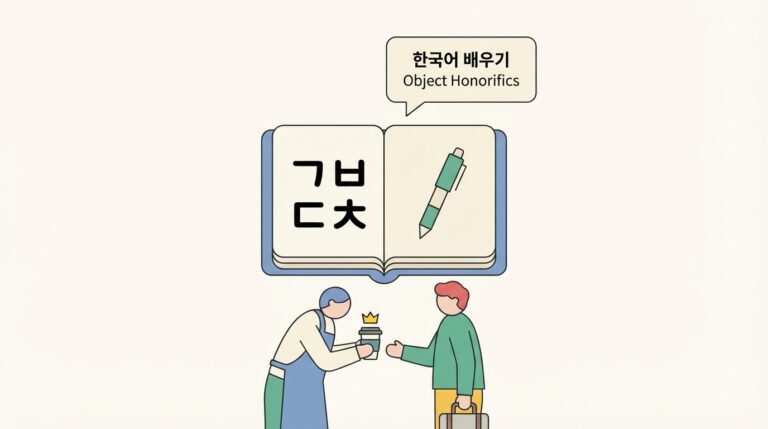
Phase 1: The Coffee That Became a King ☕👑
안녕하세요! I’m your Lead Editor at Daily Hangul.
Picture this: You are at a trendy, bustling cafe in Seongsu-dong (the Brooklyn of Seoul). The aesthetic is industrial, the K-R&B is playing in the background, and your buzzer vibrates. You walk to the counter, and the barista smiles warmly and says:
“주문하신 아메리카노 나오셨습니다.” (The Americano you ordered has come out-[honorific].)
Wait a minute. You’ve studied Korean hard. You know that -시- (shi) is the magic syllable used to elevate a person (like a boss, a grandfather, or a teacher). But since when did an Iced Americano get royal treatment? Did the coffee bean graduate from Seoul National University?
Welcome to the fascinating, sometimes hilarious world of Indirect Honorifics (간접 높임). At the B2 level, textbooks tell you one thing, but the streets of Seoul will show you another. If you don’t understand this concept, you might end up elevating your own dog, or worse, accidentally disrespecting your boss by not elevating their necktie! Let’s dive deep into the invisible rules of Korean politeness.
Phase 2: Deep Dive into Indirect Honorifics 🔍
The rule is simple but profound: “To elevate the King, you must elevate the King’s belongings.” In Korean, we don’t just respect the listener; we respect their body parts, their family members, their possessions, and even their thoughts.
1. [Noun]이/가 예쁘시네요 (Elevating Body Parts)
- Pronunciation: [Noun]-i/ga ye-ppeu-si-ne-yo. (Tip: The ‘으’ (eu) in ‘예쁘’ sounds like the disgusted sound you make when stepping in gum. ‘시’ sounds like the English word ‘she’.)
- Meaning: Your [Noun] is very pretty.
- K-Culture Moment: Imagine a K-Pop fan meeting. A fan is sitting in front of their favorite idol. They look into the idol’s eyes and say, “오빠, 눈이 참 예쁘세요!” (Oppa, your eyes are so pretty!). By adding
-시-to ‘pretty’, the fan isn’t respecting the eyeball itself; they are respecting the idol who owns the eyeball. - Editor’s Insight: This feels very warm and observant. It’s the ultimate compliment formula.
- Situation Spectrum:
[🚫 절대 금지] ———— [⚠️ 주의] ———— [✅ 자유롭게]- Friends (Casual): 🚫 (Too formal! Just say 예뻐요)
- Colleagues/Acquaintances: ✅
- Boss/Elders (Formal): ✅
- 🤔 Think About It: Why does Korean require us to respect body parts? Does your native language have a way to elevate someone’s physical features to show respect?
2. [Noun]이/가 있으시다 (Elevating Possessions / Time)
- Pronunciation: [Noun]-i/ga i-sseu-si-da.
- Meaning: You have [Noun]. (Literal: The [Noun] exists-[honorific]).
- K-Culture Moment: In a corporate K-Drama like Misaeng, a junior employee tentatively approaches the boss’s desk: “부장님, 혹시 오늘 시간 있으십니까?” (Boss, by any chance, do you have time today?).
- Editor’s Insight: Never ask your boss “시간 있어요?” (Do you have time?). Elevating their time shows that you value their schedule as highly as you value them.
- Situation Spectrum:
[🚫 절대 금지] ———— [⚠️ 주의] ———— [✅ 자유롭게]- Friends (Casual): 🚫
- Colleagues (Semi-formal): ✅
- Boss/Elders (Formal): ✅
- 🤔 Think About It: Time is money, but in Korea, someone’s time is their authority. How do you politely ask for someone’s time in your culture?
3. 말씀이 맞으십니다 (Elevating Thoughts & Words)
- Pronunciation: mal-sseu-mi ma-jeu-sim-ni-da.
- Meaning: What you said is correct. / You are right.
- K-Culture Moment: A tense boardroom meeting. The CEO makes a sharp observation. The department head nods deeply and says, “네, 대표님 말씀이 맞으십니다.” (Yes, CEO, your words are correct.)
- Editor’s Insight: ‘말씀’ is the honorific noun for ‘말’ (words), and ‘맞으십니다’ elevates the state of being correct. It’s the ultimate “I agree with you respectfully.”
- Situation Spectrum:
[🚫 절대 금지] ———— [⚠️ 주의] ———— [✅ 자유롭게]- Friends (Casual): 🚫 (Sounds like a historical drama!)
- Colleagues (Semi-formal): ⚠️ (A bit too stiff for peers)
- Boss/Elders (Formal): ✅
Phase 3: Textbook vs Real Life 📖 vs 🗣️
| 상황 (Situation) | 📖 교과서 한국어 (Textbook) | 🗣️ 진짜 한국어 (Real Life) | 💡 왜 다를까? (Why the difference?) |
|---|---|---|---|
| Commenting on a boss’s item | 부장님, 넥타이가 멋있어요. (Your tie is cool) | 부장님, 넥타이가 참 멋있으시네요. | We elevate the tie because it belongs to the boss. |
| At a cafe (Receiving an order) | 아메리카노 나왔습니다. (The Americano is out) | 아메리카노 나오셨습니다. | Hyper-correction! The service industry elevates the product to make the customer feel like royalty. |
| Asking about family | 할아버지, 고양이가 예뻐요. (Grandpa, the cat is pretty) | 할아버님, 고양이가 예쁘시네요. | Even the grandfather’s pet gets elevated status! |
Bottom Note: As a B2 learner, you should know that “커피 나오셨습니다” (The coffee has come out-[honorific]) is grammatically incorrect. But you should also know that you will hear it everywhere. Don’t correct the barista; just smile and take your royal coffee!
Phase 4: K-Culture Deep Dive 🌊
4-1. Non-verbal Communication: The Art of Nunchi (눈치)
When using indirect honorifics, body language is crucial. If you say “말씀이 맞으십니다” (Your words are correct) to an elder, you shouldn’t stare fiercely into their pupils. In Korean culture, unbroken, intense eye contact with a superior can feel challenging. Instead, aim your gaze softly at the bridge of their nose or their tie. Combine it with a slight nod, and you’ll look like a true local.
4-2. K-Beauty & The “Customer is King” Mentality
If you walk into a high-end K-Beauty store in Myeongdong, prepare to be showered with indirect honorifics. The staff will elevate your skin, your hair, and your choices.
“고객님, 피부가 참 좋으세요!” (Customer, your skin is so nice!)
“이 컬러가 고객님께 딱 맞으세요!” (This color fits you perfectly!)
This extreme level of politeness is born from Korea’s intense service culture. The staff uses language to build an invisible throne for you. By elevating everything attached to you, they elevate your shopping experience.
Phase 5: Immersive Roleplay 🎭
Scenario A: The Myeongdong Boutique
Setting: Saturday afternoon. A bright, trendy clothing boutique in Myeongdong. You are trying on a winter coat.
Characters:
– YOU: A B2 Korean learner, looking for a warm coat for the Seoul winter.
– Min-ji (25): The enthusiastic store clerk who wants to make a sale.
Min-ji: 어머, 손님! 그 코트가 정말 잘 어울리세요! ✨
(eo-meo, son-nim! geu ko-teu-ga jeong-mal jal eo-ul-li-se-yo!)
[Oh my, customer! That coat looks really good on you!]
(🎭 Min-ji claps her hands lightly, looking at you in the mirror)
YOU: 아, 정말요? 이거 요즘 인기 있는 디자인인가요?
(a, jeong-mal-yo? i-geo yo-jeum in-gi it-neun di-ja-in-in-ga-yo?)
[Oh, really? Is this a popular design these days?]
Min-ji: 네! 손님 안목이 참 높으세요! 제일 잘 나가는 상품이에요.
(ne! son-nim an-mo-gi cham no-peu-se-yo! je-il jal na-ga-neun sang-pu-mi-e-yo.)
[Yes! Your eye for fashion (taste) is very high-[honorific]! It’s our best-selling item.]
(🎭 Min-ji fixes the collar of your coat)
Min-ji: 그런데 혹시, 이 색상 말고 블랙은 없으신가요? (Wait, did she just elevate the color black?)
(geu-reon-de hok-si, i saek-sang mal-go beul-lae-geun eop-seu-sin-ga-yo?)
[But by any chance, do you not have black instead of this color?]
🔀 Your Turn! How should Min-ji actually say this if she followed strict grammar?
– A) “블랙은 없어요?” (Standard, polite)
– B) “블랙이 안 계신가요?” (Extremely wrong – treating the color black as a living human)
– C) “블랙은 없으세요?” (What she actually said – hyper-correction)✅ Best Choice: A. Grammatically, the coat is an object, so “블랙은 없어요?” is correct. However, in retail, you will almost always hear C because clerks reflexively attach
-시-to anything related to the customer’s choice!
Scenario B: Bonus K-Cafe Moment ☕
Setting: A busy cafe after lunch.
Barista: 진동벨 3번 고객님! 주문하신 아이스 아메리카노 나오셨습니다!
(jin-dong-bel sam-beon go-gaeng-nim! ju-mun-ha-sin a-i-seu a-me-ri-ka-no na-o-syeot-seum-ni-da!)
[Customer with buzzer number 3! Your iced Americano has come out-[honorific]!]
YOU (Thinking to yourself): (Ah, the legendary Coffee Honorific! I must bow to His Majesty, Lord Americano.)
YOU: 네, 감사합니다!
(ne, gam-sa-ham-ni-da!)
Phase 6: 10-Second Shadowing Drill 🗣️
Ready to sound like a native? Repeat these phrases out loud. Pay attention to the pauses (/) and the emotional tags!
- 😊 Complimenting a boss:
부장님, / 넥타이가 참 / 멋있으시네요!
(bu-jang-nim, / nek-ta-i-ga cham / meo-si-sseu-si-ne-yo!) -
🥺 Asking a favor respectfully:
선생님, / 혹시 지금 / 시간 있으세요?
(seon-saeng-nim, / hok-si ji-geum / si-gan i-sseu-se-yo?) -
😤 Agreeing with authority:
네, / 대표님 말씀이 / 맞으십니다.
(ne, / dae-pyo-nim mal-sseu-mi / ma-jeu-sim-ni-da.)
Phase 7: K-Culture Mini Glossary 📖
| 한국어 (Korean) | Romanization | English | 맥락 설명 (Context) |
|---|---|---|---|
| 간접 높임 | ganjeop nopim | Indirect Honorifics | Elevating the listener by adding honorifics to their possessions, body parts, or thoughts. |
| 사물 존칭 | samul jonching | Object Honorifics | Grammatically incorrect but socially rampant practice of elevating objects (like coffee or clothes) in the service industry. |
| 안목 | anmok | Discerning eye / Taste | Used to compliment someone’s taste. (“안목이 있으시네요” – You have great taste). |
| 서비스 마인드 | seobiseu maindeu | Service Mindset | The deep-rooted Korean culture of treating customers with utmost respect. |
| 눈치 | nunchi | Social awareness | Reading the room. Knowing when to use these honorifics requires high nunchi. |
Phase 8: Traveler’s Survival Kit 🧳
As a tourist, you will be on the receiving end of indirect honorifics all the time. If you don’t know this grammar, you might misunderstand the clerk!
🆘 Top 3 Survival Phrases to Understand in Stores:
🇰🇷 “고객님, 사이즈가 없으세요.” (go-gaeng-nim, sa-i-jeu-ga eop-seu-se-yo.)
– 🗣️ Literal: Customer, you don’t have the size.
– 🎯 Real Meaning: We don’t have your size in stock.🇰🇷 “포장해 드릴까요?” (po-jang-hae deu-ril-kka-yo?)
– 🗣️ Meaning: Shall I wrap it for you? (Often used for “To-go” at restaurants/cafes).🇰🇷 “결제 도와드리겠습니다.” (gyeol-je do-wa-deu-ri-get-seum-ni-da.)
– 🗣️ Meaning: I will help you with the payment. (Instead of just saying “Pay here”, they “help” you!).💡 Pro Tip: When the cashier asks you a question with
-으세요(euseyo), they are showing you respect. Just smile, nod, and hand over your card. Korea is a card-dominated country; even a $1 water bottle can be paid with a card!
Phase 9: Think Deeper — “한 발 더 깊이” 🧠
Language & Power: The “Customer is King” Phenomenon
Have you ever wondered why Korean cafe workers say “커피 나오셨습니다” (Coffee has come out-[honorific]) even though every Korean native speaker learns in middle school that this is grammatically wrong? It’s a fascinating look at the intersection of language and power.
In modern hyper-capitalist Korea, the customer holds immense power (often referred to as 갑을 관계 – the power dynamic between buyer and seller). To avoid even the slightest chance of sounding disrespectful, service workers reflexively attach the honorific -시- to everything connected to the customer—even the customer’s iced americano. It’s a linguistic buffer, a shield against complaints. While scholars complain about the “destruction of the Korean language,” it continues to thrive because, in the real world, politeness often trumps perfect grammar.
💬 Your Turn: In your culture, do service workers change their language drastically to accommodate customers? Do you have an equivalent of “hyper-politeness”? Share in the comments!
Phase 10: FAQ & Troubleshooting 🛠️
❌ Common Mistake #1: Elevating your own stuff!
Many B2 learners learn -시- and get too excited. They say: “제 이름은 데이비드이십니다.” (My name is David-[honorific]).
Rule: NEVER elevate yourself or your own belongings. Keep it humble: “제 이름은 데이비드입니다.”
❌ Common Mistake #2: Elevating the boss’s wife to the boss?
Wait, what if you are talking to your boss about the CEO? This gets into 압존법 (Relative Honorifics), which is fading in modern Korea, but as a rule of thumb: Always elevate the person you are talking to, and things directly related to them.
Q: “Can I write fan letters using indirect honorifics?”
A: Yes! Saying “오빠, 목소리가 참 좋으세요” (Your voice is so nice) is incredibly sweet and respectful. It shows you are not just a fan, but an educated speaker who respects them as a person.
Phase 11: Wrap-up & Action Items 🎬
One-Liner Summary: Indirect honorifics let you treat the listener like royalty by showing deep respect for their time, thoughts, and belongings!
Action Mission:
– 🥉 Bronze (Solo): Stand in front of a mirror and practice saying: “시간 있으세요?” 3 times naturally.
– 🥈 Silver (Online): Go to your favorite K-Pop idol’s Instagram or Weverse and leave a comment: “[Name]님, 눈이 참 예쁘세요!”
– 🥇 Gold (Real World): Next time you visit a Korean cafe or restaurant, listen closely. Can you catch a worker using the “Object Honorific” (사물 존칭) like “나오셨습니다”?
Phase 12: Interactive Challenge 🏆
Let’s test your B2 instincts!
1. Fill in the Blank (Situational)
You are at a company dinner. The CEO says the meat here is delicious. You want to agree politely.
“대표님 ______이/가 맞으십니다.”
A) 생각 (Thoughts)
B) 말씀 (Words)
C) 입맛 (Taste buds)
(Hint: Review Phase 2!)
2. True or False: K-Culture Edition
“If a Korean store clerk asks 영수증 필요하세요? (Do you need a receipt-[honorific]), it means they are elevating the receipt.”
(True or False?)
3. The Nunchi Test
You want to tell your Korean mother-in-law that her bag looks heavy. What is the BEST phrase?
A) 어머니, 가방이 무거워요. (Mother, the bag is heavy.)
B) 어머니, 가방이 무거우시죠. (Mother, the bag is heavy-[honorific], right?)
C) 어머니, 제 가방이 무거우세요. (Mother, my bag is heavy-[honorific].)
(Answers: 1: B, 2: False – they are elevating YOU, the listener, who is doing the ‘needing’. 3: B – Elevating her bag shows respect to her!)
Frequently Asked Questions (FAQ)
Q: What does "[Noun]이/가 예쁘시네요 (Elevating Body Parts)" mean in Korean and how do you pronounce it?
A: In Korean, "[Noun]이/가 예쁘시네요 (Elevating Body Parts)" is pronounced [Noun] and means: Your [Noun] is very pretty.
Q: What does "[Noun]이/가 있으시다 (Elevating Possessions / Time)" mean in Korean and how do you pronounce it?
A: In Korean, "[Noun]이/가 있으시다 (Elevating Possessions / Time)" is pronounced [Noun] and means: You have [Noun]. (Literal: The [Noun] exists-[honorific]).
Q: What does "말씀이 맞으십니다 (Elevating Thoughts & Words)" mean in Korean and how do you pronounce it?
A: In Korean, "말씀이 맞으십니다 (Elevating Thoughts & Words)" is pronounced [mal-sseu-mi ma-jeu-sim-ni-da.] and means: What you said is correct. / You are right.







