

Phase 1: Immersive Hook
Hello! I’m your Daily Hangul Editor, your local culture navigator and veteran Korean tutor.
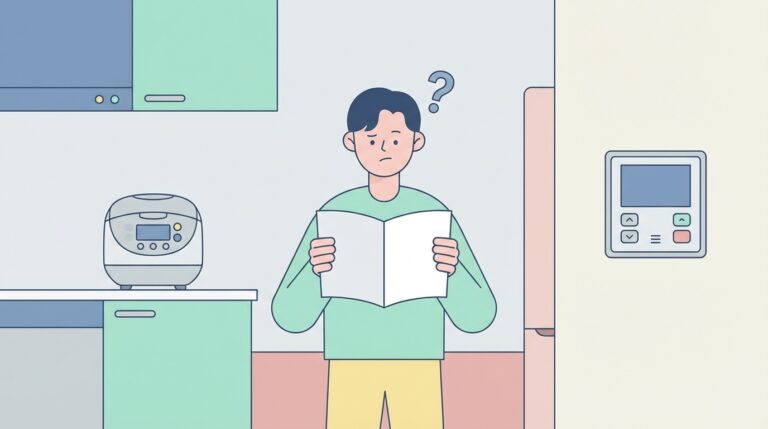
Picture this: You’ve just arrived at your cozy Airbnb in Seoul. It’s mid-December, freezing outside, and you are ready to warm up. You look at the wall to turn on the floor heating (Ondol), and suddenly you’re faced with a tiny digital screen and 15 different buttons—all labeled in Korean. 외출? 예약? 온수? You open the host’s manual, but it feels like you’re trying to decode an ancient manuscript. Or maybe you just bought a high-tech rice cooker, and it keeps enthusiastically talking to you in Korean every time you plug it in. What is it saying?!
When living in or visiting Korea, dealing with electronics (전자제품) and A/S (After-Sales service) is a rite of passage. Knowing how to read a basic manual or explain that your gadget is acting up won’t just save you from cold showers or burnt rice—it will make you feel like a true local who can navigate Korea’s hyper-convenient, tech-savvy society.
This guide is crafted from the real panic moments of my students. Let’s decode this together!
Phase 2: Deep Dive into Key Expressions
1. 전원을 켜다 / 끄다
- Pronunciation: jeonwoneul kyeoda / kkeuda [jeon-won-eul kyeo-da / kkeu-da]
- Meaning: (Literal) To turn on/off the power source. -> (Real nuance) To turn it on/off.
- K-Culture Moment: You’ll see the word ‘전원’ (power) on almost every Korean appliance manual. In a K-Drama office scene, when a presentation screen suddenly goes black, the panicked employee will shout, “전원이 꺼졌어요!” (The power went off!).
- Editor’s Insight: While manuals use the formal “전원” (power), in daily conversation, we usually drop it and just say “켜요” (turn it on) or “꺼요” (turn it off). Think of ‘전원’ as the label you read, and ‘켜다/끄다’ as the action you speak.
- Situation Spectrum:
[🚫 절대 금지] ———— [⚠️ 주의] ———— [✅ 자유롭게]
- Friends (Casual): ✅ (이거 켜봐 – Turn this on)
- Co-workers (Semi-formal): ✅ (전원 켜주세요 – Please turn on the power)
- Boss/Elders (Formal): ✅ (전원을 켜주시겠어요? – Could you turn on the power?)
- 🤔 Think About It: In Korean, we use the same verb for turning on a computer, a light, and a TV (켜다). Does your native language differentiate between “turning on” electronics and “lighting” a fire? In Korean, they share the same root!
2. 고장 나다
- Pronunciation: gojang nada [go-jang na-da]
- Meaning: (Literal) A breakdown occurs. -> (Real nuance) To be broken / out of order.
- K-Culture Moment: If your hotel’s hair dryer stops working, you bring it to the front desk and simply say, “이거 고장 났어요” (This is broken). It’s the ultimate magic phrase to get a replacement or trigger Korea’s legendary A/S.
- Editor’s Insight: Notice how it’s not “I broke it,” but rather “a breakdown occurred” (나다 = to occur/happen). Korean language often removes the subject’s direct blame in unfortunate situations. It feels less aggressive and more objective.
- Situation Spectrum:
[🚫 절대 금지] ———— [⚠️ 주의] ———— [✅ 자유롭게]
- Friends (Casual): ✅ (야, 내 폰 고장 났어 – Hey, my phone is broken)
- Co-workers (Semi-formal): ✅ (프린터가 고장 났습니다 – The printer is broken)
- Boss/Elders (Formal): ✅ (에어컨이 고장 난 것 같습니다 – It seems the AC is broken)
- 🤔 Think About It: Why does Korean prefer passive or event-focused phrasing (a breakdown happened) rather than agent-focused phrasing (I broke it)? How does this relate to maintaining harmony (Kibun) in social interactions?
3. 설명서를 읽어보다
- Pronunciation: seolmyeongseoreul ilgeoboda [seol-myeong-seo-reul il-geo-bo-da]
- Meaning: (Literal) To try reading the explanation paper. -> (Real nuance) To read the manual.
- K-Culture Moment: When you buy a DIY furniture piece from IKEA in Korea, your friend might say, “설명서 먼저 읽어봐” (Read the manual first) before you inevitably ignore it and start hammering away.
- Editor’s Insight: Look at the suffix ‘-보다’ (to try). In Korean, we rarely just “read” a manual; we “try reading” it. It softens the command, making it sound like a helpful suggestion rather than a strict order.
- Situation Spectrum:
[🚫 절대 금지] ———— [⚠️ 주의] ———— [✅ 자유롭게]
- Friends (Casual): ✅
- Co-workers (Semi-formal): ✅
- Boss/Elders (Formal): ⚠️ (Use ‘읽어보세요’ carefully; it might sound like you are instructing them. Better to say “제가 설명서를 읽어보겠습니다” – I will read the manual).
Phase 3: Textbook vs Real Life
When dealing with electronics, the written manual is highly formal, but how Koreans actually talk about them is full of slang and shortcuts.
| Situation | 📖 Textbook Korean | 🗣️ Real Korean | 💡 Why the difference? |
|---|---|---|---|
| Device won’t start | 기기가 작동하지 않습니다. (Device doesn’t operate) | 이거 안 켜져요. 아예 먹통이에요. (It won’t turn on. It’s totally dead/unresponsive) | ‘먹통’ (inkwell) is a common slang for electronics that freeze, reflecting our frustration with unresponsive tech! |
| Asking to fix it | 수리를 요청합니다. (I request a repair) | AS(에이에스) 맡겨야겠어요. (I should drop it off for A/S) | Koreans use the Konglish abbreviation “A/S” (After Service) for anything related to repairs and warranties. |
| Pressing a button | 시작 버튼을 누르십시오. (Press the start button) | 그냥 이거 눌러. (Just press this) | Manuals use the highly formal ‘-십시오’, but in daily life, efficiency and speed (pali-pali) win. |
Bottom Note for B1 Learners: Using “먹통이에요” (It’s unresponsive) at an A/S center will instantly make you sound like you’ve lived in Seoul for years!
Phase 4: Cultural Deep Dive
4-1. Non-verbal Communication: The “Tap & Shake”
When a Korean encounters a broken device, the first instinct isn’t to read the manual. It’s to give the device a gentle (or sometimes not-so-gentle) tap on the side, or shake the remote control. If you bring a broken item to a friend, hand it to them with both hands while sighing, “이거 안 돼요…” (This isn’t working…).
4-2. K-Culture Connection: Pali-pali Meets High Tech
Korea’s pali-pali (hurry, hurry) culture has created an interesting paradox with user manuals.
The Reality of Manuals: There is a running joke in Korea: “설명서는 버리는 것” (Manuals are meant to be thrown away). Koreans are early adopters and highly intuitive with tech. Instead of reading a 50-page booklet, a typical Korean will just plug it in and press buttons until it works. If it doesn’t? They immediately search for a 3-minute YouTube tutorial or a Naver blog post.
The Legendary A/S Culture: If the device actually breaks, Korea’s “A/S” (After Service) is world-renowned. In K-Dramas, you rarely see people fixing their own laptops or washing machines. Instead, an incredibly polite technician from a major brand (like Samsung or LG) arrives at their door the very next day, wearing a clean uniform and little shoe covers. For Koreans, buying an electronic device isn’t just about the hardware; it’s about buying the peace of mind that comes with lightning-fast A/S.
Phase 5: Immersive Roleplay
Scenario A: The Airbnb Boiler Crisis
- Setting: Friday night, 11:00 PM. A cozy but freezing Airbnb in Hongdae. You and your Korean friend are wearing thick padded jackets indoors. You are staring at a wall-mounted boiler controller that has way too many buttons.
- Characters:
- YOU: An international student who just moved into this Airbnb.
- Min-su (25): Your helpful but impatient Korean friend.
Min-su: 아, 진짜 너무 춥다! 보일러 안 틀었어? 🥶
(A, jinjja neomu chupda! boilleo an teureosseo?)
[Ah, it’s seriously so cold! Didn’t you turn on the boiler?]
(🎭 Min-su rubs his arms and walks toward the wall controller)
YOU: 틀고 싶은데, 어떻게 하는지 모르겠어.
(Teulgo sipeunde, eotteoke haneunji moreugesseo.)
[I want to turn it on, but I don’t know how.]
Min-su: 설명서 없어? 호스트가 안 줬어?
(Seolmyeongseo eopseo? hoseuteuga an jwosseo?)
[Is there no manual? Didn’t the host give you one?]
YOU: 여기 있어. 근데 다 한국어라서 너무 어려워.
(Yeogi isseo. Geunde da hangugeoraseo neomu eoryeowo.)
[It’s here. But it’s all in Korean so it’s too difficult.]
(🎭 You hand him a slightly crumpled piece of paper)
Min-su: 어… 보자. ‘전원 버튼을 누르고 희망 온도를 설정하세요.’
(Eo… boja. ‘jeonwon beoteuneul nureugo huimang ondoreul seoljeonghaseyo.’)
[Uh… let’s see. ‘Press the power button and set the desired temperature.’]
YOU: 전원 버튼? 이거 빨간색 버튼?
(Jeonwon beoteun? igeo ppalgansaek beoteun?)
[Power button? This red button?]
(🎭 You press the red button. A little flame icon pops up on the screen)
Min-su: 오, 켜졌다! 이제 온도 올려봐.
(O, kyeojyeotda! ije ondo ollyeobwa.)
[Oh, it turned on! Now try raising the temperature.]
YOU: 올렸는데… 갑자기 에러(Error) 소리가 나. 고장 난 거 아냐?
(Ollyeonneunde… gapjagi ereo soriga na. Gojang nan geo anya?)
[I raised it but… suddenly it’s making an error sound. Isn’t it broken?]
🔀 Your Turn! What should you suggest next?
– A) “호스트한테 전화해 보자.” (Let’s call the host.)
– B) “내일 A/S 센터에 가자.” (Let’s go to the A/S center tomorrow.)
– C) “설명서를 처음부터 끝까지 다시 읽어보자.” (Let’s read the manual again from start to finish.)✅ Best Choice: A — Why: It’s an Airbnb, so calling the host is the safest and most common action. B is incorrect because you don’t own the appliance to request A/S. C is noble, but your Korean friend Min-su will likely lose his patience and just push buttons!
(Continuing with Choice A)
YOU: 안 되겠다. 호스트한테 전화해 보자.
(An doegetda. Hoseuteuhante jeonhwahae boja.)
[This won’t work. Let’s try calling the host.]
Min-su: 그래, 그게 제일 빠르겠다. 감기 걸리겠어.
(Geurae, geuge jeil ppareugetda. Gamgi geolligesseo.)
[Yeah, that would be the fastest. We’re going to catch a cold.]
Scenario B: Bonus Roleplay – Buying Tech at Olive Young
You are buying a hair curler (고데기 – godegi) and need to know if it works in your home country.
YOU: 저기요, 이거 설명서에 프리볼트(free voltage)라고 적혀 있나요?
[Excuse me, does it say ‘free voltage’ in the manual for this?]
Staff: 아, 고객님. 그 제품은 한국 전용이라서 돼지코(adapter) 쓰셔도 외국에선 고장 날 수 있어요.
[Ah, customer. That product is strictly for Korea, so even if you use an adapter, it might break abroad.]
YOU: 아… 그럼 다른 걸로 볼게요. 감사합니다!
[Ah… then I’ll look at something else. Thank you!]
Phase 6: 10-Second Shadowing Drill
Read these out loud to practice your intonation and pacing! The slashes (/) indicate where to pause.
- 🥺 (Frustrated) 이거 / 아예 먹통이에요. / 어떻게 켜요?
(igeo / aye meoktongieyo. / eotteoke kyeoyo?)
[This is completely dead. How do I turn it on?] -
😊 (Relieved) 아! / 설명서 보니까 / 알겠어요.
(a! / seolmyeongseo bonikka / algesseoyo.)
[Ah! After looking at the manual, I understand.] -
😤 (Urgent) 에어컨이 / 고장 났어요. / A/S 불러주세요!
(eeokeoni / gojang nasseoyo. / ei-e-seu bulleojuseyo!)
[The AC is broken. Please call A/S!]
Phase 7: K-Culture Glossary (Tech & Manual Edition)
| Korean | Romanization | English | Context/Meaning |
|---|---|---|---|
| 에이에스 (A/S) | ei-e-seu | After-Sales Service | Used for repairs, warranties, or customer service. |
| 돼지코 | dwaejiko | Plug adapter | Literal translation: “Pig nose.” It refers to the travel adapters that look like a pig’s snout. |
| 먹통 | meoktong | Unresponsive / frozen | Used when a device completely freezes or stops working. |
| 무음 | mueum | Silent mode | Crucial for riding the Korean subway; taking your phone off ring volume. |
| 보일러/온돌 | boilleo/ondol | Floor heating | Korea’s traditional and modern way of heating homes from the floor up. |
| 취사 | chwisa | Cooking (rice) | The button you must press on a Korean rice cooker. If you hear “취사를 시작합니다”, you are safe! |
Phase 8: Traveler’s Survival Kit
If you are traveling in Korea, appliances in hotels, Airbnbs, and cafes can be tricky. Here are your lifesavers!
🆘 Survival Expressions for Tech Issues
1. 🇰🇷 “이거 작동이 안 돼요.” (igeo jakdongi an dwaeyo.)
– 🗣️ English: This isn’t operating/working.
– 📍 Use it at: Hotel front desk, Airbnb messages, cafes.
2. 🇰🇷 “충전기 꽂을 데 있어요?” (chungjeongi kkojeul de isseoyo?)
– 🗣️ English: Is there a place to plug in a charger?
– 📍 Use it at: Cafes, restaurants.
3. 🇰🇷 “와이파이 비밀번호 뭐예요?” (waipai bimilbeonho mwoyeyo?)
– 🗣️ English: What is the Wi-Fi password?
– 📍 Use it at: Literally everywhere in Korea.📌 Editor’s Travel Note
– Voltage: Korea uses 220V. If your device is 110V, you don’t just need a “돼지코” (adapter); you might need a transformer. Don’t plug a 110V hair dryer directly into a Korean wall—it will fry!
– Public Wi-Fi: Korea is a Wi-Fi paradise. If the cafe receipt doesn’t have the password, check the counter or a sticker on the wall.
Phase 9: Think Deeper — “One Step Further”
Global Era: Tech Konglish vs. Pure Korean
Look at Korean tech vocabulary: 에어컨 (Aircon), 리모컨 (Remocon – remote control), 스마트폰 (Smartphone), A/S (After Service). In the realm of electronics, Korea has heavily adopted and altered English words, creating “Konglish.” However, the verbs we attach to them—켜다 (turn on), 끄다 (turn off), 고장 나다 (break down)—remain deeply rooted in traditional Korean.
This blend reflects Korea’s rapid modernization. The technology was imported or rapidly developed in a globalized era, hence the English-based nouns. But the way people interact with the objects remains fundamentally Korean.
💬 Your Turn: Does your language borrow English words for modern technology, or do you invent new words in your own language? Share with us in the comments!
Phase 10: FAQ & Troubleshooting
Q1: Can I say “이거 부서졌어요” (This is broken/smashed) when my TV won’t turn on?
❌ No! 부서지다 means physically shattered into pieces (like dropping a glass or smashing a screen). If the TV looks fine but mechanically won’t turn on, you must use 고장 나다 (to have a mechanical breakdown).
Q2: I bought a camera in Korea. Can I get A/S anywhere?
In Korea, A/S is heavily tied to the brand. If you buy a Samsung, you go to a “Samsung Service Center.” They won’t fix an LG camera. Luckily, major brand service centers are everywhere in Korean cities!
Q3: Can I ask a cafe staff to charge my phone for me?
Yes! In the past, Koreans always left their phones at the counter to charge, saying “충전 좀 해주실 수 있나요?” (Could you charge this for me?). Nowadays, with power banks (보조배터리) available for rent everywhere, it’s less common, but still widely accepted.
❌ Common Mistake #1: Throwing away the receipt immediately. In Korea, you usually need the receipt (영수증) to prove the purchase date for your 1-year free A/S warranty!
Phase 11: Wrap-up & Action Items
One-Liner Summary: Whether you’re turning it on (켜다), turning it off (끄다), or dealing with a breakdown (고장 나다), reading the manual (설명서) is your first step to surviving Korean tech!
Action Mission 3 Steps:
– 🥉 Bronze (Solo): Look at your smartphone. Change the language to Korean for 5 minutes and try to find the “Settings” (설정) and “Power off” (전원 끄기) options.
– 🥈 Silver (Online): Write a comment below using today’s vocabulary: “My [Device] is broken!” (e.g., 제 노트북이 고장 났어요).
– 🥇 Gold (Real Life): Next time you are in a Korean cafe or hotel, politely ask where the outlet is using the survival phrases!
K-Culture Mission: Go to YouTube and search for “밥솥 취사 소리” (Rice cooker cooking sound). Listen to the polite Korean voice your appliance uses to talk to you. You’ll hear the exact formal Korean used in manuals!
Phase 12: Interactive Quiz
1. Situational Judgment: You are at a Korean PC Bang (Internet Cafe). The computer screen is completely black and won’t turn on. You call the staff. What is the most natural thing to say?
– A) 전원이 켜지지 않습니다.
– B) 컴퓨터가 아예 먹통이에요.
– C) 컴퓨터가 부서졌어요.
2. Fill in the Blank:
“에어컨 안 시원해. 이거 [ ______ ] 난 것 같아. A/S 부르자.”
(The AC isn’t cold. I think it’s broken. Let’s call A/S.)
3. True or False – K-Culture Edition:
“Koreans love to carefully read the entire user manual before turning on a new electronic device.”
(Answers: 1: B – A is too textbook/formal, C means physically smashed. 2: 고장. 3: False! The ‘pali-pali’ culture means most Koreans press buttons first and read the manual only if it breaks!)
Frequently Asked Questions (FAQ)
Q: What does "전원을 켜다 / 끄다" mean in Korean and how do you pronounce it?
A: In Korean, "전원을 켜다 / 끄다" is pronounced [jeonwoneul kyeoda / kkeuda [jeon-won-eul kyeo-da / kkeu-da] and means: (Literal) To turn on/off the power source. -> (Real nuance) To turn it on/off.
Q: What does "고장 나다" mean in Korean and how do you pronounce it?
A: In Korean, "고장 나다" is pronounced [gojang nada [go-jang na-da] and means: (Literal) A breakdown occurs. -> (Real nuance) To be broken / out of order.
Q: What does "설명서를 읽어보다" mean in Korean and how do you pronounce it?
A: In Korean, "설명서를 읽어보다" is pronounced [seolmyeongseoreul ilgeoboda [seol-myeong-seo-reul il-geo-bo-da] and means: (Literal) To try reading the explanation paper. -> (Real nuance) To read the manual.







