

Phase 1: Immersive Hook
Hello! I’m your Daily Hangul Editor.
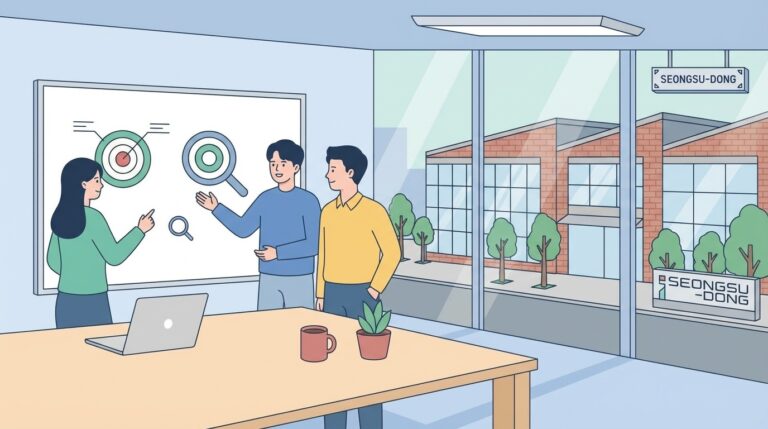
Imagine this: You are sitting in a sleek, glass-walled meeting room in Seongsu-dong, the Brooklyn of Seoul. Your Korean marketing team is brainstorming a launch strategy for a new K-Beauty brand. The Team Lead stares at the whiteboard, sighs, and says, “타깃을 더 뾰족하게 잡으세요.”
Literally translated? “Hold the target more pointedly.”
Wait, what? Are we doing archery or marketing?
If you simply use dictionary translations like “고객층을 정하다” (decide the customer base) in a modern Korean startup or corporate environment, you will certainly be understood. But if you want to sound like a true industry insider—someone who grasps the fast-paced, hyper-competitive Korean market—you need to know how Korean marketers actually talk about segmentation and targeting.
By mastering these expressions, you won’t just survive a business meeting; you’ll earn that coveted nod of respect from your Korean colleagues. Let’s dive into the real-world vocabulary of Korean marketing!
Phase 2: Deep Dive into Core Expressions
1. 취향을 저격하다
- Pronunciation: chwihyang-eul jeogyeokhada [chee-hyang-eul juh-gyuk-ha-da]
- Meaning: (Literal) To snipe someone’s taste / (Real Nuance) To hit the bullseye of the target audience’s preferences perfectly.
- K-Culture Moment: You will hear this everywhere—from a K-pop idol introducing a new concept (“이번 앨범은 팬들 취향 저격입니다!”) to cosmetics ads. In a marketing context, it means creating a product or campaign so perfectly tailored to a specific segment that they can’t help but buy it.
- Editor’s Insight: This phrase carries an energetic, triumphant feeling. It’s not just about “meeting needs”; it’s about evoking a visceral “Wow, they made this just for me!” reaction.
- Situation Spectrum:
[🚫 절대 금지] ———— [⚠️ 주의] ———— [✅ 자유롭게]
- Casual with colleagues: ✅
- Semi-formal (Brainstorming/Presentations): ✅ (Very common in creative industries)
- Highly formal (Reporting to conservative executives): ⚠️ (Use “니즈에 부합하다” instead)
- 🤔 Think About It: Why does Korean use a hunting/military metaphor (“snipe/shoot”) to describe consumer satisfaction? Does your native language use aggressive verbs for successful marketing?
2. 핀셋 마케팅
- Pronunciation: pinset mageting [pin-set ma-keh-ting]
- Meaning: (Literal) Tweezers marketing / (Real Nuance) Hyper-targeting a very specific demographic or niche market.
- K-Culture Moment: Department stores in Gangnam use “tweezers marketing” to offer private shopping sessions exclusively for their top 1% VIPs. Recently, it refers to targeting extreme niche subcultures, like vegan-baking enthusiasts who love vintage cameras.
- Editor’s Insight: This is a classic “Konglish” business term. Just as tweezers pluck a single strand of hair, this strategy plucks a specific persona out of the general public.
- Situation Spectrum:
[🚫 절대 금지] ———— [⚠️ 주의] ———— [✅ 자유롭게]
- Casual with colleagues: ✅
- Semi-formal: ✅
- Highly formal: ✅ (Perfectly acceptable in professional reports)
- 🤔 Think About It: How does “tweezers marketing” reflect the hyper-competitive nature of the Korean market, where general mass marketing often fails?
3. 타깃을 뾰족하게 잡다
- Pronunciation: tagis-eul ppyojokhage japda [ta-gees-eul pyo-jok-ha-geh jap-da]
- Meaning: (Literal) To hold the target sharply / (Real Nuance) To define the target persona with extreme precision.
- K-Culture Moment: A favorite phrase of startup CEOs in Pangyo (Korea’s Silicon Valley). If your target is “Women in their 20s,” a Korean manager will tell you to make it “sharper.” A “sharp” target would be “Women in their late 20s who live alone, work in tech, and seek ‘Gat-saeng’ (highly productive) lifestyles.”
- Editor’s Insight: “뾰족하다” (sharp/pointed) visually represents narrowing down a wide funnel into a sharp, concentrated tip.
- Situation Spectrum:
[🚫 절대 금지] ———— [⚠️ 주의] ———— [✅ 자유롭게]
- Casual: ✅
- Semi-formal: ✅
- Formal: ✅
Phase 3: Textbook vs Real Life
| Situation | 📖 Textbook Korean | 🗣️ Real Korean | 💡 Why is it different? |
|---|---|---|---|
| Defining the audience | 주요 고객층을 정합시다. | 타깃을 더 뾰족하게 잡아보죠. | Startups prefer visual, dynamic slang over static academic terms. |
| Meeting consumer needs | 고객의 요구를 만족시켰습니다. | 고객 니즈(Needs)를 완벽히 저격했죠. | English loanwords (Konglish) are heavily used to sound modern and professional. |
| Dividing the market | 시장을 세분화해야 합니다. | 세그먼트를 더 잘게 쪼개야 해요. | “쪼개다” (to slice/chop) gives a much more hands-on, active feeling than “세분화” (segmentation). |
Bottom Note for C1 Learners: In Korean business, blending native Korean action verbs (잡다, 쪼개다) with English marketing nouns (타깃, 세그먼트, 니즈) is the ultimate way to sound like a native professional.
Phase 4: Cultural Deep Dive
4-1. Non-verbal Communication: The “Nunchi” of Market Reading
In Korean marketing, “Nunchi” (눈치) isn’t just about reading the room; it’s about reading the market’s hidden subtext. When a Korean marketer says, “요즘 20대 타깃은 이런 거 안 좋아해요” (The 20s target doesn’t like this these days), they aren’t relying solely on data. They are using their societal Nunchi—a collective sense of what is currently considered “cringe” versus “trendy” on Korean social media.
4-2. K-Culture Connection: Pop-ups & Fandom “Tweezers Marketing”
Why are there dozens of new “Pop-up Stores” in Seongsu-dong every single week? This is the physical manifestation of 시장 세분화 (Market Segmentation) in Korea.
Brands know they can’t capture everyone with a generic TV commercial anymore. Instead, they use 핀셋 마케팅 (Tweezers Marketing). They open a 5-day pop-up store designed specifically for a hyper-niche fandom—for example, a pop-up entirely themed around a specific webtoon character, offering exclusive “photocards” (포토카드) and limited-edition merchandise. This perfectly hits the “Instagrammable” needs of the MZ generation. It’s not just shopping; it’s an immersive targeting strategy.
Phase 5: Immersive Roleplay Scenario
Main Scenario: The Seongsu-dong Strategy Meeting
- Setting: Friday, 3 PM. A trendy, exposed-brick startup office in Seongsu-dong. The whiteboard is filled with graphs.
- Characters:
- YOU: A foreign marketing manager leading the launch of a new vegan cosmetic line.
- Ji-yoon (30s): Your sharp, trend-savvy Korean Team Lead.
Ji-yoon: 자, 이번 비건 뷰티 신제품, 타깃층을 어떻게 잡을까요? 📊
(Ja, ibeon bigeon byuti sinjepum, tagitcheung-eul eotteoke jabeulkkayo?)
[Alright, how should we set the target audience for this new vegan beauty product?]
YOU: 일단 2030 여성층을 메인으로 세분화해 봤습니다.
(Ildan isamgong yeoseongcheung-eul meineuro sebunhwahae bwatseumnida.)
[For now, I segmented women in their 20s and 30s as the main base.]
Ji-yoon: 흠… 2030 여성이면 범위가 너무 넓어요. 타깃을 더 뾰족하게 잡아야 할 것 같은데요.
(Heum… isamgong yeoseong-imyeon beomwiga neomu neolbeoyo. Tagis-eul deo ppyojokhage jabaya hal geot gateundeyo.)
[Hmm… Women in their 20s and 30s is too broad. We need to define the target much sharper.]
YOU: 맞아요. 그럼 단순히 연령대 말고, 라이프스타일로 접근하는 건 어떨까요?
(Majayo. Geureom dansunhi yeonnyeongdae malgo, raipeuseutailleo jeopgeunhaneun geon eotteolkkayo?)
[Right. Then, instead of just age groups, how about approaching it by lifestyle?]
Ji-yoon: 오, 좋은데요? 구체적인 페르소나가 있나요?
(O, joeundeyo? Guchejeogin pereusonaga innayo?)
[Oh, I like that. Do you have a specific persona in mind?]
YOU: 요즘 유행하는 ‘갓생(Gat-saeng)’을 추구하면서 환경에 관심 많은 직장인 어때요?
(Yojeum yuhaenghaneun ‘gatsaeng’eul chuguhameyeonseo hwangyeong-e gwansim maneun jikjang-in eottaeyo?)
[How about office workers who pursue the trendy ‘highly productive (Gat-saeng)’ lifestyle and care about the environment?]
Ji-yoon: 완벽해요! 그분들 취향을 제대로 저격하려면 패키징도 감성적이어야겠네요.
(Wanbyeokaeyo! Geubundeul chwihyang-eul jedaero jeogyeokharyeomyeon paekijingdo gamseongjeogieoyagenneyo.)
[Perfect! To truly hit the bullseye of their tastes, the packaging needs to be aesthetically pleasing too.]
YOU: 네, 그래서 친환경 종이 패키지를 기획했습니다.
(Ne, geuraeseo chinhwangyeong jong-i paekijireul gihoekaetseumnida.)
[Yes, so I planned eco-friendly paper packaging.]
Ji-yoon: 아주 좋아요. 완전 핀셋 마케팅으로 밀어붙여 봅시다. 런칭 행사는 어디서 할까요?
(Aju joayo. Wanjeon pinset mageting-euro mireobutyeo bopsida. Reonching haengsaneun eodiseo halkkayo?)
[Very good. Let’s push forward with full-on tweezers marketing. Where should we do the launch event?]
🔀 당신의 차례! 어떻게 대답할까요? (Your Turn!)
– A) “저희 회사 회의실에서 간단하게 발표하죠.” (Too boring for this target!)
– B) “성수동에서 이색 팝업 스토어를 열어서 니즈를 공략하시죠!” (Hits the cultural trend!)
– C) “아무 식당이나 빌려서 밥 먹으면서 할까요?” (Completely misses the point!)✅ Best Choice: B — Seongsu-dong is the holy grail for MZ generation marketing. Mentioning a pop-up store proves you don’t just know the language; you know the market.
Phase 6: 10-Second Shadowing Drill
Practice speaking like a confident marketing manager giving a presentation. Pay attention to the pauses (/) and intonation!
😤 단호하고 프로페셔널하게 (Firm and Professional):
“이번 신제품은 / MZ세대의 니즈를 파악해 / 그들의 취향을 / 제대로 / 저격했습니다!”
(ibeon sinjepumeun / M-Z sedae-ui nijeureul paakae / geudeurui chwihyang-eul / jedaero / jeogyeokaetseumnida!)
Phase 7: K-Culture Glossary (Marketing & Trends)
| 한국어 | Romanization | English | Context / Meaning |
|---|---|---|---|
| MZ세대 | M-Z sedae | MZ Generation | Millennials + Gen Z. The ultimate obsession of Korean marketers. Used to describe anyone trendy from teens to late 30s. |
| 가심비 | gasimbi | Cost-to-psychological satisfaction | Consumers paying a premium not for utility, but for emotional satisfaction. Key metric in niche targeting. |
| 갓생 | gatsaeng | “God-life” (Highly productive life) | A behavioral segment of young Koreans striving for extreme daily productivity (e.g., 5 AM workouts, studying after work). |
| 팝업 성지 | pabop seongji | Pop-up holy land | Places like Seongsu or The Hyundai Seoul where targeted pop-up stores are densely concentrated. |
| 페르소나 | pereusona | Persona | Used heavily in Korean startups to describe the exact hypothetical customer of a targeted segment. |
Phase 8: Traveler’s Survival Kit (The Pop-up Hunter)
As a C1 learner visiting Korea, you won’t just go to traditional tourist spots. You’ll likely visit the exact pop-up stores that brands use for their “Tweezers Marketing.” Here’s how to navigate them.
🆘 Survival Phrases for Pop-up Stores
– 🇰🇷 “여기 웨이팅 등록 어떻게 해요?” (yeogi weiting deungnok eotteoke haeyo?)
– “How do I register for the waiting list here?”
– 📍 Use: Outside crowded pop-ups. You usually need to input your phone number on a tablet.
– 🇰🇷 “이거 한정판인가요? 언제까지 팔아요?” (igeo hanjeongpaningayo? Eonjekkaji parayo?)
– “Is this limited edition? Until when do you sell it?”
– 📍 Use: When a brand’s target marketing is creating FOMO (Fear Of Missing Out).
– 🇰🇷 “인스타 팔로우하면 샘플 받을 수 있나요?” (inseuta pallouhamyeon saempeul badeul su innayo?)
– “Can I get a sample if I follow on Instagram?”📌 Editor’s Travel Note:
If you don’t have a Korean phone number (starting with 010), the “CatchTable” or waiting tablets at pop-ups might reject your input. Pro Tip: Look for a staff member and politely say: “제가 외국 번호밖에 없어서요. 따로 웨이팅 할 수 있을까요?” (I only have a foreign number. Is there another way to wait?). They usually have a manual list!
Phase 9: Think Deeper — Konglish in the Global Era
🧠 Language & Power: The Illusion of Professionalism via English
Have you noticed how much English is used in Korean marketing? Target, Needs, Segment, Persona, Insight. In Korean corporate culture, heavily peppering your speech with English loanwords (Konglish) is often perceived as a sign of being educated, modern, and “global.” However, these words are often adapted into uniquely Korean grammatical structures (e.g., “니즈를 저격하다” – Sniping the needs).
Some critics argue this alienates older generations or creates an artificial barrier to entry in the business world. Yet, for young startups, it serves as an in-group dialect that signals agility and trendiness.
💬 Your Turn: Does your industry in your home country borrow heavily from another language to sound “more professional”? Share your thoughts in the comments!
Phase 10: FAQ & Troubleshooting
Q: Can I use “MZ세대 (MZ Generation)” in a formal business report?
Yes! While it sounds like internet slang, it has become a standard demographic term in Korean business, media, and even government reports.
Q: If “취향 저격” means sniping someone’s taste, can I use it toward my boss? (e.g., “부장님 취향 저격이네요!”)
⚠️ Caution. If you are close with your boss and giving them a coffee, it’s a cute, witty compliment. But do not use it to describe an executive’s business decision. It’s meant for consumer trends or lighthearted personal preferences.
❌ Common Mistake #1: Translating “Target audience” literally to “목표 청중” (Mokpyo cheongjung). This sounds like you are reading a 1980s academic paper.
✅ Do this instead: Just use “타깃층” (Target-cheung) or “주요 타깃” (Juyo target).
Phase 11: Wrap-up & Action Items
🎯 One-Liner Summary: To speak like a Korean marketer, don’t just divide customers; “sharpen” your target (타깃을 뾰족하게 잡다) and “snipe” their specific tastes (취향을 저격하다).
🚀 Your Action Missions:
– 🥉 Bronze: Stand in front of a mirror and firmly deliver the shadowing drill sentence.
– 🥈 Silver: Find a Korean advertisement on YouTube and leave a comment: “완전 20대 취향 저격이네요!” (Totally hits the tastes of people in their 20s!).
– 🥇 Gold: The next time you discuss a project with Korean peers, suggest: “타깃을 조금 더 뾰족하게 잡아볼까요?” Watch their eyes light up with respect.
Phase 12: Interactive Quiz
Q1. You are pitching a new fitness app designed specifically for office workers who want to work out at 5 AM. Which phrase best describes this strategy?
1) 글로벌 마케팅 (Global marketing)
2) 핀셋 마케팅 (Tweezers marketing)
3) 레트로 마케팅 (Retro marketing)
Q2. Fill in the blank: “이번 광고는 밀레니얼 세대의 _________을 완벽하게 저격했습니다.” (This ad perfectly hit the bullseye of the millennial generation’s ___.)
1) 나이 (Age)
2) 직업 (Job)
3) 취향 (Taste)
Q3. True or False: To sound professional in a modern Korean startup, you should always strictly use pure native Korean words instead of English loanwords like “타깃” (Target) or “니즈” (Needs).
👀 Click here for Answers!
Q1: 2) 핀셋 마케팅. Because you are hyper-targeting a very specific lifestyle sub-segment (5 AM workers), just like picking something up with tweezers!
Q2: 3) 취향. “취향 저격” is the ultimate pairing for hitting consumer preferences.
Q3: False. In Korean business/marketing, utilizing established Konglish terms (타깃, 세그먼트, 니즈) combined with native verbs (잡다, 쪼개다) actually makes you sound much more like an industry insider.
Frequently Asked Questions (FAQ)
Q: What does "취향을 저격하다" mean in Korean and how do you pronounce it?
A: In Korean, "취향을 저격하다" is pronounced [chwihyang-eul jeogyeokhada [chee-hyang-eul juh-gyuk-ha-da] and means: (Literal) To snipe someone's taste / (Real Nuance) To hit the bullseye of the target audience's preferences perfectly.
Q: What does "핀셋 마케팅" mean in Korean and how do you pronounce it?
A: In Korean, "핀셋 마케팅" is pronounced [pinset mageting [pin-set ma-keh-ting] and means: (Literal) Tweezers marketing / (Real Nuance) Hyper-targeting a very specific demographic or niche market.
Q: What does "타깃을 뾰족하게 잡다" mean in Korean and how do you pronounce it?
A: In Korean, "타깃을 뾰족하게 잡다" is pronounced [tagis-eul ppyojokhage japda [ta-gees-eul pyo-jok-ha-geh jap-da] and means: (Literal) To hold the target sharply / (Real Nuance) To define the target persona with extreme precision.







