

Phase 1: Immersive Hook — The Sound of Modern Seoul
Hello! I’m the Lead Editor of Daily Hangul, your veteran tutor and cultural navigator.
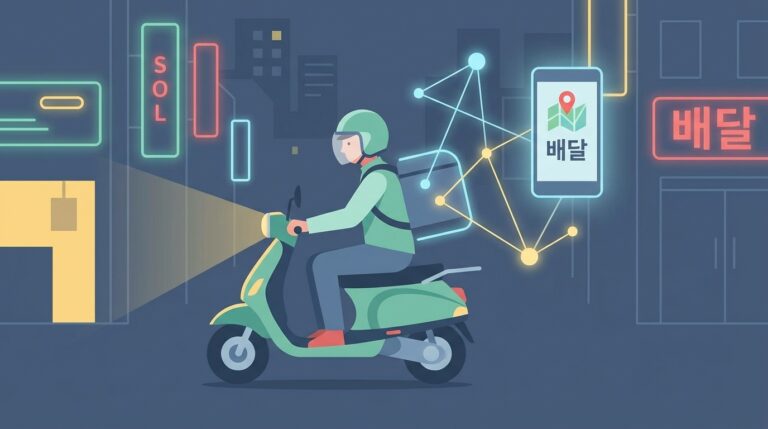
Imagine this: You are sitting at a bustling chicken and beer (Chimaek) restaurant near the Han River. It’s Friday night, 9 PM. Suddenly, you hear a familiar, high-pitched chime echoing from the kitchen: “배달의민족 주문~!” (Order from Baedal Minjok!). Within seconds, a rider in a mint-colored helmet dashes in, grabs a plastic bag, and disappears into the neon-lit Seoul night.
In K-Dramas, these delivery riders are often portrayed as hardworking youths chasing their dreams. But if you turn on the Korean 9 PM news, you’ll hear a very different story—a heated debate about 플랫폼 노동자의 노동권 (Platform Workers’ Labor Rights).
At the C2 level, your goal isn’t just to order food. Your goal is to sit with your Korean colleagues, watch that news broadcast, and engage in a deep, nuanced conversation about the gig economy, algorithms, and the human cost of Korea’s famous “Ppalli-Ppalli” (Hurry-hurry) culture. If you try to translate English debate terms directly into Korean, you’ll sound like a translated textbook.
Today, we are diving deep into the real vocabulary of Korean social issues. Let’s equip you with the words that will make native speakers think, “Wow, this person truly understands Korean society.”
Phase 2: Deep Dive into Core Expressions
To debate platform labor rights like a highly educated native, you need these four advanced expressions.
1. 사각지대에 놓이다
- Pronunciation: sa-gak-ji-dae-e no-i-da (Think of ‘sa-gak’ as a sharp, square corner where you can’t see what’s coming.)
- Meaning: Literal: To be placed in a blind spot. / Real nuance: To fall through the cracks of the system (especially regarding legal or social protection).
- K-Culture Moment: You’ll hear newscasters use this constantly when a tragedy occurs, like a delivery rider getting injured without insurance. “노동법의 사각지대에 놓여 있습니다” (They are placed in the blind spot of labor laws).
- Editor’s Insight: This phrase is incredibly versatile for any social issue. It carries a tone of empathy and systemic critique. It doesn’t just mean a problem exists; it means society has failed to see them.
- Situation Spectrum:
[🚫 절대 금지] ———— [⚠️ 주의] ———— [✅ 자유롭게]
- Casual with friends (about politics): ✅
- Formal debates / Work dinners: ✅
- Ordering food (Daily life): 🚫 (Too academic for casual chatter)
- 🤔 Think About It: Why does Korean heavily use spatial metaphors like ‘사각지대’ (blind spot) or ‘안전망’ (safety net) when discussing social welfare? How does your native language describe systemic failures?
2. 특수형태근로종사자 (특고)
- Pronunciation: teuk-su-hyeong-tae-geun-no-jong-sa-ja (Usually abbreviated as 특고 – teuk-go in the news).
- Meaning: Literal: Special type labor worker. / Real nuance: Independent contractors who work like employees but lack labor rights (e.g., gig workers, delivery riders, insurance agents).
- K-Culture Moment: During a union strike, you’ll see riders holding banners with the word “특고.” It’s the legal loophole that classifies them as ‘freelancers’ so platforms don’t have to pay severance or health insurance.
- Editor’s Insight: If you use the word “특고” in a conversation with a Korean, their jaw will drop. It shows you don’t just know the language; you read Korean newspapers.
- Situation Spectrum:
[🚫 절대 금지] ———— [⚠️ 주의] ———— [✅ 자유롭게]
- Casual with friends: ⚠️ (Might sound a bit stiff, like a politician)
- Work / Academic Debate: ✅
- 🤔 Think About It: By calling them “Special Type” instead of “Workers,” the law shifts responsibility. How does legal terminology shape public perception in your country?
3. 별점 테러
- Pronunciation: byeol-jjeom te-reo (The ‘byeol’ sounds like ‘bell’ with a ‘y’ inside. ‘Te-reo’ is the English word ‘terror’).
- Meaning: Literal: Star rating terror. / Real nuance: Review bombing; leaving malicious 1-star reviews out of spite.
- K-Culture Moment: A customer gets angry because the delivery took 40 minutes instead of 30, so they leave a 1-star review. For platform workers, who are “알고리즘의 노예” (slaves to the algorithm), one ‘별점 테러’ can mean losing their account or getting fewer delivery calls.
- Editor’s Insight: This is a modern, highly common slang used by everyone from teenagers to news anchors. It highlights the absolute power consumers hold over gig workers in Korea’s service-heavy culture.
- Situation Spectrum:
[🚫 절대 금지] ———— [⚠️ 주의] ———— [✅ 자유롭게]
- Casual with friends: ✅
- Work / Office: ✅
- 🤔 Think About It: The concept of “갑질” (abuse of power) is deeply rooted in Korea. Does the gig economy democratize “갑질” by giving every consumer the power to ruin a worker’s livelihood via reviews?
Phase 3: Textbook vs. Real Life Korean
When reading a textbook vs. talking over Soju, the vocabulary shifts dramatically.
| 상황 (Situation) | 📖 교과서 한국어 (Textbook) | 🗣️ 진짜 한국어 (Real Life) | 💡 왜 다를까? (Why the difference?) |
|---|---|---|---|
| Addressing a rider | 배달원 (Delivery person) | 기사님, 라이더님 (Driver, Rider) | ‘원’ sounds bureaucratic. ‘-님’ shows respect for their labor. |
| Waiting for work | 휴식 시간 (Rest time) | 콜 대기 중 (Waiting for a call) | Gig workers don’t ‘rest’; they anxiously wait for the app’s algorithm to assign a task. |
| The Boss | 고용주 (Employer) | 플랫폼 (The Platform) / 알고리즘 | In the gig economy, the human boss is replaced by a faceless app algorithm. |
| Getting fired | 해고되다 (To be fired) | 계정 정지 당하다 (Account suspended) | They aren’t legally “employees,” so they can’t be “fired”—their app access is just revoked. |
Bottom Note: As a C2 learner, you should use the Real Life terms in casual debates, but keep the Textbook terms in your pocket if you are writing a formal essay or taking the TOPIK II exam.
Phase 4: Cultural Deep Dive — The Cost of ‘Ppalli-Ppalli’
4-1. Non-verbal Communication: The Art of Disagreeing Gracefully
Debating social issues in Korea requires high-level 눈치 (Nunchi). If you strongly disagree with a colleague about platform workers’ rights, do not stare them down and say “You’re wrong.”
Instead, tilt your head slightly, inhale a soft “쓰으읍…” (Sseuu-eup) or “음…” (Eum…), and say: “그 말씀도 맞는데…” (What you’re saying is also correct, but…). In Korea, preserving the harmony of the relationship often takes precedence over winning the argument.
4-2. K-Food Connection: The Irony of Baedal Culture
Korea’s delivery culture is world-renowned. You can get a piping hot bowl of Jjamppong delivered to a park bench by the Han River. But this ultra-convenience is fueled by the ‘빨리빨리’ (Hurry-hurry) culture.
Delivery apps show the rider’s GPS location in real-time. If the dot stops at a traffic light for too long, consumers get impatient. This creates a lethal system where riders risk their lives, running red lights, just to beat the algorithm’s timer and avoid a 별점 테러. When you debate this topic, you must acknowledge this cultural paradox: We love the convenience, but we are complicit in the pressure.
Phase 5: Immersive Roleplay — The Company Dinner Debate
Setting: Friday, 7:30 PM. A smoky Samgyeopsal (Pork Belly) restaurant in Gangnam. Bottles of Soju line the table. You are dining with your Korean colleagues. The TV on the wall plays a news report about a delivery rider’s strike demanding minimum wage.
Characters:
– YOU: A foreign professional working in Seoul (C2 level). You care about social justice.
– Min-su (32, Colleague): Practical, slightly cynical, uses delivery apps daily.
– Ji-won (45, Team Leader): Traditional, focuses on the legal/economic aspects.
Dialogue:
Min-su: 아유, 또 파업이야? 요즘 배달비 너무 비싸서 시켜 먹지도 못하겠는데.
(A-yu, tto pa-eob-i-ya? Yo-jeum bae-dal-bi neo-mu bi-ssa-seo si-kyeo meok-ji-do mot-ha-get-neun-de.)
Ugh, another strike? Delivery fees are so expensive lately I can’t even afford to order.
(🎭 Stage Direction: Min-su flips the pork belly, looking annoyed)
Ji-won: 그러게 말이야. 근데 라이더들은 개인사업자잖아? 자기가 일한 만큼 버는 건데 최저임금을 어떻게 보장해 주나?
(Geu-reo-ge mal-i-ya. Geun-de ra-i-deo-deul-eun gae-in-sa-eop-ja-jan-a? Ja-gi-ga il-han man-keum beo-neun geon-de choe-jeo-im-geum-eul eo-tteo-ke bo-jang-hae ju-na?)
Exactly. But aren’t riders independent contractors? They earn as much as they work, so how can a minimum wage be guaranteed?
🔀 Your Turn! How do you respond to your Team Leader?
– A) “팀장님이 틀렸어요. 그들은 근로자입니다!” (Team Leader, you are wrong. They are workers!)
– B) “팀장님 말씀도 맞지만, 사실상 알고리즘의 통제를 받으니 특수고용직으로 봐야 하지 않을까요?”
– C) “대박! 배달비 진짜 미쳤어요!” (Awesome! Delivery fees are crazy!)✅ Best Choice: B — “You have a point, Team Leader, but since they are practically controlled by algorithms, shouldn’t they be viewed as special type workers?” This is the perfect C2 response. It uses the “Yes, but…” Nunchi technique and drops advanced vocabulary (특수고용직, 알고리즘의 통제).
⚠️ Choice A Analysis: Too aggressive. Telling a Korean senior “You are wrong” directly will freeze the atmosphere.
⚠️ Choice C Analysis: This ignores the social issue entirely and is too casual for a debate with a Team Leader.
YOU (Choosing B): 팀장님 말씀도 맞지만, 사실상 알고리즘의 통제를 받으니 노동법의 사각지대에 놓인 것 같아요.
(Tim-jang-nim mal-sseum-do mat-ji-man, sa-sil-sang al-go-ri-jeum-ui tong-je-reul bat-eu-ni no-dong-beob-ui sa-gak-ji-dae-e no-in geot gat-a-yo.)
You have a point, Team Leader, but since they are practically controlled by the algorithm, I think they are placed in a blind spot of the labor law.
Min-su: 오… (눈을 크게 뜨며) 한국어 진짜 잘하시네요. 뉴스 앵커 같았어요 방금!
(O… hanguk-eo jin-jja jal-ha-si-ne-yo. Nyu-seu aeng-keo gat-at-eo-yo bang-geum!)
Wow… (Eyes widening) Your Korean is so good. You sounded like a news anchor just now!
🚖 Bonus Scenario: The Kakao Taxi Ride
You are in a Kakao Taxi. The driver looks exhausted.
Driver: 손님, 요즘은 콜 잡기가 하늘의 별 따기예요. 카카오가 수수료를 너무 많이 떼가서요.
(Son-nim, yo-jeum-eun kol jap-gi-ga ha-neul-ui byeol tta-gi-ye-yo. Ka-ka-o-ga su-su-ryo-reul neo-mu man-i tte-ga-seo-yo.)
Customer, catching a call these days is like plucking a star from the sky. Kakao takes too much commission.
YOU: 아, 정말요? 플랫폼 수수료 문제가 심각하네요. 기사님들 정말 힘드시겠어요.
(A, jeong-mal-yo? Peul-laet-pom su-su-ryo mun-je-ga sim-gak-ha-ne-yo. Gi-sa-nim-deul jeong-mal him-deu-si-get-eo-yo.)
Ah, really? The platform commission issue is serious. It must be so hard for you drivers.
Phase 6: 10-Second Shadowing Drill
Speak aloud to practice your C2-level cadence. Follow the pauses (/) and tone.
😤 단호하고 진지하게 (Firm and serious):
“플랫폼 노동자들은 / 겉으로는 사장님이지만, / 사실상 알고리즘의 노예나 다름없습니다.”
(peul-laet-pom no-dong-ja-deul-eun / geot-eu-ro-neun sa-jang-nim-i-ji-man, / sa-sil-sang al-go-ri-jeum-ui no-ye-na da-reum-eop-seum-ni-da.)
“Platform workers are ‘bosses’ on the outside, but practically, they are no different from slaves to the algorithm.”
Phase 7: K-Culture Glossary (Platform Economy Edition)
| 한국어 (Korean) | Romanization | English | 맥락 설명 (Context) |
|---|---|---|---|
| 긱 경제 | gik gyeong-je | Gig Economy | Often used in news. Short-term, flexible labor, but highly unstable. |
| 콜 | kol | Call / Order | Derived from “Call taxi,” now refers to any platform order assigned to a worker. |
| 갑질 | gap-jil | Power abuse | The structural hierarchy where the platform (or customer) abuses the worker. |
| 산재보험 | san-jae-bo-heom | Industrial Accident Insurance | A massive debate topic. Most platform workers are excluded from this safety net. |
| 오토바이 | o-to-ba-i | Scooter / Motorcycle | The primary vehicle of delivery riders. Notice the Konglish! |
Phase 8: Traveler’s Survival Kit (Delivery App & Taxi)
Even if you’re just visiting Korea, you will interact with platform workers constantly. Here are 3 survival expressions to treat them with respect and navigate the system.
🆘 서바이벌 표현 TOP 3
1. 🇰🇷 “문 앞에 두고 벨 눌러주세요.” (Mun ap-e du-go bel nul-leo-ju-se-yo.)
– 🗣️ Meaning: Please leave it at the door and ring the bell.
– 📍 Where to use: Delivery app request box (요청사항).
2. 🇰🇷 “기사님, 천천히 안전하게 오세요.” (Gi-sa-nim, cheon-cheon-hi an-jeon-ha-ge o-se-yo.)
– 🗣️ Meaning: Driver, please come slowly and safely.
– 📍 Where to use: Texting the rider on a rainy day.
3. 🇰🇷 “기사님, 여기서 내려주세요.” (Gi-sa-nim, yeo-gi-seo nae-ryeo-ju-se-yo.)
– 🗣️ Meaning: Driver, please drop me off here.
– 📍 Where to use: Inside a Kakao Taxi when approaching your destination.📌 Editor’s Travel Note
– Tip Culture: Korea has NO tipping culture! Trying to give cash to a delivery rider or taxi driver will confuse them.
– How to show appreciation: Leave a 5-star review (별점 5점) and a nice comment. In the platform economy, stars are literally money.
Phase 9: Think Deeper — “Language & Power”
🧠 언어와 권력 (Language & Power)
In Korean, words carry intense social weight. When platform companies classify delivery riders as “사장님” (Boss/Independent Contractor) rather than “근로자” (Worker), it sounds respectful on the surface. But linguistically, this is a brilliant evasion of power. By labeling them as “bosses,” companies strip away their legal obligations to provide severance pay, paid leave, and accident insurance. The title of “사장님” becomes an illusion of freedom that masks the reality of a modern-day day laborer. Does your native language have similar euphemisms that protect corporate power?💬 Your Turn: How is gig work described in your country? Are they called “partners,” “freelancers,” or “employees”? Let me know in the comments!
Phase 10: FAQ & Troubleshooting
Q: When talking to a delivery rider or taxi driver, can I use “아저씨” (Ahjussi)?
A: NO. ⚠️ While “Ahjussi” literally means “middle-aged man,” it has taken on a slightly condescending or overly familiar tone in modern Korea. Always use “기사님” (Gi-sa-nim – Driver). It shows respect for their profession.
Q: Is it okay to debate social issues like this at the workplace?
A: Maybe. In Korea, politics and labor rights can be sensitive. It’s safe to discuss them if a news story brings it up naturally, but always maintain a neutral, analytical tone (using the ‘Yes, but…’ Nunchi method from Phase 4). Avoid getting emotionally angry.
❌ 흔한 실수 (Common Mistake): Translating “Algorithm” as “수학 공식” (Math formula).
✅ 이렇게 하세요: Just say “알고리즘” (Al-go-ri-jeum). Koreans use the English loanword universally to describe the invisible digital boss of platform apps.
Phase 11: Wrap-up & Action Items
One-Liner Summary: Platform workers in Korea may be called independent contractors, but they are often trapped in the blind spot (사각지대) of labor laws, controlled by algorithms.
Your 3-Step Action Mission:
– 🥉 Bronze: Stand in front of a mirror and firmly say, “노동법의 사각지대에 놓여 있습니다.” (Sound like a news anchor!)
– 🥈 Silver: Go to a Korean news YouTube channel (like SBS or KBS), find a video about 배달 라이더 (Delivery riders), and read the comments to spot the words we learned today.
– 🥇 Gold (For those in Korea): Next time you order from Baedal Minjok or Coupang Eats, write “기사님, 안전하게 오세요” in the request box!
K-Culture Mission: Watch the K-Drama “Strongest Deliveryman” or “Navillera” (which touches on gig work). Pay attention to how the riders are treated by customers versus how they treat each other.
Phase 12: Interactive Quiz
1. Situational Judgment: You are ordering food and it’s pouring rain. What is the most culturally appropriate note to leave for the delivery rider?
– A) 팁 5,000원 드릴게요! (I’ll give you a 5,000 won tip!)
– B) 기사님, 늦어도 괜찮으니 안전하게 오세요. (Driver, it’s okay if you’re late, please come safely.)
– C) 아저씨, 빨리 오세요! (Ahjussi, come quickly!)
2. Fill in the Blank:
플랫폼 노동자들은 법적인 보호를 받지 못하는 ( ___________ )에 놓여 있습니다.
(Hint: A blind spot)
3. True or False — K-Culture Edition:
It is illegal to give a 1-star review (별점 테러) on Korean delivery apps. ( T / F )
4. Roleplay Consequence: In Phase 5, if you had chosen Option A (“팀장님이 틀렸어요”), what would likely happen next in a Korean setting?
– A) The Team Leader respects your boldness and promotes you.
– B) The atmosphere becomes instantly icy, and your colleague Min-su awkwardly tries to change the subject to sports.
👉 정답 보기 (Click for Answers)
- B (Korea has no tipping culture, and C is rude. B shows empathy.)
- 사각지대 (Blind spot)
- False (It’s not illegal, but it’s a massive social issue because it destroys the worker’s algorithm standing.)
- B (Directly telling a senior they are wrong is a major Nunchi failure in Korean corporate culture.)
Frequently Asked Questions (FAQ)
Q: What does "사각지대에 놓이다" mean in Korean and how do you pronounce it?
A: In Korean, "사각지대에 놓이다" is pronounced [sa-gak-ji-dae-e no-i-da (Think of 'sa-gak' as a sharp, square corner where you can't see what's coming.] and means: Literal: To be placed in a blind spot. / Real nuance: To fall through the cracks of the system (especially regarding legal or social protection).
Q: What does "특수형태근로종사자 (특고)" mean in Korean and how do you pronounce it?
A: In Korean, "특수형태근로종사자 (특고)" is pronounced [teuk-su-hyeong-tae-geun-no-jong-sa-ja (Usually abbreviated as 특고 - teuk-go in the news] and means: Literal: Special type labor worker. / Real nuance: Independent contractors who work like employees but lack labor rights (e.g., gig workers, delivery riders, insurance agents).
Q: What does "별점 테러" mean in Korean and how do you pronounce it?
A: In Korean, "별점 테러" is pronounced [byeol-jjeom te-reo (The 'byeol' sounds like 'bell' with a 'y' inside. 'Te-reo' is the English word 'terror'] and means: Literal: Star rating terror. / Real nuance: Review bombing; leaving malicious 1-star reviews out of spite.






