

Phase 1: 공감 — 몰입형 오프닝 (Immersive Hook)
Hello! I’m the lead editor of Daily Hangul.
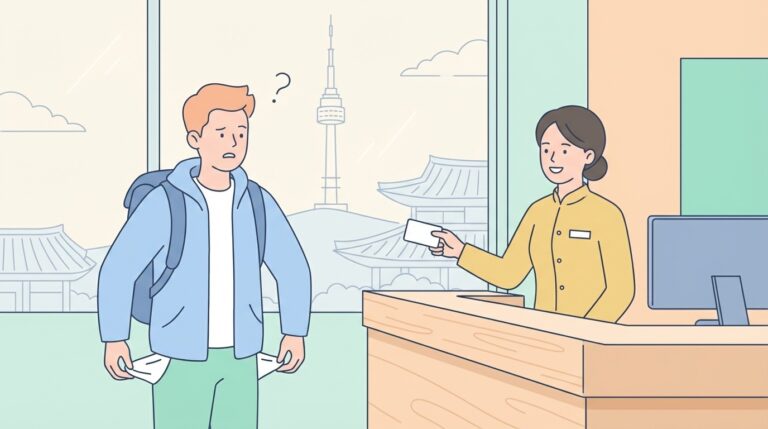
Picture this: You just got back to your hotel after an amazing, exhausting day in Seoul. Maybe you spent hours cheering at a K-Pop concert, or perhaps you walked 20,000 steps exploring the vibrant streets of Hongdae and eating way too much Korean BBQ. You are ready to crash on that soft hotel bed. You dig into your bag to grab your key card… wait. You check your pockets. Empty. You check your wallet. Not there.
Cue the K-Drama slow-motion panic scene! 😱
If you don’t know what to say, you might end up nervously using a translation app while the front desk staff stares at you politely. But don’t worry! Knowing just one or two natural Korean phrases will not only solve your problem in seconds but might also earn you a warm, impressed smile from the staff.
This guide is based on real SOS messages from our beginner (A1) students who found themselves locked out of their rooms in Korea. Let’s turn this travel hiccup into a moment where you look like a total Korean insider!
Phase 2: 핵심 표현 심층 분석 (Deep Dive)
Here are the three survival phrases you need to save your night.
1. 저기요… / 죄송한데요…
- Pronunciation:
- 저기요: jeogiyo [juh-gee-yo]
- 죄송한데요: joesonghandeyo [jway-song-han-deh-yo]
- Meaning: Excuse me… / I’m sorry, but…
- K-Culture Moment: You’ll see this in every K-Drama when a character needs to approach a stranger or get a waiter’s attention. In a hotel lobby, approaching the desk with a slight bow and “죄송한데요…” instantly shows you have Nunchi (social awareness).
- Editor’s Insight: You aren’t literally saying “I apologize for committing a crime.” It’s a soft, polite cushion. It tells the staff, “I know you’re busy, but I need a little help.”
- Situation Spectrum:
[🚫 절대 금지] ———— [⚠️ 주의] ———— [✅ 자유롭게]
- Friends (Casual): 🚫 (Too formal!)
- Strangers/Staff (Formal): ✅
- 🤔 Think About It: In your culture, do you apologize before asking a customer service worker for help? In Korea, this small “cushion language” makes everything run smoother!
2. 방 키를 잃어버렸어요.
- Pronunciation: bang kireul ireobeoryeosseoyo [bang kee-reul ee-roh-buh-ryuh-sso-yo]
- Tip: The ‘어 (eo)’ sound is like the ‘uh’ in ‘up’. Say it smoothly!
- Meaning: I lost my room key.
- K-Culture Moment: “잃어버렸어요 (I lost it)” is a dramatic staple! Think of the K-Drama heroine crying in the rain because she lost the necklace the male lead gave her. Now, you are the main character, and the necklace is your plastic hotel key.
- Editor’s Insight: ‘방’ means room, ‘키’ is key (easy, right?), and ‘잃어버렸어요’ is the magic verb for “lost.” Don’t worry about grammar; just memorize this chunk as one single unit!
- Situation Spectrum:
[🚫 절대 금지] ———— [⚠️ 주의] ———— [✅ 자유롭게]
- Friends (Casual): ⚠️ (Friends use a shorter version: 잃어버렸어)
- Strangers/Staff (Formal): ✅ (The ‘요’ at the end makes it perfectly polite)
- 🤔 Think About It: Korean often borrows English words like ‘키(Key)’ and ‘호텔(Hotel)’. Can you guess why modern objects often use English-derived words in Korean?
3. 안에 두고 나왔어요. (Bonus Situation!)
- Pronunciation: ane dugo nawasseoyo [ah-neh doo-go nah-wa-sso-yo]
- Meaning: I left it inside (the room).
- K-Culture Moment: This happens all the time in Korea because hotel doors lock automatically the second they shut. You step out to grab ice or your delivery food (K-Food midnight snack!), the door clicks, and boom—you’re locked out.
- Editor’s Insight: Use this if you didn’t lose the key in the city, but just locked it inside. It literally means “I left it inside and came out.”
- Situation Spectrum:
[🚫 절대 금지] ———— [⚠️ 주의] ———— [✅ 자유롭게]
- Strangers/Staff (Formal): ✅
Phase 3: 교과서 vs 진짜 한국어 (Textbook vs Real Life)
| 상황 | 📖 교과서 한국어 | 🗣️ 진짜 한국어 | 💡 왜 다를까? |
|---|---|---|---|
| I lost my key | 제가 객실 열쇠를 분실했습니다. (Very stiff) | 방 키 잃어버렸어요 ㅠㅠ | “분실” is a formal written word. In speaking, Koreans prefer the native verb “잃어버리다” and the English word “키(key)”. |
| Can I get a new one? | 새로운 열쇠를 하나 발급해 주시겠습니까? | 새 키 하나 주실 수 있나요? | Shorter, softer, and much more natural for a quick request. |
| Left it inside | 객실 내부에 열쇠를 두고 퇴실했습니다. | 방 안에 두고 나왔어요. | Native speakers drop formal Sino-Korean words (내부, 퇴실) in casual spoken situations. |
Bottom Note: As an A1 beginner, don’t try to sound like a news anchor! Speaking slightly casually but ending with “요 (yo)” is the perfect sweet spot for sounding friendly and polite.
Phase 4: 문화적 맥락 — K-Culture 딥다이브 (Cultural Deep Dive)
4-1. 비언어적 요소 (Non-verbal Communication)
When you approach the front desk to confess you lost your key, don’t march up and demand a new one. Channel your inner Nunchi.
– Walk up slightly hesitantly.
– Give a small head nod (a mini-bow) to the staff.
– Use a soft, slightly apologetic voice when you say “저기요… (Excuse me…)”.
This non-verbal “I know I made a mistake” vibe will make the Korean staff rush to help you with a sympathetic smile!
4-2. K-Travel & K-Food Connection: The “Delivery” Trap
Why do so many tourists get locked out of their rooms in Korea? Two words: Baedal (Delivery) Apps!
Korean delivery culture is world-famous. You order crispy fried chicken (치킨) at 1 AM. The driver leaves it in front of your hotel room. You are so excited to eat that you step into the hallway in your pajamas, let the heavy door shut behind you, and realize… the card key is inside the room.
Pro tip: Most Korean hotel rooms use the card key to keep the electricity on. If you pull it out to go get your chicken, the lights will shut off in 30 seconds. Always check your pocket before the door clicks!
Phase 5: 실전 롤플레이 시나리오 (Immersive Roleplay)
시나리오 A: 메인 롤플레이 (The Midnight Panic)
- Setting: A sleek hotel lobby in Gangnam. It’s 11:30 PM. The lighting is dim, soft jazz is playing.
- Characters:
- YOU: A tired tourist who just realized your pocket is empty.
- Ji-hoon (25): The friendly night-shift receptionist.
Ji-hoon: 안녕하세요. 무엇을 도와드릴까요? 😊
(annyeonghaseyo. mueoseul dowadeurilkkayo?)
(Hello. How may I help you?)
YOU: 저기요…
(jeogiyo…)
(Excuse me…)
Ji-hoon: 네, 손님.
(ne, sonnim.)
(Yes, guest.)
YOU: 방 키를 잃어버렸어요. 😢
(bang kireul ireobeoryeosseoyo.)
(I lost my room key.)
Ji-hoon: 아, 네. 방 번호가 어떻게 되시나요?
(a, ne. bang beonhoga eotteoke doesinayo?)
(Ah, I see. What is your room number?)
YOU: 704호예요.
(chil-baek-sa-hoyeyo.)
(It’s room 704.)
Ji-hoon: 본인 확인을 위해 여권 좀 보여주시겠어요?
(bonin hwagineul wihae yeogwon jom boyeojusigesseoyo?)
(Could you show me your passport for verification?)
🔀 당신의 차례! 어떻게 대답할까요? (Your Turn! How will you reply?)
– A) “여권 없어요.” (I don’t have my passport.)
– B) “네, 여기 있어요.” (Yes, here it is.)
– C) “왜요?” (Why?)✅ Best Choice: B — “여기 있어요 (Here it is)” is the perfect survival phrase when handing over an ID or credit card! Hand it over with two hands for extra politeness.
⚠️ Choice C 분석: “왜요? (Why?)” sounds very defensive and a bit rude to a staff member who is just following protocol.
YOU: 네, 여기 있어요.
(ne, yeogi isseoyo.)
(Yes, here it is.)
(🎭 Stage Direction: You hand the passport over with both hands.)
Ji-hoon: 확인되셨습니다. 새 키 발급해 드리겠습니다.
(hwagindoeseotseumnida. sae ki balgeuphae deurigetseumnida.)
(Verified. I will issue a new key for you.)
YOU: 아, 감사합니다!
(a, gamsahamnida!)
(Ah, thank you!)
Phase 6: 10초 섀도잉 드릴 (Shadowing Drill)
Listen to the rhythm of the sentence. Pause at the slashes!
🥺 저기요... / 방 키를 / 잃어버렸어요.
(jeogiyo… / bang kireul / ireobeoryeosseoyo.)
😅 방 안에 / 두고 / 나왔어요.
(bang ane / dugo / nawasseoyo.)
Phase 7: K-Culture 미니 사전 (K-Culture Glossary)
| 한국어 | Romanization | 영어 | 맥락 설명 (Context) |
|---|---|---|---|
| 눈치 | nunchi | Social awareness | The Korean superpower of “reading the room” and acting appropriately. |
| 프런트 | peureonteu | Front desk | Konglish for the hotel reception desk. |
| 카드키 | kadeuki | Card key | Almost all Korean hotels use plastic tap cards, not physical metal keys. |
| 여권 | yeogwon | Passport | Hotels legally require your passport to verify your identity before giving a new key! |
| 호 | ho | Room number counter | Attached to numbers (e.g., 704호 = Room 704). |
Phase 8: 여행자 서바이벌 키트 (Traveler’s Survival Kit)
🆘 서바이벌 표현 TOP 3 (For Hotel Emergencies)
- 🇰🇷 “도와주세요.” (dowajuseyo.)
- 🗣️ English: Please help me.
- 📍 Use it: Anytime you are stuck or confused.
- 🇰🇷 “여기 있어요.” (yeogi isseoyo.)
- 🗣️ English: Here it is.
- 📍 Use it: When handing your passport or credit card to the staff.
- 🇰🇷 “와이파이 비밀번호가 뭐예요?” (waipai bimilbeonhoga mwoyeyo?)
- 🗣️ English: What is the Wi-Fi password?
- 📍 Use it: Because let’s be real, checking your messages is just as important as getting into your room!
📌 Editor’s Travel Note
– No Tipping! If the staff helps you get a new key or brings it to your room, do NOT give them a tip. Korea is a strictly no-tip culture. A bright “감사합니다!” (Thank you) and a bow is the highest reward you can give.
– Elevator Security: In modern Korean hotels, you must tap your key card inside the elevator before you can press your floor button. Don’t leave your key in the room!
Phase 9: 비판적 사고 코너 — “한 발 더 깊이” (Think Deeper)
🗣️ 언어와 권력 (Language & Power)
🧠 Think Deeper:
In many Western cultures, a paying hotel guest might just say, “I lost my key, can I get a new one?” But in Korea, you will hear native speakers say “I am sorry, but… (죄송한데요)” first. This isn’t because they feel deeply guilty! Korean polite language (Jondaetmal) focuses heavily on respecting the other person’s effort and maintaining harmony (Kibun). By apologizing first, you acknowledge that you are creating a little extra work for the staff. It makes the transaction cooperative rather than purely transactional.💬 Your Turn: In your culture, how do people usually speak to hospitality staff? Is it casual and direct, or formal and cautious? Share in the comments!
Phase 10: FAQ & 오해 방지 (Troubleshooting)
Q: “Can I just say ‘방 키 어디 있어요?’ (Where is my room key?)”
A: No! ⚠️ That translates to “Where is my key?” which sounds like you are accusing the staff of hiding it. Always use “잃어버렸어요” (I lost it).
Q: “Do I have to pay a fee for losing the key?”
A: Maybe. Some smaller hotels or guesthouses might charge you 10,000 KRW for a lost card. Bigger luxury hotels usually replace it for free the first time.
❌ 흔한 실수 #1 (Common Mistake):
Using “너” (You) or “당신” (You) to address the staff.
✅ 이렇게 하세요 (Do this instead):
Never use the word “You” in Korean when speaking to staff. Just say “저기요” (Excuse me) and get straight to the point.
Phase 11: 요약 및 액션 아이템 (Wrap-up)
🎯 One-Liner Summary:
When you lose your hotel key, soften the panic with “저기요… 방 키를 잃어버렸어요.” (Excuse me… I lost my room key.)
🎬 Action Mission 3단계:
– 🥉 Bronze (혼자서): Stand in front of a mirror, look perfectly apologetic (Nunchi!), and say “방 키를 잃어버렸어요” out loud 3 times.
– 🥈 Silver (온라인): Write the phrase “방 키 잃어버렸어요 ㅠㅠ” in your notebook or in our Korean learner’s community.
– 🥇 Gold (실전): Next time you are in Korea, try speaking to a hotel staff member using “저기요…” instead of English “Excuse me!”
📺 K-Culture Mission:
Next time you watch a K-Drama set in an office or a hotel (like King the Land or Hotel Del Luna), listen closely! Whenever a character loses a phone, a document, or an item, you will hear them shout: “잃어버렸어!” Did you hear it?
Did you ever get locked out of a hotel room? Tell me your funny travel stories in the comments below! 👇
Phase 12: 퀴즈 — 인터랙티브 챌린지 (Interactive Quiz)
1. You are locked out of your hotel room because you left the key inside. What should you say to the front desk?
A) 방 키 어디 있어요? (Where is my room key?)
B) 방 안에 두고 나왔어요. (I left it inside.)
C) 새 키 당장 주세요. (Give me a new key right now.)
정답 보기 (Click for Answer)
정답은 B!
A sounds accusatory, and C is incredibly rude! B perfectly explains the situation.
2. True or False: If the hotel staff brings a new key up to your room, you should give them a 5,000 won tip to show your appreciation.
정답 보기 (Click for Answer)
False!
Korea does not have a tipping culture. Tipping can actually cause confusion or make the staff feel uncomfortable. Just say “감사합니다!” (Thank you!) and give a polite bow.
Frequently Asked Questions (FAQ)
Q: What does "저기요... / 죄송한데요..." mean in Korean and how do you pronounce it?
A: In Korean, "저기요... / 죄송한데요..." is pronounced [저기요: jeogiyo [juh-gee-yo] and means: a key conversational Korean expression covered in this lesson.
Q: What does "방 키를 잃어버렸어요." mean in Korean and how do you pronounce it?
A: In Korean, "방 키를 잃어버렸어요." is pronounced [bang kireul ireobeoryeosseoyo [bang kee-reul ee-roh-buh-ryuh-sso-yo] and means: a key conversational Korean expression covered in this lesson.
Q: What does "안에 두고 나왔어요. (Bonus Situation!)" mean in Korean and how do you pronounce it?
A: In Korean, "안에 두고 나왔어요. (Bonus Situation!)" is pronounced [ane dugo nawasseoyo [ah-neh doo-go nah-wa-sso-yo] and means: I left it inside (the room).







