

Hello! I’m the Senior Editor at Daily Hangul, your veteran tutor and local cultural navigator.
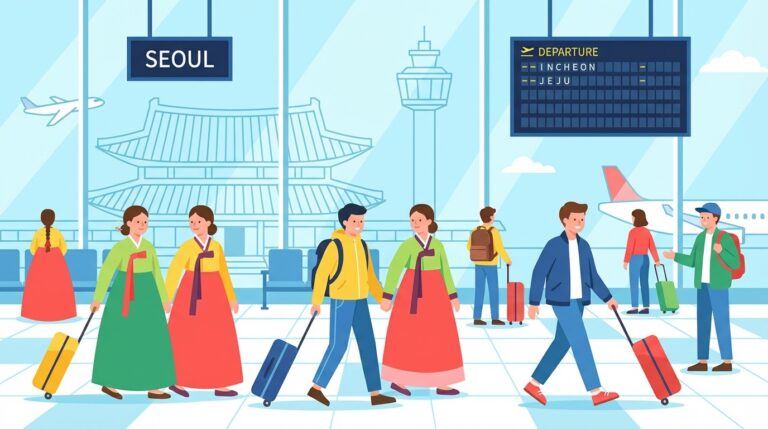
Picture this: It’s the Friday before the Chuseok (추석) holiday. You turn on the Korean news, expecting to see families making traditional pancakes (Jeon). Instead, the reporter is standing in the middle of Incheon International Airport, and it looks like a scene from a disaster movie—except everyone is smiling and rolling expensive suitcases.
Wait, isn’t Chuseok the ‘Korean Thanksgiving’ where everyone goes to their hometown? Well, yes and no. Welcome to the modern Korean reality: 연휴가 길어서 여행 가는 사람들도 많다 (The holiday is long, so many people go on trips).
If you only learned Korean from textbooks, you might think everyone is bowing to their ancestors all week. But if you want to sound like a true local—and maybe understand why your Korean colleagues are secretly checking flight prices during a meeting—you need to know how to talk about the modern holiday escape. Let’s dive in!
Phase 2: Core Expressions Deep Dive
1. 연휴가 길어서 여행을 많이 가요.
- Pronunciation: yeonhyuga gireoseo yeohaengeul mani gayo (The ‘yeo’ sounds like the ‘yu’ in ‘yuck’, and ‘eo’ is like the ‘uh’ in ‘up’)
- Meaning: Because the holiday is long, many people travel.
- K-Culture Moment: You’ll hear this exact phrase on every TV news broadcast during the holiday season. It’s the ultimate small talk topic in the office elevator.
- Editor’s Insight: The grammar
A/V-아/어서is your best friend in B1 level. It links a cause (long holiday) to an effect (travel). It feels much softer and more conversational than the formal-기 때문에.- Situation Spectrum:
[🚫 절대 금지] ———— [⚠️ 주의] ———— [✅ 자유롭게]
- 친구 사이(Casual): ✅ (Drop the ‘요’ -> 가)
- 직장 동료(Semi-formal): ✅
- 직장 상사·어른(Formal): ✅
- 🤔 Think About It: Koreans work some of the longest hours in the OECD. When a 3-day holiday expands into a 5-day weekend, it’s treated like a rare oasis. How do people in your culture react to long weekends?
2. 고향에 내려가는 대신 호캉스 하려고요.
- Pronunciation: gohyange naeryeoganeun daesin hokangseu haryeogoyo
- Meaning: Instead of going down to my hometown, I plan to do a ‘hocance’ (hotel + vacance).
- K-Culture Moment: In K-Dramas, the wealthy protagonist always broods in a luxury hotel suite during the holidays. In reality, young Koreans book luxury hotels to escape the stressful nagging of relatives.
- Editor’s Insight:
호캉스 (Hocance)is a magical portmanteau of Hotel + Vacance (French for vacation). Also, note the phrase내려가다 (to go down). In Korea, going from Seoul to anywhere else is called ‘going down’, even if the destination is geographically north!- Situation Spectrum:
[🚫 절대 금지] ———— [⚠️ 주의] ———— [✅ 자유롭게]
- 친구 사이(Casual): ✅
- 직장 동료(Semi-formal): ✅
- 직장 상사·어른(Formal): ⚠️ (Traditional bosses might judge you slightly for not visiting your parents!)
- 🤔 Think About It: Why is the phrase ‘going down’ (내려가다) so ingrained? It reflects Seoul’s historical and cultural position as the ‘center’ or ‘top’ of the country.
3. 비행기 표가 다 매진됐대요!
- Pronunciation: bihaenggi pyoga da maejindwaetdaeyo (Say ‘mae-jin’ sharply, like ‘magic’ without the ‘ic’)
- Meaning: They say all the flight tickets are sold out!
- K-Culture Moment: Imagine a K-Pop fan failing to get concert tickets. That same despair is felt by Koreans trying to book a flight to Jeju Island or a KTX train to Busan during Chuseok.
- Editor’s Insight: The suffix
-대요is B1 gold. It’s the contracted form of-다고 해요(I heard that / They say that). You use it when sharing the devastating gossip that you can’t go to Japan because flights are fully booked.- Situation Spectrum:
[🚫 절대 금지] ———— [⚠️ 주의] ———— [✅ 자유롭게]
- 친구 사이(Casual): ✅ (매진됐대!)
- 직장 동료(Semi-formal): ✅
- 직장 상사·어른(Formal): ⚠️ (Use ‘매진되었다고 합니다’ for highly formal settings)
- 🤔 Think About It: The concept of ‘Ticketing War’ (피켓팅 – Blood Ticketing) applies not just to K-Pop, but to holiday trains. Survival of the fastest clicker!
Phase 3: Textbook vs Real Life
| Situation | 📖 Textbook Korean | 🗣️ Real Korean | 💡 Why is it different? |
|---|---|---|---|
| Asking about plans | 추석에 무엇을 하십니까? | 이번 연휴 때 뭐 해요? | ‘연휴’ (long holiday) focuses on the time off, rather than the traditional holiday itself. |
| Hometown visit | 저는 고향에 갑니다. | 본가 내려가요. | ‘본가’ (parents’ house) is used more often by independent adults living in Seoul than the poetic ‘고향’ (hometown). |
| Explaining travel | 연휴가 길어서 여행을 갑니다. | 연휴 길어서 걍(그냥) 해외 나가려고요. | Efficient and slightly flexing. Traveling abroad (‘해외 나가다’) during holidays is a massive modern trend. |
Phase 4: Cultural Deep Dive
4-1. Non-verbal Communication: The Art of Nunchi (눈치)
When a senior colleague asks, “Are you going down to your hometown this Chuseok?” use your Nunchi. If you are secretly flying to Bali, you don’t need to brag loudly. A modest smile and, “Ah, the holiday is long, so I’m taking a short trip with family,” prevents you from sounding like you’re rubbing your vacation in the face of someone stuck making pancakes for 20 relatives.
4-2. K-Travel & K-Food Connection: The Highway Rest Stop
Even if you’re just traveling domestically during the long holiday, the K-Culture experience peaks at the 고속도로 휴게소 (Highway Rest Stop). If you are stuck in the infamous Chuseok traffic jam (귀성길), the rest stop is your oasis. It’s not just for bathroom breaks; it’s a food festival. You must eat 소떡소떡 (Sotteok Sotteok)—a skewer of alternating sausages and rice cakes popularized by a famous comedian on TV. When Koreans travel during holidays, the journey (and the food) is half the destination.
Phase 5: Immersive Roleplay
Scenario A: The Office Pantry
Setting: Wednesday afternoon, 3 PM. The company pantry. The air is buzzing because the 5-day Chuseok holiday starts tomorrow. You are getting an iced Americano when your Korean coworker, Min-su (32, friendly but nosy), walks in.
민수: 아, 드디어 내일부터 연휴네요! (Name) 씨는 이번 추석에 본가 가요? ✈️
(A, deudieo naeilbuteo yeonhyuneyo! (Name) ssineun ibeon chuseoge bonga gayo?)
[Ah, the holiday finally starts tomorrow! Are you going to your parents’ house this Chuseok?]
(🎭 Stage Direction: Min-su leans against the counter, looking exhausted in advance)
YOU: 음… 사실 고향에 안 가요.
(Eum… sasil gohyange an gayo.)
[Um… actually I’m not going to my hometown.]
민수: 오? 진짜요? 그럼 서울에 계속 있어요? 심심하지 않아요?
(O? jinjjayo? geureom seoure gyesok isseoyo? simsimhaji anayo?)
[Oh? Really? Then are you staying in Seoul? Won’t you be bored?]
🔀 Your Turn! How do you answer?
– A) “네, 그냥 집에서 쉴 거예요.” (Yes, I’ll just rest at home.)
– B) “연휴가 길어서 제주도로 여행 가려고요!” (The holiday is long, so I’m planning to travel to Jeju Island!)
– C) “알 빠 아니잖아요?” (None of your business?)✅ Best Choice: B — It uses our target grammar and perfectly captures the modern trend. Min-su will likely be very jealous!
⚠️ Choice C Analysis: Unless you want to be fired or start a fistfight, never say this. It’s highly aggressive internet slang.
(If you chose B…)
민수: 와, 대박! 부럽다… 표 구하기 진짜 힘들었을 텐데. 비행기 표 안 매진됐어요?
(Wa, daebak! bureopda… pyo guhagi jinjja himdeureosseul tende. bihaenggi pyo an maejindwaesseoyo?)
[Wow, awesome! I’m jealous… It must have been really hard to get tickets. Weren’t the flights sold out?]
YOU: 네, 3달 전에 미리 예매했어요!
(Ne, sedal jeone miri yemaehaesseoyo!)
[Yes, I booked them 3 months in advance!]
Scenario B: Bonus K-Culture Moment – The Ticketing War
Setting: PC Bang (Internet Cafe) at 6:00 AM, one month before Chuseok.
Korean Friend: 야, 59분이다! 새로고침 준비해!! (Ya, osip-gubunida! saerogochim junbihae!!)
[Hey, it’s 59 minutes! Get ready to refresh!!]
YOU: 눌렀어! 어? 대기 인원 10만 명…? (Nulleosseo! eo? daegi inwon simman myeong…?)
[I clicked! Huh? 100,000 people waiting…?]
Korean Friend: 아… 이번 명절엔 강제 서울 여행이다. (Ah… ibeon myeongjeoren gangje seoul yeohaengida.)
[Ah… I guess we are forced to travel in Seoul this holiday.]
Phase 6: 10-Second Shadowing Drill
Let’s practice explaining your smart travel plans with the perfect B1 intonation!
😊 이번 연휴가 / 너무 길어서 / ✈️ 해외로 / 여행 가려고요!
(ibeon yeonhyuga / neomu gireoseo / haewero / yeohaeng garyeogoyo!)
Emotion Tag: Say it with a bright, slightly excited tone, pausing naturally at the slashes to build anticipation before dropping the ‘travel abroad’ bomb.
Phase 7: K-Culture Glossary
| 한국어 (Korean) | Romanization | English | Context |
|---|---|---|---|
| 연휴 | yeonhyu | Long weekend/Consecutive holidays | Any holiday linked with weekends (e.g., 3+ days). |
| 귀성길 | gwiseonggil | The journey home | The notoriously congested drive to one’s hometown during Chuseok or Seollal. |
| 피켓팅 | piketting | Blood ticketing | A fierce online battle to buy tickets (KTX, flights, concerts). |
| 호캉스 | hokangseu | Hotel vacation | Taking a relaxing vacation by staying at a fancy hotel, usually in the city. |
| 힐링 | hilling | Healing/Relaxing | Konglish used to describe activities that destress you (like traveling!). |
Phase 8: Traveler’s Survival Kit
If you are one of the many people traveling during the long holiday, keep these phrases in your back pocket.
🆘 Survival Phrase #1: Navigating the KTX (Train)
– 🇰🇷 “입석 표라도 있나요?” (ipseok pyorado innayo?)
– 🗣️ Pronunciation Guide: ip-seok pyo-ra-do in-na-yo?
– 📍 Where to use: Train station ticket counter.
– 💡 Meaning: “Do you even have standing tickets?” When seats are sold out, standing tickets are your last hope!🆘 Survival Phrase #2: Highway Rest Stops
– 🇰🇷 “소떡소떡 하나 주시고, 케첩은 제가 뿌릴게요.” (sotteoksotteok hana jusigo, kecheobeun jaega ppurilgeyo.)
– 🗣️ Pronunciation Guide: so-tteok-so-tteok ha-na ju-si-go, ke-cheo-beun je-ga ppu-ril-gge-yo.
– 📍 Where to use: Highway rest stop food stalls.
– 💡 Meaning: “One Sotteok Sotteok please, I will squeeze the ketchup myself.” A true local move.📌 Editor’s Travel Note
– Traffic Apps: Do NOT use Google Maps for driving in Korea. Use Naver Map or Kakao T. They calculate real-time Chuseok traffic.
– Ghost Town Seoul: During the actual day of Chuseok, many mom-and-pop shops close. However, major malls (like COEX), amusement parks, and palaces (Gyeongbokgung) stay open and are great places to visit!
Phase 9: Think Deeper – “한 발 더 깊이”
Food, Family & Identity: The Changing Face of Chuseok
Historically, Chuseok was about Jesa (ancestral rites), bringing the extended family together to cook mountains of food and honor the past. But as modern Korean society becomes more fast-paced and individualistic, the concept of ‘family time’ is shifting. The phrase “연휴가 길어서 여행 가요” isn’t just a casual statement; it represents a massive cultural shift. Younger generations are replacing stressful cooking duties with ‘Healing’ (힐링) trips to Da Nang or Jeju, sometimes taking their parents with them. The holiday is transforming from an ‘obligation to ancestors’ to a ‘reward for the living’.
💬 Your Turn: Does your culture have a major family holiday? Is the younger generation changing how it’s celebrated? Share your thoughts in the comments!
Phase 10: FAQ & Troubleshooting
Q: Can I say “명절 잘 보내세요” (Have a good holiday) to my boss even if they are just traveling?
Yes! Regardless of what they are doing (traveling, sleeping, visiting parents), “연휴 잘 보내세요” (Have a good long weekend) or “풍성한 한가위 되세요” (Have a bountiful Chuseok – formal) are universally polite.
Q: I heard Koreans say ‘메리 추석’ (Merry Chuseok). Is that real?
Yes, but it’s a joke! Younger people mix ‘Merry Christmas’ with Chuseok to sound playful. Use it with friends, but never in a formal email!
❌ Common Mistake #1: Saying “저는 추석에 고향에 내려가요” when your parents live in Seoul.
✅ Do this instead: If you live in Seoul and your parents also live in Seoul, just say “본가에 가요” (I’m going to my parents’ house). ‘고향에 내려가다’ implies a long-distance trip to the provinces.
Phase 11: Wrap-up & Action Items
One-Liner Summary: Modern Chuseok isn’t just about going home; it’s the golden ticket for travel, so use A/V-아/어서 to explain your awesome vacation plans!
Action Mission:
– 🥉 Bronze: Look in the mirror and practice saying “비행기 표가 매진됐대요!” with a shocked face.
– 🥈 Silver: Write a comment below using the grammar -아/어서 to explain why you like long holidays.
– 🥇 Gold: Ask a Korean friend or language partner: “이번 연휴 때 어디 여행 가요?” (Are you traveling anywhere this long holiday?)
🎁 K-Culture Mission: Go to a flight booking site (like Skyscanner) and check the flight prices from Seoul to Jeju Island exactly during the Chuseok dates. You will immediately understand the word ‘피켓팅’ (Blood Ticketing)!
Phase 12: Interactive Quiz
1. Fill in the blank:
“이번에 ( )가 길어서, 고향에 가는 대신 호캉스를 하려고요.”
(A) 주말 (B) 휴게소 (C) 연휴 (D) 눈치
2. True or False – K-Culture Edition:
“During Chuseok, every single restaurant and cafe in Seoul is closed for 3 days.” (T/F)
3. Situational Judgment:
Your boss asks why you aren’t visiting your hometown this Chuseok. You want to politely explain that the train tickets sold out. What do you say?
A) 기차 표 매진됐대!
B) 기차 표가 다 매진되어서 못 가요.
C) 내 알 빠 아니잖아요.
(Answers: 1. C (Long holiday), 2. False (Major malls and chains stay open, though smaller shops may close on the day of), 3. B (Polite and uses the correct grammar! A is too casual, C is incredibly rude).)
Frequently Asked Questions (FAQ)
Q: What does "연휴가 길어서 여행을 많이 가요." mean in Korean and how do you pronounce it?
A: In Korean, "연휴가 길어서 여행을 많이 가요." is pronounced [yeonhyuga gireoseo yeohaengeul mani gayo (The 'yeo' sounds like the 'yu' in 'yuck', and 'eo' is like the 'uh' in 'up'] and means: Because the holiday is long, many people travel.
Q: What does "고향에 내려가는 대신 호캉스 하려고요." mean in Korean and how do you pronounce it?
A: In Korean, "고향에 내려가는 대신 호캉스 하려고요." is pronounced [gohyange naeryeoganeun daesin hokangseu haryeogoyo] and means: Instead of going down to my hometown, I plan to do a 'hocance' (hotel + vacance).
Q: What does "비행기 표가 다 매진됐대요!" mean in Korean and how do you pronounce it?
A: In Korean, "비행기 표가 다 매진됐대요!" is pronounced [bihaenggi pyoga da maejindwaetdaeyo (Say 'mae-jin' sharply, like 'magic' without the 'ic'] and means: They say all the flight tickets are sold out!







