

Phase 1: 공감 — 몰입형 오프닝 (Immersive Hook)
Hello! I’m your editor from Daily Hangul.
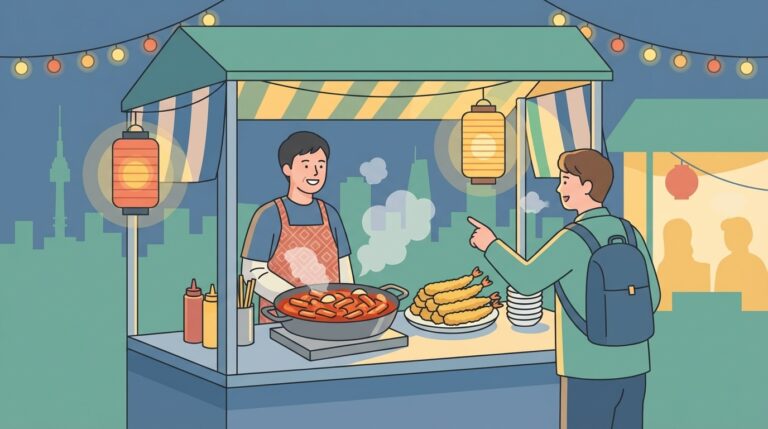
Picture this: You are walking down the vibrant streets of Hongdae or Myeongdong on a chilly evening. The neon lights are flashing, K-Pop is blasting from a nearby cosmetics shop, and then… you smell it. The sweet, spicy aroma of Tteokbokki (떡볶이) bubbling in a giant red pan, right next to a golden mountain of crispy Twigim (튀김 – Korean fried snacks).
You step up to the Pojangmacha (포장마차 – street stall). The friendly owner looks at you, tongs in hand, waiting for your order.
Your textbook taught you how to say, “I would like to purchase one apple, please.” But how do you survive this fast-paced, mouth-watering street food chaos? How do you tell her you want that crispy squid dipped directly into the spicy red sauce, just like you saw in your favorite K-Drama?
Don’t worry! I’ve been there with countless students who froze in front of the Tteokbokki pan. Today, I’m going to teach you the ultimate ‘Insider Street Food’ survival phrases. By the end of this guide, you won’t just be eating street food; you’ll be experiencing it like a true local!
Phase 2: 핵심 표현 심층 분석 (Deep Dive)
Let’s learn the 3 magical phrases that will make you look like a K-Street Food veteran.
1. 떡볶이 1인분 주세요.
- Pronunciation: Tteokbokki il-inbun juseyo. (
ilsounds like ‘eel’,inbunsounds like ‘in-boon’)- Meaning: Please give me one serving of Tteokbokki.
- K-Culture Moment: In Korea, street food is usually ordered by the ‘serving’ (인분), not by the bowl or piece. If you go with a friend, you might say “2인분 주세요” (ni-inbun juseyo – 2 servings).
- Editor’s Insight: Just pointing and saying “This one” works, but saying “1인분 주세요” instantly shows you know how the Korean food system works. It sounds incredibly natural.
- Situation Spectrum:
[🚫 절대 금지] ———— [⚠️ 주의] ———— [✅ 자유롭게]
- Casual / Street Vendors: ✅ (Perfect!)
- Formal Restaurants: ✅ (Still perfect!)
- 🤔 Think About It: Why do Koreans use ‘servings’ (인분) instead of just sizing like Small/Medium/Large? It ties back to Korea’s sharing culture—you usually order multiple ‘servings’ to place in the middle of the table and share with everyone!
2. 튀김은 섞어 주세요.
- Pronunciation: Twigim-eun seok-eo juseyo. (
seoksounds like ‘suck’,eosounds like the ‘uh’ in ‘uh-oh’)- Meaning: Please mix the fried snacks (into the Tteokbokki sauce).
- K-Culture Moment: This is the Holy Grail of street food phrases! You know how K-Drama characters always eat their fried squid covered in red sauce? If you just buy Twigim, it comes in a plain bag. If you say “섞어 주세요” (Please mix it), the vendor will chop the Twigim and bury it in the glorious Tteokbokki sauce.
- Editor’s Insight: This phrase separates the tourists from the locals. It shows you know the secret combination!
Situation Spectrum:
[🚫 절대 금지] ———— [⚠️ 주의] ———— [✅ 자유롭게]
- Street Vendors / Bunsik shops: ✅
- Fancy Dining: 🚫 (They don’t mix things like this!)
- 🤔 Think About It: Koreans love mixing flavors (think of Bibimbap!). Can you think of a dish in your country where mixing everything together makes it taste 10 times better?
3. 국물 좀 마실게요.
- Pronunciation: Gukmul jom masilgeyo. (
Gukmul= Soup/Broth,masilgeyo= I will drink)- Meaning: I’m going to drink some broth.
- K-Culture Moment: Next to the Tteokbokki, there are always fish cakes (Odeng) on skewers swimming in hot broth. This broth is FREE! You just take a paper cup, scoop the broth yourself, and sip it to calm the spicy Tteokbokki burn.
- Editor’s Insight: You don’t even have to ask for permission, but saying this politely as you grab a cup is a very warm, polite gesture to the owner.
- Situation Spectrum:
[🚫 절대 금지] ———— [⚠️ 주의] ———— [✅ 자유롭게]
- Street Stalls: ✅
- Convenience Stores: 🚫 (They don’t have open broth!)
Phase 3: 교과서 vs 진짜 한국어 (Textbook vs Real Life)
| 상황 (Situation) | 📖 교과서 (Textbook) | 🗣️ 진짜 한국어 (Real Life) | 💡 왜 다를까? (Why is it different?) |
|---|---|---|---|
| Calling the vendor | 저기요 (Excuse me) | 이모님! (Auntie!) | “이모” means aunt. Calling vendors “Auntie” builds instant affection (Jeong) and gets you better service! |
| Asking to mix sauce | 소스와 튀김을 같이 주세요. | 섞어 주세요. / 버무려 주세요. | Street stalls are fast-paced. Shorter verbs like “섞다” (to mix) are much more efficient. |
| Asking if it’s spicy | 이것은 맵습니까? | 이거 많이 매워요? | Natural spoken Korean uses the “~요” ending, and adding “많이” (a lot) makes it sound softer. |
Bottom Note: For beginners (A2), stick to adding “~주세요” (Please give me) to whatever you are pointing at. It’s polite, simple, and always works!
Phase 4: 문화적 맥락 — K-Culture 딥다이브 (Cultural Deep Dive)
4-1. 비언어적 요소 (Non-verbal Communication)
At a Pojangmacha, body language is just as important as words.
– The Tongs & Scissors: Vendors use giant scissors to cut your food. Don’t be alarmed; scissors are the ultimate Korean kitchen tool!
– Self-Service: Water, napkins, and Odeng broth are almost always self-service. Waiting for the vendor to bring them to you might leave you thirsty!
– Nunchi (눈치) at the stall: Space is tight. If new customers arrive, naturally scoot over a little bit to make room. That’s good Nunchi!
4-2. K-Drama Connection: The Comfort Food Trope
Have you ever noticed that whenever a K-Drama heroine gets rejected by her crush or scolded by her boss, she goes to a Pojangmacha? She stands in the cold, eating spicy Tteokbokki and drinking Soju or Odeng broth.
Why? Because Bunsik (분식 – street food) is Korea’s ultimate soul food. It’s cheap, it’s warm, and the spiciness physically releases stress. The “이모님” (Auntie) at the stall often acts as a silent therapist, just handing over a warm cup of broth. When you eat at a street stall, you are taking part in a deeply comforting Korean ritual.
Phase 5: 실전 롤플레이 시나리오 (Immersive Roleplay)
메인 롤플레이 (Main Scenario)
- Setting: Friday, 8:00 PM. A bustling street stall near Gangnam Station. Steam is rising into the cold night air.
- Characters:
- YOU: A hungry traveler exploring Seoul, craving something spicy.
- 이모님 (Imo-nim): The stall owner. 50s, wearing a colorful apron, moving very fast.
YOU: 저기요… 이모님! (Jeogiyo… Imo-nim!)
(Excuse me… Auntie!)
(🎭 You smile and approach the stall)
이모님: 네, 삼촌/학생! 뭐 줄까? (Ne, samchon/haksaeng! Mwo julkka?)
(Yes, young man/student! What can I give you?)
YOU: 떡볶이 1인분 주세요. (Tteokbokki il-inbun juseyo.)
(One serving of Tteokbokki, please.)
이모님: 네~ 튀김도 줄까? (Ne~ Twigim-do julkka?)
(Okay~ Should I give you fried snacks too?)
YOU: 네, 튀김도 1인분 주세요. (Ne, Twigim-do il-inbun juseyo.)
(Yes, one serving of fried snacks too, please.)
🔀 당신의 차례! (Your Turn!) The vendor is grabbing a bag for the Twigim. How do you tell her you want them mixed with the Tteokbokki sauce?
- A) “소스! 소스!” (Sauce! Sauce!)
- B) “따로 주세요.” (Please give it separately.)
- C) “섞어 주세요!” (Please mix it together!)
✅ Best Choice: C — “섞어 주세요” (Seok-eo juseyo) is exactly what you need to say to get that delicious sauce-soaked Twigim!
⚠️ Choice B 분석: “따로 주세요” means “Give them separately.” Choose this ONLY if you want to keep your fried snacks dry and crispy!
이모님: 오케이, 맛있게 섞어 줄게! (Okay, masitge seok-eo julge!)
(Okay, I’ll mix it deliciously for you!)
YOU: 감사합니다! 아, 국물 좀 마실게요. (Gamsahamnida! Ah, gukmul jom masilgeyo.)
(Thank you! Ah, I’ll drink some broth.)
이모님: 그럼~ 저기 종이컵 써! (Geureom~ jeogi jong-i-keop sseo!)
(Of course~ use the paper cups over there!)
Phase 6: 10초 섀도잉 드릴 (Shadowing Drill)
Read these out loud! Pay attention to the pauses (/) and emotions.
- 😊 Bright & Polite:
이모님! / 떡볶이 1인분 / 주세요~
(Imo-nim! / Tteokbokki il-inbun / juseyo~) -
🤤 Craving the sauce:
튀김은 / 꼭 / 섞어 주세요!
(Twigim-eun / kkok / seok-eo juseyo!) -
🥶 Cold and needing warmth:
오뎅 국물 좀 / 마실게요.
(Odeng gukmul jom / masilgeyo.)
Phase 7: K-Culture 미니 사전 (K-Culture Glossary)
| 한국어 | Romanization | English | Context |
|---|---|---|---|
| 분식 | bunsik | Flour-based food | The category of food including Tteokbokki, ramen, and gimbap. |
| 포장마차 | pojangmacha | Street food stall | Covered street tents selling late-night food and drinks. |
| 1인분 | il-inbun | One serving | The standard unit of ordering food in Korea. |
| 이모님 | imo-nim | Auntie (Polite) | Affectionate term for a female restaurant/stall owner. |
| 찍먹 | jjingmeok | Dipping style | Eating fried food by dipping it into the sauce yourself. |
| 부먹 | bumeok | Pouring style | Having the sauce poured over the fried food (like “섞어 주세요”). |
Phase 8: 여행자 서바이벌 키트 (Traveler’s Survival Kit)
Street stalls operate a bit differently from regular restaurants. Here are your absolute survival phrases!
🆘 서바이벌 표현 (Survival Phrases)
– 🇰🇷 “이거 많이 매워요?” (Igeo mani maewoyo?)
– 🗣️ English: Is this very spicy?
– 📍 Use it when: The Tteokbokki looks a little too red.
– 🇰🇷 “계좌이체 되나요?” (Gyejwa-iche doenayo?)
– 🗣️ English: Can I do a bank transfer?
– 📍 Use it when: You don’t have cash. (Most stalls don’t accept credit cards!).
– 🇰🇷 “포장해 주세요.” (Pojang-hae juseyo.)
– 🗣️ English: Please pack it to go (Take-out).
– 📍 Use it when: You want to eat it comfortably in your hotel room.📌 Editor’s Travel Note
– Cash is King: While Korea is 99% cashless, street stalls are the 1% where you still need physical Korean Won (현금) or a Korean bank account to transfer money.
– Stand and Eat: At a traditional Pojangmacha, there are usually no chairs. You stand around the cart, eat your food, drop your skewers in a cup, and pay at the end.
Phase 9: 비판적 사고 코너 — “한 발 더 깊이” (Think Deeper)
Food & Identity: The Power of the Pojangmacha
Have you noticed that when you eat at a Korean street stall, you are literally rubbing shoulders with strangers? In Korean culture, food is rarely a solitary experience. The word for ‘family’ in Korean is 식구 (Sikgu), which literally means “mouths that eat together.”
Even when strangers stand together at a Bunsik stall, sharing the same pot of soy sauce for their fish cakes or passing napkins to one another, there is a momentary sense of community. It breaks down social barriers; a CEO in a suit and a college student in sweatpants both stand equally in front of the Tteokbokki pan.
💬 Your Turn:
Does your culture have a type of food or a dining style that brings strangers together? Share it in the comments below!
Phase 10: FAQ & 오해 방지 (Troubleshooting)
Q: Can I really just drink the fish cake broth for free?
Yes! It’s an unwritten rule of Korean street food. However, it’s polite to actually buy something (like Tteokbokki or one Odeng skewer) rather than just drinking the broth and leaving!
Q: Is it rude to ask for “Imo-nim” if the vendor is a man?
Yes! For a man, you can say “사장님!” (Sajang-nim – Boss/Owner). In fact, “사장님” works perfectly for both men and women if you want to be safe and polite.
❌ 흔한 실수 (Common Mistake): Expecting a table service.
Tourists often stand away from the stall, waiting for someone to take their order.
✅ 이렇게 하세요 (Do this instead): Walk right up to the pan! Make eye contact, point to what you want, and speak up. Street food in Korea is proactive!
Phase 11: 요약 및 액션 아이템 (Wrap-up)
One-Liner Summary: To order street food like a local, ask for “1-inbun” and tell the Imo-nim to “mix it” (섞어 주세요)!
🎯 Action Missions:
– 🥉 Bronze (Solo): Stand in front of a mirror and say, “이모님! 떡볶이 1인분 섞어 주세요!” three times with confidence.
– 🥈 Silver (Online): Comment below with your favorite Korean street food using the phrase “~주세요” (e.g., 호떡 주세요!).
– 🥇 Gold (Real Life): Visit a Korean restaurant, Asian market, or a local stall in Korea and use “포장해 주세요” (To-go, please) or ask for 1인분!
🍜 K-Culture Mission:
Next time you watch a K-Drama, look closely at the street food scenes. Notice how the characters hold their paper cups of hot broth to warm their hands. Try to spot the green speckled plates—they are the iconic symbol of Korean Bunsik!
Phase 12: 퀴즈 — 인터랙티브 챌린지 (Interactive Quiz)
Test your new K-Street Food knowledge!
1. Situational Judgment: You want to buy some fried squid (Twigim), but you want it soaked in the spicy Tteokbokki sauce. What do you say?
– A) 따로 주세요. (Ttaro juseyo.)
– B) 섞어 주세요. (Seok-eo juseyo.)
– C) 안 맵게 해주세요. (An maepge haejuseyo.)
2. Fill in the Blank:
“Please give me one serving of Tteokbokki!”
-> 떡볶이 1( ___ ) 주세요.
3. True or False:
You must pay an extra 1,000 won to drink the Odeng (fish cake) broth at a street stall.
(Scroll down for answers!)
Answers (Click to reveal)
1. B – “섞어 주세요” means mix it! ‘A’ means keep it separate, and ‘C’ means make it not spicy.
2. 인분 (inbun) – The standard unit for a food serving in Korea.
3. False – The broth is completely free! Just grab a paper cup and serve yourself.
Frequently Asked Questions (FAQ)
Q: What does "떡볶이 1인분 주세요." mean in Korean and how do you pronounce it?
A: In Korean, "떡볶이 1인분 주세요." is pronounced [Tteokbokki il-inbun juseyo. (il sounds like 'eel', inbun sounds like 'in-boon'] and means: Please give me one serving of Tteokbokki.
Q: What does "튀김은 섞어 주세요." mean in Korean and how do you pronounce it?
A: In Korean, "튀김은 섞어 주세요." is pronounced [Twigim-eun seok-eo juseyo. (seok sounds like 'suck', eo sounds like the 'uh' in 'uh-oh'] and means: Please mix the fried snacks (into the Tteokbokki sauce).
Q: What does "국물 좀 마실게요." mean in Korean and how do you pronounce it?
A: In Korean, "국물 좀 마실게요." is pronounced [Gukmul jom masilgeyo. (Gukmul = Soup/Broth, masilgeyo = I will drink] and means: I'm going to drink some broth.







