

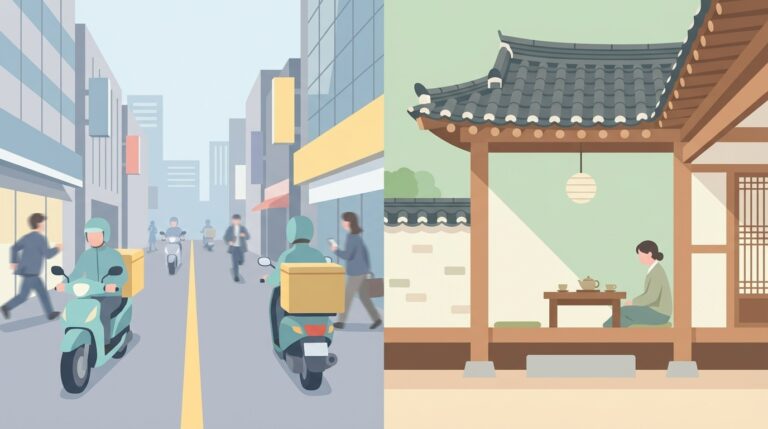
Phase 1: Immersive Hook
Hello! I’m your Daily Hangul Editor.
Imagine this: You’re watching a K-Drama. The main character orders food on their phone. Before they can even finish their dramatic sigh, the doorbell rings. Ding-dong! The delivery driver is already there. Or perhaps you’ve been to Korea and noticed something peculiar in the elevators—the ‘Close Door’ button is completely worn out, its paint chipped away by thousands of impatient fingers.
Welcome to the beating heart of modern South Korea: 빨리빨리 (Ppalli-ppalli) culture.
Directly translating to “hurry, hurry” or “quick, quick,” Ppalli-ppalli is much more than a phrase. It’s a national ethos, a lifestyle, and sometimes, a source of profound stress. For a B2 learner, understanding Ppalli-ppalli isn’t just about learning how to tell a taxi driver to speed up. It’s about grasping the very rhythm of Korean society—why the Wi-Fi is so fast, why the food arrives instantly, and why your Korean friends might tap their feet when a website takes more than 3 seconds to load.
In this unit, we’re going to explore the double-edged sword of this hyper-speed culture, the real-life phrases you need to navigate it, and how to avoid cultural faux pas when things get too fast.
Phase 2: Deep Dive into Key Expressions
Let’s look at the core vocabulary that defines the fast lane of Korean life.
1. 빨리빨리 (Ppalli-ppalli)
- Pronunciation: [ppalli-ppalli] + [Sounds like ‘pah-lee pah-lee’, but tense your lips on the ‘pp’ like you’re slightly annoyed.]
- Meaning: Literal: Quickly, quickly / Real nuance: Hurry up, do it immediately!
- K-Culture Moment: You’re at a crowded K-BBQ restaurant. The manager is practically jogging between tables, yelling “빨리빨리!” to the staff to turn over the tables. It’s the chaotic symphony of a Friday night in Seoul.
- Editor’s Insight: This word is the anthem of Korea. However, while Koreans use it constantly among themselves, using it as a foreigner toward a Korean service worker can sound incredibly demanding or rude if not done carefully.
- Situation Spectrum:
[🚫 절대 금지] ———— [⚠️ 주의] ———— [✅ 자유롭게]
- Friends (Casual): ✅
- Coworkers (Semi-formal): ⚠️ (Only if you are the boss!)
- Elders/Service staff (Formal): 🚫
- 🤔 Think About It: Why is this word repeated twice? In Korean, repeating an adverb amplifies its urgency. Does your language have a similar way of doubling words for emphasis?
2. 답답하다 (Dapdaphada)
- Pronunciation: [dapdaphada] + [Dap-dap-ha-da. ‘Dap’ sounds like the ‘dop’ in ‘adopt’.]
- Meaning: Literal: Stifling/Suffocating / Real nuance: Feeling frustrated because something/someone is too slow, inflexible, or not working out.
- K-Culture Moment: You’re watching a K-Drama, and the male lead misunderstands the female lead for the 10th episode in a row. A Korean viewer will clutch their chest and say, “아, 진짜 답답해!” (Ah, so frustrating!).
- Editor’s Insight: This is the emotional counterpart to Ppalli-ppalli. When Ppalli-ppalli is blocked, Koreans feel Dapdaphada. It physically feels like a weight on your chest.
- Situation Spectrum:
[🚫 절대 금지] ———— [⚠️ 주의] ———— [✅ 자유롭게]
- Friends (Casual): ✅
- Expressing your own feelings (Neutral): ✅
- Describing a senior’s behavior: 🚫
- 🤔 Think About It: Is there a specific word in your native language that describes the physical sensation of mental frustration when things don’t move fast enough?
3. 여유롭다 (Yeoyuropda)
- Pronunciation: [yeoyuropda] + [Yuh-yoo-rope-da. Smooth and relaxed, like exhaling deeply.]
- Meaning: Literal: To have room/space / Real nuance: To be relaxed, unhurried, having spare time or mental peace.
- K-Culture Moment: The ultimate goal of a hard-working K-Pop idol on their day off. You’ll often hear them say on a vlog, “오랜만에 여유로워요” (I feel relaxed/unrushed for the first time in a while).
- Editor’s Insight: This is the antidote to Ppalli-ppalli. Because Korean society is so fast-paced, 여유 (yeoyu – relaxation/leisure) is highly romanticized. People will drive 3 hours just to sit in a quiet cafe for 1 hour to feel “여유롭다”.
- Situation Spectrum:
[🚫 절대 금지] ———— [⚠️ 주의] ———— [✅ 자유롭게]
- In almost all situations: ✅
Phase 3: Textbook vs Real Life
How do we express the need for speed, or the frustration of slowness, in the real world?
| Situation | 📖 Textbook Korean | 🗣️ Real Korean | 💡 Why the difference? |
|---|---|---|---|
| Urging a friend to hurry | 서둘러 주세요. (Please hurry.) | 야, 빨리빨리! 현기증 나. (Hey, hurry! I’m getting dizzy.) | “현기증 나” is a popular internet meme showing dramatic physical distress over waiting. |
| Feeling frustrated | 저는 지금 답답합니다. (I am feeling stifled right now.) | 아, 속 터져! (Ah, my insides are bursting!) | Koreans use visceral, body-related metaphors to express extreme emotional frustration. |
| Ordering at a restaurant | 음식을 빨리 주실 수 있나요? (Can you give us the food quickly?) | 사장님~ 여기 주문이요! (Boss~ Order here!) | In Korea, you don’t need to ask them to be fast; speed is the default. Just assertively call for the order! |
Bottom Note: At a B2 level, sprinkling in phrases like “속 터져” (my insides are bursting/I’m so frustrated) when watching a drama with friends will instantly earn you ‘insider’ status.
Phase 4: Cultural Deep Dive
4-1. Non-verbal Communication (The Silent ‘Hurry’)
Language is only half the battle. If you want to master the Ppalli-ppalli culture, you need to understand the body language.
– The Foot Tap / Finger Drumming: A universal sign of Dapdaphada.
– The Immediate Stand-Up: Have you ever been on a flight that lands at Incheon Airport? The literal millisecond the seatbelt sign turns off, 90% of the passengers shoot up to grab their bags. It’s an unspoken rule: we must get out of here now.
– 눈치 (Nunchi): In a fast-paced environment, Nunchi (the ability to read the room) is crucial. If the cafe line behind you is long, your Nunchi should tell you to order quickly.
4-2. K-Culture Connection: The Miracle of Baedal (Delivery)
If you want to see Ppalli-ppalli in its most glorious, positive form, look at the Korean food delivery ecosystem (배달 – Baedal).
Koreans love eating together, but modern life is incredibly busy. The solution? A delivery system that borders on magic. In K-Dramas, you constantly see characters eating Jajangmyeon (black bean noodles) or Fried Chicken in the park. Yes, they will deliver a hot meal to you outside, in a public park along the Han River, usually within 30 minutes.
Critical Viewpoint: While this speed is a dream for consumers, it reflects a society with immense pressure on workers. The “hurry” often comes at the cost of the delivery drivers’ safety, sparking ongoing debates in Korea about finding a balance between convenience and human well-being.
Phase 5: Immersive Roleplay
Scenario A: The Gangnam Lunch Rush
Setting: Friday, 12:15 PM. A famous Pork Cutlet (Tonkatsu) restaurant in Gangnam. There’s a line out the door, and the servers are practically sprinting. You are with your Korean coworker, Minho.
Characters:
– YOU: An expat working in Seoul, still getting used to the lightning-fast lunch hour.
– Minho (30): Your friendly, efficient Korean coworker who eats like he’s in a race.
Dialogue:
Minho: 와, 사람 진짜 많네요. 우리 빨리 시켜요!
(Wa, saram jinjja manneyo. Uri ppalli sikyeoyo!)
[Wow, there are so many people. Let’s order quickly!]
YOU: 네, 저는 돈까스 먹을게요.
(Ne, jeoneun donkkaseu meogeulgeyo.)
[Yes, I’ll have the tonkatsu.]
Minho: 사장님! 여기 돈까스 두 개요! 최대한 빨리 부탁드릴게요~
(Sajangnim! Yeogi donkkaseu du gaeyo! Choidaehan ppalli butakdeurilgeyo~)
[Boss! Two tonkatsu here! Please make it as fast as possible~]
(🎭 Stage Direction: Less than 5 minutes later, the food arrives. Minho starts eating at lightning speed and finishes his entire meal in 8 minutes while you are only a quarter of the way through.)
Minho: 후아, 잘 먹었다. 천천히 드세요, 저는 핸드폰 좀 보고 있을게요.
(Hua, jal meogeotda. Cheoncheonhi deuseyo, jeoneun haendeupon jom bogo isseulgeyo.)
[Phew, I ate well. Take your time eating, I’ll just be looking at my phone.]
🔀 Your Turn! How do you respond?
– A) “저도 다 먹었어요! 나갈까요?” (I’m done too! Shall we go?) – Lie and leave half your food.
– B) “천천히 먹을게요. 먼저 가셔도 돼요.” (I’ll eat slowly. You can go first.) – Slightly awkward for coworkers to split up.
– C) “아, 미안해요! 저도 빨리 먹을게요.” (Ah, sorry! I’ll eat quickly too.) – Feeling the pressure!✅ Best Choice: Actually, the best choice is a secret Option D: “속도가 진짜 빠르시네요! 저는 조금만 더 천천히 먹을게요.” (Your speed is really fast! I’ll just eat a little more slowly.) Minho genuinely means you can take your time. Acknowledging his speed playfully eases the tension, though you might naturally speed up your chewing anyway!
Scenario B: Bonus – The Subway Transfer Rush
Setting: Sindorim Station during rush hour.
You are walking normally, but a sea of people is power-walking past you. Your friend grabs your sleeve.
Friend: 야, 뛰어! 문 닫힌다!
(Ya, ttwieo! Mun datinda!)
[Hey, run! The doors are closing!]
YOU: 헉, 다음 거 타면 안 돼?
(Heok, daeum geo tamyeon an dwae?)
[Gasp, can’t we just take the next one?]
Friend: 다음 차 5분 뒤에 와. 답답하게 왜 그래, 빨리!
(Daeum cha obun dwie wa. Dapdaphage wae geurae, ppalli!)
[The next train is in 5 minutes. Don’t be so frustrating, hurry!]
(In Korea, waiting 5 minutes for a subway is considered an eternity!)
Phase 6: 10-Second Shadowing Drill
Let’s practice the rhythm of Korean frustration and speed!
😤 아 진짜 / 너무 답답해요. / 좀 / 빨리 해 주시면 / 안 될까요?
(Ah jinjja / neomu dapdaphaeyo. / jom / ppalli hae jusimyeon / an doelkkayo?)
[Ah seriously / it’s so frustrating. / Could you please / do it a bit faster?]
Pro-tip: Put heavy emphasis on “진짜” (jinjja) and “답답해요” (dapdaphaeyo). The pauses (/) are crucial to sound like a native speaker catching their breath from frustration.
Phase 7: K-Culture Glossary
| Korean | Romanization | English | Context |
|---|---|---|---|
| 빨리빨리 | ppalli-ppalli | Hurry up | The foundational mindset of modern Korean society. |
| 답답하다 | dapdaphada | Frustrating/Stifling | Used when progress is blocked or someone is too slow. |
| 여유 | yeoyu | Leisure/Relaxation | What Koreans desperately seek on weekends to escape Pali-Pali. |
| 성격이 급하다 | seonggyeogi geupada | Impatient/Hasty | “To have a hurried personality.” Very common trait in Korea! |
| 벼락치기 | byeorakchigi | Cramming | Doing things at the absolute last minute with extreme speed. |
Phase 8: Traveler’s Survival Kit
Navigating Korea’s fast-paced environment requires some survival phrases, especially when you are actually in a rush!
🆘 Survival Phrases for the Fast Lane
– 🇰🇷 “기사님, 조금만 서둘러 주실 수 있나요?” (Gisanim, jogeumman seodulleo jusil su innayo?)
– 🗣️ English: Driver, could you please hurry a little bit?
– 📍 Where to use: In a taxi when you are late.
– 💡 Pro Tip: Never just yell “빨리 가주세요!” (Go fast!). It sounds aggressive. Adding “조금만” (a little bit) softens the command perfectly.📌 Editor’s Travel Note
– Escalator Etiquette: In Korea, the right side of the escalator is for standing, and the left side is for walking/running. If you stand on the left, you will definitely hear a polite throat clear or a soft “지나갈게요” (Let me pass).
– Elevator Buttons: Don’t be shocked if someone rapidly presses the ‘Close Door’ button the second you step into the elevator. It’s not personal; it’s muscle memory!
Phase 9: Think Deeper — “한 발 더 깊이”
🧠 Think Deeper: The Duality of Progress (Language & Society)
South Korea went from a war-torn country in the 1950s to a global economic powerhouse in just a few decades. This “Miracle on the Han River” was fueled by the Ppalli-ppalli mentality. Efficiency became a survival skill. However, this hyper-speed culture has a dark side: intense competition, high stress, and burnout. When a Korean says “답답해” (It’s frustrating), it’s not just impatience; it’s a conditioned anxiety that falling behind means failing. Today, the younger generation is pushing back, searching for 소확행 (Small but certain happiness) and 여유 (Leisure) to counter the relentless speed of their parents’ generation.
💬 Your Turn: How does your culture view speed and efficiency? Is doing things slowly seen as a sign of laziness, or a sign of enjoying life? Share your thoughts below!
Phase 10: FAQ & Troubleshooting
Q: Can I tell a waiter “빨리빨리 주세요” (Please give it to me quickly) if my food is late?
A: NO. Even though Koreans are fast, using “빨리빨리” as a customer towards a worker is considered rude and condescending. Instead, politely ask: “주문한 음식 언제 나오나요?” (When will the food we ordered come out?).
Q: My Korean friend keeps walking 5 steps ahead of me. Are they angry?
A: Probably not! Many Koreans naturally walk very fast (성격이 급해서 – because they are impatient). Just jokingly say, “야, 같이 가!” (Hey, go together!) and they’ll slow down.
❌ Common Mistake: Confusing 일찍 (Early) and 빨리 (Quickly).
– “일찍 오세요” = Come early (e.g., meeting is at 2, arrive at 1:50).
– “빨리 오세요” = Come quickly (hurry up and get here now!).
Phase 11: Wrap-up & Action Items
One-Liner Summary: Ppalli-ppalli is the engine of Korea, but knowing when to speed up and when to appreciate Yeoyu (leisure) is the true mark of a cultural insider.
Action Mission:
– 🥉 Bronze: Watch a Korean person type on their smartphone. Observe the speed.
– 🥈 Silver: Next time you are frustrated by a slow computer, sigh deeply and say aloud, “아, 진짜 답답해!”
– 🥇 Gold: Order food at a Korean restaurant. Time how long it takes from ordering to the food hitting the table. Tell the waiter “정말 빨리 나오네요!” (It comes out really fast!).
K-Culture Mission:
Watch one episode of a K-Drama set in a workplace (like Misaeng or Start-Up). Count how many times you hear the word “빨리” (Ppalli) or see someone running!
Phase 12: Interactive Quiz
1. You are at a cafe, and the person in front of you is taking 5 minutes to choose between an Americano and a Latte. How do you feel in Korean?
– A) 여유롭다
– B) 답답하다
– C) 시원하다
(Answer: B – Dapdaphada! You are feeling the stifling frustration of slowness.)
2. True or False – K-Culture Edition: In Korea, if a delivery takes 40 minutes, people generally consider it to be “very fast.”
(Answer: False. 40 minutes is considered slow or just average. 15-20 minutes is the expected standard for typical Baedal!)
3. Fill in the Blank:
Friend: “I haven’t started my essay that’s due tomorrow!”
You: “____ 해!” (Hurry up and do it!)
(Answer: 빨리빨리 – ppalli-ppalli)
Frequently Asked Questions (FAQ)
Q: What does "빨리빨리 (Ppalli-ppalli)" mean in Korean and how do you pronounce it?
A: In Korean, "빨리빨리 (Ppalli-ppalli)" is pronounced [ppalli-ppalli] and means: Literal: Quickly, quickly / Real nuance: Hurry up, do it immediately!
Q: What does "답답하다 (Dapdaphada)" mean in Korean and how do you pronounce it?
A: In Korean, "답답하다 (Dapdaphada)" is pronounced [dapdaphada] and means: Literal: Stifling/Suffocating / Real nuance: Feeling frustrated because something/someone is too slow, inflexible, or not working out.
Q: What does "여유롭다 (Yeoyuropda)" mean in Korean and how do you pronounce it?
A: In Korean, "여유롭다 (Yeoyuropda)" is pronounced [yeoyuropda] and means: Literal: To have room/space / Real nuance: To be relaxed, unhurried, having spare time or mental peace.







