

Phase 1: Immersive Hook
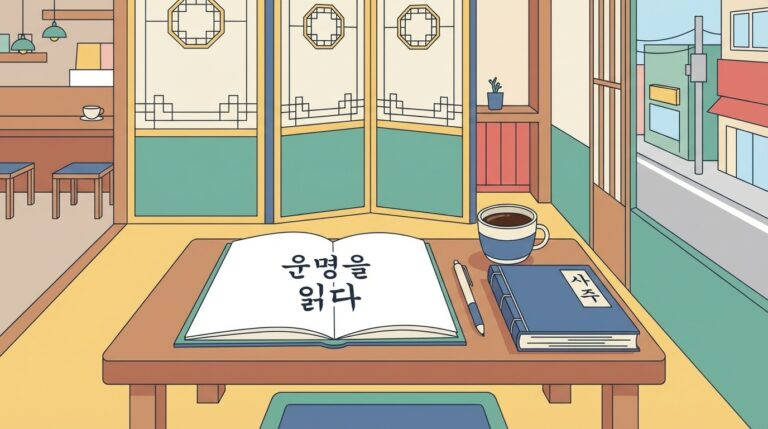
Hello! I’m your Daily Hangul editor. Imagine this: You’re walking down the vibrant neon-lit streets of Hongdae on a Friday night. Amidst the buskers and late-night food stalls, you see a row of small, warmly lit tents (포장마차) or cozy cafes with signs displaying mystical Chinese characters and the words 사주 (Saju) or 타로 (Tarot).
If you’ve watched K-Dramas like Reply 1988 or Strong Girl Bong-soon, you’ve definitely seen this scene. The protagonist’s mother desperately consulting a shaman, or a couple nervously waiting to hear if they are meant for each other. You might think, “Is this a strict religious thing?” Not quite! For modern Koreans, especially Millennials and Gen Z, visiting a Saju cafe is a mix of therapy, entertainment, and a culturally acceptable way to vent about life’s uncertainties.
If you walk into one of these tents without knowing the basics, you might just get a generic “You have good luck.” But if you know exactly what to ask? You’ll unlock a deeply authentic Korean cultural experience. Let’s dive in!
Phase 2: Deep Dive into Key Expressions
1. 연애운 봐주세요.
- Pronunciation: yeonae-un bwajuseyo [yeon-ae-oon bwa-joo-say-yo]
- Meaning: (Literal) Please look at my romance luck. / (Real nuance) Can you tell me my romantic fortune?
- K-Culture Moment: You sit down, sip your iced Americano, and lean in. This is the #1 question young Koreans ask. Whether you’re single or crushing on someone, asking for your yeonae-un sets the mood for a juicy reading.
- Editor’s Insight: The word 운 (un) means “luck” or “fortune.” By attaching it to different topics, you tell the reader exactly what you want to focus on.
- Situation Spectrum:
[🚫 절대 금지] ———— [⚠️ 주의] ———— [✅ 자유롭게]
- Casual Saju Cafe / Friends: ✅
- Formal/Business: 🚫
- 🤔 Think About It: Why does Korean language categorize “fortune” into such specific buckets (love, wealth, career, health)? What does this say about the practical nature of Korean hopes and dreams?
2. 저랑 이 사람 궁합이 어때요?
- Pronunciation: jeorang i saram gunghabi eottaeyo? [jeo-rang ee sah-ram goong-hahb-ee uh-ttae-yo?]
- Meaning: (Literal) How is the compatibility between me and this person? / (Real nuance) Are we a good match?
- K-Culture Moment: K-Pop fans often go to Saju cafes just to check their Gunghap (compatibility) with their favorite idol! Or, before getting married, a Korean couple’s parents might secretly check their Gunghap to ensure a harmonious future.
- Editor’s Insight: Gunghap is so culturally ingrained that Koreans even use it to describe food! (e.g., “Chicken and beer have perfect Gunghap.”)
- Situation Spectrum:
[🚫 절대 금지] ———— [⚠️ 주의] ———— [✅ 자유롭게]
- Asking a Saju Master: ✅
- Asking a friend about your crush: ✅
- 🤔 Think About It: Do you have a concept similar to Gunghap in your culture, like Zodiac compatibility?
3. 태어난 시간이 어떻게 되세요?
- Pronunciation: taeeonan sigani eotteoke doeseyo? [tae-uh-nan shee-gahn-ee uh-ttuh-kay dway-say-yo?]
- Meaning: (Literal) How does your birth time become? / (Real nuance) What time were you born?
- K-Culture Moment: The Master will ask you this immediately. Saju translates to “Four Pillars.” To calculate your destiny, they need four things: the Year, Month, Day, and Time you were born.
- Editor’s Insight: If you don’t know your exact birth time, they can’t do a full Saju reading! (You’ll have to settle for Tarot instead.)
- Situation Spectrum:
[🚫 절대 금지] ———— [⚠️ 주의] ———— [✅ 자유롭게]
- Master asking you (Formal): ✅
- 🤔 Think About It: Notice the polite structure “어떻게 되세요?” (How does it become?). Koreans use this indirect phrasing instead of the direct “What is it?” to show respect.
Phase 3: Textbook vs Real Life
| Situation | 📖 Textbook Korean | 🗣️ Real Korean | 💡 Why the difference? |
|---|---|---|---|
| Telling the Master what you want | 저의 미래에 대해 알고 싶습니다. (I want to know about my future.) | 올해 취업운 좀 보려고요. (I’m here to see my job luck for this year.) | Koreans are specific when paying for a reading. General future is too vague; they want actionable advice for this year! |
| Asking if it’s bad | 제 운명이 나쁜가요? (Is my destiny bad?) | 혹시… 안 좋은 거 있어요? (By any chance… is there anything bad?) | Softening the blow. Koreans use “안 좋은 거” (not good things) to sound less harsh than “나쁜” (bad). |
| Giving your birth time | 저는 밤 열 시에 태어났습니다. (I was born at 10 PM.) | 밤 10시쯤이요. (Around 10 PM.) | Conversational Korean drops the “I was born” part. Just give the time + 이요/요 for politeness! |
Phase 4: Cultural Deep Dive
4-1. Non-verbal Communication: The Art of “Reaction” (리액션)
When getting your Saju read, you cannot just sit there in silence! Korean culture places a huge emphasis on active listening, known as giving good “리액션” (reactions). When the Master tells you something remarkably accurate, you should lean forward, widen your eyes, and say, “아~ 맞아요!” (Ah~ That’s right!) or “대박…” (Wow/Jackpot…). Good reactions make the Master more enthusiastic, and they might even give you extra advice!
4-2. K-Culture Connection: Therapy for the Modern Soul
In K-Dramas, visiting a fortune teller is often used as a plot device to foreshadow a dramatic breakup or a hidden chaebol heir. But in real-life Seoul, Saju cafes function almost like affordable therapy. The hyper-competitive nature of Korean society (school, jobs, marriage) creates a lot of stress. Sitting down with a stranger who tells you, “Don’t worry, your career luck will blossom next year. Just rest for now,” provides immense psychological comfort. It’s less about religious devotion and more about seeking reassurance.
Phase 5: Immersive Roleplay
Setting: It’s a rainy Saturday afternoon. You’re inside a cozy “Saju & Tarot” cafe in Hongdae. The air smells like roasted coffee and old paper. Across from you sits the Saju Master, flipping through a thick book of ancient Chinese characters.
Characters:
– YOU: An adventurous expat/traveler living in Korea.
– Master Lee (50s): A friendly but slightly mysterious Saju reader.
Dialogue:
Master Lee: 어서 오세요. 사주 보실 건가요?
(eoseo oseyo. saju bosil geongayo?)
[Welcome. Are you going to get a Saju reading?]
(🎭 Stage Direction: Master Lee takes a sip of his tea and opens his notebook)
YOU: 네, 맞아요.
(ne, majayo.)
[Yes, that’s right.]
Master Lee: 태어난 년, 월, 일, 그리고 시간이 어떻게 되세요?
(taeeonan nyeon, wol, il, geurigo sigani eotteoke doeseyo?)
[What is your birth year, month, day, and time?]
YOU: 1995년 5월 10일, 아침 8시쯤이요.
(cheongubaekgusibonyeon owol sib-il, achim yeodeolsijjeumiyo.)
[May 10, 1995, around 8 AM.]
Master Lee: (scribbling characters) 흠… 불(Fire)의 기운이 강하네요. 혹시 특별히 궁금한 거 있어요?
(heum… burui giuni ganghaneyo. hoksi teukbyeolhi gunggeumhan geo isseoyo?)
[Hmm… You have strong Fire energy. Is there anything specific you are curious about?]
🔀 Your Turn! How do you answer?
– A) “저는 부자가 될까요?” (Will I become a rich person?)
– B) “올해 재물운 좀 봐주세요.” (Please look at my wealth luck for this year.)
– C) “아무거나 다 말해주세요!” (Tell me absolutely everything!)✅ Best Choice: B — Reason: Asking for a specific “운” (luck) like “재물운” (wealth luck) is exactly how locals sound.
⚠️ Choice A & C Analysis: “A” sounds a bit childish (like a fairy tale). “C” is too broad; Saju masters charge by the topic or give a general overview, but you get your money’s worth by being specific!
YOU: 올해 재물운 좀 봐주세요!
(olhae jaemurun jom bwajuseyo!)
[Please look at my wealth luck for this year!]
Master Lee: 오, 내년부터 돈이 들어오네요!
(o, naenyeonbuteo doni deureooneyo!)
[Oh, money is coming in starting next year!]
YOU: 대박! 감사합니다!
(daebak! gamsahamnida!)
[Jackpot! Thank you!]
Phase 6: 10-Second Shadowing Drill
Practice this sentence so you sound like a local when you sit down at the cafe!
😊 올해 / 제 재물운은 / 어떤가요?
(olhae / je jaemuruneun / eotteongayo?)
[How is my wealth luck this year?]
Pro-tip: Don’t read it like a robot! Raise your pitch slightly at the end on “가요?” to sound curious and eager.
Phase 7: K-Culture Glossary
| Korean | Romanization | English | Context |
|---|---|---|---|
| 사주 | saju | Four Pillars of Destiny | The traditional Korean fortune-telling method based on birth data. |
| 타로 | taro | Tarot cards | Very popular among the younger generation for quick, specific questions. |
| 운세 | unse | Fortune / Luck | The overall flow of your luck. (Often checked daily on apps like Naver!) |
| 궁합 | gunghap | Compatibility | Used for romantic partners, business partners, and even food pairings! |
| 부적 | bujeok | Talisman / Amulet | A yellow paper with red ink given by shamans to ward off bad luck. |
Phase 8: Traveler’s Survival Kit
Are you planning to visit Hongdae or Myeongdong? You’ll definitely see these tents. Here’s your survival kit!
🆘 Survival Phrases for the Saju Tent
– 🇰🇷 “얼마예요?” (eolmayeyo?) – How much is it?
– 🇰🇷 “영어로 가능해요?” (yeongeoro ganeunghaeyo?) – Is English possible?
– 🇰🇷 “타로 하나 봐주세요.” (taro hana bwajuseyo.) – Please do one Tarot reading.📌 Editor’s Travel Note
– Language Barrier: Most traditional Saju masters do not speak English. Look for cafes in Hongdae or Itaewon with signs that explicitly say “English Tarot/Saju” or bring a Korean friend to translate!
– Pricing: A basic Tarot reading is usually around 10,000 KRW, while a comprehensive Saju reading can be 30,000 to 50,000 KRW.
– Must-Have: You absolutely MUST know your time of birth (AM/PM) for Saju. If you don’t, stick to Tarot!
Phase 9: Think Deeper — “Media vs Reality”
🧠 Think Deeper: High-Tech Nation, Ancient Beliefs
South Korea has some of the fastest internet in the world, leads in smartphone technology, and produces cutting-edge K-Pop and K-Beauty. Yet, before launching a major tech startup, a CEO might still consult a Saju master for an auspicious launch date. Why?
In a fast-paced, highly competitive society where one exam or one job interview feels like life or death, Saju offers an illusion of control and comfort. It tells people that their struggles aren’t just their fault—it’s just the flow of their “destiny” this year, and better days are scientifically (astrologically) guaranteed to come. It’s a fascinating blend of ancient philosophy serving as modern psychological first aid.
💬 Your Turn: In your culture, what do people do when they feel uncertain about their future? Do you read horoscopes, or is there another tradition? Let us know in the comments!
Phase 10: FAQ & Troubleshooting
Q: “Can foreigners get a Saju reading?”
Yes! Saju is based on the solar/lunar calendar and the time of your birth. The Master will convert your Western birthdate into the lunar calendar system. Just make sure you know exactly what time you were born!
Q: “Is it rude to say I don’t believe in it?”
If you sit down for a reading, it’s polite to treat it with respect. You don’t have to believe it, but saying “I think this is fake” directly to the Master lacks Nunchi (social tact). Treat it as a fun cultural experience.
❌ Common Mistake #1: Asking “When will I die?”
✅ Do this instead: Saju masters generally avoid predicting death as it’s considered taboo and bad luck. Stick to “건강운” (Geongang-un / Health luck) instead!
Phase 11: Wrap-up & Action Items
One-Liner Summary: To get your fortune told like a local in Korea, remember to be specific about the luck (운) you want, and bring your exact birth time!
Your Action Missions:
– 🥉 Bronze (Solo): Find out your exact time of birth today.
– 🥈 Silver (Online): Comment on this post: “올해 제 [연애운/재물운/직업운]은 어떨까요?”
– 🥇 Gold (Real Life): Next time you are in Korea or at a local K-Festival, walk up to a Tarot/Saju tent and say “연애운 봐주세요!”
K-Culture Mission: Go to YouTube and search for “K-pop idol Saju.” You’ll find tons of videos where Saju masters analyze the compatibility (Gunghap) of idol groups. Listen closely to see if you can catch the words 운 (luck) and 궁합 (compatibility)!
Phase 12: Interactive Quiz
Test your new K-Culture knowledge!
1. Fill in the Blank:
You want to know if you’ll get that promotion this year. You sit down and say:
“올해 _________ 좀 봐주세요.” (Please look at my career luck this year.)
Hint: Career/Job is 직업 (jigeop).
2. True or False — K-Culture Edition:
If you want a full Saju reading, you only need to know your birth year, month, and day.
3. Situational Judgment:
The master tells you that your love luck is terrible this year. What is the most culturally appropriate reaction?
– A) Yell “You’re lying!” and flip the table.
– B) Say “아… 그래요? (Ah… really?)” with a slight nod, showing you are listening.
– C) Demand a refund.
(Check your answers by highlighting below!)
Click to reveal answers
1. 직업운 (jigeobun)
2. False! You MUST know the exact time of your birth for Saju.
3. B! Good reactions (리액션), even to bad news, show respect for the master’s reading.
Frequently Asked Questions (FAQ)
Q: What does "연애운 봐주세요." mean in Korean and how do you pronounce it?
A: In Korean, "연애운 봐주세요." is pronounced [yeonae-un bwajuseyo [yeon-ae-oon bwa-joo-say-yo] and means: (Literal) Please look at my romance luck. / (Real nuance) Can you tell me my romantic fortune?
Q: What does "저랑 이 사람 궁합이 어때요?" mean in Korean and how do you pronounce it?
A: In Korean, "저랑 이 사람 궁합이 어때요?" is pronounced [jeorang i saram gunghabi eottaeyo? [jeo-rang ee sah-ram goong-hahb-ee uh-ttae-yo?] and means: (Literal) How is the compatibility between me and this person? / (Real nuance) Are we a good match?
Q: What does "태어난 시간이 어떻게 되세요?" mean in Korean and how do you pronounce it?
A: In Korean, "태어난 시간이 어떻게 되세요?" is pronounced [taeeonan sigani eotteoke doeseyo? [tae-uh-nan shee-gahn-ee uh-ttuh-kay dway-say-yo?] and means: (Literal) How does your birth time become? / (Real nuance) What time were you born?







