

Panic Mode On? How to Say “Calm Down” in Korean Like a K-Drama Hero
Phase 1: The Hook — Don’t Be the One Who Freezes!
Annyeonghaseyo! This is your Daily Hangul Editor.
Picture this: You are watching your favorite K-Drama. The main character receives shocking news. Suddenly, they grab the back of their neck (a classic K-Drama move for high blood pressure!) and start breathing heavily. What does the hero next to them say?
Or maybe you are in Seoul. You left your bag on the subway, and you are running to the station office, hyperventilating in English. The staff looks at you with wide eyes. If you don’t know the right words, panic takes over.
Today, we aren’t just learning words; we are learning emotional First Aid. Knowing how to tell someone (or yourself) to “Calm down” is crucial for travel emergencies, misunderstandings, or just surviving a spicy tteokbokki incident. Let’s learn how to bring the temperature down, Korean style.
Phase 2: Deep Dive — The Core Expressions
1. 진정하세요 (Jin-jeong-ha-se-yo)
- Pronunciation: [Jin-jeong-ha-se-yo]
- Sound-alike: “Gin” (like the drink) + “Jong” (like a bell) + “Ha-say-yo”.
- Meaning: Please calm down. (Standard/Polite)
- K-Culture Moment: In medical dramas like Hospital Playlist, doctors often say this to panicked guardians. It’s firm but polite.
- Editor’s Insight: This is your “Emergency Button.” Use this when someone is visibly shaking, crying, or shouting. It’s not for casual teasing; it’s for real distress.
- Situation Spectrum:
[🚫 Boss/Elders (Use caution)] ———— [⚠️ Strangers] ———— [✅ Juniors/Friends]
(Note: Telling a very angry elder to “calm down” might make them angrier! Use “Please listen to me” instead.) - 🤔 Think About It: Why is the word “Please” (yo) attached to the end? In Korea, even in emergencies, hierarchy and politeness matter. Is it the same in your language?
2. 괜찮아요 (Gwaen-chan-a-yo)
- Pronunciation: [Gwaen-chan-a-yo]
- Sound-alike: “Gwen” (Stefani) + “Chan” (Jackie) + “Ah-yo”.
- Meaning: It’s okay / You are fine / No problem.
- K-Culture Moment: The ultimate magic word. A child falls down? Gwaenchanayo. A fan cries meeting their idol? Gwaenchanayo. You spill water? Gwaenchanayo.
- Editor’s Insight: While “Jinjeonghaseyo” is an instruction, “Gwaenchanayo” is empathy. It tells the person, “The situation is under control.”
- Situation Spectrum:
[✅ Boss/Elders] ———— [✅ Strangers] ———— [✅ Friends]
3. 천천히 말해 보세요 (Cheon-cheon-hi mal-hae bo-se-yo)
- Pronunciation: [Cheon-cheon-he mal-hae bo-say-yo]
- Sound-alike: “Chun-Chun” (train sound) + “He” + “Mal-hae”.
- Meaning: Please try to speak slowly.
- Editor’s Insight: Essential for you! If a Korean person is speaking too fast in an emergency, say this to calm them down so you can understand.
Phase 3: Textbook vs. Real Life
| Situation | 📖 Textbook Korean | 🗣️ Real Street Korean | 💡 Why the difference? |
|---|---|---|---|
| Friend is freaking out | 진정하십시오 (Jinjeong-hasipsio) | 워워~ (Wo-wo~) / 릴랙스 (Rillaekseu) | “Wo-wo” is like calming a horse. “Relax” is Konglish. It’s funny and lighthearted. |
| Trying to comfort | 걱정하지 마세요 (Do not worry) | 걱정 마 (Geok-jeong ma) | Dropping the ‘yo’ creates intimacy among friends. |
| Shocking situation | 놀라지 마세요 (Do not be surprised) | 대박… 괜찮아? (Daebak… Gwaenchana?) | In reality, we react first (“Daebak”) before comforting. |
💡 Editor’s Note: “Wo-wo~” is strictly for close friends! Do not say “Wo-wo” to a police officer or a taxi driver.
Phase 4: Cultural Context — The “Glass of Water” Theory
4-1. Non-verbal Communication: The Back Pat
In the West, you might hug someone to calm them down. In Korea, especially with slightly older people or colleagues, a hug can be too intimate. instead, lightly patting the person’s upper back or rubbing it while saying “Gwaenchanayo” is the standard gesture of comfort.
4-2. K-Drama Connection: The Water Slap vs. Water Drink
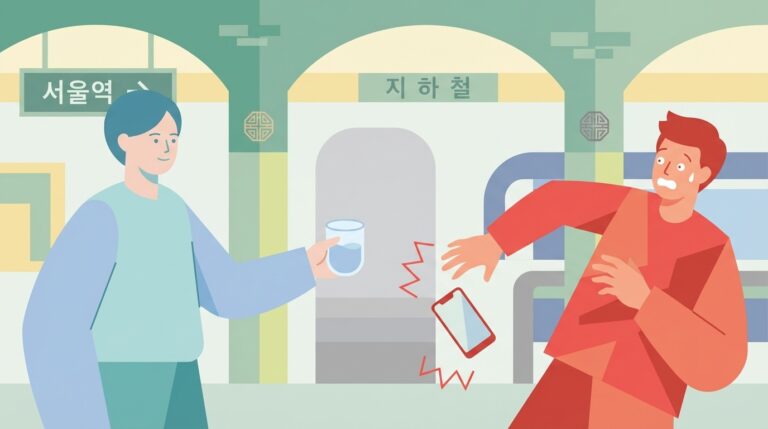
We’ve all seen the “Kimchi Slap,” but have you noticed the “Water Ritual”? When a character gets too angry or shocked:
1. Someone brings a glass of cold water.
2. They say “Mul masyeoyo” (Drink water).
3. It physically cools them down.
Pro Tip: If your friend is angry, don’t just say “Calm down.” Hand them a cold drink. It works better than words!
Phase 5: Immersive Roleplay
Setting: Seoul, Friday night. You are in a taxi with your Korean friend, Minji. She realizes she left her phone at the restaurant.
Characters:
* YOU: The calm traveler.
* Minji: Your panicked Korean friend.
Dialogue:
Minji: (Searching pockets frantically) 어떡해! 내 핸드폰! 식당에 두고 왔나 봐! 😱
(Eotteokhae! Nae haendeupon! Sikdang-e dugo wanna bwa!)
(What do I do! My phone! I think I left it at the restaurant!)
YOU: (Choose your response!)
🔀 Decision Point: What do you say?
- A) “워워~ 릴랙스!” (Wo-wo~ Relax!)
- B) “진정해, 민지야. 괜찮아.” (Jinjeong-hae, Minji-ya. Gwaenchana.)
- C) “경찰서 가요!” (Let’s go to the police station!)
✅ Best Choice (B): “Jinjeong-hae” (Casual form of Jinjeonghaseyo) + “Gwaenchana.” You are being a supportive friend.
⚠️ Choice A: A bit too playful for a lost phone situation. She might get annoyed.
🚫 Choice C: Too extreme! The restaurant probably has it.
(Continued…)
YOU: 진정해. 기사님, 차 좀 돌려주세요. (Jinjeong-hae. Driver, please turn the car around.)
Minji: (Taking a deep breath) 휴… 고마워. 너 진짜 침착하다.
(Hyu… Gomawo. Neo jinjja chimchak-hada.)
(Phew… Thanks. You are really calm.)
Phase 6: 10-Second Shadowing Drill
Read this aloud. Focus on the soothing tone.
- Emotion: 🥺 Empathetic & Soft
- Sentence: 괜찮아요 / 당황하지 / 마세요.
- Romanization: Gwaen-chan-a-yo / Dang-hwang-ha-ji / ma-se-yo.
- Meaning: It’s okay / don’t / panic.
Phase 7: K-Culture Mini Glossary
| Korean | Romanization | Meaning | Context |
|---|---|---|---|
| 멘붕 | Men-bung | Mental Breakdown | Slang used when you are totally panicked or confused. |
| 심호흡 | Sim-ho-heup | Deep Breath | What you tell someone to do before speaking. |
| 119 | Il-il-gu | 911 (Emergency) | Medical/Fire emergency number. |
Phase 8: Traveler’s Survival Kit
In a real emergency (not just a lost phone), you need short, clear words.
🆘 Survival Card: Emergency
- 🇰🇷 “도와주세요!” (Do-wa-ju-se-yo!)
- 🗣️ Meaning: Help me!
- 📍 Use: When you are hurt or in danger.
- 🇰🇷 “천천히 말해 주세요.” (Cheon-cheon-hi mal-hae ju-se-yo)
- 🗣️ Meaning: Please speak slowly.
- 📍 Use: When 119 dispatchers or police speak too fast.
- 💡 Pro Tip: Dialing 1330 connects you to a 24-hour travel helpline with English interpretation. Save this number!
Phase 9: Think Deeper — “Don’t Cry” Culture
🧠 Think Deeper:
You often hear Koreans say “Ulji-ma” (Don’t cry) immediately when someone starts tearing up. In some Western cultures, letting it all out is encouraged (“Let it out”).
However, in Korea, maintaining composure (Chemyon – Face) is historically important. Telling someone “Don’t cry” or “Calm down” is often a way of helping them protect their dignity in public. It’s not about suppressing emotion, but saving face.💬 Your Turn: In your country, is it okay to cry loudly in public? How do people react?
Phase 10: FAQ & Troubleshooting
- Q: Can I say “Jinjeonghaseyo” to my boss if he is yelling?
- NO! 🚫 Telling a superior to “calm down” implies they are being irrational. It’s rude. Instead, say “죄송합니다” (I’m sorry) and wait for the storm to pass. Read the Nunchi.
- Q: What if I forget the words?
- Body Language: Use the “hands pressing down” gesture (palms facing floor, moving down slowly). It’s the universal sign for “lower the energy.”
- ❌ Common Mistake: Smiling while saying “Jinjeonghaseyo.”
- Fix: Keep a serious, concerned face. Smiling might look like you are mocking them.
Phase 11: Wrap-up & Action Mission
One-Liner: When panic hits, breathe deep and say “Gwaenchanayo” (It’s okay) to reset the room.
🎬 Action Mission:
* 🥉 Bronze: Look in the mirror, make a worried face, then switch to a calm face and say “Gwaenchanayo.”
* 🥈 Silver: Watch a K-Drama scene where someone is fighting. Identify if they use formal or informal language.
* 🥇 Gold: Next time a friend stresses about a deadline or lost item, try saying “Gwaenchana, Jinjeonghae” and pat their back!
Phase 12: Interactive Quiz
- Situation: You accidentally stepped on a stranger’s foot on the subway. They look annoyed. What should you say?
- A) 진정하세요! (Calm down!)
- B) 죄송합니다. 괜찮으세요? (Sorry. Are you okay?)
- True or False: You should always offer a hug to a Korean stranger who is crying.
- (True / False)
Answer Key:
1. B. Saying “Calm down” (A) to someone YOU hurt is rude! Apologize first.
2. False. Physical touch with strangers is rare. Handing them a tissue is better.
See you in the next lesson! Stay calm and learn Korean! 👋
Frequently Asked Questions (FAQ)
Q: What does "진정하세요 (Jin-jeong-ha-se-yo)" mean in Korean and how do you pronounce it?
A: In Korean, "진정하세요 (Jin-jeong-ha-se-yo)" is pronounced [Jin-jeong-ha-se-yo] and means: a key conversational Korean expression covered in this lesson.
Q: What does "괜찮아요 (Gwaen-chan-a-yo)" mean in Korean and how do you pronounce it?
A: In Korean, "괜찮아요 (Gwaen-chan-a-yo)" is pronounced [Gwaen-chan-a-yo] and means: a key conversational Korean expression covered in this lesson.
Q: What does "천천히 말해 보세요 (Cheon-cheon-hi mal-hae bo-se-yo)" mean in Korean and how do you pronounce it?
A: In Korean, "천천히 말해 보세요 (Cheon-cheon-hi mal-hae bo-se-yo)" is pronounced [Cheon-cheon-he mal-hae bo-say-yo] and means: a key conversational Korean expression covered in this lesson.







