

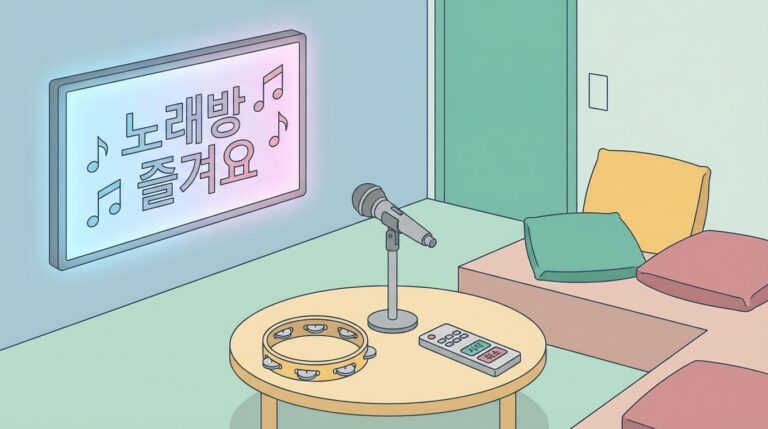
Don’t Panic at the Noraebang! 🎤 Survival Korean for “Bad Singers”
Phase 1: Immersive Hook
Hello! This is your Daily Hangul Editor. 👋
Picture this: You are in a dim room illuminated by flashing disco lights. A tambourine is in your left hand. Your Korean friends are cheering. Suddenly, the screen shows “YOUR TURN.”
Panic sets in. You remember that K-Drama scene where the main character sings a ballad so beautifully that everyone cries. But you? You sound more like a dying cat than a K-Pop idol. 🙀
Wait! Before you drop the mic and run, here is a secret: Korean Noraebang (Karaoke) isn’t about perfection. It’s about Heung (흥 – excitement/mood).
But still, you need to know how to humble yourself or compliment others to survive the night. Today, we will learn how to talk about pitch and rhythm (or the lack thereof) to save face and fit in!
Phase 2: Deep Dive (Core Expressions)
Here are the top 3 expressions to handle your singing skills.
1. 저는 음치예요 (Jeo-neun eumchi-yeyo)
- Pronunciation: [jeo-neun eum-chi-ye-yo] (Sounds like: Jeo-neun + Eum as in ‘room’ + Chi as in ‘cheese’ + yeyo)
- Meaning: “I am tone-deaf.”
- Breakdown:
- 음 (Eum): Sound/Tone
- 치 (Chi): A suffix for someone bad at something (like a fool).
- K-Culture Moment: In almost every romantic comedy, there is a lovable character who sings with passion but absolutely zero pitch. They are a proud 음치. Saying this before you sing lowers expectations and makes everyone laugh with you.
- Editor’s Insight: This is the ultimate shield. If you say this, no matter how bad you are, people will say, “Gwaenchanhayo!” (It’s okay!).
- Situation Spectrum:
[✅ Friends] ———— [✅ Co-workers] ———— [✅ Boss]- 🤔 Think About It: Why does Korean have a specific noun for a “tone-deaf person”? It shows how central music and singing are to social life here.
2. 노래 못해요 (Norae mot-haeyo)
- Pronunciation: [no-rae mot-hae-yo] (The ‘t’ in mot stops abruptly)
- Meaning: “I can’t sing well.”
- Literal: Song + Can’t do.
- K-Culture Moment: Think of an idol on a variety show being asked to sing trot, and they shyly wave their hands saying this phrase (before absolutely crushing it).
- Editor’s Insight: In Korea, modesty is key. Even if you are decent, you should start with this phrase. It’s called ‘preventative humility.’
- Situation Spectrum:
[✅ Friends] ———— [✅ Co-workers] ———— [✅ Boss]3. 가수 같아요! (Gasu gatayo!)
- Pronunciation: [ga-su ga-ta-yo]
- Meaning: “You sound like a professional singer!”
- Literal: Singer + same as/like.
- Editor’s Insight: When your Korean friend hits that high note perfectly, don’t just clap. Scream this. It is the highest compliment.
- Situation Spectrum:
[✅ Friends] ———— [✅ Co-workers] ———— [✅ Boss]
Phase 3: Textbook vs. Real Life
| Situation | 📖 Textbook Korean | 🗣️ Real Life Korean | 💡 Why is it different? |
|---|---|---|---|
| Complimenting | 노래를 참 잘하시네요. (You sing very well.) | 대박! 가수예요? (Daebak! Are you a singer?) | Textbook is too stiff. Koreans use reactions like “Daebak” to show excitement. |
| Being modest | 저는 노래를 잘 못 부릅니다. (I cannot sing songs well.) | 저 음치/박치예요. (I’m tone/rhythm deaf.) | Using specific nouns like Eumchi sounds more native and funnier. |
| Missing the beat | 박자를 놓쳤어요. (I missed the beat.) | 아! 박자… (Ah! The beat…) | In the moment, you don’t speak full sentences. Just blaming the “beat” is enough! |
💡 Note: 박치 (Bakchi) is the rhythm version of 음치 (Eumchi). If you have no rhythm, you are a Bakchi.
Phase 4: Cultural Context — The “Nunchi” of Noraebang
4-1. Non-verbal Communication: The Tambourine Master
Even if you are an 음치 (tone-deaf), you can still be the MVP of the night. How?
– Tambourine: Shake it to the beat when others sing.
– Clapping: Never sit still. If a ballad ends, clap gently. If a dance song ends, cheer loudly.
– Nunchi (Sense): Do not press “Cancel” on someone else’s song, and never sing a sad ballad when the mood is hyped up!
4-2. K-Drama Connection
Have you seen scenes where office workers go to a Noraebang with their boss? The subordinate often wears a tie around their head and shakes the tambourine desperately. This is Service (서비스) spirit. You sacrifice your image to make the group happy. In real life, you don’t need the tie on your head, but the enthusiasm is mandatory!
Phase 5: Immersive Roleplay
Setting: Friday night in Hongdae. A coin karaoke (Coin Noraebang) with your new Korean friends, Min-ji and Jun-ho.
Characters:
* YOU: A beginner in Korean, nervous about singing.
* Min-ji: Excited, holds the remote control like a weapon.
Dialogue:
Min-ji: (Passing you the mic) 자! 이제 [Your Name] 차례야! 🎤
(Ja! Ije [Your Name] charye-ya!)
(Okay! Now it’s your turn!)
YOU: (Hesitating with the mic)
(Stage Direction: You look at the screen nervously.)
🔀 Decision Point: How do you respond?
A) “저는 음치예요… 하지만 해볼게요!” (I’m tone-deaf… but I’ll try!)
B) “싫어요. 안 해요.” (I hate it. I won’t do it.)
C) “당연하죠! 비켜세요!” (Of course! Move over!)
✅ Best Choice: A
* Why? It lowers expectations (humility) but shows participation (social effort). Koreans love this attitude.
⚠️ Choice B Analysis:
* Refusing too strongly kills the mood (breaks the Heung). Even if you just hum, you should try.
Min-ji: (Laughing) 괜찮아! 여기 가수 없어. 그냥 즐겨!
(Gwaenchana! Yeogi gasu eopseo. Geunyang jeulgyeo!)
(It’s okay! There are no singers here. Just enjoy!)
Phase 6: 10-Second Shadowing Drill
Practice these to survive the mic hand-over.
- 🥺 Shy/Humble:
저 / 노래 / 진~짜 / 못해요.
(Jeo / norae / jin~jja / mot-haeyo)
I / singing / really / can’t do. -
😤 Making an excuse:
아! / 박자가 / 너무 / 빨라요!
(Ah! / bakja-ga / neomu / ppallayo!)
Ah! / the beat / is too / fast!
Phase 7: K-Culture Mini Glossary
| Korean | Romanization | Meaning | Context |
|---|---|---|---|
| 음치 | Eumchi | Tone-deaf person | A common character trait in K-Dramas. |
| 박치 | Bakchi | Rhythm-deaf person | Someone who claps on the wrong beat. |
| 18번 | Sip-pal-beon | Favorite Song | Your “Go-to” song that you sing best. |
| 취소 | Chwiso | Cancel | The most important button on the remote if you panic. |
Phase 8: Traveler’s Survival Kit (The Remote Control)
The Korean Karaoke remote is huge and confusing. Here are the 3 buttons you MUST know.
🆘 Remote Control Survival
1. 시작 (Si-jak): Start. (Usually a big Green or Blue button).
2. 취소 (Chwi-so): Cancel. (Red button). Press this to stop a song.
3. 예약 (Ye-yak): Reserve. Pick a song and press this to queue it up.💡 Pro Tip: If you can’t read the song book, just look at the remote for “인기차트” (Popular Chart) to see what others are singing.
Phase 9: Think Deeper — “The beauty of Imperfection”
Why do Koreans love ‘Eumchi’ (Tone-deaf people)?
In Western culture, singing publicly often feels like a performance where you need to be talented. In Korea, Noraebang is a place to release Han (repressed emotion) and stress. Ironically, an Eumchi who screams their lungs out with passion is often more loved in a Noraebang than a perfect singer who sits still.
🧠 Think About It: Does your culture value perfection or participation more in social settings?
Phase 10: FAQ & Troubleshooting
Q: Can I sing a song in English?
A: Absolutely! Every Korean Noraebang has a huge collection of Pop songs. Look for the button “팝송” (Pop Song) on the remote. It might actually make you popular because it’s “exotic”!
Q: What if I really, really don’t want to sing?
A: It is polite to sing at least one song. If you truly can’t, use the “Tambourine Strategy” (Phase 4). Be the most energetic cheerleader, and people will forgive you for not holding the mic.
❌ Common Mistake:
Don’t look at your phone while others are singing. That is considered rude. Watch the screen or the singer!
Phase 11: Wrap-up & Mission
One-Liner Summary:
Don’t worry about pitch; just say “Jeoneun Eumchi-yeyo” and sing with your heart!
Your Mission:
* 🥉 Bronze: Look in the mirror and say “Gasu gatayo!” (You are like a singer!) to yourself.
* 🥈 Silver: Find a scene in a K-Drama where someone sings badly. (Hint: Hospital Playlist has great examples).
* 🥇 Gold: Go to a Coin Noraebang (even alone!) and find the “취소” (Cancel) button.
Phase 12: Quiz — Interactive Challenge
1. If your friend sings amazingly, what is the BEST reaction?
A) You are an Eumchi.
B) Gasu gatayo!
C) Norae mot-haeyo.
2. True or False?
In Korea, you should never sing if you are bad at it.
Answers:
1. B (Gasu gatayo = You are like a singer!)
2. False (It’s about the mood/Heung, not the skill!)
Frequently Asked Questions (FAQ)
Q: What does "저는 음치예요 (Jeo-neun eumchi-yeyo)" mean in Korean and how do you pronounce it?
A: In Korean, "저는 음치예요 (Jeo-neun eumchi-yeyo)" is pronounced [jeo-neun eum-chi-ye-yo] and means: "I am tone-deaf."
Q: What does "노래 못해요 (Norae mot-haeyo)" mean in Korean and how do you pronounce it?
A: In Korean, "노래 못해요 (Norae mot-haeyo)" is pronounced [no-rae mot-hae-yo] and means: "I can't sing well."
Q: What does "가수 같아요! (Gasu gatayo!)" mean in Korean and how do you pronounce it?
A: In Korean, "가수 같아요! (Gasu gatayo!)" is pronounced [ga-su ga-ta-yo] and means: "You sound like a professional singer!"







