

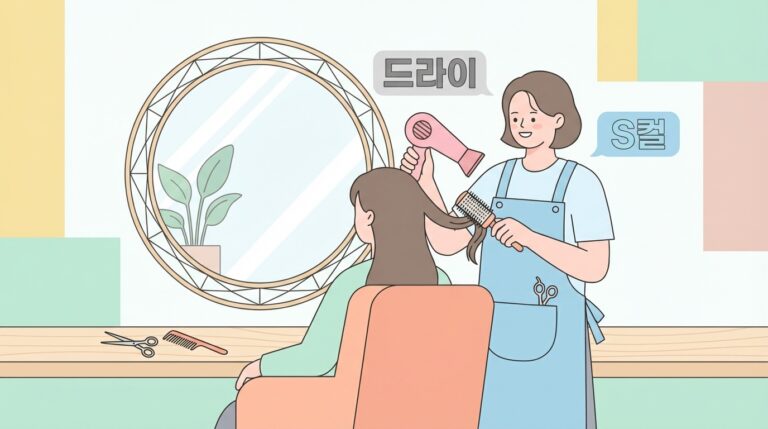
Get That K-Drama Hair! 💇♀️ How to Ask for the Perfect “Dry” (Blow-out) in Korea
👋 Hello! This is your Daily Hangul Editor.
Picture this: You’re watching your favorite K-Drama. The main character has a big date or a crucial job interview. They walk into a salon looking a bit messy, and 30 minutes later? They walk out looking like a goddess with bouncing, shiny waves. ✨
In Korea, we don’t just go to the salon to cut hair. We go there to get “Dry” (드라이).
Wait, isn’t “dry” just removing water? 🚿 In standard English, yes. But in the K-Beauty world, “Dry” means “Styling” or a “Blow-out.”
I’ve seen so many students walk into a salon in Gangnam, ask for a “dry,” and get confused when the stylist brings out round brushes and curling irons instead of just a towel. Today, I’ll teach you how to ask for that specific K-Pop idol look without any miscommunication. Let’s get your hair ready for its close-up! 📸
🔍 Phase 2: Deep Dive into Key Expressions
1. 드라이 예쁘게 해 주세요 (Deu-ra-i ye-ppeu-ge hae ju-se-yo)
- Pronunciation: [Deu-ra-i ye-ppeu-ge hae ju-se-yo]
- Tip: “Deu-ra-i” sounds like “Dry” but with a soft rolling ‘r’. “Ju-se-yo” should sound soft and pleading, not demanding.
- Meaning:
- Literal: Please do the dry prettily.
- Real Nuance: “Please style/blow-out my hair beautifully.”
- K-Culture Moment: You know those scenes where K-Pop idols arrive at the airport (Airport Fashion)? Their hair looks natural but perfect. They definitely got “Dry” done that morning!
- Editor’s Insight: This is the magic phrase. If you just say “Dry,” they might just blast air at your head. Adding “Ye-ppeu-ge” (prettily) signals that you want styling.
- Situation Spectrum:
[🚫 Boss] ———— [⚠️ Colleague] ———— [✅ Salon Staff]- (Note: Use this specifically with salon staff. It’s polite and standard!)
- 🤔 Think About It: Why do Koreans use the English word “Dry” for styling? It likely came from professional salon terminology where “blow-dry” implies shaping the hair with heat, not just drying.
2. 웨이브 굵게 넣어 주세요 (We-i-beu gulg-ge neo-eo ju-se-yo)
- Pronunciation: [We-i-beu gulg-ge nuh-uh ju-se-yo]
- Sound Analogy: “Gulg-ge” sounds a bit like gulping water. It means “thickly” or “boldly.”
- Meaning: Please put in thick/loose waves.
- K-Culture Moment: Think of the classic “rich family’s daughter” (chaebol) look in dramas. Those elegant, large curls? That is “Gulg-ge” (thick) waves.
- Editor’s Insight: If you don’t say “Gulg-ge,” you might get very tight, “ajumma” (older lady) style perms. This adjective saves you!
3. 뿌리 볼륨 좀 살려 주세요 (Ppuri bol-lyum jom sal-lyeo ju-se-yo)
- Pronunciation: [Bbu-ri bol-lyum jom sal-lyuh ju-se-yo]
- Meaning: Please revive/save my root volume.
- Editor’s Insight: Korean styling is OBSESSED with root volume. Flat hair is considered sad. Asking to “save” (sal-lyeo) your roots is the secret to looking like a local.
📖 Phase 3: Textbook vs. Real Life
| Situation | 📖 Textbook Korean | 🗣️ Real Korean (Salon Vibe) | 💡 Why is it different? |
|---|---|---|---|
| I want a style | 머리 모양 내 주세요 (Please make a hair shape) | 드라이 해 주세요 (Do ‘Dry’ please) | Konglish terms are standard in the beauty industry. |
| Specific Curls | 파마 해 주세요 (Please perm it) | C컬 / S컬 넣어 주세요 (Put in C-curl / S-curl) | “Perm” is permanent. For one-day styling, we use “C-curl” (ends in) or “S-curl” (wavy). |
| Too flat | 머리가 납작해요 (Head is flat) | 볼륨이 죽었어요 (The volume died 💀) | Koreans personify hair volume. It’s either “dead” or “alive”! |
🎭 Phase 4: Cultural Deep Dive
4-1. Non-verbal: The Power of the Photo 📱
In Korean salons, “Show, Don’t Tell” is the golden rule. Even Koreans do this. Before you sit down, search Naver or Instagram for #빌드펌 (Build Perm) or #레이어드컷 (Layered Cut). Show the photo and say:
“이 사진처럼 해 주세요.” (Like this photo, please.)
4-2. K-Drama Connection: The “Special Day” Makeover
In dramas, characters go to salons not just for cuts, but before blind dates (sogeting) or weddings. This is real life! It’s very common for Koreans to pay about 20,000~40,000 KRW just to have their hair washed and styled before a special event. It’s affordable luxury. Don’t feel shy about going to a salon just for a wash and dry!
🎬 Phase 5: Roleplay Scenario
📍 Setting: A trendy salon in Hongdae on a Friday evening. K-Pop plays softly in the background.
👥 Characters:
* YOU: Preparing for a friend’s wedding party.
* Stylist (Siljang-nim): Stylish, quick, wearing all black.
Stylist: 어서 오세요~ 예약하셨나요? 👋
(Eoseo oseyo~ yeyak ha-syeot-na-yo?)
(Welcome! Did you make a reservation?)
YOU: 네, 5시에 예약했어요. 드라이 예쁘게 하고 싶어요.
(Ne, 5-si-e yeyak haess-eo-yo. Deu-ra-i ye-ppeu-ge ha-go si-peo-yo.)
(Yes, at 5. I want to get a nice blow-out/style.)
Stylist: 아, 네! 특별한 날이신가 봐요. 어떤 스타일 원하세요?
(Ah, ne! Teuk-byeol-han nar-i-sin-ga bwa-yo. Eot-teon seu-ta-il won-ha-se-yo?)
(Ah! Must be a special day. What style do you want?)
🔀 Decision Point: Your Turn!
- A) “그냥… 예쁘게?” (Just… prettily?)
- B) “웨이브 굵게 S컬로 넣어 주세요.” (Thick S-curl waves, please.)
- C) “뿌리 볼륨 팍팍!” (Root volume maximize!)
✅ Best Choice: B
* Why? Option A is too vague and risky. Option B gives specific instruction using terms the stylist understands immediately (S-curl).
Stylist: 알겠습니다. S컬로 여신 머리 만들어 드릴게요! 💇♀️
(Al-get-seum-ni-da. S-curl-lo yeo-sin meo-ri man-deu-reo deu-ril-ge-yo!)
(Got it. I’ll make you ‘Goddess Hair’ with S-curls!)
🗣️ Phase 6: 10-Second Shadowing Drill
Let’s practice the nuance! Read the / as a short pause.
1. The Polite Request (😊 Soft & Expectant)
오늘은 / 드라이 / 예쁘게 / 부탁드려요!
(O-neul-eun / deu-ra-i / ye-ppeu-ge / bu-tak-deu-ryeo-yo!)
Translation: I ask for a pretty style today!
2. The Specific Detail (👌 Professional)
뿌리 볼륨 좀 / 많이 / 살려 주세요.
(Bbu-ri bol-lyum jom / ma-ni / sal-lyeo ju-se-yo.)
Translation: Please revive the root volume a lot.
📚 Phase 7: K-Culture Mini Glossary
| Korean | Romanization | Meaning | Context |
|---|---|---|---|
| S컬 / C컬 | S-curl / C-curl | S-wave vs. Inward curl | Essential terms to describe the shape of the hair ends. |
| 실장님 | Siljang-nim | Manager/Head Stylist | A polite title for an experienced stylist. Better than calling them “Hey.” |
| 여신 머리 | Yeosin meori | Goddess Hair | Long, flowy, wavy hair often seen on actresses. The ultimate goal. |
| 손이고 | Son-i-go | “It’s Ironing” | Slang short for “Customer, this is (done with) a curling iron.” Used when you show a photo of a perm, but the stylist says it’s actually styled with heat. |
🆘 Phase 8: Traveler’s Survival Kit (Salon Edition)
Walking into a foreign salon is scary. Here are your shields:
🆘 Survival Card #1: The Price Check
* 🇰🇷 “드라이 비용은 얼마예요?” (Deu-ra-i bi-yong-eun eol-ma-ye-yo?)
* 🗣️ Meaning: How much is the styling cost?
* 💡 Tip: Basic styling usually excludes cutting. Confirm the price first!🆘 Survival Card #2: The Time Check
* 🇰🇷 “얼마나 걸려요?” (Eol-ma-na geol-lyeo-yo?)
* 🗣️ Meaning: How long does it take?
* 💡 Tip: Important if you have a dinner reservation right after.📌 Editor’s Travel Note:
* Tipping: 🚫 NO TIPPING in Korean salons. The price you see is the price you pay. If you tip, they might run after you to return the “forgotten money.”
* Reservations: Famous salons (especially in Gangnam/Hongdae) require reservations via Naver Map or Kakao Hair Shop. Walk-ins might wait for hours.
🧠 Phase 9: Think Deeper — Appearance & Etiquette
Topic: Why is “grooming” (Dan-jang) so important in Korea?
In Korea, taking care of your appearance, especially hair, is considered a form of respect for the person you are meeting. It’s not just about vanity; it’s about “Che-myeon” (Face/Reputation). Showing up with messy, wet hair to a meeting or a date can be seen as “lack of sincerity” (Seong-ui).
🧠 Think Deeper: In your culture, is spending money on hair styling considered a luxury for the rich, or a necessary etiquette for special days? Does “looking natural” mean actually doing nothing, or spending hours to look like you did nothing?
🔧 Phase 10: FAQ & Troubleshooting
Q: Can I bring a picture of a K-Pop idol even if I don’t look like them?
A: YES! 100%. Stylists love clear visual references. Just don’t expect the face to change (classic Korean joke: “Son-nim, that is the face”). Focus on the hair texture and volume.
Q: Do I need to wash my hair before going?
A: No. “Dry” service usually includes a shampoo wash. In fact, the head massage during the wash is the best part!
❌ Common Mistake:
* Don’t say: “Hair Dry please.” (Keep it simple: just “Dry” or “Dry-hago sipeoyo”.)
* Don’t say: “Cut and Dry.” (Say “Cut” and “Dry” separately, or you might just get a cut and a quick water removal.)
🎁 Phase 11: Wrap-up & Mission
One-Liner: In Korea, “Dry” isn’t just drying; it’s the magic spell for K-Drama hair! ✨
🏆 Action Mission:
* 🥉 Bronze: Look in the mirror and practice saying “Ppu-ri bol-lyum sal-lyeo ju-se-yo” 3 times with a pleading face.
* 🥈 Silver: Find a photo of a Korean hairstyle you like and identify if it’s “S-curl” or “C-curl.”
* 🥇 Gold: Visit a Korean salon (or a K-salon in your country) and ask for a “Dry” service before a night out!
💬 Your Turn: Have you ever had a “bad hair day” disaster while traveling? Tell us in the comments! 👇
Frequently Asked Questions (FAQ)
Q: What does "드라이 예쁘게 해 주세요 (Deu-ra-i ye-ppeu-ge hae ju-se-yo)" mean in Korean and how do you pronounce it?
A: In Korean, "드라이 예쁘게 해 주세요 (Deu-ra-i ye-ppeu-ge hae ju-se-yo)" is pronounced [Deu-ra-i ye-ppeu-ge hae ju-se-yo] and means: a key conversational Korean expression covered in this lesson.
Q: What does "웨이브 굵게 넣어 주세요 (We-i-beu gulg-ge neo-eo ju-se-yo)" mean in Korean and how do you pronounce it?
A: In Korean, "웨이브 굵게 넣어 주세요 (We-i-beu gulg-ge neo-eo ju-se-yo)" is pronounced [We-i-beu gulg-ge nuh-uh ju-se-yo] and means: a key conversational Korean expression covered in this lesson.
Q: What does "뿌리 볼륨 좀 살려 주세요 (Ppuri bol-lyum jom sal-lyeo ju-se-yo)" mean in Korean and how do you pronounce it?
A: In Korean, "뿌리 볼륨 좀 살려 주세요 (Ppuri bol-lyum jom sal-lyeo ju-se-yo)" is pronounced [Bbu-ri bol-lyum jom sal-lyuh ju-se-yo] and means: Please revive/save my root volume.







