

Phase 1: Greeting & Immersive Hook
Hello! This is your Daily Hangul Editor. 👋
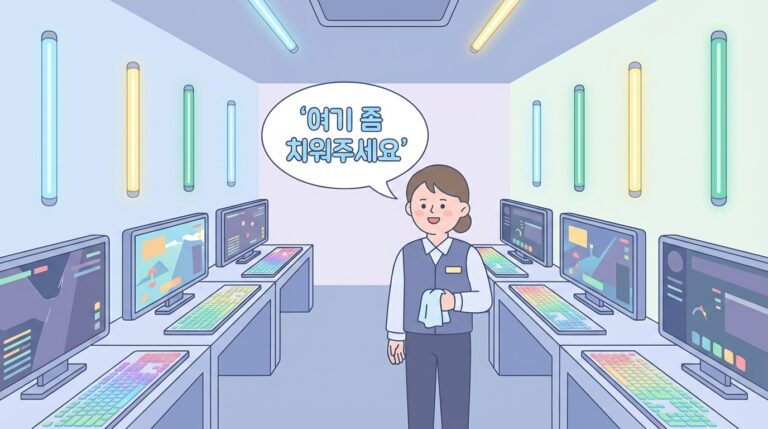
Picture this: You are in Hongdae, the heart of Seoul’s youth culture. You just walked into a PC Bang (PC Room) to play League of Legends or maybe just to book concert tickets with Korea’s lightning-fast internet. 🖥️⚡
You find the perfect seat—curved monitor, mechanical keyboard, comfortable gaming chair. But wait… 😱
There’s an empty Ramyun bowl and a sticky soda ring on the desk left by the previous gamer. Yuck. You can’t put your phone down there!
You see a staff member walking by. In K-Dramas, the cool protagonist might just snap their fingers (don’t do that!), but what should you say?
If you don’t know this phrase, you might have to clean it yourself with a wet tissue. Today, let’s learn the magic sentence to get that VIP treatment. Let’s dive in!
Phase 2: Deep Dive (Key Expressions)
Here are the 3 essential expressions to survive a messy desk situation.
1. 여기 좀 치워 주세요 (Yeogi jom chiwo juseyo)
- Pronunciation: [Yeo-gi] + [jom] + [chi-wo] + [ju-se-yo]
- Sound Analogy: Yeo-gi (Yogi bear) + Jom (sounds like ‘comb’ but with a J) + Chi-wo (Chewy) + Ju-se-yo (Juice-say-yo).
- Meaning: Literal: Please remove/clean here a little. Real nuance: “Could you please clean this spot for me?”
- K-Culture Moment: You’ll hear “Chiwo-juseyo” in K-Dramas when a detective walks into a messy crime scene, or in reality TV shows like I Live Alone when hosts are cleaning their houses.
- Editor’s Insight: The word ‘Jom’ (좀) is magic. Literally, it means “a little,” but in requests, it softens your tone from a demand to a polite favor. Always use ‘Jom’!
- Situation Spectrum:
[🚫 Boss/Elders] ———— [⚠️ Strangers/Staff] ———— [✅ Friends]
(Actually, this phrase is perfect for Staff (⚠️) and Strangers. For friends, drop the ‘yo’.)- 🤔 Think About It: Why do Koreans add “a little” (Jom) even when the mess is huge? It’s a linguistic buffer to avoid sounding demanding.
2. 여기요 / 저기요 (Yeogiyo / Jeogiyo)
- Pronunciation: [Yeo-gi-yo] / [Jeo-gi-yo]
- Meaning: Literal: Here / Over there. Real nuance: “Excuse me!” (to call staff).
- Editor’s Insight: Before you ask them to clean, you need their attention. Don’t say “Excuse me” in English. Shout “Jeogiyo!” confidently.
3. 물티슈 있어요? (Multisyu isseoyo?)
- Pronunciation: [Mul-ti-syu] + [i-sseo-yo?]
- Meaning: Do you have wet wipes?
- K-Culture Moment: Koreans love Mul-ti-syu (Wet tissues). You get them at restaurants, gas stations, and street promotions. If the mess is small, asking for a wipe and doing it yourself is very ‘Sensible (Sense-it-da)’.
Phase 3: Textbook vs. Real Life
Let’s compare how a robot speaks vs. how a Seoul local speaks.
| Situation | 📖 Textbook Korean | 🗣️ Real Korean | 💡 Why is it different? |
|---|---|---|---|
| Calling Staff | 종업원님 (Jongeopwon-nim – Employee) | 사장님! / 저기요! (Boss! / Over there!) | Calling everyone “Boss” (Sajangnim) is the ultimate flatter. It shows respect! |
| Asking to clean | 이것을 청소해 주십시오. (Please clean this.) | 여기 좀 닦아 주세요. (Please wipe here.) | ‘Clean’ (Cheongso) sounds like cleaning the whole room. ‘Wipe’ (Dakka) is specific to the table. |
| Pointing out trash | 쓰레기가 있습니다. (There is trash.) | (Pointing) 이거 좀… (This is a bit…) | Koreans often leave sentences unfinished to let the listener infer the problem (High-context culture). |
💡 Editor’s Note: For A1 beginners, just pointing at the mess and saying “Yeogi jom…” (Here, a little…) with a troubled face works 100% of the time!
Phase 4: Cultural Context — K-Culture Deep Dive
4-1. Non-verbal: The “PC Bang” Click
In modern Korean PC Bangs, you actually don’t always need to speak. Most desks have a “Call Staff” button on the screen. However, if you haven’t logged in yet because the keyboard is dirty, you must use your voice!
4-2. K-Food Connection: The PC Bang Restaurant
Why is the desk dirty? Because PC Bangs are basically restaurants that have computers. 🍜
* The Scene: In K-Dramas, you see couples eating Ramyeon and drinking iced Americanos while gaming. It’s a huge part of the culture.
* The Context: Since people eat greasy food (fries, hotdogs, pork cutlets) at the desk, asking to “clean” usually means “wipe the food grease.”
Phase 5: Interactive Roleplay Scenario
🎬 Scene: It’s Friday night at a neon-lit PC Bang in Gangnam. It’s noisy. You found the last empty seat, but there’s a spilled Coke on the desk.
Characters:
* YOU: An exchange student really wanting to play games.
* Min-su: Part-time staff (Alba), wearing a headset around his neck, holding a rag.
(Dialogue Start)
YOU: (Raising your hand slightly) 저기요! (Excuse me!)
(Jeo-gi-yo!)
Min-su: (Rushes over) 네, 손님? (Yes, customer?)
(Ne, son-nim?)
YOU: 여기 좀 치워 주세요. (Please clean this place.)
(Yeo-gi jom chi-wo ju-se-yo.)
Min-su: 아, 죄송합니다! 금방 해 드릴게요. (Ah, sorry! I’ll do it right away.)
(Ah, joe-song-ham-ni-da! Geum-bang hae deu-ril-ke-yo.)
(🎭 Stage Direction: Min-su wipes the desk super fast with a cloth.)
🔀 Decision Point: Min-su finished cleaning. What do you say?
A) No words, just sit down.
B) 감사합니다! (Thank you!)
C) 수고하세요~ (Keep up the good work / Goodbye)
✅ Best Choice: B or C.
* B (Gamsahamnida) is standard and polite.
* C (Sugohaseyo) is a very Korean way to acknowledge their hard work as they leave. It makes you sound like a local!
Phase 6: 10-Second Shadowing Drill
Repeat this 3 times. Focus on the rhythm!
Emotion: 😥 (Slightly troubled/apologetic for bothering them)
“Excuse me, please clean here a little!”
저기요, / 여기 / 좀 / 치워 주세요!
(Jeogiyo, / yeogi / jom / chiwo juseyo!)
- Tip: Stretch the “Jo~m” slightly to sound softer.
Phase 7: K-Culture Mini Glossary
| Korean | Romanization | Meaning | Context |
|---|---|---|---|
| PC방 | PC Bang | PC Room | Internet cafe/Gaming center. ‘Bang’ means room. |
| 알바 | Alba | Part-timer | Short for ‘Arbeit’ (German). The staff working there. |
| 선불 | Seonbul | Pre-paid | Most PC Bangs require you to pay first at a kiosk (machine). |
| 라면 | Ramyeon | Instant Noodles | The soul food of PC Bangs. It tastes 3x better here. |
| 자리 | Jari | Seat/Spot | “Jari isseoyo?” means “Is there a seat?” |
Phase 8: Traveler’s Survival Kit
Visiting a PC Bang is a “Must-Do” Korean experience. Here is your survival card.
🆘 PC Bang Survival Phrases
1. “회원이에요 / 비회원이에요.” (I am a member / I am a non-member.)
* (Hwe-won i-e-yo / Bi-hwe-won i-e-yo)
* Tip: As a traveler, you are usually a “Non-member” (Bi-hwewon). Choose this on the Kiosk.
2. “프린트 돼요?” (Can I print?)
* (Peu-rin-teu dwae-yo?)
* Use: Many travelers go to PC Bangs just to print e-tickets or documents.
3. “화장실 어디예요?” (Where is the bathroom?)
* (Hwa-jang-sil eo-di-ye-yo?)📌 Editor’s Travel Note:
Most PC Bangs accept credit cards at the kiosk machine. You don’t need cash! Also, you don’t need to tip the staff for cleaning or bringing food.
Phase 9: Think Deeper — “Wait, why is it so fast?”
🧠 Cultural Topic: “Palli-Palli” (Hurry-Hurry) Culture
When you ask “Please clean this,” you will notice the staff (Alba) rushes over and cleans it in 5 seconds flat. Why?
Korea is famous for its ‘Palli-Palli’ culture. Speed is a virtue, especially in service. In a PC Bang, time is literally money (you pay by the hour). If the staff is slow, the customer loses gaming time. So, the staff is trained to clear tables, serve Ramyeon, and process payments at lightning speed. It’s not just efficient; it’s a form of consideration for the customer’s time.
💬 Your Turn: In your country, if a waiter runs to your table, would you feel impressed or rushed? Let me know!
Phase 10: FAQ & Troubleshooting
Q: Can I use “Chiwo juseyo” at a cafe too?
A: Yes! If you find a table at Starbucks with empty cups left behind, point to them and say this exact phrase. It works perfectly.
Q: Should I help them clean?
A: No, you don’t have to. But lifting your bag or moving aside slightly while they wipe shows good manners (and protects your bag from flying wet wipe water!).
❌ Common Mistake #1:
Don’t say “Ya!” (Hey!) to call the staff. You might hear this in gangster movies, but in real life, it is extremely rude and might start a fight.
✅ Use: “Jeogiyo” or “Sajangnim.”
Phase 11: Wrap-up & Mission
One-Liner Summary: To get a clean seat, call out “Jeogiyo!” and ask politely “Yeogi jom chiwo juseyo.”
🚀 Action Mission:
* 🥉 Bronze: Practice saying “Yeogi jom chiwo juseyo” 3 times in front of a mirror. Watch your facial expression (be polite!).
* 🥈 Silver: Go to a Korean restaurant (or Asian restaurant) in your city and imagine saying it when you see a dirty table.
* 🥇 Gold: Visit a real PC Bang in Korea, order a Ramyeon on the computer screen, and enjoy the K-Gaming vibe!
K-Culture Mission: Watch a clip of “Faker” (Pro Gamer) playing LoL. Look at how clean his setup is. That’s the goal!
Phase 12: Quiz — Do you have ‘Nunchi’?
1. You walk into a PC Bang and the staff is busy. The desk has one small tissue on it. What is the most “Sensible” (Nunchi) thing to do?
* A) Scream “CLEAN THIS!” until they come.
* B) Call the police.
* C) Just pick it up yourself and throw it away.
2. Fill in the blank:
To sound polite, you should add “______” (a little) when asking for a favor.
* Answer: _______ (Hint: Starts with J)
Answers:
1. C. While asking is okay, for a tiny trash, doing it yourself makes you a cool, considerate person. But if it’s dirty/sticky, definitely ask!
2. 좀 (Jom). It softens the request.
Frequently Asked Questions (FAQ)
Q: What does "여기 좀 치워 주세요 (Yeogi jom chiwo juseyo)" mean in Korean and how do you pronounce it?
A: In Korean, "여기 좀 치워 주세요 (Yeogi jom chiwo juseyo)" is pronounced [Yeo-gi] and means: Literal: Please remove/clean here a little. Real nuance: "Could you please clean this spot for me?"
Q: What does "여기요 / 저기요 (Yeogiyo / Jeogiyo)" mean in Korean and how do you pronounce it?
A: In Korean, "여기요 / 저기요 (Yeogiyo / Jeogiyo)" is pronounced [Yeo-gi-yo] and means: Literal: Here / Over there. Real nuance: "Excuse me!" (to call staff).
Q: What does "물티슈 있어요? (Multisyu isseoyo?)" mean in Korean and how do you pronounce it?
A: In Korean, "물티슈 있어요? (Multisyu isseoyo?)" is pronounced [Mul-ti-syu] and means: Do you have wet wipes?







