

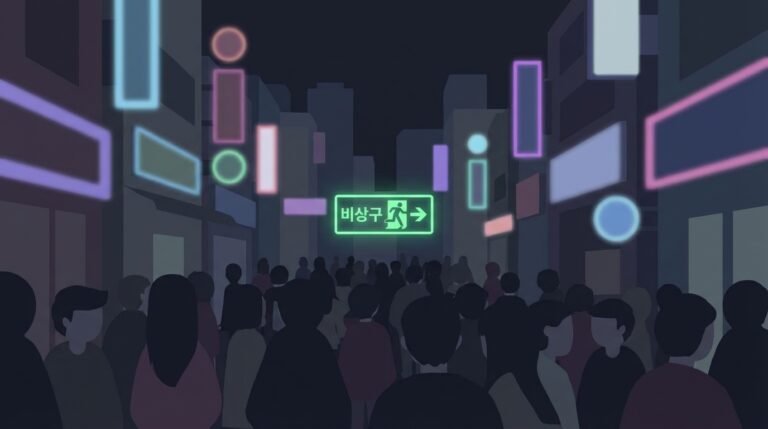
Surviving the Friday Night Crowd: Advanced Korean Fire Safety & The ‘Nunchi’ of Evacuation
Phase 1: The Immersive Hook
Hello! This is your Daily Hangul Senior Editor.
Imagine this: You are in a bustling Noraebang (Karaoke) in Hongdae on a Friday night. You’re belting out the high notes of a K-Pop ballad, the tambourine is shaking, and the vibe is electric. Suddenly, the music cuts out. An alarm blares—not the rhythmic beat of a song, but a piercing, mechanical shriek.
In that split second, the scene shifts from a K-Drama romance to a disaster thriller like the movie Exit. Everyone looks around. Someone mutters, “오작동 아니야?” (Isn’t it a malfunction?).
At this C2 level, simply knowing “불이야!” (Fire!) is not enough. You need to understand the complex administrative terms that dictate your safety in ‘Multi-use Facilities’ and the cultural psychology of why people hesitate to evacuate. Today, we aren’t just learning words; we are dissecting the Korean approach to safety in the places you love to visit most.
This isn’t just about passing a TOPIK exam; it’s about being the person who knows exactly what ‘비상구 유도등’ means when the smoke starts rising. Let’s get serious.
Phase 2: Deep Dive into Core Expressions
1. 다중 이용 시설 (Dajung Iyong Siseol)
- Pronunciation: [Dajung iyong siseol] + (Sounds like: Da like ‘Dad’, jung like ‘Jung’le + iyong + siseol)
- Meaning: Literal: Many-People-Use Facility / Real Nuance: Multi-use facility (Legally defined high-risk areas like cinemas, PC bangs, and sauna/jjimjilbangs).
- K-Culture Moment: You’ll hear this term constantly in news reports after an incident, or in K-Dramas featuring chaebol protagonists inspecting their department stores. It implies a space with strict legal responsibilities.
- Editor’s Insight: This is a heavy, administrative term. You wouldn’t use it to describe a small cafe, but you would use it when discussing government regulations or news. It carries the weight of “public responsibility.”
- Situation Spectrum:
[🚫 Casual Chat] ———— [⚠️ News/Debate] ———— [✅ Formal Report] - 🤔 Think About It: Why does Korean law distinguish these facilities so strictly? It reflects the high population density of Korean cities. Does your country have a specific legal term for “places where many strangers gather in a confined space”?
2. 안전 불감증 (Anjeon Bulgugamjeung)
- Pronunciation: [Anjeon bulgamjeung]
- Meaning: Literal: Safety Insensitivity Syndrome / Real Nuance: A widespread lack of safety awareness; the “it won’t happen to me” mentality.
- K-Culture Moment: Whenever a preventable accident occurs in a drama or real life, news anchors and elders will click their tongues and sigh, blaming “safe insensitivity” (safety blindness). It is a powerful social critique.
- Editor’s Insight: This is a critical C2 vocabulary word. It’s used to criticize the attitude rather than the accident itself. Use this to sound like a true intellectual observer of Korean society.
- Situation Spectrum:
[🚫 To a stranger] ———— [⚠️ Serious Discussion] ———— [✅ News/Debate] - 🤔 Think About It: Korea developed rapidly (‘Miracle on the Han River’). Do you think this focus on speed (ppalli-ppalli) contributed to Anjeon Bulgugamjeung? Is efficiency the enemy of safety?
3. 적치물 (Jeokchimul)
- Pronunciation: [Jeokchimul]
- Meaning: Literal: Piled up objects / Real Nuance: Obstacles (usually illegal) blocking hallways or emergency exits.
- K-Culture Moment: In investigative news programs or reality shows about fire fighters, you will see them pointing at boxes stacked in a stairwell and shouting about “bulbeop jeokchimul” (illegal obstacles).
- Editor’s Insight: If you see boxes blocking a fire exit in your apartment or office, you can file a complaint saying, “비상구에 적치물이 있어서 위험해요.” (It’s dangerous because there are obstacles in the emergency exit.) It sounds very professional and authoritative.
- Situation Spectrum:
[🚫 Romantic Date] ———— [⚠️ Managing Building] ———— [✅ Filing Complaint] - 🤔 Think About It: In highly commercialized areas like Myeongdong, space is money. Why do shop owners risk fines to stack goods in exits? It’s a clash between capitalism and safety standards.
Phase 3: Textbook vs. Real Life
| Situation | 📖 Textbook Korean | 🗣️ Real Korean | 💡 Why the difference? |
|---|---|---|---|
| The Alarm Rings | 비상구로 신속히 대피하십시오. (Evacuate quickly via the emergency exit.) | 뭐야? 오작동인가? 가만히 있어 봐. (What is it? Malfunction? Just stay put for a sec.) | The “Boy who cried wolf” effect. False alarms are common, leading to hesitation (Safety Insensitivity). |
| Blocked Exit | 비상구 앞에 물건을 두지 마십시오. (Do not place items in front of the exit.) | 아, 사장님! 여기 막아두시면 큰일 나요! (Ah, Boss! If you block this, it’s big trouble!) | Using “Keun-il nayo” (Big trouble happens) appeals to consequences rather than just the law. |
| Crowd Control | 질서를 지켜 주십시오. (Please maintain order.) | 밀지 마세요! 밀지 마! (Don’t push! Don’t push!) | In an actual emergency, polite requests dissolve. Short, imperative commands save lives. |
Bottom Note: At C2 level, you must understand the formal instruction but be prepared to hear (and use) the urgent, informal commands.
Phase 4: Cultural Deep Dive
4-1. Non-verbal Communication: The “Crowd Nunchi”
In a potential disaster situation in Korea, Nunchi (reading the room) becomes a survival skill. If you see locals—especially middle-aged shopkeepers who know the building well—suddenly moving with purpose, do not wait for an announcement. Follow them. In Korea, collective movement often precedes official instruction.
4-2. K-Culture Connection: The “Disaster Movie” Trope vs. Reality
K-Drama Context: You’ve seen it in movies like Tower or Tunnel. The hero knows exactly where the Sohwajeon (hydrant) is. In reality, recent stricter laws (Unit: Strengthening Standards) mean that Multi-use Facilities like Karaoke bars must have explicit, glow-in-the-dark maps.
K-Pop Context: At concerts, the “Safety Team” (security) is often stricter than the police. Fans often police themselves, shouting “Dwi-ro!” (Move back!) to prevent crushing. This self-regulating culture is a unique aspect of Korean fandom safety.
Phase 5: Immersive Roleplay Scenario
Setting: Friday, 11:00 PM. A basement Noraebang (Karaoke) in Gangnam. The air is thick. You are with two Korean colleagues, Min-su (relaxed) and Hye-jin (cautious).
Characters:
– YOU: A foreign executive working in Seoul.
– Min-su: “Ah, it’s just a sensor error. Let’s finish this song!”
– Hye-jin: “I smell burning rubber…”
Dialogue:
Min-su: (Waving hand) 아, 신경 쓰지 마. 저번에도 이러다 꺼졌어. 🎤
(Ah, sin-gyeong sseuji ma. Jeobeon-edo ireoda kkeojyeosseo.)
(Ah, don’t worry about it. It turned off like this last time too.)
Hye-jin: (Sniffing the air) 아니야, 오빠. 타는 냄새 나는데? 진짜 불 난 거 아니야?
(Aniya, oppa. Taneun naemsae naneunde? Jinjja bul nan geo aniya?)
(No, oppa. I smell something burning? Isn’t it a real fire?)
YOU: (Looking at the blocked door map) ………………..
🔀 Your Turn! How do you respond?
- A) “설마요. 민수 씨 말이 맞겠죠.” (Dismiss it politely)
- B) “일단 나갑시다. ‘안전 불감증’이 제일 무서운 거예요.” (Use the key term and take charge)
- C) “비상구 확인했어? 저기 적치물 때문에 막혔던데.” (Point out the hazard logically)
✅ Best Choice: B — Reason: At C2 level, using a term like ‘안전 불감증’ in context is powerful. It cuts through the hesitation and frames the evacuation as a smart, conscious choice rather than panic.
⚠️ Choice C Analysis: Good, but B is more persuasive to move the group immediately. C might lead to a debate about the boxes.
Phase 6: 10-Second Shadowing Drill
Emotion: 😤 Firm & Urgent (Authoritative)
“지금 / 오작동 따질 때가 / 아니에요. / 일단 / 밖으로 / 나갑시다!”
(Jigeum / ojakdong ttajil ttaega / anieyo. / Ildan / bakkeuro / nagapsida!)
Translation: Now is not the time to argue if it’s a malfunction. Let’s get out first!
Phase 7: K-Culture Mini Glossary
| Korean | Romanization | English | Context |
|---|---|---|---|
| 소화기 | Sohwagi | Fire Extinguisher | Every PC Bang and Karaoke room MUST have one by law. |
| 스프링클러 | Seupeuringkeulleo | Sprinkler | Often the center of inspection controversies in dramas. |
| 비상벨 | Bisang-bel | Emergency Bell | The loud alarm you hear. |
| 대피 안내도 | Daepi annaedo | Evacuation Map | Look for this on the back of the door in any Multi-use facility. |
| 골든 타임 | Goldeun Taim | Golden Time | The critical first few minutes to respond to a disaster. |
Phase 8: Traveler’s Survival Kit (Disaster Edition)
When visiting complex malls like COEX or Lotte World Tower, or crowded clubs in Itaewon:
🆘 Survival Expression #1
– 🇰🇷 “비상구가 어디예요?” (Bisangguga eodiyeyo?)
– 🗣️ Pronunciation: [Bee-sang-gu-ga uh-di-ye-yo?]
– 📍 Where: Clubs, Underground malls, Cinemas.
– 💡 Pro Tip: In older buildings, exits are sometimes locked or blocked. As you enter a basement venue, just glance for the green Run Man sign. It’s not paranoia; it’s being smart.📌 Editor’s Safety Note
– App: Download ‘Emergency Ready App’ (안전디딤돌). It provides disaster alerts in English.
– Location: If you are trapped, shouting might not work. Use your phone flashlight to signal.
Phase 9: Think Deeper — “Safety vs. Speed”
The Paradox of ‘Ppalli-ppalli’ (Hurry Hurry):
Korea is famous for its speed—fast internet, fast delivery, fast construction. However, many sociologists argue that this ‘Ppalli-ppalli’ culture is the root cause of safety insensitivity (안전 불감증). Skipping safety checks to save time has led to historical tragedies. As a C2 learner, when you hear news about stricter “Fire Safety Standards,” understand that this is a societal effort to slow down and prioritize life over speed.
💬 Your Turn: In your culture, is efficiency valued over safety protocols? Or is it the opposite? How do you express this tension in your language?
Phase 10: FAQ & Troubleshooting
Q: Can I break a window in a high-rise building if there is a fire?
A: In modern Korean skyscrapers (Residential-Commercial complexes), windows often don’t open. Look for the triangle sticker marked ‘비상 탈출구’ (Emergency Escape) on the window. That specific pane is designed to shatter easily. Breaking others might be impossible.
Q: Is it rude to leave a ‘Hoesik’ (company dinner) if I feel unsafe?
A: Traditionally, yes. But in the post-COVID and post-Itaewon era, safety sensitivity is respected. You can say, “사람이 너무 밀집되어서 불안해요. 잠시 바람 좀 쐬고 올게요.” (I feel anxious because it’s too crowded. I’ll go get some fresh air.)
❌ Common Mistake: Shouting “Help!” (Doa-juseyo!) in a noisy crowd.
✅ Better: Shout “Buriya!” (Fire!) or specific commands like “Nagayo!” (Get out!). People react faster to specific threats than general pleas.
Phase 11: Wrap-up & Action Mission
One-Liner: Safety isn’t just about luck; it’s about vocabulary like ‘다중 이용 시설’ and the mindset to overcome ‘안전 불감증’.
🚀 Action Missions:
– 🥉 Bronze: Look at the ceiling of your room/office. Can you find the ‘Sensing Head’ (detector)? Say “Gam-ji-gi” (Detector) out loud.
– 🥈 Silver: Next time you enter a cafe or bar, find the ‘Hwajae Daepi-do’ (Evacuation Map) and take a picture.
– 🥇 Gold: Ask a Korean friend, “요즘 다중 이용 시설 안전 기준이 강화됐다면서요?” (I heard safety standards for multi-use facilities have been strengthened recently?) and watch their surprised face at your advanced knowledge!
Phase 12: Interactive Quiz
- Situational Judgment: You see boxes piled up in front of a fire exit in your office building. What is the most appropriate professional term to describe these boxes?
- A) 쓰레기 (Garbage)
- B) 짐 (Luggage)
- C) 적치물 (Obstacles/Piled objects)
- D) 선물 (Gifts)
- K-Culture True/False: In Korea, if a fire alarm rings in a cafe, everyone immediately runs out without hesitation.
- (True / False)
Answers:
1. C (적치물) – This is the legal term used in safety regulations.
2. False – Due to ‘Safety Insensitivity’ and frequent false alarms, people often hesitate. You must be the one to initiate action.
Frequently Asked Questions (FAQ)
Q: What does "다중 이용 시설 (Dajung Iyong Siseol)" mean in Korean and how do you pronounce it?
A: In Korean, "다중 이용 시설 (Dajung Iyong Siseol)" is pronounced [Dajung iyong siseol] and means: Literal: Many-People-Use Facility / Real Nuance: Multi-use facility (Legally defined high-risk areas like cinemas, PC bangs, and sauna/jjimjilbangs).
Q: What does "안전 불감증 (Anjeon Bulgugamjeung)" mean in Korean and how do you pronounce it?
A: In Korean, "안전 불감증 (Anjeon Bulgugamjeung)" is pronounced [Anjeon bulgamjeung] and means: Literal: Safety Insensitivity Syndrome / Real Nuance: A widespread lack of safety awareness; the "it won't happen to me" mentality.
Q: What does "적치물 (Jeokchimul)" mean in Korean and how do you pronounce it?
A: In Korean, "적치물 (Jeokchimul)" is pronounced [Jeokchimul] and means: Literal: Piled up objects / Real Nuance: Obstacles (usually illegal) blocking hallways or emergency exits.







