

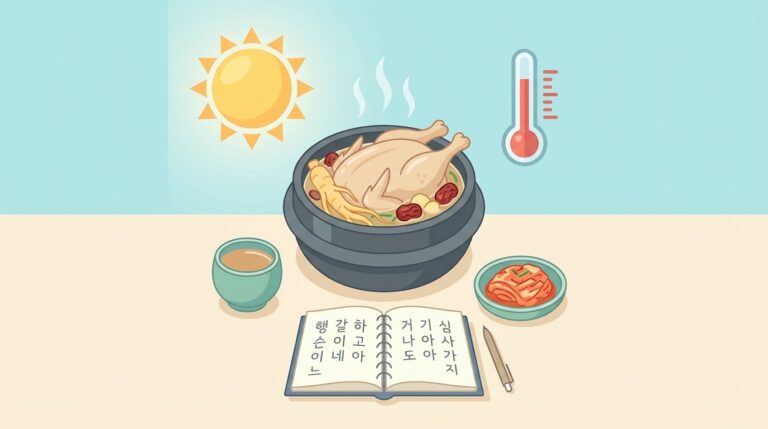
Phase 1: Immersive Hook
Hello! This is your Daily Hangul Editor. 👋
Imagine this scene: It is mid-July in Seoul. The temperature is 35°C (95°F), and the humidity is suffocating. You are sweating just by standing still.
You walk past a restaurant, and there is a line of people waiting outside. You peek inside, and everyone is eating boiling hot soup with steam rising into their faces.
Wait, are they crazy? Why would anyone eat hot soup in this weather?
If you ask a Korean friend, they will wipe the sweat from their forehead, take a sip of the boiling broth, and say with a satisfied smile:
“Ah, siwonhada!” (Ah, it’s refreshing!)
Welcome to the world of Boknal (복날), the three hottest days of the Korean summer. Today, we are going to learn why Koreans fight fire with fire, and how you can join this tasty tradition without passing out from the heat!
Phase 2: Deep Dive (Key Expressions)
Here are the top 3 expressions you need to survive the Korean summer like a local.
1. 이열치열 (I-yeol-chi-yeol)
- Pronunciation: [Ee-yul-chee-yul]
- Sounds like: “E-yell, Chi-yell” (Imagine yelling at the heat!)
- Meaning:
- Literal: Fight heat with heat.
- Real Nuance: “The best way to beat the summer heat is to eat hot food and sweat it out.”
- K-Culture Moment: You will hear this on every Korean variety show (like Running Man) during the summer episodes. When the MCs are suffering in the sun, they shout this before eating spicy noodles or hot soup.
- Editor’s Insight: This isn’t just a phrase; it’s a lifestyle. It implies that sweating cools your body down naturally.
- Situation Spectrum:
[✅ Casual] ———— [✅ Formal](It is an idiom, so it’s safe to use with everyone!)- 🤔 Think About It: In your country, do you only drink ice water when it’s hot? Why do you think Koreans believe warming the stomach is better for health?
2. 삼계탕 주세요 (Samgyetang juseyo)
- Pronunciation: [Sam-gye-tang ju-se-yo]
- Sam (like Samsung) + gye (like guest without ‘st’) + tang (like tongue) + ju-se-yo.
- Meaning: “Please give me Ginseng Chicken Soup.”
- K-Culture Moment: In K-Dramas, when a character is sick or working too hard, a caring mom or boyfriend brings them this dish. It is the ultimate “love language” food.
- Editor’s Insight: Samgyetang is a whole young chicken stuffed with sticky rice, ginseng, and dates. It is the #1 food for Boknal.
- Situation Spectrum:
[✅ Restaurant] ———— [✅ Ordering]3. 몸보신 해야겠어요 (Mombosin haeyagesseoyo)
- Pronunciation: [Mom-bo-shin hae-ya-ge-sseo-yo]
- Mom (Body) + Bo-shin (Protect/Nourish).
- Meaning: “I need to nourish my body (to restore energy).”
- K-Culture Moment: Your Korean boss might say this before taking the team out for lunch in July. It means, “Let’s eat something expensive and healthy because we are tired.”
- Editor’s Insight: Use this when you feel drained by the heat. Your Korean friends will be impressed that you know this concept!
- 🤔 Think About It: Does your language have a specific word for “eating food to restore energy”? Or is food just food?
Phase 3: Textbook vs. Real Life
How to react when eating hot soup in summer?
| Situation | 📖 Textbook Korean | 🗣️ Real Korean (Insa Style) | 💡 Why is it different? |
|---|---|---|---|
| Tasting the soup | 맛있어요. (It is delicious.) | 국물이 시원해요! (The broth is refreshing!) | “Siwonhada” usually means “cool” (temperature), but for hot soup, it means “relieving” or “satisfying.” |
| Feeling hot | 날씨가 더워요. (The weather is hot.) | 쪄 죽겠어요. (I’m steaming to death.) | Koreans love dramatic exaggeration to express shared suffering. |
| Suggesting lunch | 점심 먹으러 갈래요? (Shall we go for lunch?) | 오늘 몸보신하러 가자! (Let’s go energize our bodies!) | Framing it as “health care” makes the invitation harder to refuse. |
💡 Editor’s Tip: If you say “Siwonhada!” while eating boiling soup, you are officially 100% Korean in spirit. Older people will love you.
Phase 4: Cultural Deep Dive
4-1. Non-verbal: The “Sweat” Etiquette 💦
Foreigners often feel embarrassed about sweating in restaurants. In Korea, especially during Boknal, sweating while eating is seen as “detoxing.”
– Don’t hide it: It’s okay to have a pile of tissues on your table.
– The Sound: Making an “Ahhh~” sound after sipping hot broth shows you are enjoying it properly.
4-2. K-Food Connection: The “Queue” Culture ⏳
On Boknal (Chobok, Jungbok, Malbok), popular Samgyetang restaurants have massive lines.
– The waiting list: You might have to write your name on a whiteboard or take a number ticket.
– Critical Thinking: Why wait 1 hour for chicken soup? Because eating the right food on the right day is a communal ritual. It feels like you are participating in a national event.
Phase 5: Immersive Roleplay
Setting: It is Chobok (초복), the first special heat day. You are at a famous Samgyetang restaurant with your Korean friend, Min-su. It is loud and crowded.
Characters:
– YOU: Hungry and hot foreign student.
– Min-su: Your Korean friend who wants to feed you healthy food.
Let’s Start!
Min-su: 와, 사람 진짜 많다! 그래도 오늘 꼭 먹어야 해. (Wow, so many people! But we must eat this today.)
YOU: (Wiping sweat)
🔀 Your Choice! What do you say?
– A) 왜 이렇게 사람이 많아요? (Why are there so many people?)
– B) 오늘이 초복이라서 그래요? (Is it because today is Chobok?)
– C) 더워 죽겠어요. 집에 가요. (I’m dying of heat. Let’s go home.)✅ Best Choice: B – Showing you know about “Chobok” will impress Min-su.
⚠️ Choice C Analysis: Complaining is okay, but suggesting to leave might disappoint Min-su, who wants to treat you.
(The food arrives. It is boiling vigorously.)
Min-su: 나왔다! 뜨거우니까 조심해. (It’s here! Watch out, it’s hot.)
YOU: (Taking a sip of the broth)
🔀 Your Choice! How do you react?
– A) 뜨거워요! (It’s hot!)
– B) 으아~ 시원하다! (Ah~ It’s refreshing!)✅ Best Choice: B – This is the magic phrase! Min-su will laugh and say you sound like an old man (ajeossi).
Phase 6: 10-Second Shadowing Drill
Repeat after me. Imagine you just took a sip of savory, hot ginseng chicken soup.
“Ah, this broth is really refreshing!”
😊 국물이 / 정말 / 시원해요!
(Gung-muri / jeong-mal / si-won-hae-yo!)
- Intonation: Start high on “Ah”, drop low on “si-won”, and stretch the end slightly.
- Emotion: Relief and satisfaction. Like getting into a hot tub.
Phase 7: K-Culture Glossary: Boknal Edition
| Korean | Romanization | Meaning | Context |
|---|---|---|---|
| 초복 / 중복 / 말복 | Chobok / Jungbok / Malbok | The 3 Dog Days | The three hottest days of the year by the lunar calendar. |
| 인삼 | Insam | Ginseng | The main ingredient in Samgyetang that gives you energy. |
| 깍두기 | Kkakdugi | Radish Kimchi | You MUST eat this with the soup. It balances the taste. |
| 반계탕 | Ban-gye-tang | Half-chicken soup | If a whole chicken is too much, order this “half” version! |
Phase 8: Traveler’s Survival Kit
Dining in a Samgyetang Restaurant
🆘 Survival Phrases
1. 🇰🇷 “소금 좀 주세요.” (Sogeum jom juseyo)
– 🗣️ [So-geum jom ju-se-yo]
– 🇬🇧 “Please give me some salt.” (The soup is usually unseasoned; you dip the meat in salt).
- 🇰🇷 “뼈는 어디에 버려요?” (Ppyeoneun eodie beoryeoyo?)
- 🗣️ [Ppyeo-neun uh-dee-ae buh-ryuh-yo?]
- 🇬🇧 “Where do I throw the bones?” (Usually, there is a metal bucket on the table).
- 🇰🇷 “앞접시 주세요.” (Ap-jeop-si juseyo)
- 🗣️ [Ap-jup-shi ju-se-yo]
- 🇬🇧 “Please give me a small plate.” (To cool the boiling chicken before eating).
📌 Editor’s Travel Note:
Most Samgyetang restaurants give you a small cup of yellowish liquor called Insam-ju (Ginseng wine). It’s free! You can drink it or pour it into your soup to remove the smell of the meat.
Phase 9: Think Deeper — “One Step Further”
Topic: Food & Paradox (Hot vs. Cold)
In Western culture, summer means ice cream and cold soda. In Korea, summer means boiling soup. Why?
This reflects the Eastern medical philosophy of “Balance.” It is believed that in summer, your outside is hot, but your stomach gets cold (especially from air conditioning and ice water). Eating hot food warms the stomach, balancing your internal temperature with the external heat.
🧠 Think Deeper:
Does this logic make sense to you? Or do you think it’s just a placebo effect? Have you ever felt better after eating hot food on a hot day?
Phase 10: FAQ & Troubleshooting
Q: Do I have to eat Samgyetang? I’m vegetarian.
A: Absolutely not! While chicken is traditional, many Koreans enjoy Kong-guksu (Cold Soy Milk Noodles) on Boknal. It is cold, vegan-friendly (usually), and full of protein!
Q: Is it true people eat dog meat on Boknal?
A: This is a fading tradition mainly among the very old generation and is becoming illegal/highly controversial in modern Korea. The vast majority of Koreans eat Chicken (Samgyetang) or Duck. You do not need to worry about accidentally ordering it in a normal area.
❌ Common Mistake:
Don’t eat the dates (jujubes) inside the soup if you hear the myth that “the date absorbs all the toxins from the chicken.”
Truth: It’s just a myth! You can eat the dates, but they might be mushy and tasteless after boiling. It’s up to you!
Phase 11: Wrap-up & Mission
One-Liner Summary:
On the hottest days (Boknal), Koreans eat boiling Chicken Soup (Samgyetang) to fight the heat (Iyeolchiyeol)!
🚀 Your Action Mission:
– 🥉 Bronze: Say “Iyeolchiyeol” out loud next time you drink hot coffee or tea.
– 🥈 Silver: Look up a photo of “Samgyetang” on Instagram and comment “맛있겠다!” (Looks delicious!).
– 🥇 Gold: Go to a Korean restaurant (or cook it!) and post a photo with the caption: “Proper body maintenance! #Mombosin #Samgyetang”
Phase 12: Interactive Quiz
1. Situation Judgment:
Your friend is sweating while eating spicy noodles. What phrase fits this situation best?
– A) Happy Birthday!
– B) Iyeolchiyeol! (Fight heat with heat!)
– C) Saranghae! (I love you!)
2. True or False:
When a Korean says the hot soup is “Siwonhada” (Refreshing), it means the soup is cold.
– (True / False)
3. Vocabulary:
What is the name of the special “Body Nourishing” days in summer?
– A) Pepero Day
– B) Boknal
– C) Chuseok
🔑 Answers:
1. B (It’s the perfect idiom for hot food in summer.)
2. False (It means the feeling is refreshing/relieving, not the temperature.)
3. B (Boknal is the Dog Days of Summer.)
Frequently Asked Questions (FAQ)
Q: What does "이열치열 (I-yeol-chi-yeol)" mean in Korean and how do you pronounce it?
A: In Korean, "이열치열 (I-yeol-chi-yeol)" is pronounced [Ee-yul-chee-yul] and means: a key conversational Korean expression covered in this lesson.
Q: What does "삼계탕 주세요 (Samgyetang juseyo)" mean in Korean and how do you pronounce it?
A: In Korean, "삼계탕 주세요 (Samgyetang juseyo)" is pronounced [Sam-gye-tang ju-se-yo] and means: a key conversational Korean expression covered in this lesson.
Q: What does "몸보신 해야겠어요 (Mombosin haeyagesseoyo)" mean in Korean and how do you pronounce it?
A: In Korean, "몸보신 해야겠어요 (Mombosin haeyagesseoyo)" is pronounced [Mom-bo-shin hae-ya-ge-sseo-yo] and means: a key conversational Korean expression covered in this lesson.






