

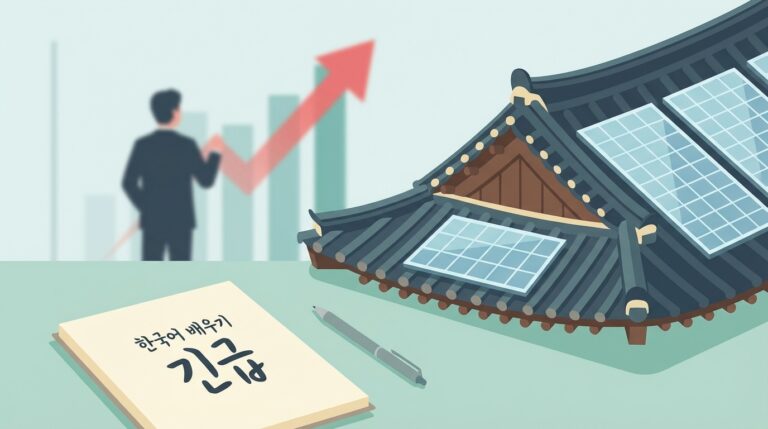
Phase 1: The Hook — The “Chaebol Boardroom” Tension
Greeting: 안녕하세요! It’s your Daily Hangul Senior Editor. 👋
K-Drama Cold Open: You know that intense scene in a corporate K-Drama (like Reborn Rich or Start-Up)? The camera pans across a glossy boardroom in Gangnam. The music is tense. A foreign investor slams a document on the table and asks, “What about your carbon footprint?” The protagonist, usually a third-generation heir, freezes. The subtitles might say “We are trying,” but the Korean nuance suggests a desperate, almost impossible struggle against reality.
Today, we are diving into that exact tension: The RE100 (Renewable Energy 100%) pressure.
The ‘Why’: If you are working with Korean companies or following Korean news, you must understand this. Korea is a manufacturing powerhouse (semiconductors, cars, ships), but it has very little land for solar or wind power. This creates a massive gap between idealism (ideals) and realism (reality). Understanding the language of this dilemma is the key to reaching C2 proficiency—it’s about expressing reluctant compliance and systemic limitation.
Transparency: This guide combines business Korean, high-level idioms, and the cultural context of Korea’s “Ppalli-Ppalli” (hurry-hurry) industrial history colliding with modern environmental demands.
Phase 2: Deep Dive into Core Expressions
1. 발등에 불이 떨어지다 (Baldeung-e buri tteoreojida)
- Pronunciation: [bal-deung-e bu-ri tteo-reo-ji-da] + (Sounds like: ‘Bal’ as in ball, ‘deung’ as in dung, ‘buri’ as in bury)
- Meaning: Literal: Fire has fallen on the instep (top of the foot). | Real Nuance: An imminent crisis that requires immediate action; being in a frantic rush because a deadline is looming.
- K-Culture Moment: Think of a K-Pop idol group realizing their comeback is next week but the choreography isn’t finished. That panic? That’s baldeung-e bul.
- Editor’s Insight: In the context of RE100, Korean companies aren’t just “planning”; they are in a state of emergency. Using this idiom shows you understand the urgency and panic behind the policy shifts.
- Situation Spectrum:
[🚫 Formal Speech/News] ———— [⚠️ Meeting] ———— [✅ Casual/Colleagues]- (Note: While an idiom, it is widely used in news headlines and serious business discussions to describe the state of affairs, though less so in formal written reports.)
- 🤔 Think About It: Why does Korean culture use a metaphor of physical pain (fire on the foot) to describe time pressure? Does this reflect the high-stress nature of Korean society?
2. 울며 겨자 먹기 (Ulmyeo gyeoja meokgi)
- Pronunciation: [ul-myeo gyeo-ja meok-gi]
- Meaning: Literal: Eating mustard while crying. | Real Nuance: Biting the bullet; doing something you really don’t want to do (because it’s expensive or difficult) but have no choice.
- K-Culture Moment: A variety show penalty where the loser has to eat something spicy? That’s literal. But figuratively, think of a character in a drama forced to marry someone for a merger.
- Editor’s Insight: Since renewable energy is expensive and scarce in Korea, joining RE100 is often described as ulmyeo gyeoja meokgi for smaller companies. They have to do it to export, but it hurts their bottom line.
- Situation Spectrum:
[🚫 Formal Report] ———— [⚠️ Internal Meeting] ———— [✅ Casual/Analysis]
3. 현실적 여건 (Hyeonsiljeok yeogeon)
- Pronunciation: [hyeon-sil-jeok yeo-geon]
- Meaning: Realistic conditions / Practical constraints.
- K-Culture Moment: Every time a politician or CEO apologizes for a scandal or delay: “Considering the hyeonsiljeok yeogeon…” (Translation: We can’t do it, stop asking.)
- Editor’s Insight: This is the ultimate C2 shield. It’s a polite, sophisticated way to say “No” or “Not yet” without explicitly refusing. It shifts the blame to the situation rather than the will.
- Situation Spectrum:
[🚫 Casual] ———— [⚠️ Colleagues] ———— [✅ Formal/Presentation]
Phase 3: Textbook vs. Real Life (Business Edition)
| Situation | 📖 Textbook Korean | 🗣️ Real Business Korean | 💡 Why the difference? |
|---|---|---|---|
| Reporting a delay due to lack of energy supply | 재생에너지가 부족해서 늦어지고 있습니다. (We are late because renewable energy is lacking.) | 수급 불균형으로 인해 일정을 조율하고 있습니다. (We are adjusting the schedule due to supply-demand imbalance.) | ‘Imbalance’ (불균형) sounds structural and inevitable, minimizing personal fault. |
| Complaining about cost | 비용이 너무 비쌉니다. (The cost is too expensive.) | 채산성을 맞추기가 쉽지 않은 상황입니다. (It is a situation where securing profitability is not easy.) | C2 level requires specific economic terms like ‘profitability’ (채산성). |
| Saying we have no choice | 어쩔 수 없이 해야 합니다. (We have to do it unavoidably.) | 글로벌 스탠다드에 맞추려면 불가피한 선택입니다. (It is an inevitable choice to meet global standards.) | Framing it as ‘Global Standards’ validates the struggle. |
Phase 4: Cultural Deep Dive — The “Ppalli-Ppalli” vs. Nature
4-1. The Geography of “Nunchi”
Korea is 70% mountainous. To install solar panels, you often have to cut down trees (which is bad for the environment). To install wind turbines, you face noise complaints from densely populated villages. This is the Korean RE100 Paradox.
In this context, Nunchi (눈치) isn’t just about reading people; it’s about reading the global trade winds. Korean conglomerates (Samsung, SK, Hyundai) live and die by exports. Even if the infrastructure isn’t there, they must pretend to be ready or move fast to catch up. This creates a culture of “Seon-eon (Declaration) First, Solution Later”—declaring carbon neutrality first to save face, then scrambling to figure out how.
4-2. K-Pop Connection: The “Green” Album Dilemma
Have you noticed K-Pop groups releasing “Eco-friendly albums” without plastic cases? This is the pop-culture reflection of the same industrial pressure. Just as factories are pressured to use green energy, entertainment companies are pressured to reduce plastic waste. Fans often criticize this as Greenwashing (그린워싱) if the company still sells 20 random photo cards.
Phase 5: Immersive Roleplay — The Strategy Meeting
Setting: Monday morning, 10:00 AM. A glass-walled meeting room in Pangyo (Korea’s Silicon Valley). The atmosphere is heavy. You are a Sustainability Manager talking to the Production Team Leader (Choi).
Characters:
* YOU (Manager): Trying to push for 100% renewable energy use by 2030.
* Choi (Team Leader): A veteran who knows the harsh reality of factory costs.
Dialogue:
YOU: 팀장님, 이번 글로벌 고객사 요구사항 보셨죠? 2030년까지 RE100 달성 못 하면 계약 끊겠대요.
(Timjangnim, ibeon geullobeol gogaeksa yogusahang bosyeotjyo? RE100 dalseong mot hamyeon gyeyak kkeungetdaeyo.)
(Team Leader, you saw the global client’s requirements, right? If we don’t hit RE100 by 2030, they’ll cut the contract.)
Choi: 아, 봤죠. 근데 솔직히 말해서, 국내 전력 수급 상황 보면 그게 어불성설인 거 아시잖아요?
(Ah, bwatjyo. Geunde soljikhi malhaeseo, gungnae jeollyeok sugeup sanghwang bomyeon geuge eobulseongseol-in geo asijanayo?)
(Ah, I saw it. But honestly, looking at the domestic power supply situation, you know that’s logical nonsense, right?)
🔀 Decision Point: How do you respond?
- A) “그래도 해야 해요! 안 하면 우리 망해요.” (Too emotional/direct)
- B) “맞습니다. 하지만 발등에 불이 떨어진 격이라, 대안을 찾아야 합니다.” (Empathizes + Urgency)
- C) “팀장님이 노력해 주셔야죠.” (Passing the buck – Dangerous!)
✅ Best Choice: B. You acknowledge his reality (Validation) but reiterate the unavoidable urgency (Fact). Using the idiom baldeung-e bul here creates a sense of shared crisis.
Choi: (Sighs) 울며 겨자 먹기로 비싼 재생에너지 인증서(REC)라도 사야겠네요… 예산팀이 난리 날 텐데.
(We’ll have to buy expensive REC certificates like eating mustard while crying… The budget team is going to go crazy.)
Phase 6: 10-Second Shadowing Drill
Situation: Explaining to a foreign boss why progress is slow in Korea.
Expression: “Ideally we want to move fast, but considering the realistic constraints, we need a two-track strategy.”
🇰🇷 이상적으로는 / 빨리 가고 싶지만, / 현실적 여건을 고려할 때 / 투 트랙 전략이 / 필요합니다.
(Isangjeog-euroneun / ppalli gago sipjiman, / hyeonsiljeok yeogeoneul goryeohal ttae / tu-teuraek jeollyagi / piryohamnida.)Emotion: 😟 Regretful but 🧠 Analytical.
Pronunciation Tip: “Yeogeon-eul” links together like “Yeogoneul”.
Phase 7: K-Culture Glossary (Green Edition)
| Korean | Romanization | Meaning | Context |
|---|---|---|---|
| 그린워싱 | Geurin-wosing | Greenwashing | Pretending to be eco-friendly for marketing. Used frequently by K-Pop fans and NGOs. |
| 보여주기식 | Boyeojugisik | For show / Window dressing | Doing something just to look good to others. (e.g., “Is this policy just boyeojugisik?”) |
| 친환경 | Chin-hwangyeong | Eco-friendly | The magic word on every Korean product package today. |
| 재생에너지 | Jaesaeng eneoji | Renewable Energy | Solar, Wind, Hydro, etc. |
| 전력난 | Jeollyeok-nan | Power shortage crisis | Occurs during peak summer/winter. Mentioning this explains why RE100 is hard. |
Phase 8: Traveler’s Survival Kit (Eco-Travel)
Even as a traveler, you enter this “Eco-Regulation” world. Korea has strict recycling laws and recently banned single-use items in many hotels and cafes.
🆘 Survival Expression #1: The Café Tumbler Discount
* 🇰🇷 “텀블러에 담아주세요.” (Teombeulleo-e damajuseyo.)
* Use: “Please put it in my tumbler.”
* Benefit: Many cafes like Starbucks or Mega Coffee give a 300-500 KRW discount. It shows you are a “Concept (Conscious) Consumer” (개념 소비).📌 Editor’s Travel Note:
* Hotels: As of 2024, many large hotels in Korea do not provide free toothbrushes/toothpaste due to environmental regulations. Bring your own kit or be prepared to buy one at the convenience store (pyeonui-jeom) downstairs!
Phase 9: Think Deeper — “Why is it harder for Korea?”
Topic: Geography vs. Idealism
Most RE100 leading countries have vast flat lands (USA) or strong winds (UK/Denmark). Korea is a small peninsula with distinct four seasons (less sun in monsoon season, less wind than the North Sea) and is isolated from the grid (cannot import electricity from neighbors like EU countries can).
🧠 Think Deeper: When global standards are applied uniformly to countries with different geographical “fates,” is it fair? In Korean, we might ask: “이것이 과연 공정한 처사인가?” (Is this truly a fair treatment?). How does your country handle this balance between environmental duty and industrial survival?
Phase 10: FAQ & Troubleshooting
Q: Can I use “발등에 불이 떨어졌다” to my boss?
A: Maybe. If you are describing yourself or the team being in trouble, yes. But do not use it to describe the boss’s mistake. It implies a lack of preparation.
Q: What is the difference between “어렵다” (difficult) and “곤란하다” (troublesome/awkward)?
A: In a business negotiation about regulations:
* 어렵다 (Eoryeopda): “We can’t do it (technical/resource capability).” -> Soft “No.”
* 곤란하다 (Gollanhada): “Putting us in this position is awkward/harmful.” -> “You are asking too much.”
❌ Common Mistake:
* Don’t say: “RE100은 불가능해요.” (RE100 is impossible.) -> Too direct/aggressive.
* Say: “현실적으로 애로사항이 많습니다.” (Realistically, there are many difficulties/pain points.) -> “Aero-sahang” is a magical business word for “problems.”
Phase 11: Wrap-up & Action Mission
One-Liner: When ideal regulations meet harsh reality, use “현실적 여건” (realistic conditions) to negotiate with grace.
🚀 Action Mission:
* 🥉 Bronze: Look at a product near you. Is it “친환경” (Eco-friendly)? Say “이건 친환경 제품이에요” out loud.
* 🥈 Silver: Go to a Korean news site (Naver News) and search for “RE100”. Try to find the word “비상” (Emergency) or “부담” (Burden) in the headlines.
* 🥇 Gold: Next time you order coffee, try the “Tumbler” phrase or refuse a straw by saying “빨대는 괜찮아요” (I’m okay without a straw).
💬 Your Turn: Does your country have a version of “Eating mustard while crying”? Tell me in the comments!
Phase 12: Interactive Quiz
1. Situational Judgment:
Your boss asks why the factory hasn’t switched to 100% solar energy yet. What is the most C2-level professional response?
* A) 돈이 없어서 못 했습니다. (We couldn’t because we have no money.)
* B) 사장님이 안 시키셨잖아요. (You didn’t tell us to, Boss.)
* C) 초기 투자 비용과 국내 전력 수급 문제로 현실적인 어려움이 있습니다. (There are realistic difficulties due to initial investment costs and domestic power supply issues.)
2. Fill in the Blank:
“New environmental regulations are starting next month. We are completely unprepared! Totally _________!”
* A) 눈치 (Nunchi)
* B) 발등에 불이 떨어졌어 (Fire on the instep)
* C) 금수저 (Gold spoon)
(Answers: 1-C, 2-B)
Frequently Asked Questions (FAQ)
Q: What does "발등에 불이 떨어지다 (Baldeung-e buri tteoreojida)" mean in Korean and how do you pronounce it?
A: In Korean, "발등에 불이 떨어지다 (Baldeung-e buri tteoreojida)" is pronounced [bal-deung-e bu-ri tteo-reo-ji-da] and means: Literal: Fire has fallen on the instep (top of the foot). | Real Nuance: An imminent crisis that requires immediate action; being in a frantic rush because a deadline is looming.
Q: What does "울며 겨자 먹기 (Ulmyeo gyeoja meokgi)" mean in Korean and how do you pronounce it?
A: In Korean, "울며 겨자 먹기 (Ulmyeo gyeoja meokgi)" is pronounced [ul-myeo gyeo-ja meok-gi] and means: Literal: Eating mustard while crying. | Real Nuance: Biting the bullet; doing something you really don't want to do (because it's expensive or difficult) but have no choice.
Q: What does "현실적 여건 (Hyeonsiljeok yeogeon)" mean in Korean and how do you pronounce it?
A: In Korean, "현실적 여건 (Hyeonsiljeok yeogeon)" is pronounced [hyeon-sil-jeok yeo-geon] and means: Realistic conditions / Practical constraints.







