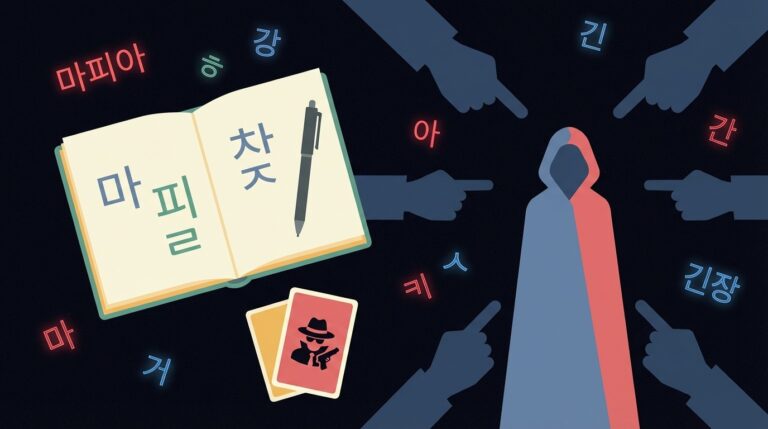
Phase 1: The Trust Game — “Why are you so quiet?”
Hello! This is your Daily Hangul Editor.
Imagine you are watching a Korean variety show like Running Man or the intense psychological survival show The Genius. The music stops. The captions turn red. Someone points a finger and shouts, “You’re trying to frame me, aren’t you?”
In Korea, board games—especially social deduction games like Mafia (similar to Werewolf)—are not just games. They are a battlefield of Nunchi (eye-measure/intuition) and rhetoric. If you only know textbook Korean like “저 사람은 마피아입니다” (That person is the Mafia), you will be eliminated in the first round.
To survive in a Korean game night (or a heated office meeting), you need to master the art of psychological warfare. You need to know how to accuse without being aggressive, how to defend yourself with wit, and how to read the silence.
Today, we aren’t just learning words; we are learning how to survive the “Politics” (정치질) of conversation.
Phase 2: Deep Dive into Psychological Warfare
1. 몰아가다 (Mollagada)
- Pronunciation: [Mol-la-ga-da] + Sounds like ‘Mole-la-ga-da’ (Imagine herding moles into a corner.)
- Meaning:
- Literal: To drive/chase (something) towards a direction.
- Real Nuance: To frame, corner, or railroad someone. It implies creating a specific atmosphere to make someone look guilty or responsible.
- K-Culture Moment: Think of a K-Drama courtroom scene or a chaotic family dinner. One person starts accusing the protagonist, and suddenly everyone agrees. The victim shouts, “사람 매도하지 마!” (Don’t bury me socially!) or “나 이상한 사람으로 몰아가지 마!” (Don’t frame me as the weird one!)
- Editor’s Insight: This is a C1 level verb because it describes the dynamic of the conversation, not just the action. It’s about manipulating the flow.
- Situation Spectrum:
[🚫 Formal/Boss] ———— [⚠️ Colleagues] ———— [✅ Friends/Games]
(Use caution with bosses; you can’t say “Why are you cornering me?” to a CEO unless you want to be fired. But in a game? Essential.) - 🤔 Think About It: Why does Korean have a specific verb for “driving a person into a corner socially”? It reflects the collectivist culture where public opinion (Yeoron) can overpower individual truth.
2. 정치질(을) 하다 (Jeongchi-jil-eul hada)
- Pronunciation: [Jeong-chi-jil] + ‘Jeong’ like ‘Jung’ in Jungian psychology.
- Meaning:
- Literal: Doing politics (with a negative suffix ‘-jil’).
- Real Nuance: Playing dirty politics/Manipulating the crowd. It’s not about government; it’s about swaying votes in a game or office dynamics to target someone.
- K-Culture Moment: In e-sports (League of Legends) or game streams, when a player blames a teammate for a loss to avoid blame themselves, the chat spams: “정치질 ㄴㄴ” (No playing politics).
- Editor’s Insight: The suffix ‘-jil’ (-질) usually degrades the noun it attaches to (e.g., Sonsaeng-jil = acting like a teacher condescendingly). Using this shows you understand the intent behind someone’s words.
- Situation Spectrum:
[🚫 Elders] ———— [⚠️ Close Peers] ———— [✅ Gaming/Internet] - 🤔 Think About It: Politics exists everywhere, but labeling it “Political Action” (Jeongchijil) calls out the artificiality of the behavior. Is there a slang for this in your language?
3. 촉이 오다 (Chogi oda) / 쎄하다 (Ssae-hada)
- Pronunciation: [Chog-i-o-da] / [Ssae-ha-da]
- Meaning:
- Chogi oda: To get a hunch/gut feeling (literally: the “tip” or “sense” comes).
- Ssae-hada: To feel “off” or spooky. A bad vibe.
- K-Culture Moment: Every thriller K-Drama detective says this. “뭔가 촉이 왔어.” (I got a hunch.) Or in a horror movie, when entering a dark room: “여기 좀 쎄한데?” (This place feels sketchy.)
- Editor’s Insight: In Mafia, you don’t say “I deduce he is the killer.” You say, “그냥 느낌이 쎄해.” (Just feels off.) Logic is secondary to intuition in Korean high-context communication.
- Situation Spectrum:
[🚫 Formal Reports] ———— [⚠️ Casual Meetings] ———— [✅ Daily Life] - 🤔 Think About It: Why is “gut feeling” (Chok) often considered as valid as evidence in casual Korean arguments? It relates to Nunchi—reading the invisible air.
Phase 3: Textbook vs. Real Life (The Mafia Edition)
| Situation | 📖 Textbook Korean | 🗣️ Real Korean (C1 Level) | 💡 Why the difference? |
|---|---|---|---|
| Accusing | 저 사람이 의심스럽습니다. (That person is suspicious.) |
쟤가 지금 연기하는 거라니까? (I’m telling you, he’s acting right now!) |
Real games rely on meta-gaming (acting, concept) rather than just “suspicion.” |
| Defending | 저는 마피아가 아닙니다. (I am not the Mafia.) |
와, 진짜 억울하다. (Wow, I’m genuinely falsely accused/frustrated.) |
“억울하다” appeals to emotion, which is more persuasive than a factual denial. |
| Dying | 제가 죽을 것 같습니다. (I think I will die.) |
나 오늘 밤에 무조건 썰린다. (I’m definitely getting sliced/cut tonight.) |
Slang like “sseollinda” adds dramatic flair and urgency essential for gaming. |
💡 Bottom Note: In C1 level, you stop describing facts and start describing feelings and intent. Use “억울하다” (feeling falsely accused) effectively—it’s the ultimate defense card.
Phase 4: Cultural Deep Dive — The Art of “Nunchi”
4-1. Non-verbal: The Eyes Don’t Lie (or Do They?)
In Western poker, a “Poker Face” is key. In Korean Mafia, it’s about active emotional display.
* Silence is Deadly: If you are too quiet, you are “carrying a secret.” If you are too loud, you are “overcompensating.” You must find the middle ground.
* The Appeal: When accused, Koreans often appeal to the group’s bond. “How can you suspect me? We’ve been friends for 10 years!” This blends game logic with social pressure.
4-2. K-Culture Connection: The “Maknae” on Top
Usually, Korea has a strict age hierarchy. But in board games, this flips.
* The Trope: In variety shows, the youngest member (Maknae) often betrays the older members (Hyung/Unnie) for the win. This “Ha-geuk-sang” (하극상 – revolt from below) is a classic comedic trope.
* Critical View: Why is this funny? Because it temporarily breaks the suffocating social hierarchy. The game becomes a “safe space” to be rude or aggressive to older people (within limits).
Phase 5: Immersive Roleplay — Who is the Mafia?
Setting: A private room in a Board Game Cafe in Hongdae. 11:00 PM. Empty snack bowls and tension in the air. You are playing with 3 Korean friends: Minji (Sharp, aggressive), Hyunwoo (Quiet, poker face), and Soojin (Easily swayed).
Characters:
* YOU: The foreigner who speaks surprisingly good Korean. Currently suspected.
* Minji: The accuser.
Dialogue:
Minji: 야, 솔직히 말해. 너 아까 고개 숙일 때 웃었지? 😏
(Ya, soljikhi malhae. Neo akka gogae sugil ttae useotji?)
(Hey, be honest. You smirked when you put your head down earlier, didn’t you?)
YOU: (Decide your move below!)
Hyunwoo: (crossing arms) 나도 좀 쎄하긴 했어.
(Nado jom ssae-ha-gin haesseo.)
(I also felt something was a bit off.)
Minji: 거봐! 얘 지금 정치질 하려고 일부러 조용한 척하는 거야.
(Geobwa! Yae jigeum jeongchijil haryeogo ilbureo joyonghan cheokhaneun geoya.)
(See! He’s pretending to be quiet just to play politics.)
🔀 Your Turn! How do you survive this attack?
- A) “웃기는 무슨! 나 진짜 시민이야. 억울해 죽겠네!” (Deny with strong emotion: “Laughing? No way! I’m a citizen. I’m dying of frustration!”)
- B) “민지야, 너야말로 나 몰아가는 거 아니야?” (Counter-attack: “Minji, aren’t you the one trying to corner me right now?”)
- C) “저는 마피아가 아닙니다.” (Textbook robot response)
✅ Best Choice: B — At C1 level, use the vocabulary we learned (몰아가다). It shifts the suspicion back to her.
⚠️ Choice A Analysis: Good, very natural (“억울해”), but B is more strategic.
❌ Choice C Analysis: Too formal. You sound like an AI, which makes you look even more suspicious (or just boring).
Phase 6: 10-Second Shadowing Drill
Let’s practice the “Intuition” sentence. Say this when you want to express suspicion without concrete proof.
Context: Whispering to a friend next to you.
😤 Emphasis: Suspicious & Sharp
“아무래도 / 쟤가 범인인 것 같아. / 느낌이 너무 쎄해!”
(Amuraedo / jyaega beomin-in geo gata. / Neukkimi neomu ssae-hae!)
“Somehow / I think he is the culprit. / The vibe is just too off!”
Phase 7: K-Culture Mini Glossary (Game Edition)
| Korean | Romanization | Meaning | Context |
|---|---|---|---|
| 트롤 | Teu-rol | Troll | Someone who ruins the game intentionally or by being bad at it. |
| 하드캐리 | Ha-deu-cae-ri | Hard Carry | One person dominating the game and leading the team to victory. |
| 입털다 | Ip-teol-da | To run one’s mouth | Literally “dusting off one’s mouth.” Used when someone talks too much or bluffs. |
| 뇌절 | Noe-jeol | Overdoing it | When someone repeats a joke or action until it’s annoying (Brain overload). |
Phase 8: Traveler’s Survival Kit (The “Intuition” Edition)
Even if you aren’t playing Mafia, you need “Chok” (Intuition) when traveling. Here is how to use these psychological words in real travel situations.
🆘 Survival Scenario: The Taxi Detour
You feel the taxi driver is taking a longer route than the map shows.
- 🇰🇷 Phrase: “기사님, 길이 좀 돌아가는 느낌인데요?”
(Gisa-nim, giri jom doraganeun neukkim-indeyo?)
“Driver, it feels like we are going the long way around?”- 💡 Pro Tip: You don’t say “You are cheating me.” You share a “feeling” (neukkim). It’s softer but shows you are aware (Nunchi).
📌 Editor’s Travel Note:
Use apps like KakaoTaxi or Uber (UT) to prevent this. If you must hail a cab on the street, keep your map app open with the sound on. It signals: “I have digital backup, don’t try any Jeongchijil on me.”
Phase 9: Think Deeper — Language & Hierarchy
Topic: The Paradox of Polite Aggression
In Korean Mafia games, you might notice something strange. People often use Honorifics (Jondaemal) while aggressively accusing each other.
“혹시 마피아 아니세요?” (By any chance, aren’t you the Mafia? – Polite phrasing)
This creates a unique layer of psychological pressure. The polite form creates a distance (distancing oneself from the accused), making the accusation feel colder and more objective. In Korea, dropping honorifics (Banmal) usually signals intimacy or anger, but maintaining strict politeness during a fight can be even scarier. It implies, “I am treating you as a stranger/enemy.”
💬 Your Turn: In your culture, does being more polite make an argument scarier or softer? Share in the comments!
Phase 10: FAQ & Troubleshooting
Q: Can I use “Jeongchijil” (Politics) at work?
A: MAYBE. You can use it with close colleagues to complain about a third party (e.g., “Management is doing politics again”). Do NOT say it directly to your boss or in a formal presentation. It’s slang.
Q: Is “Ssae-hada” (Feels off) rude?
A: NO. It describes your feeling, not the person. However, saying “You look Ssae-hada” to someone’s face is rude. Saying “This situation feels Ssae-hada” is perfectly fine.
❌ Common Mistake #1: Confusing logical arguments with emotional appeals.
✅ Fix: In Korea, saying “I didn’t do it because X, Y, Z” is good, but adding “진짜 너무해요!” (You guys are too much!) or showing frustration is often more convincing in social games.
Phase 11: Wrap-up & Action Mission
Summary: Today we learned how to survive psychological warfare using “Mollagada” (Cornering), “Jeongchijil” (Political play), and trusting your “Chok” (Gut feeling).
🚀 Action Mission:
* 🥉 Bronze: Look in the mirror and practice your “Unfair/Innocent” face while saying “진짜 억울해요!”
* 🥈 Silver: Watch a clip of The Genius or Running Man on YouTube. Find a moment where members betray each other and identify the word “배신” (Betrayal) or “몰아가기”.
* 🥇 Gold: Next time you watch a movie with friends, predict the villain by saying, “쟤 좀 쎄한데?” (He seems a bit off/suspicious).
K-Culture Mission: Watch the K-Drama Squid Game (again?) or Liar Game. Pay attention to how the characters form alliances. That is the definition of Jeongchijil!
See you in the next game! Trust no one, but trust Daily Hangul! 😉
Frequently Asked Questions (FAQ)
Q: What does "몰아가다 (Mollagada)" mean in Korean and how do you pronounce it?
A: In Korean, "몰아가다 (Mollagada)" is pronounced [Mol-la-ga-da] and means: Literal: To drive/chase (something) towards a direction.
Q: What does "정치질(을) 하다 (Jeongchi-jil-eul hada)" mean in Korean and how do you pronounce it?
A: In Korean, "정치질(을) 하다 (Jeongchi-jil-eul hada)" is pronounced [Jeong-chi-jil] and means: Literal: Doing politics (with a negative suffix '-jil').
Q: What does "촉이 오다 (Chogi oda) / 쎄하다 (Ssae-hada)" mean in Korean and how do you pronounce it?
A: In Korean, "촉이 오다 (Chogi oda) / 쎄하다 (Ssae-hada)" is pronounced [Chog-i-o-da] and means: Chogi oda: To get a hunch/gut feeling (literally: the "tip" or "sense" comes).