

Panic-Proof Korean: How to Call 119 Like a Local Hero
Phase 1: The Golden Time (Immersive Hook)
안녕하세요! This is your Daily Hangul Editor.
Imagine this: You are watching a tense scene in a K-Drama like Hospital Playlist or The Glory. The music stops abruptly. A character collapses on a rainy street. The protagonist fumbles for their phone, hands shaking, and dials three digits. They don’t speak in perfect, polite textbook paragraphs. They shout fragments, locations, and conditions.
“여기 사람 쓰러졌어요! 빨리 와주세요!”
In real life, emergencies don’t come with subtitles. If you’re hiking on Bukhansan or eating spicy seafood at a coastal pojangmacha (tent stall) and something goes wrong, can you be the hero?
Calling 119 (Korea’s 911) is terrifying even for locals. For a foreigner, the fear of not being understood is paralyzing. But here’s the secret: You don’t need perfect grammar. You need impact and keywords.
Today, we aren’t just learning words; we are learning survival. Let’s make sure you never have to feel helpless in Korea.
Phase 2: Deep Dive into Critical Phrases
Here are the B2-level phrases that cut through the noise when seconds count.
1. [장소]인데, [상황]이에요.
- Pronunciation: [Jangso]-inde, [Sanghwang]-ieyo.
- Meaning: This is [Location], and [Situation] is happening.
- K-Culture Moment: In thriller movies, you’ll hear victims whisper this structure frantically. “여기 지하실인데, 살려주세요.” (I’m in the basement, please save me.)
- Editor’s Insight: The grammar point -(으)ㄴ/는데요 is crucial here. Unlike a simple period, it leaves the sentence “open,” signaling to the dispatcher that you are waiting for instructions or that there is more urgency. It’s softer yet more urgent than a robotic “입니다.”
- Situation Spectrum:
[🚫 Casual] ———— [✅ Urgent/Standard] ———— [🚫 Too Formal]- (In an emergency, politeness levels drop, but this is the standard polite form that gets respect and action.)
- 🤔 Think About It: Why do Koreans often state the context (background info) before the request? In English, we might say “Help me, I’m at X.” In Korean, we say “I’m at X, so (implied) help me.”
2. 의식이 없어요 / 숨을 안 쉬어요.
- Pronunciation: Uisigi eopseoyo / Sumeul an swioyo.
- Sound Analogy: Uisig sounds like “We seek.” Sum sounds like “Soom” (rhymes with room).
- Meaning: He/She is unconscious / Not breathing.
- K-Culture Moment: Every medical drama ever. The paramedic shouts this while rushing the gurney into the ER (Eung-geup-sil).
- Editor’s Insight: Knowing specific medical states is B2 level. Instead of just saying “아파요” (It hurts), being specific triggers a different protocol for the dispatchers (sending an Advanced Life Support ambulance).
3. 큰 건물이 안 보여요. 위치 추적 해주세요.
- Pronunciation: Keun geonmuri an boyeoyo. Wichi chujeok hae-juseyo.
- Meaning: I can’t see any big buildings. Please track my location.
- Editor’s Insight: Korea has highly advanced GPS tracking for 119. If you are panicked and can’t explain, asking for “Wichi Chujeok” (Location Tracking) is your lifeline. It authorizes them to ping your phone’s GPS immediately.
- 🤔 Think About It: Korea has one of the densest CCTV and network grids in the world. How does this “hyper-connectivity” change the way people ask for help compared to your country?
Phase 3: Textbook vs. Real Life
| Situation | 📖 Textbook Korean | 🗣️ Real Korean (Survival) | 💡 Why? |
|---|---|---|---|
| Calling for an Ambulance | 구급차를 보내 주십시오. (Please send an ambulance.) | 구급차 좀 빨리 보내주세요! (Send an ambulance, hurry!) | “Please” (십시오) is too stiff. In panic, we use 좀 (please/just) + 빨리 (hurry) for emphasis. |
| Describing Location | 서울시 강남구 테헤란로 123번지입니다. | 강남역 1번 출구 바로 앞이에요! (Right in front of Gangnam Stn Exit 1!) | In a dense city, Landmarks (subway exits, franchises) are faster to find than street numbers. |
| Someone is hurt | 저의 친구가 부상을 입었습니다. (My friend has sustained an injury.) | 친구가 많이 다쳤어요! 피가 많이 나요! (Friend is hurt bad! Bleeding a lot!) | Use direct, sensory descriptions (blood, hurt) rather than formal nouns (injury). |
Phase 4: Cultural Deep Dive — The “Ppalli-Ppalli” Emergency
4-1. Non-verbal: The “Golden Time” Protocol
In Korea, you might hear the term “골든타임” (Golden Time) on the news constantly. It refers to the critical window to save a life. Because of this cultural obsession with speed:
* Don’t hang up: Even if you can’t speak well, keep the line open so they can hear the background noise and track you.
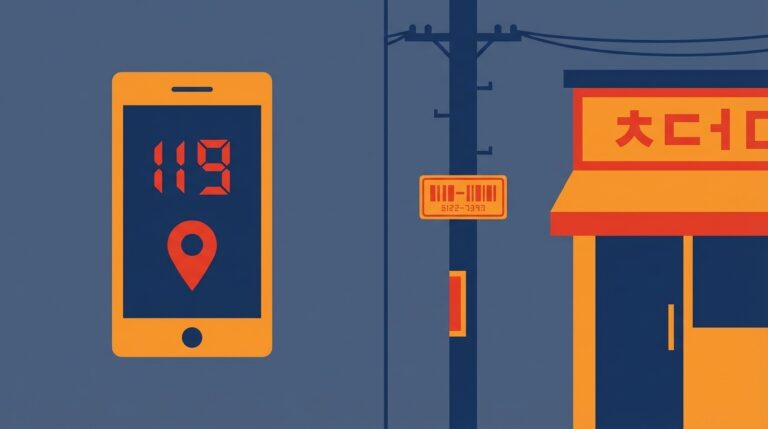
* Look for the “Pole Number”: If you are hiking or in a rural area, look for a utility pole (telephone pole). Every pole in Korea has a unique ID number (전신주 번호). Read that to 119, and they will know your exact coordinates.
4-2. K-Drama Connection: The “Oppapa” Reflex
In dramas, when the heroine gets sick, the hero often carries her on his back (eobba). While romantic on screen, in reality, do not move an injured person unless there is immediate danger (fire/explosion). Korean Good Samaritan laws exist, but the cultural instinct to “physically help” (moving someone) can sometimes cause more harm. Use your voice, not your back!
Phase 5: Immersive Roleplay
Scenario A: Emergency at the Han River Park
Setting: It’s a Friday night at Han River Park (Banpo). You are eating delivery chicken with your Korean friend, Min-su. Suddenly, Min-su grabs his throat. He is having a severe allergic reaction.
Characters:
* YOU: Foreigner living in Seoul (B2 Level Korean).
* Dispatcher (119): Urgent, professional voice.
Dialogue:
YOU: (Dialing 119) 여보세요! 제 친구가 갑자기 숨을 못 쉬어요!
(Yeoboseyo! Je chinguga gapjagi sumeul mot swioyo!)
(Hello! My friend suddenly can’t breathe!)
Dispatcher: 환자 의식은 있습니까? 위치가 어디예요?
(Is the patient conscious? Where is your location?)
YOU: 의식은 있는데 말은 못 해요. 여기 반포 한강공원 편의점 앞이에요.
(He’s conscious but can’t speak. We are in front of the convenience store at Banpo Han River Park.)
Dispatcher: 편의점 이름이 뭐예요? 근처에 큰 건물 있어요?
(What is the name of the store? Any big buildings nearby?)
🔀 Decision Point: How do you pinpoint the location?
- A) “음… 나무가 많고 사람들이 많아요.” (Um… lots of trees and people.)
- B) “GS25 반포 1호점이에요. 세빛둥둥섬이 바로 보여요!” (It’s GS25 Banpo Branch #1. I can see Sevit Island right there!)
- C) “빨리 와주세요, 몰라요!” (Just come quick, I don’t know!)
✅ Best Choice: B
Analysis: Korea relies heavily on Landmarks (POIs). Naming the specific franchise branch (GS25 Banpo 1) or a visible landmark (Sevit Island) is the fastest way for dispatchers to locate you. Choice A is too vague, and C wastes valuable time.
Dispatcher: 네, 구급차 바로 출동합니다. 전화 끊지 마세요.
(Okay, ambulance is dispatching now. Do not hang up.)
Phase 6: 10-Second Shadowing Drill
Let’s practice the urgency. Don’t be shy—loud and clear!
- 😤 Urgent/Loud: 여기 / 응급환자가 / 있어요! (Yeogi / eung-geup-hwan-ja-ga / isseoyo!) -> Here / is an emergency patient!
- 🥺 Desperate: 숨을 / 안 쉬어요 / 빨리 와주세요! (Sumeul / an swioyo / ppalli wa-juseyo!) -> He’s not breathing / please come quickly!
Phase 7: K-Culture Mini Glossary
| Korean | Romanization | Meaning | Context |
|---|---|---|---|
| 응급실 | Eung-geup-sil | Emergency Room (ER) | The setting of many intense K-Drama scenes. |
| 119 (일일구) | Il-il-gu | 119 | Korea’s emergency number for fire & medical. |
| 위치 추적 | Wichi chujeok | Location Tracking | Using GPS/Cell towers to find you. |
| 골든타임 | Goldeun-taim | Golden Time | The critical time window to save a life. |
Phase 8: Traveler’s Survival Kit
🆘 Survival Phrases for 119
- “통역 부탁합니다.” (Tong-yeok bu-tak-hap-nida.)
- Translation: Please request an interpreter.
- Pro Tip: 119 has a 3-way interpretation service connected to BBB Korea or tourism hotlines. Say “English” clearly if you blank out.
- “제 위치를 카카오톡으로 보낼까요?”
- Translation: Should I send my location via KakaoTalk?
- Pro Tip: Sometimes dispatchers will text you a link. Clicking it sends your precise GPS coordinates.
📌 Editor’s Travel Note:
* 119 vs. 112: 119 is for Fire/Medical. 112 is for Police. Don’t mix them up! (Think: 9 ends with a curve like a fire hose, 2 looks like a kneeling officer… okay, maybe just memorize it!)
Phase 9: Think Deeper — Technology vs. Privacy
🧠 One Step Deeper:
In Korea, when you call 119, the government can access your location data, CCTV footage nearby, and even credit card transaction history (during pandemics) to trace movements. This allows for incredibly fast response times.
💬 Your Turn: Does this level of “Safety Surveillance” make you feel safer, or does it feel like an invasion of privacy compared to your home country? How much privacy are you willing to trade for a 5-minute ambulance arrival time?
Phase 10: FAQ & Troubleshooting
- Q: Will the ambulance cost money?
- A: Generally, NO. Basic 119 ambulance transport to the hospital is free in Korea, even for foreigners. However, the hospital treatment itself will cost money (though it’s very affordable compared to the US).
- Q: Can I just take a taxi to the ER?
- A: Yes, for minor injuries. Korean taxis are fast. But for life-threatening issues, 119 is safer because they communicate with the hospital en route to prepare a bed.
❌ Common Mistake: Panicking and speaking your native language immediately.
✅ Fix: Take one second to say “English, please” or “Korea… No…” to alert them to switch to an interpreter.
Phase 11: Wrap-up & Mission
Summary: Today we learned how to use “-(으)ㄴ/는데요” to explain situations, how to describe specific medical states (의식/숨), and the importance of landmarks in location tracking.
🚀 Action Mission:
* 🥉 Bronze: Save “119” in your contacts as “Emergency – Medical/Fire” so you don’t freeze.
* 🥈 Silver: Open Naver Map or KakaoMap right now. Find your current location and identify the nearest “Big Building” or convenience store name in Korean.
* 🥇 Gold: (Mental Simulation) Next time you are at a cafe, look around. If someone fainted right now, what is the exact Korean sentence you would shout?
Phase 12: Interactive Quiz
- Situation: You are hiking and lost. You see a telephone pole. What should you look for?
- A) The bird’s nest.
- B) The “Pole Number” (전신주 번호).
- C) A Wifi signal.
- True or False: In Korea, you must pay the ambulance driver cash upon arrival.
- ( ) True
- ( ) False
- Fill in the blank: “여기 서울역 _______인데요, 친구가 다쳤어요!”
- A) 위 (Top)
- B) 근처 (Near/Vicinity)
- C) 안녕 (Hello)
(Answers: 1-B, 2-False, 3-B)
Frequently Asked Questions (FAQ)
Q: What does "[장소]인데, [상황]이에요." mean in Korean and how do you pronounce it?
A: In Korean, "[장소]인데, [상황]이에요." is pronounced [Jangso] and means: This is [Location], and [Situation] is happening.
Q: What does "의식이 없어요 / 숨을 안 쉬어요." mean in Korean and how do you pronounce it?
A: In Korean, "의식이 없어요 / 숨을 안 쉬어요." is pronounced [Uisigi eopseoyo / Sumeul an swioyo.] and means: He/She is unconscious / Not breathing.
Q: What does "큰 건물이 안 보여요. 위치 추적 해주세요." mean in Korean and how do you pronounce it?
A: In Korean, "큰 건물이 안 보여요. 위치 추적 해주세요." is pronounced [Keun geonmuri an boyeoyo. Wichi chujeok hae-juseyo.] and means: I can't see any big buildings. Please track my location.







