

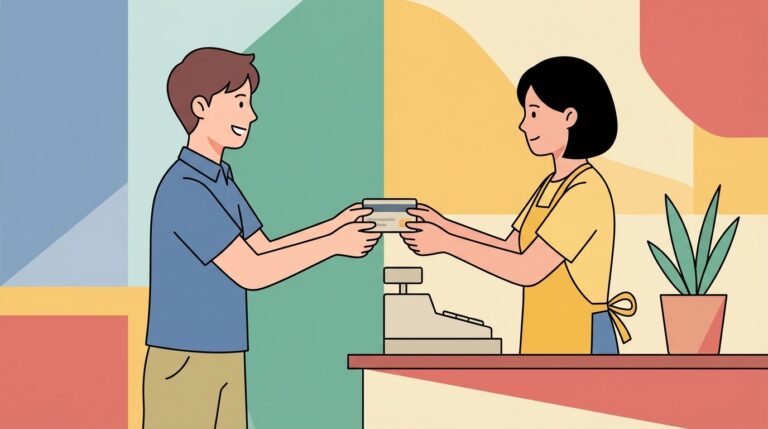
Phase 1: The Panic at the Register 😱
Hello! This is your Daily Hangul Editor.
Imagine this: You’ve just finished the most amazing Samgyeopsal (pork belly) dinner. The K-Pop playlist was fire, the kimchi was spicy, and you are full. You walk to the counter to pay. The ajumma (middle-aged lady) looks at you, waiting.
Suddenly, your mind goes blank. In K-Dramas, the rich CEO just throws a credit card on the table and walks away. But you are not a rich CEO in a drama! You need to ask how much it is, but you don’t want to just point and grunt.
Don’t worry. This moment—the payment—is the final boss of the dining experience. Today, I’ll give you the cheat codes to clear this level with style.
Phase 2: Deep Dive into Core Expressions 🧠
Here are the only phrases you really need to survive the checkout counter.
1. 얼마예요? (How much is it?)
- Pronunciation: [Eol-ma-ye-yo?]
- Sound-alike: Think of “All my” friends + “Yay” + “Yo”-yo.
- Meaning:
- Literal: How much is it?
- Real Nuance: The universal key to buying anything.
- K-Culture Moment: Picture a street food stall (Pojangmacha) in a drama. The main character points at a spicy rice cake (Tteokbokki) and asks this with a hungry look.
- Editor’s Insight: You can use this everywhere. Taxi, market, convenience store. It’s the Swiss Army Knife of Korean questions.
- Situation Spectrum:
[🚫 Formal Meeting] ———— [⚠️ Boss] ———— [✅ Everywhere Else]- 🤔 Think About It: In some cultures, talking about money is taboo. In Korea, asking the price loudly and confidently is just part of the transaction. Why do you think market haggling is seen as “communication” rather than just business in Korea?
2. 계산해 주세요. (Check, please / Please calculate.)
- Pronunciation: [Gye-san-hae ju-se-yo]
- Sound-alike: “Gye” (like Guest) + “San” (like Santa) + “Hae” (like Hair) + “Ju-se-yo”.
- Meaning: Please calculate the bill for me.
- K-Culture Moment: You are leaving a calm, aesthetic cafe in Hongdae. You hand over your card and say this softly. Very chic.
- Editor’s Insight: In proper sit-down restaurants, we don’t usually ask “How much?” at the table. We walk to the door/counter and say this phrase.
- Situation Spectrum:
[🚫 Close Friends] ———— [⚠️ Casual] ———— [✅ Restaurants/Cafes]3. 영수증 주세요. (Receipt, please.)
- Pronunciation: [Yeong-su-jeung ju-se-yo]
- Meaning: Please give me the receipt.
- Editor’s Insight: Korea is becoming very digital. Many places won’t give you a receipt unless you ask. If you are traveling for business, memorize this!
Phase 3: Textbook vs. Real Life 🥊
| Situation | 📖 Textbook Korean | 🗣️ Real Street Korean | 💡 Why the difference? |
|---|---|---|---|
| At a busy cafe | 커피 얼마입니까? (How much is the coffee?) | 아메리카노 하나요. (One Americano, please.) | In fast-paced Seoul, we skip asking the price if it’s on the menu. We just order! |
| Giving a card | 여기 제 신용카드입니다. (Here is my credit card.) | (Silently hands card with two hands) | Body language speaks louder than words. Speed is key! |
| Leaving the restaurant | 안녕히 계세요. (Goodbye/Stay in peace.) | 잘 먹었습니다! (I ate well!) | Thanking the chef for the food is the ultimate compliment. |
Phase 4: Cultural Deep Dive — The Art of Paying 🎭
4-1. The “Two-Hand” Rule (Non-verbal)
In Korea, giving a credit card with one hand can look rude, like you are tossing it at the cashier.
* The Fix: Hold your card with one hand, and support your wrist/elbow with the other hand. It shows respect.
* Nunchi Tip: Watch the cashier’s eyes. If they are busy, just a slight bow with your head works, too.
4-2. The K-Drama “Fighting for the Bill”
Have you seen that scene in K-Dramas where two people fight over who pays? One grabs the bill, the other blocks them.
* Context: This is Nunchi in action. Paying for someone else is a sign of caring or seniority (the older/senior person usually pays).
* Reality Check: If you are a guest or younger, it’s polite to offer to pay once, but if they insist, let them pay and say “Thank you, I ate well!”
Phase 5: Immersive Roleplay 🎬
Scenario: It is Friday night at a loud BBQ restaurant in Gangnam. You are with Min-su (your Korean friend).
Min-su: 배부르다! (I’m full!) That was so good.
(Min-su pats his stomach and looks at the empty soju bottles)
YOU: Yeah, really good. (Checks watch) Oh, we should go.
Min-su: 잠깐만 (Wait), I’ll get the bill.
(Min-su reaches for his wallet)
🔀 Your Turn! What do you do?
- A) Sit quietly and let him pay. (Safe, but maybe too passive?)
- B) Say “No, no! I pay!” and pretend to reach for your wallet. (The Korean Way)
- C) Immediately send him money on Venmo/Paypal. (Too American!)
✅ Best Choice: B
Even if Min-su ends up paying, showing the intention to pay creates a warm feeling (Jeong). Afterwards, you can say:
YOU: 잘 먹었습니다! (I ate well!)
Min-su: Next time, you buy coffee! ☕️
Phase 6: 10-Second Shadowing Drill 🎤
Try to mimic the emotion! Use the / to pause.
- (Curious & Hungry) 😊 이거 / 얼마예요?
(I-geo / eol-ma-ye-yo?) - (Polite at the counter) 💳 계산 / 해 주세요.
(Gye-san / hae ju-se-yo.) - (Grateful leaving) 😋 잘 / 먹었습니다!
(Jal / meo-geot-seum-ni-da!)
Phase 7: K-Culture Mini Glossary 📚
| Korean | Romanization | Meaning | Context |
|---|---|---|---|
| 더치페이 | Deochi-pay | Dutch Pay | Splitting the bill. (Younger generation does this more). |
| N빵 | N-bbang | Splitting 1/N | Slang for dividing the bill exactly by the number of people. |
| 쏜다! | Ssonda! | I’m treating! | Literally “I shoot!” Used when you want to pay for everyone. |
Phase 8: Traveler’s Survival Kit 🧳
🆘 Survival Card: Paying
* Phrase: “카드 돼요?” (Ka-deu dwae-yo?)
* Meaning: Do you take credit cards?
* Pro Tip: Korea is a cashless society. Even buying a $1 water bottle at a convenience store with a card is normal. But carry cash for street food (Bungeoppang/Tteokbokki)!
Phase 9: Think Deeper — Why No Tipping? 🤔
Food & Identity:
In Korea, there is no tipping culture. In fact, leaving money on the table might confuse the waiter—they might run after you thinking you forgot your change!
Why? In Korean philosophy, the service is already included in the price, and doing one’s job well is a matter of professional pride, not a way to earn extra cash. It reflects a communal mindset where “good service” is the standard expectation, not a bonus feature.
💬 Your Turn: How does this compare to your country? Do you feel relieved not to calculate a tip, or awkward walking away without leaving one?
Phase 10: FAQ & Troubleshooting 🛠️
- Q: Can I split the bill at the register?
- A: Maybe. In busy lunch spots, they might do it. But if there is a long line, the cashier hates it. It’s better for one person to pay and others to transfer money later (using KakaoPay etc.).
- Q: I don’t know numbers in Korean! How do I understand the price?
- A: Don’t panic! almost every register has a screen facing you. Just look at the screen. If not, they will type it on a calculator for you.
- ❌ Common Mistake: Trying to tip the taxi driver or waiter.
- ✅ Fix: Just say “Gam-sa-ham-ni-da” (Thank you) with a smile. That is the best tip.
Phase 11: Wrap-up & Mission 🚀
Summary: Today we learned “Eolmayeyo?” (How much?) and that body language (two hands!) is just as important as words.
Your Mission:
* 🥉 Bronze: Say “Jal meo-geot-seum-ni-da” after your next meal (even if you cooked it!).
* 🥈 Silver: Watch a K-Drama scene in a restaurant and look for the receipt. Do they take it or throw it away?
* 🥇 Gold: Go to a Korean restaurant in your city. When you pay, try handing your card with two hands and say “Gyesan-hae juseyo.”
Phase 12: Interactive Quiz 🧩
- Situation: You are at a street food stall. You want to know the price of the Gim-bap. You say:
- A) Annyeong-haseyo?
- B) Eolmayeyo?
- C) Mianhaeyo.
- True or False: You should always leave a 15% tip at a Korean BBQ restaurant.
- (True / False)
- Roleplay Logic: Your boss invites you to dinner. At the end, he says “I will pay.” You should:
- A) Immediately say “Okay” and walk out.
- B) Say “Thank you” and let him pay.
- C) Fight him physically for the bill.
Answers:
1. B (A is Hello, C is Sorry)
2. False (No tipping!)
3. B (Fighting the boss is too much risk, just express gratitude!)
Frequently Asked Questions (FAQ)
Q: What does "얼마예요? (How much is it?)" mean in Korean and how do you pronounce it?
A: In Korean, "얼마예요? (How much is it?)" is pronounced [Eol-ma-ye-yo?] and means: a key conversational Korean expression covered in this lesson.
Q: What does "계산해 주세요. (Check, please / Please calculate.)" mean in Korean and how do you pronounce it?
A: In Korean, "계산해 주세요. (Check, please / Please calculate.)" is pronounced [Gye-san-hae ju-se-yo] and means: a key conversational Korean expression covered in this lesson.
Q: What does "영수증 주세요. (Receipt, please.)" mean in Korean and how do you pronounce it?
A: In Korean, "영수증 주세요. (Receipt, please.)" is pronounced [Yeong-su-jeung ju-se-yo] and means: Please give me the receipt.







