

Phase 1: The Immersive Hook
👋 안녕하세요! Daily Hangul Editor here.
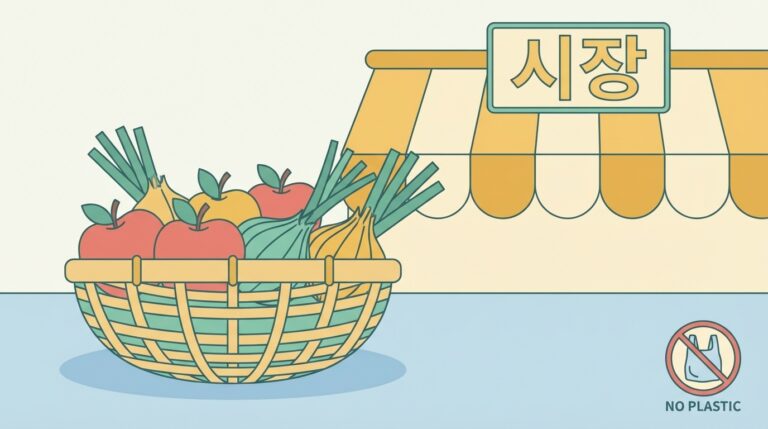
Picture this: You are the main character in a healing K-Drama like Hometown Cha-Cha-Cha. You’re strolling through a vibrant Traditional Market (Sijang), surrounded by mountains of red kimchi and fresh fruits. You buy some apples, and the Ahjumma (middle-aged lady) reaches for a black plastic bag.
In that split second, you pause. You don’t want the plastic. You want to look like a seasoned local, not a clueless tourist. You whip out your own eco-bag and say the magic phrase.
Suddenly, the Ahjumma smiles, “Aigo! You are so smart!” and maybe—just maybe—she tosses in an extra apple as Service (freebie).
Today, we aren’t just learning words; we are learning how to be an eco-friendly insider in Korea. Let’s master the art of the “Jangbaguni” (Shopping Basket).
Phase 2: Deep Dive into Key Expressions
1. 봉투 필요 없어요 (Bongtu pilyo eopseoyo)
- Pronunciation: [Bong-too pil-yo up-suh-yo]
- Sound check: ‘Bong’ like ‘Bongos’, ‘tu’ like ‘two’. ‘Up’ sounds like ‘Up’ in ‘Upstairs’.
- Meaning: “I don’t need a bag.”
- K-Culture Moment: In reality TV shows like I Live Alone, celebrities often say this to show they are environmentally conscious. It’s a small flex of being a “good citizen.”
- Editor’s Insight: Saying this quickly proves you know the system (that bags cost money, usually 20-50 won). It saves you coins and saves the planet!
- Situation Spectrum:
[🚫 To Elders (Rude)] ———— [✅ Standard Polite] ———— [✅ Casual]- This phrase is Standard Polite (✅). You can use it with anyone in a service role.
- 🤔 Think About It: Korea is very strict about recycling. Why do you think shopkeepers used to give out black plastic bags for free, but now hesitate?
2. 장바구니 있어요 (Jangbaguni isseoyo)
- Pronunciation: [Jang-ba-gu-ni is-suh-yo]
- Meaning: “I have a shopping basket/bag.”
- K-Culture Moment: Have you seen airport fashion photos of K-Pop idols? Many carry stylish canvas Eco-bags. That is your Jangbaguni!
- Editor’s Insight: This is the proactive version of expression #1. It implies, “Don’t worry, I came prepared.”
- Situation Spectrum:
[🚫 To Elders] ———— [✅ Standard Polite] ———— [✅ Casual] - 🤔 Think About It: The word Jang (장) means ‘market’ or ‘shopping’. Baguni means ‘basket’. So it literally means “Market Basket.”
3. 여기 담아 주세요 (Yeogi dama juseyo)
- Pronunciation: [Yuh-gi da-ma ju-se-yo]
- Meaning: “Please put it in here.”
- Editor’s Insight: Use this while holding your bag open. It’s a great non-verbal + verbal combo move.
- Situation Spectrum:
[🚫 Command] ———— [✅ Request] ———— [✅ Polite Request]
Phase 3: Textbook vs. Real Life
| Situation | 📖 Textbook Korean | 🗣️ Real Korean | 💡 Why the difference? |
|---|---|---|---|
| Refusing a bag | 봉투를 주지 않으셔도 됩니다. (Please do not give me a bag.) | 봉투 됐어요. (Bag, done/forget it.) | Koreans love speed (Palli-palli). “됐어요” is a bit blunt but very common contextually. |
| Showing your bag | 저는 장바구니를 가지고 왔습니다. (I have brought a shopping basket.) | 가방 있어요! (I have a bag!) | In spoken Korean, we drop particles and use simpler words like Gabang (Bag) instead of Jangbaguni. |
Bottom Note: For A2 learners, stick to “봉투 필요 없어요” (No need for bag). It is softer than “됐어요” and safer to use!
Phase 4: Cultural Deep Dive
4-1. The “Black Bag” Legacy
In older K-Dramas (or historical ones like Reply 1988), you see moms carrying black plastic bags (Geom-jeong Bong-dari). This used to be the symbol of the traditional market. If you carried a black bag, it meant you had good food inside! Today, using an Eco-bag is the new trend, showing you are modern and conscious.
4-2. Non-verbal “Nunchi”
When you hand over your eco-bag for them to fill, open it wide for them. Don’t just hand them a crumpled ball of fabric. It shows consideration (Baeryeo) for the busy merchant.
Phase 5: Immersive Roleplay
Setting: Saturday morning at Mangwon Market. The smell of fried chicken is in the air. You are at a popular fruit stall. The owner is a busy Ahjumma.
Characters:
* YOU: An expat trying to buy peaches.
* Ahjumma: Fast, loud, but kind-hearted vendor.
Dialogue:
YOU: 복숭아 주세요. (Peaches, please.)
Ahjumma: 네, 5,000원입니다~ (Okay, 5,000 won~)
(Ahjumma reaches for a black plastic bag)
YOU: 아, 잠시만요! [ ??? ]
(Ah, wait a moment! …)
🔀 YOUR TURN! What do you say?
* A) 봉투 주세요. (Give me a bag.)
* B) 봉투 필요 없어요. 여기 담아 주세요. (I don’t need a bag. Put it here please.)
* C) 봉투 싫어요. (I hate bags.)✅ Best Choice: B
* Why? It perfectly solves the problem. You refuse the plastic and offer a solution (your bag).
* Why not C? “싫어요” is too strong/childish. It sounds like you emotionally hate the bag!
Ahjumma: 어머, 장바구니 가져왔어? 아이고 예쁘네. (Oh my, you brought a basket? It’s pretty.)
(Ahjumma puts the peaches in your eco-bag and adds one small plum)
Ahjumma: 이거 서비스! (This is service/free!)
Phase 6: 10-Second Shadowing Drill
Let’s practice the rhythm. Don’t sound like a robot!
- Polite Rejection 👋
- 봉투 / 필요 없어요. (Bongtu / pilyo eop-suh-yo.)
- Emotion: Calm, shaking hand slightly.
- Prepared Shopper 🎒
- 저 / 장바구니 / 있어요! (Jeo / Jangbaguni / is-suh-yo!)
- Emotion: Proud and bright.
Phase 7: K-Culture Mini Glossary
| Korean | Rom | English | Context |
|---|---|---|---|
| 장바구니 | Jangbaguni | Shopping Basket/Bag | Can refer to a physical basket or the “Cart” icon on online shopping sites (Coupang/Gmarket). |
| 봉투 | Bongtu | Bag/Envelope | Used for plastic bags (Binil-bongtu) or money envelopes at weddings. |
| 서비스 | Seobiseu | Service (Freebie) | Small free items given by vendors to show affection or gratitude. |
| 알뜰하다 | Altteul-hada | Thrifty/Frugal | A compliment used when someone saves money or uses coupons/bags well. |
Phase 8: Traveler’s Survival Kit
What if you didn’t bring a bag? Don’t panic.
🆘 Survival Expression #1
* 🇰🇷 “봉투 하나 주세요.” (Bongtu hana juseyo)
* 🗣️ Pronunciation: [Bong-too ha-na ju-se-yo]
* 📍 Where: Any market or convenience store.
* 💡 Pro Tip: In Korea, you must pay for bags (usually 20 won to 100 won). It is not the vendor being stingy; it is the law!📌 Editor’s Travel Note
* Standard Supermarkets (E-mart, Lotte Mart): They often do not sell disposable plastic bags anymore. You must buy a reusable standard waste bag (trash bag) or bring your own.
* Traditional Markets: They are a bit more lenient, but bringing your own is loved by locals.
Phase 9: Think Deeper — “Food & Identity”
🧠 Why do Koreans give “Service” (Freebies)?
In Western markets, a price is a price. In a Korean Traditional Market, the transaction is a human connection. Giving an extra apple or a handful of peppers is called “Jeong” (정 – affection/attachment). When you bring your own bag, you show you care about the community, and the vendor might respond with Jeong (extra food). It’s not just business; it’s a relationship.
💬 Your Turn: Does your culture have a concept of “freebies” at markets? Tell me in the comments!
Phase 10: FAQ & Troubleshooting
- Q: Can I put unpaid items in my personal bag while shopping?
- NO! 🚫 Unlike some countries where you bag as you shop, in Korea, this can be misunderstood as theft. Use the store’s basket first, pay, and then put items in your bag.
- Q: Is it okay to use a dirty/old bag?
- Yes! A worn-out bag shows you are a veteran shopper. Nobody judges the fashion of your grocery bag (unless it’s a super cool K-Pop merch bag, then they might compliment it!).
- ❌ Common Mistake:
- Asking “Is the bag free?” (봉투 공짜예요?).
- Correction: Just assume it costs money. Asking for it for free puts the vendor in an awkward position regarding the law.
Phase 11: Wrap-up & Mission
One-Liner: To be a pro shopper in Korea, refuse the plastic and show off your eco-bag!
🔥 Action Missions:
* 🥉 Bronze: Say “Bongtu pilyo eopseoyo” 3 times while looking at your trash can.
* 🥈 Silver: Next time you go to any store (even in your country), take your own bag and think the Korean phrase in your head.
* 🥇 Gold: Go to a Korean market (or H-Mart) and actually use the phrase “Yeogi dama juseyo”!
🎬 K-Culture Mission: Watch a scene from Little Forest (Korean movie). Watch how the main character shops and cooks. It’s the ultimate ASMR for market lovers.
Phase 12: Interactive Quiz
- Situation: You are at a convenience store. You only bought a pack of gum. The clerk reaches for a bag. What is the most natural thing to say?
- a) 봉투 주세요. (Give me a bag.)
- b) 봉투 필요 없어요. (I don’t need a bag.)
- c) 봉투 사랑해요. (I love bags.)
- True or False?
- In Korea, plastic bags are always free at traditional markets.
- (Answer: False. While some old-school vendors might give them, the law requires charging for them.)
🔑 Quiz Answer: 1-b. (Buying a bag for just gum is wasteful, and ‘c’ is weird!)
See you next time at the market! Happy Shopping! 🛒
Frequently Asked Questions (FAQ)
Q: What does "봉투 필요 없어요 (Bongtu pilyo eopseoyo)" mean in Korean and how do you pronounce it?
A: In Korean, "봉투 필요 없어요 (Bongtu pilyo eopseoyo)" is pronounced [Bong-too pil-yo up-suh-yo] and means: a key conversational Korean expression covered in this lesson.
Q: What does "장바구니 있어요 (Jangbaguni isseoyo)" mean in Korean and how do you pronounce it?
A: In Korean, "장바구니 있어요 (Jangbaguni isseoyo)" is pronounced [Jang-ba-gu-ni is-suh-yo] and means: "I have a shopping basket/bag."
Q: What does "여기 담아 주세요 (Yeogi dama juseyo)" mean in Korean and how do you pronounce it?
A: In Korean, "여기 담아 주세요 (Yeogi dama juseyo)" is pronounced [Yuh-gi da-ma ju-se-yo] and means: "Please put it in here."







