

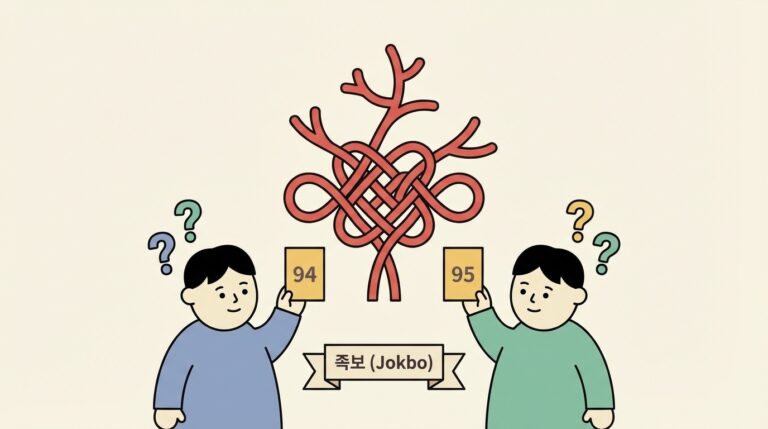
Phase 1: The ‘Age’ Trap — Immersive Hook
Hello! This is your Daily Hangul Editor.
Imagine you are watching a K-Pop variety show. The members are laughing, but suddenly the atmosphere freezes. One member says to another, ‘Wait, why are you speaking informally to me? I’m your Hyung!’ The other replies, ‘But I went to school with your friend!’
Cue the chaotic subtitles: ‘The Jokbo (Genealogy) is twisted!’ ᾒF
Welcome to the most confusing yet fascinating part of Korean social culture: The ‘Fast Birthday’ (Ppareun Nyeonsaeng). In Korea, age isn’t just a number; it’s a hierarchy. But what happens when someone born in early 1995 goes to school with people born in 1994? Who is the older brother, and who is the friend?
If you don’t understand this, you might accidentally offend a Korean friend or, conversely, act too stiff when you could have been chill. Today, we are going to untangle this ‘Jokbo’ together so you can navigate Korean social circles like a true insider.
Phase 2: Deep Dive into Core Expressions
1. “저 빠른 95년생이에요.” (Jeo ppareun gusibo-nyeonsaeng-ieyo.)
- Pronunciation: [Jeo PPa-reun gu-ship-o nyeon-saeng-i-e-yo]
(‘PPa’ sounds like the ‘Pa’ in ‘Papa’ but with a burst of air!)- Meaning: ‘I was born early in the year 1995 (Jan/Feb).’
- Real Nuance: “Technically I was born in ’95, but I identify with the class of ’94. Please treat me as one year older.”
- K-Culture Moment: In the drama Reply 1994, characters constantly argue about this. It’s the ultimate defense card when someone tries to make you call them ‘Oppa’ or ‘Unnie.’
- Editor’s Insight: This system was legally abolished for schools recently, but for anyone born before 2003 (most adults you meet), this rule still dictates their social circle. It’s not about biology; it’s about academic cohort.
- Situation Spectrum:
[Use freely when introducing yourself]- ᾑ4 Think About It: Why is the ‘school year’ more important than the actual birth year in defining friendship in Korea?
2. “족보 꼬이네요.” (Jokbo kkoineyo.)
- Pronunciation: [Jok-bo KKo-i-ne-yo]
- Meaning: Literal: “The family tree is twisting.” / Real: “This age situation is messy/awkward.”
- K-Culture Moment: You’ll hear this in variety shows like Running Man when guests have complicated age gaps. Everyone laughs and sighs.
- Editor’s Insight: Use this when you realize: Person A is friends with Person B, Person B is friends with Person C, but Person A and C strictly use honorifics. It’s a great ice-breaker phrase!
- Situation Spectrum:
[Casual ✅] — [Business ⚠️](Avoid in serious meetings, perfect for drinking parties).3. “그뢜 친구 하실래요?” (Geureom chingu hasillaeyo?)
- Pronunciation: [Geu-reom Chin-gu ha-sil-lae-yo?]
- Meaning: “Then, do you want to be friends?”
- Real Nuance: “Shall we drop the honorifics and just speak casually (Banmal) like same-age friends?”
- Editor’s Insight: In English, everyone is a “friend.” In Korean, Chingu specifically implies SAME AGE (or same school cohort). Asking this is a big step in intimacy.
- Situation Spectrum:
[Very Close ✅] — [First Meeting ⛔]
Phase 3: Textbook vs. Real Life
| Situation | 📖 Textbook Korean | 🗣️ Real Korean (In the Street) | 💡 Why is it different? |
|---|---|---|---|
| Asking Age | 나이가 어떻게 되세요? (How old are you?) |
몇 년생이세요? (What year were you born?) |
Asking the Year avoids the confusion of ‘Korean Age’ vs. ‘International Age.’ |
| Clarifying | 1월에 태어났어요. (I was born in January.) |
저 빠른이에요. (I’m a ‘fast’ one.) |
‘Fast’ immediately signals: ‘Don’t treat me like the others born in my year.’ |
| Sorting it out | 우리 같은 나이이니까 반말해요. (Since we are same age, let’s use Banmal.) |
정리 할까요? (Shall we sort this out?) |
It treats the relationship hierarchy like a tangled cable that needs fixing. Efficient! |
Phase 4: Cultural Deep Dive — K-Culture Connection
4-1. The Art of ‘Seoyeol’ (Ranking) & Nunchi
When you first meet Koreans at a social gathering (like a Hoesik or club meeting), you might feel an intense “scanning” vibe. That is Nunchi in action. They aren’t judging your outfit; they are calculating the Seoyeol (Ranking) to decide whether to use polite language (Jondaemal) or casual language (Banmal). The “Fast Birthday’ is the glitch in this matrix.
Tip: If the “genealogy gets twisted,” the safest bet is to stick to polite language (Jondaemal) until the other person explicitly says, “Let’s be friends.”
4-2. K-Drama Trope: The “Ya! No… Oppa?” Moment
Have you seen scenes where a character gets angry and yells “Ya!” (Hey!), only to realize the other person is actually a “senior” because of a fast birthday? The awkward silence that follows is pure comedy gold. In Reply 1988, the dynamics of the neighborhood friends are entirely built on these school-year rules.
Phase 5: Immersive Roleplay — The BBQ Disagreement
Setting: A noisy Samgyeopsal (pork belly) restaurant in Hongdae. Friday night. You are with Minji (Born May 1994) and Hyun-woo (Born Feb 1995, a ‘Fast 95’). You are born in July 1994.
Minji: (🥩 Pouring soju) 현우야, 잔 받아!
(Hyun-woo-ya, jan bada! / Hyun-woo, take this glass!)
Hyun-woo: (😏 Smirking) 보자 보자 하니까… 누나, 저도 친구들은 94년생이에요.
(Boja boja hanikka… Noona, jeodo chingudeur-eun 94-nyeonsaeng-ieyo. / Wait a minute… Noona, my friends are all born in ’94 too.)
Minji: 그게 무슨 소리야? 너 95년생이잖아!
(Geuge museun soriya? Neo 95-nyeonsaeng-ijana! / What are you talking about? You’re born in ’95!)
Hyun-woo: 저 ‘빠른’이에요. 우리 그냥 친구 할까요?
(Jeo ‘ppareun’-ieyo. Uri geunyang chingu halkkayo? / I’m a ‘fast’ one. Should we just be friends?)
🔀 Decision Point: Minji looks at YOU for help. What do you say?
- A) “연도가 중요하지! 현우가 동생이야.” (Years matter! Hyun-woo is the younger brother.)
- B) “에이, 그냥 다 같이 친구 해요! 술 맛 떨어지게.” (Ey, let’s all just be friends! Don’t ruin the drinking vibe.)
- C) “족보 짜짜 꼬이네요…” (Wow, the genealogy is seriously twisted…)
✅ Best Choice: B — In a casual drinking setting with similar ages (within 1 year), suggesting “let’s all be friends” (We Are The World style) is the “Cool Foreigner” move. It solves the conflict instantly.
⚠️ Choice A Analysis: This is technically “correct” by strict rules, but Hyun-woo might pout.
💡 Choice C Analysis: Good observation, but it doesn’t solve the problem!
Phase 6: 10-Second Shadowing Drill
Let’s practice the magic sentence to end the awkwardness.
“우리 / 나이도 비슷한데 / 그냥 친구 할까요?”
(Uri / na-i-do bi-seut-han-de / geu-nyang chin-gu hal-kka-yo?)
Since our ages are similar, shall we just be friends?
- Emotion: 😊 Friendly & Cool (Smile with your eyes!)
- Intonation: Raise the tone slightly at the end (할까요↗️) to sound inviting, not demanding.
Phase 7: K-Culture Mini Glossary
| Korean | Romanization | Meaning | Context |
|---|---|---|---|
| 학번 | Hakbeon | Class Number (e.g., Class of ’14) | The absolute ruler of university hierarchy. More important than birth year! |
| 서열 | Seoyeol | Rank/Hierarchy | Determining who is ‘higher’ to decide language levels. |
| 말 놓자 | Mal noja | Let’s lower the speech | A phrase to switch from Polite to Casual language. |
| 동갑 | Donggap | Same age | The golden ticket to instant friendship. |
Phase 8: Traveler’s Survival Kit — Nightlife Edition
If you are partying in Hongdae or Itaewon, you WILL be asked your age.
🆘 Survival Phrases TOP 3
- “몇 년생이세요?” (Myeot nyeon-saeng i-se-yo?)
- Meaning: What year were you born?
- Why: Safest way to ask age without confusion.
- “저 94년생이에요.” (Jeo gu-sa nyeon-saeng i-e-yo.)
- Meaning: I was born in ’94.
- Tip: Just memorize your birth year in Sino-Korean numbers (Gu-Sa, Gu-O, etc.)!
- “언니(형)라고 불러도 듼까요?” (Unnie/Hyung-rago bul-leo-do dwel-kka-yo?)
- Meaning: Can I call you Big Sister/Brother?
- Effect: Koreans LOVE hearing this from foreigners. Instant bonding.
📌 Editor’s Travel Note:
If you are a foreigner, Koreans are usually lenient with age rules. But if you show you understand Ppareun Nyeonsaeng, they will think, “Wow, this person is a true Korean local!”
Phase 9: Think Deeper — Language & Power
🧠 Why does a few months’ difference dictate language?
Korea’s honorific system is deeply rooted in Confucianism, where social order creates harmony. By establishing who is older (even by a month in the ‘school year’ system), Koreans clarify roles: the older one takes care of the younger (buys dinner), and the younger one respects the older.
However, this “Fast Birthday” system is fading. The younger generation (Gen Z) increasingly thinks, “If we were born in the same year, we are friends.”
💬 Your Turn: In your culture, does age determine how you speak to someone? Does a 1-year gap matter? Share in the comments!
Phase 10: FAQ & Troubleshooting
Q: I’m a foreigner. Can I just ignore this and say ‘You’ to everyone?
* A: You can, and they will forgive you. But you will miss out on the deep connection (Jeong) that comes from properly addressing someone as Hyung or Noona.
Q: If I was born in Jan 1996, am I friends with 1995?
* A: If you went to school in Korea, yes. If not, it’s up to you! You can choose to be a “Global 96” or a “Korean Fast 96.” Using the “Fast” card might help you befriend older people easily.
❌ Common Mistake: Asking “How old are you?” to an elder or superior immediately.
✅ Fix: Wait for the right social context (drinking, casual chat), or let them ask you first!
Phase 11: Wrap-up & Action Mission
One-Liner Summary: Korean age isn’t just biology; it’s about which ‘Class’ you belong to, but being flexible is the key to being popular.
🎯 Action Mission:
– 🥉 Bronze: Say your birth year in Korean out loud 3 times. (“Jeo OO-nyeon-saeng ieyo.”)
– 🥈 Silver: Watch a K-Pop variety show clip and spot when they talk about ‘Jokbo’ or ‘Seoyeol.’
– 🥇 Gold: Ask a Korean friend (or teacher), “Do you have any friends with fast birthdays?” Watch them explain their complex friend web!
Phase 12: Interactive Quiz
- True or False: If you are born in February 1995, you are automatically friends with someone born in 1996.
- (Answer: False. In the ‘Fast’ system, Feb ’95 belongs to the ’94 cohort, so ’96 would be their junior.)
- Situation: You meet someone born in the same year as you. What is the best phrase to suggest speaking casually?
- A) Jokbo kkoineyo. (Genealogy is twisted.)
- B) Urim mal no-ulkkayo? (Shall we lower our speech?)
- C) Annyeonghaseyo. (Hello.)
- (Answer: B. This is the standard polite way to suggest casual speech.)
Frequently Asked Questions (FAQ)
Q: What does "“저 빠른 95년생이에요.” (Jeo ppareun gusibo-nyeonsaeng-ieyo.)" mean in Korean and how do you pronounce it?
A: In Korean, "“저 빠른 95년생이에요.” (Jeo ppareun gusibo-nyeonsaeng-ieyo.)" is pronounced [Jeo PPa-reun gu-ship-o nyeon-saeng-i-e-yo] and means: ‘I was born early in the year 1995 (Jan/Feb).’
Q: What does "“족보 꼬이네요.” (Jokbo kkoineyo.)" mean in Korean and how do you pronounce it?
A: In Korean, "“족보 꼬이네요.” (Jokbo kkoineyo.)" is pronounced [Jok-bo KKo-i-ne-yo] and means: Literal: “The family tree is twisting.” / Real: “This age situation is messy/awkward.”
Q: What does "“그뢜 친구 하실래요?” (Geureom chingu hasillaeyo?)" mean in Korean and how do you pronounce it?
A: In Korean, "“그뢜 친구 하실래요?” (Geureom chingu hasillaeyo?)" is pronounced [Geu-reom Chin-gu ha-sil-lae-yo?] and means: “Then, do you want to be friends?”







