

Phase 1: The Immersive Hook
Greeting: 안녕하세요! It’s your Daily Hangul Senior Editor. 👋
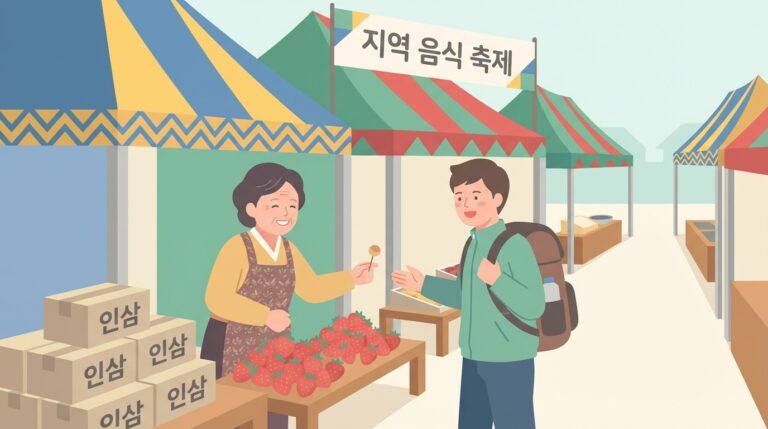
Imagine this: You’ve stepped out of Seoul and landed in a vibrant countryside town. Colorful tents line the streets, the smell of grilling meat or sweet strawberries fills the air, and trot music is blasting from a speaker nearby. You are at a Regional Specialty Festival (지역 특산물 축제).
K-Culture Cold Open:
Think of those scenes in variety shows like 2 Days & 1 Night (1박 2일) or Running Man. The cast arrives at a village, and the elders feed them until they can’t move. Or recall that scene in Hometown Cha-Cha-Cha where the whole village gathers for a feast. The warmth, the noise, the sheer amount of food—that is the ‘Jeong (정)’ of a Korean festival.
The ‘Why’:
If you only know textbook Korean here, you might just buy your item and leave. But if you know the real language of the festival, you won’t just get better prices; you might walk away with a handful of free apples, a new ‘mother’ who calls you ‘son/daughter,’ and a memory that isn’t in any guidebook.
Transparency: This guide combines field notes from my travels to the Boryeong Mud Festival, Nonsan Strawberry Festival, and countless traditional markets, mixed with questions my intermediate students ask when they want to go “off the beaten path.”
Phase 2: Deep Dive into Core Expressions
Here are the three golden phrases to unlock the local hearts (and wallets).
1. 혹시 시식해 봐도 될까요?
- Pronunciation: [Hoksi sisik-hae bwado doelkkayo?] (Sounds like: Hok-she she-shik-he bwa-do dwel-gga-yo?)
- Meaning: “By any chance, may I try a sample?”
- K-Culture Moment: In food documentaries or Mukbangs, you often see vendors cutting a piece of fruit or meat and feeding it directly to the customer. That represents confidence in their product.
- Editor’s Insight: ‘먹어 봐도 돼요?’ is okay, but ‘시식 (sampling)’ sounds much more sophisticated and polite. It shows you know the system. Most festivals exist for you to taste things.
- Situation Spectrum:
[🚫 Formal Meeting] ———— [⚠️ Dept Store] ———— [✅ Festival/Market]- 🤔 Think About It: Why do Korean vendors often feed you the sample directly with a toothpick or their (gloved) hands? What does this say about personal space and affection in Korea?
2. 제철이라서 그런지 정말 신선하네요!
- Pronunciation: [Jecheol-iraseo geureonji jeongmal sinseonhaneyo!]
- Meaning: “Perhaps because it’s in season, it’s really fresh!”
- K-Culture Moment: Watch any cooking show like Three Meals a Day (삼시세끼). The cast always obsesses over ‘Jecheol’ (in season) ingredients. It is the highest compliment you can pay to food.
- Editor’s Insight: This isn’t just a comment; it’s a compliment to the vendor. You are acknowledging their hard work and the timing of the festival. Expect a big smile in return.
- Situation Spectrum:
[✅ Casual] ———— [✅ Semi-formal] ———— [✅ Formal]- 🤔 Think About It: Korea has four very distinct seasons. How has this climate shaped the language around food and freshness?
3. 사장님, 덤 좀 주시면 안 돼요? (with a smile!)
- Pronunciation: [Sajangnim, deom jom jusimyeon an dwaeyo?] (The ‘eo’ in Deom sounds like the ‘u’ in Thumb)
- Meaning: “Boss, can’t you give me a little extra (freebie)?”
- K-Culture Moment: Every K-Drama market scene ever. The main character buys apples, and the lady throws in two more “just because you’re pretty.”
- Editor’s Insight: ‘덤 (Deom)’ is a unique cultural concept. It’s not a discount; it’s a ‘bonus’ given out of affection. Warning: Say this aegyo-style (playfully). Do not demand it.
- Situation Spectrum:
[🚫 Dept Store/Franchise] ———— [⚠️ Supermarket] ———— [✅ Traditional Market/Festival]
Phase 3: Textbook vs. Real Life
| Situation | 📖 Textbook Korean | 🗣️ Real Local Korean | 💡 Why the difference? |
|---|---|---|---|
| Asking for a discount | 깎아 주세요. (Please cut the price.) | 에이~ 멀리서 왔는데 좀 더 주세요! (Ay~ I came from far away, give me more!) | Direct haggling can be harsh. Using “I came from far away” appeals to their hospitality (Insim). |
| Asking if it’s delicious | 이거 맛있어요? (Is this delicious?) | 이거 요즘 제일 잘 나가요? (Is this the best seller these days?) | Of course they will say it’s delicious. Asking what’s “popular” gets a more honest recommendation. |
| Buying a lot | 많이 주세요. (Give me a lot.) | 꽉꽉 채워 주세요! (Pack it tight/full!) | Onomatopoeia like ‘꽉꽉’ (kkwak-kkwak) emphasizes the visual fullness and sounds friendlier. |
Bottom Note: B2 learners, try using “멀리서 왔어요” (I came from far away). It is a magic key in rural areas!
Phase 4: Cultural Deep Dive
4-1. Non-verbal: The Art of “Jeong” (정)
In local festivals, the transaction is secondary; the connection is primary. When a vendor offers you a sample, don’t just grab it. Make eye contact, nod slightly, and say “Wah!” after tasting. This reaction is part of the payment.
4-2. K-Food Connection: The “Teuksanmul” (Specialty) Pride
Koreans are obsessed with regional specialties (특산물). Hanwoo beef must be from Hoengseong. Dried yellow corvina must be from Yeonggwang. When you visit a festival, you aren’t just buying food; you are validating the region’s identity. Mentioning, “I heard [Region Name] apples are the best in Korea,” will instantly upgrade your status from ‘tourist’ to ‘guest.’
Phase 5: Immersive Roleplay Scenario
Setting: It’s the annual Geumsan Ginseng Festival. The air smells earthy and bitter. You stop at a tent where an energetic middle-aged woman (Eomeonim) is stacking ginseng roots.
Characters:
* YOU: A foreign tourist who loves healthy food.
* Eomeonim: A proud local vendor with a loud voice and warm heart.
The Dialogue:
Eomeonim: 아이고! 외국인 청년이 인삼을 다 아네? 이리 와서 한 뿌리 먹어봐! 💪
(Aigo! A young foreigner knows ginseng? Come here and try a root!)
(Stage Direction: She waves a small cup of ginseng honey tea at you)
YOU: (Taking the cup) 와, 감사합니다. [ 1 ]
(Wah, thank you. [ 1 ])
Eomeonim: 그치? 우리 금산 인삼이 최고야. 이거 부모님 선물로 딱인데, 한 박스 가져가.
(Right? Our Geumsan ginseng is the best. This is perfect for your parents, take a box.)
🔀 Decision Point! How do you respond?
* A) “네, 주세요.” (Straightforward, polite)
* B) “음… 학생이라 돈이 별로 없는데… 덤 많이 주시면 살게요!” (Charming negotiation)
* C) “비싸요. 깎아주세요.” (Too direct for a high-value item)
✅ Best Choice: B
Reason: Using your status (student/traveler) combined with asking for Deom (extra roots or candy) is the culturally savvy way to negotiate. It makes the vendor feel generous rather than cheated.
YOU (Option B): 학생이라 돈이 별로 없는데… 덤 많이 주시면 살게요!
Eomeonim: (Laughing) 아이고, 알았어! 내가 사탕이랑 홍삼 젤리도 듬뿍 넣어줄게!
(Aigo, okay! I’ll put in plenty of candy and red ginseng jelly too!)
Phase 6: 10-Second Shadowing Drill
Let’s practice the magic phrase to praise the food.
Emotion: 😍 Delighted & Impressed
와, / 산지에서 먹으니까 / 맛이 / 확실히 다르네요!
(Wa, / sanji-eseo meogeunikka / masi / hwaksilhi dareuneyo!)
Wow, / since I’m eating it at the source / the taste / is definitely different!
Phase 7: K-Culture Mini Glossary
| Korean | Romanization | Meaning | Context |
|---|---|---|---|
| 특산물 | Teuksanmul | Regional Specialty | The star product of the region (e.g., Jeju tangerines). |
| 인심 | Insim | Human Heart/Generosity | “Wow, the Insim here is great!” (big portions/freebies). |
| 택배 | Taekbae | Delivery Service | You can buy 10kg of kimchi and ship it to your hotel/home instantly. |
| 장날 | Jangnal | Market Day | Traditional markets often open every 5 days (e.g., 2nd, 7th). |
Phase 8: Traveler’s Survival Kit
Heading to a local festival? Don’t leave without these tips.
🆘 Survival Phrases
1. “이거 택배 되나요?” (Igeo taekbae doenayo?) – “Can I ship this?” (Crucial for heavy items!)
2. “카드 결제 돼요?” (Kadeu gyeolje dwaeyo?) – “Do you accept cards?”
3. “유통기한이 언제까지예요?” (Yutong-gihani eonjekkajiyeyo?) – “When is the expiration date?”📌 Editor’s Travel Note
* Cash is Queen: While many stalls accept cards now, having 10,000 KRW bills invites better Insim (generosity) and makes bargaining easier.
* The ‘Plastic Bag’ Reality: You will end up with many black plastic bags. Bring a sturdy eco-bag or backpack to consolidate them.
Phase 9: Think Deeper — Food & Identity
Topic: Why are Koreans obsessed with “Local Specialties”?
In many countries, an apple is just an apple. In Korea, an apple is a “Cheongsong Apple” or a “Chungju Apple.” This isn’t just marketing; it’s geography and pride. Korea is 70% mountainous with distinct climates in each valley, creating unique tastes. Furthermore, presenting a gift that is a “Specialty from [Region]” signifies that you cared enough to find the best source, not just the nearest supermarket.
💬 Your Turn: Does your country have famous regional foods? (e.g., Champagne from France, Parmigiano from Italy). How do you ask for them in your language?
Phase 10: FAQ & Troubleshooting
- Q: Can I bargain at a festival?
- A: Maybe. If the price is written down (fixed price), usually no. If it’s a pile of vegetables or fruit on the ground, a little “aegyo” bargaining works. But don’t be aggressive. It’s a festival, not a battle!
- Q: An elderly vendor is speaking to me in ‘Banmal’ (casual language). Is she rude?
- A: No. In the countryside, grandmothers often use Banmal to younger people as a sign of affection/intimacy, treating you like a grandchild. Smile and reply in polite language (Jondaemal).
- ❌ Common Mistake: Touching food without asking.
- ✅ Fix: Always point and ask “만져 봐도 돼요?” (Can I touch?) or wait for the sample. Hygiene is important.
Phase 11: Wrap-up & Action Items
One-Liner Summary:
At a Korean festival, praising the freshness (제철) and charmingly asking for a bonus (덤) is more important than perfect grammar.
🎯 Action Missions:
* 🥉 Bronze: Stand in front of a mirror and practice your “Wow, delicious!” face while saying “Sanji-eseo meogeunikka dareuneyo!”
* 🥈 Silver: Search for “Korean [Food Name] Festival” on YouTube and listen for the background noise. Can you hear vendors shouting?
* 🥇 Gold: Visit a local Korean market (or a Korean grocery store in your country) and ask, “Is this in season?” (이거 제철이에요?)
K-Culture Mission:
Watch an episode of “Delicious Rendezvous” (맛남의 광장). Observe how Paik Jong-won promotes local specialties to help farmers. Notice the vocabulary he uses to describe the taste!
Phase 12: Quiz — Interactive Challenge
1. Situation Judgment:
A vendor gives you a free apple after you bought a box. What is the most natural thing to say?
* A) “왜 공짜로 줘요?” (Why are you giving this for free?)
* B) “사장님 인심이 진짜 좋으시네요!” (Boss, your generosity is really great!)
* C) “환불해 주세요.” (Please refund me.)
2. K-Culture True/False:
Korean festivals usually provide a delivery service (Taekbae) so you don’t have to carry heavy local specialties home.
* ( True / False )
Answer Key:
1. B. Complimenting their Insim ensures you might get another apple next time!
2. True. It’s a crucial part of the festival economy.
Frequently Asked Questions (FAQ)
Q: What does "혹시 시식해 봐도 될까요?" mean in Korean and how do you pronounce it?
A: In Korean, "혹시 시식해 봐도 될까요?" is pronounced [Hoksi sisik-hae bwado doelkkayo?] and means: "By any chance, may I try a sample?"
Q: What does "제철이라서 그런지 정말 신선하네요!" mean in Korean and how do you pronounce it?
A: In Korean, "제철이라서 그런지 정말 신선하네요!" is pronounced [Jecheol-iraseo geureonji jeongmal sinseonhaneyo!] and means: "Perhaps because it's in season, it's really fresh!"
Q: What does "사장님, 덤 좀 주시면 안 돼요? (with a smile!)" mean in Korean and how do you pronounce it?
A: In Korean, "사장님, 덤 좀 주시면 안 돼요? (with a smile!)" is pronounced [Sajangnim, deom jom jusimyeon an dwaeyo?] and means: "Boss, can't you give me a little extra (freebie)?"







