

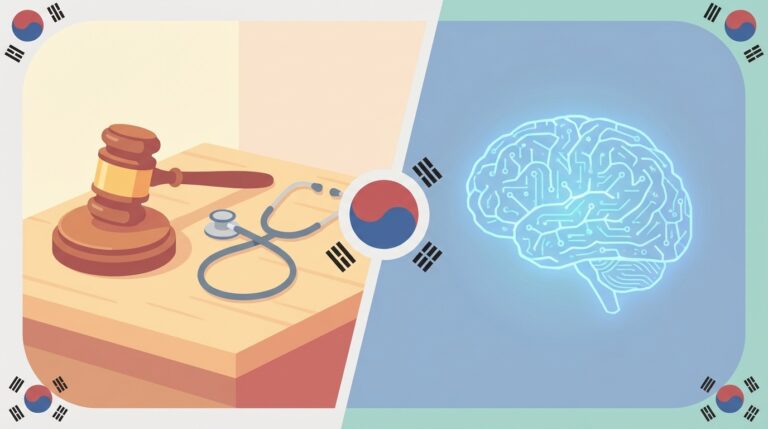
Phase 1: The Immersive Hook
Greeting: 안녕하세요! This is your Daily Hangul Senior Editor.
K-Culture Cold Open: Picture this scene from a high-stakes K-Medical drama like Hospital Playlist or Dr. Romantic. The operating room is tense. The vital signs monitor is beeping erratically. A brilliant but rebellious doctor decides to ignore the standard protocol to save a patient’s life, shouting, “I’ll take full responsibility!” (내가 책임질게!).
Now, imagine replacing that doctor with an Artificial Intelligence. The AI calculates a 49% survival rate and decides not to operate based on probability. Cold, efficient, and… lacking Jeong (정, warm-hearted connection).
The ‘Why’: As an advanced (C1) learner, you can handle basic conversations. But can you discuss the future of humanity in Korean? Can you argue whether an AI judge would be fairer than a human judge who might be swayed by power? In Korea, a nation obsessed with both cutting-edge technology and deep-rooted human relationships, this debate is hot.
Transparency: This guide dives into advanced vocabulary and critical thinking, derived from real debates I’ve had with my C1 students who want to sound intellectual, not just fluent.
Phase 2: Deep Dive into Key Expressions
1. 참작하다 (Chamjak-hada)
- Pronunciation: [Cham-jak-ha-da] Sounds like “Charm” + “Jack” + “Ha-da”
- Meaning: To take into account; to consider (extenuating circumstances).
- K-Culture Moment: In courtroom K-Dramas like Juvenile Justice, you often hear lawyers begging the judge: “정상 참작해 주십시오” (Please take the circumstances into consideration/show leniency). They are appealing to the judge’s humanity, something an AI might struggle to do.
- Editor’s Insight: This word is the bridge between Law and Emotion. It implies that the strict rule isn’t everything.
- Situation Spectrum:
[🚫 Casual Friends] ———— [⚠️ Colleagues] ———— [✅ Formal/Legal/Debate] - 🤔 Think About It: Why does Korean law (and society) place such high value on “circumstances” rather than just the act itself? Does this reflect a culture that values context over absolute truth?
2. 책임을 지다 (Chaegim-eul jida)
- Pronunciation: [Chae-gim-eul ji-da]
- Meaning: To take responsibility / To be held accountable.
- K-Culture Moment: When a medical accident happens in a drama, the hospital director asks, “누가 책임질 거야?” (Who is going to take responsibility?). In Korea, “taking responsibility” often means resigning or accepting severe social punishment.
- Editor’s Insight: The verb 지다 (to carry/bear) is used here because responsibility in Korea feels like a physical weight on your shoulders.
- Situation Spectrum:
[✅ All Situations](Used everywhere from breaking a cup to crashing a stock market).
3. 대체하다 (Daeche-hada)
- Pronunciation: [Dae-che-ha-da]
- Meaning: To replace / To substitute.
- Context: Used when discussing AI replacing human jobs. “AI가 의사를 대체할 수 있을까?” (Can AI replace doctors?)
- 🤔 Think About It: If an AI replaces a judge, can we still call the verdict “Justice” (정의)?
Phase 3: Textbook vs. Real Life (Debate Edition)
| Situation | 📖 Textbook / News Formal | 🗣️ Real Debate / Comment Section | 💡 Why the difference? |
|---|---|---|---|
| Discussing Errors | 오진이 발생할 확률이 있습니다. (There is a probability of misdiagnosis.) | 기계도 뻑나면 답 없지. (If the machine glitches, there’s no answer/hope.) | Koreans use ‘뻑나다’ (slang for glitching/breaking down) to emphasize the frustration with tech failure. |
| Questioning Fairness | 공정성에 문제가 제기될 수 있습니다. (Issues regarding fairness may be raised.) | 유전무죄 무전유죄는 없어지려나? (Will “Money=Innocent, No Money=Guilty” disappear?) | This is a famous satirical idiom highlighting social class issues in the legal system. |
| Scepticism | 시기상조라고 생각합니다. (I think it is premature.) | 아직 멀었어. (It’s still far away.) | Directness is preferred in spoken arguments to show strong conviction. |
Phase 4: Cultural Deep Dive — The “Jeong” Factor in Logic
4-1. Nunchi vs. Algorithm
In a Korean hospital or court, Nunchi (눈치) plays a hidden role. A human doctor reads the patient’s fear, not just the chart. A human judge reads the defendant’s remorse, not just the evidence.
– The Conflict: Koreans fear that AI lacks Nunchi. An AI doctor might announce a terminal illness bluntly: “You have 3 weeks.” A Korean doctor might soften the blow for the family’s sake.
– Key Insight: In Korea, “How you say it” is often as important as “What the diagnosis is.”
4-2. The “Yujeon-Muje” Complex (K-Drama Trope)
One reason some Koreans support AI judges is the cynicism shown in dramas like Vincenzo or Stranger.
– The Phrase: 유전무죄 무전유죄 (Yu-jeon-mu-je, Mu-jeon-yu-je) — “Have money, not guilty; No money, guilty.”
– The Hope: People hope AI will be blind to wealth and connections (In-maek), unlike the corrupt officials often depicted in media.
Phase 5: Immersive Roleplay — The Ethical Debate
Setting: A trendy cafe in Hongdae on a rainy Sunday. You are debating with Min-su (30, a cynical tech developer) about a news report regarding AI diagnosis.
Min-su:
(Sighs and points to phone) 야, 이 기사 봤어? 왓슨인지 뭔지, 인공지능이 의사보다 암 진단율이 높대.
(Ya, did you see this article? Watson or whatever, they say AI has a higher cancer diagnosis rate than doctors.)
YOU:
진짜요? 기술이 발전하는 건 좋지만… 좀 무섭기도 하네요.
(Really? It’s good that technology is advancing, but… it’s also a bit scary.)
Min-su:
무서울 게 뭐 있어? 난 의사보다 기계가 나아. 의사들은 피곤하면 오진도 하잖아. 감정도 없고 실수도 없는 AI가 낫지 않아?
(What’s there to be scared of? I prefer machines over doctors. Doctors misdiagnose when they’re tired. Isn’t an emotionless, error-free AI better?)
🔀 Your Turn! How do you respond?
Choice A (Humanist): “하지만 기계는 책임을 질 수 없잖아요.” (But a machine cannot take responsibility.)
Choice B (Pragmatist): “맞아요. 객관적인 데이터가 더 중요하죠.” (You’re right. Objective data is more important.)
Choice C (Critical – Advanced): “그래도 환자의 마음을 헤아려 주는 건 의사만 할 수 있죠.” (Still, only a doctor can fathom/understand the patient’s heart.)
✅ Best Choice for C1 Practice: Choice A. It introduces a complex ethical concept involving the verb 지다.
YOU (Choice A):
하지만 기계는 책임을 질 수 없잖아요. 만약 수술이 잘못되면 누가 사과해요? 알고리즘이요?
(But a machine cannot take responsibility. If the surgery goes wrong, who apologizes? The algorithm?)
Min-su:
(Pauses, nodding) 음… 그건 그렇네. 사과 안 하는 의사도 싫지만, 사과 못 하는 기계는 더 끔찍하다.
(Hmm… that’s true. I hate doctors who don’t apologize, but a machine that CAN’T apologize is even more terrible.)
Phase 6: 10-Second Shadowing Drill
Practice these lines to sound like an intellectual K-Drama protagonist.
1. The Skeptic (Feeling: Dubious/Concerned) 🤨
“인공지능이 / 인간의 존엄성까지 / 판단할 수는 / 없다고 봐요.”
(In-gong-ji-neung-i / in-gan-ui jon-eom-seong-kkaji / pan-dan-hal su-neun / eop-da-go bwa-yo.)
= “I don’t think AI can judge even human dignity.”
2. The Realist (Feeling: Cold/Firm) 😤
“감정에 치우치지 않는 / 냉정한 판결이 / 필요합니다.”
(Gam-jeong-e chi-u-chi-ji an-neun / naeng-jeong-han pan-gyeol-i / pil-yo-ham-ni-da.)
= “We need a cold verdict that isn’t swayed by emotion.”
Phase 7: K-Culture Mini Glossary (Advanced)
| Korean | Romanization | English | Context |
|---|---|---|---|
| 윤리 | Yulli | Ethics | The core theme. “인공지능 윤리 가이드라인” (AI Ethics Guidelines). |
| 오진 | Ojin | Misdiagnosis | A critical fear in the medical field. |
| 전례 | Jeol-lye | Precedent | Essential legal term. AI relies on precedents, but can it create new ones? |
| 심신미약 | Sim-sin-mi-yak | Mental/Physical weakness | A controversial legal defense in Korea often criticized for leading to lenient sentences. |
| 골든타임 | Gol-deun-ta-im | Golden Time | The critical window for medical treatment. Can AI speed this up? |
Phase 8: Traveler’s Survival Kit (Emergency Edition)
Even if you are debating AI, you have a physical body. If you get sick in Korea, you need real doctors, not AI (yet).
🆘 Medical Emergency Survival Cards
1. Symptom Description (Advanced):
🇰🇷 “증상이 간헐적으로 나타나요.”
(Jeung-sang-i gan-heol-jeok-eu-ro na-ta-na-yo.)
= “The symptoms appear intermittently.”
Use this to sound precise to the doctor.2. Asking for Detail:
🇰🇷 “정확한 진단명이 뭔가요?”
(Jeong-hwak-han jin-dan-myeong-i mwon-ga-yo?)
= “What is the exact diagnosis name?”📌 Editor’s Note: Korean hospitals are incredibly fast (
Ppalli-Ppalliculture). You might feel rushed. Don’t be afraid to ask, “잠시만요” (One moment) if you need time to process the Korean.
Phase 9: Think Deeper — “Tech vs. Humanity”
Topic: The Efficiency Paradox
Korea is one of the most automated countries in the world (ordering kiosks, robot baristas). Yet, the longing for Jeong (Human warmth) is stronger than ever.
🧠 Think Deeper:
Why do we see a rise in “Healing” (힐링) trends and sentimental essays in Korea alongside the AI boom? perhaps as technology becomes colder and more efficient, the value of inefficient, messy, but warm human interaction becomes a luxury.💬 Your Turn: Would you trust an AI judge to sentence a criminal? Or is the “human element” (even if flawed) essential for justice? Let me know in the comments!
Phase 10: FAQ & Troubleshooting
Q: Can I use ‘판단하다’ (judge) and ‘판결하다’ (sentence/rule) interchangeably?
A: No!
– 판단하다 is general judgment (thinking/deciding). Anyone can do it. “상황을 판단해봐.” (Judge the situation.)
– 판결하다 (or 선고하다) is strictly legal. Only judges do it. “징역 10년을 선고했다.” (Sentenced to 10 years prison.)
❌ Common C1 Mistake:
Don’t say “AI가 판결을 생각해요.” (AI thinks the verdict.)
✅ Say: “AI가 판결을 내려요 (or 도출해요).” (AI hands down/derives the verdict.)
Phase 11: Wrap-up & Action Mission
One-Liner: Advanced Korean isn’t just about hard words; it’s about discussing values like responsibility and empathy.
Action Mission:
– 🥉 Bronze: Read a Korean news headline about AI (search ‘인공지능 판사’ on Naver).
– 🥈 Silver: Write a 3-sentence comment on that article using “참작하다” or “책임.”
– 🥇 Gold: Ask a Korean friend: “넌 인공지능 판사 찬성해, 반대해?” and hold a 5-minute debate!
K-Culture Mission: Watch one episode of “Juvenile Justice” (소년심판) on Netflix. Observe how the judge struggles with emotion vs. law. That is the human element AI tries to replicate!
Frequently Asked Questions (FAQ)
Q: What does "참작하다 (Chamjak-hada)" mean in Korean and how do you pronounce it?
A: In Korean, "참작하다 (Chamjak-hada)" is pronounced [Cham-jak-ha-da] and means: To take into account; to consider (extenuating circumstances).
Q: What does "책임을 지다 (Chaegim-eul jida)" mean in Korean and how do you pronounce it?
A: In Korean, "책임을 지다 (Chaegim-eul jida)" is pronounced [Chae-gim-eul ji-da] and means: To take responsibility / To be held accountable.
Q: What does "대체하다 (Daeche-hada)" mean in Korean and how do you pronounce it?
A: In Korean, "대체하다 (Daeche-hada)" is pronounced [Dae-che-ha-da] and means: To replace / To substitute.






