

Phase 1: The Art of “Soft” Persuasion
Hello, Daily Hangul family! It’s your editor here. 👋
Picture this: You’re watching a K-Drama. The main character is late for a meeting, but she needs a huge favor from her grumpy boss. Does she walk in and say, “Do this because it is logical”?
Absolutely not.
She probably starts with a hesitant look, maybe offers a vitamin drink, and then says, “You know how hard the team worked yesterday…” (cue sentimental music 🎻).
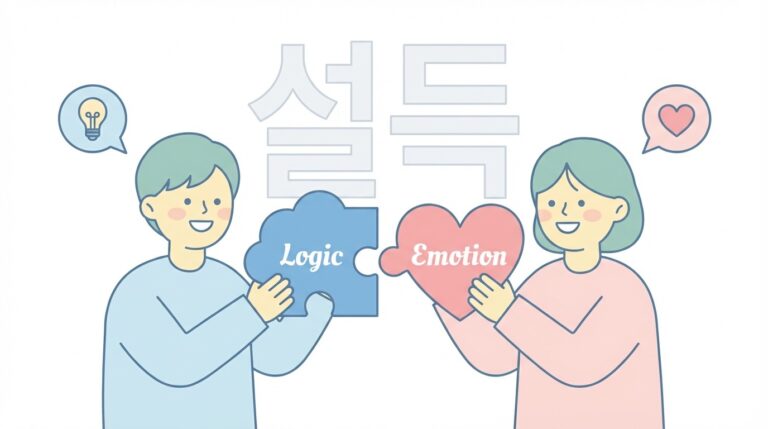
In Korea, persuasion isn’t just about logic; it’s about emotional connection and shared context. If you just list facts, you sound like a robot (or a rude textbook). Today, we’re going to learn the secret weapons of Korean persuasion—grammar points that turn a demand into a reasonable suggestion that’s impossible to refuse.
Ready to become a master negotiator? Let’s dive in.
Phase 2: Deep Dive into Key Expressions
To persuade someone in Korean at a B1 level, you need to move beyond simple “Because” (~서). You need nuance.
1. ~잖아요 (~jan-a-yo)
- Pronunciation: [ja-na-yo]
Sound analogy: Sounds a bit like “Jah” (as in Jamaica) + “Na” + “Yo”.- Meaning: “You know…” / “As you know” / “Come on, isn’t it true that…”
- K-Culture Moment: Think of a variety show (like Running Man). When a member is accused of cheating, they yell, “I didn’t know the rules, you know!” (Moll-at-ja-na-yo!)
- Editor’s Insight: This is your “Agreement Builder.” You use this when the listener already knows the reason, and you are just reminding them to get them on your side. It forces them to nod.
- Situation Spectrum:
[🚫 Boss (Risky)] ———— [⚠️ Colleague] ———— [✅ Friends]
(Use with caution with strict superiors; it can sound pushy if overused.)- 🤔 Think About It: Why does reminding someone “you know this” work better than telling them new information? It creates a feeling of “we are on the same team.”
2. ~거든요 (~geo-deun-yo)
- Pronunciation: [geo-deun-yo]
Sound analogy: “Go” + “Dune” (like the movie) + “Yo”.- Meaning: “For your information…” / “The thing is…” / “Actually…”
- K-Culture Moment: A calm, cool female lead explaining why she won’t date the rich guy. “I have a dream I need to pursue, you see.” (Kkum-i it-geo-deun-yo.)
- Editor’s Insight: This provides a reason the listener doesn’t know yet. It’s softer than a direct statement. It explains the background of your decision.
- Situation Spectrum:
[🚫 Formal Presentation] ———— [⚠️ Boss] ———— [✅ Friendly/Polite]3. ~기 때문에 (~gi ttae-mun-e)
- Pronunciation: [gi ttae-mu-ne]
Sound analogy: “Key” + “Te” (like Teddy) + “Moon” + “Eh”.- Meaning: “Because of [Reason]” (Logical/Formal)
- K-Culture Moment: News anchors or office dramas where someone is giving a formal report. “Sales dropped because of the seasonal change.”
- Editor’s Insight: This is the “suit and tie” of reasons. Use this when you want to sound professional, objective, and firm.
- Situation Spectrum:
[✅ Boss/Formal] ———— [⚠️ Close Friend (Too stiff)] ———— [🚫 Kid]
Phase 3: Textbook vs. Real Life
| Situation | 📖 Textbook Korean | 🗣️ Real Korean (Insider) | 💡 Why? |
|---|---|---|---|
| Refusing an invite | 바빠서 못 가요. (I can’t go because I’m busy.) |
오늘 좀 바쁘거든요. (Oneul jom bappeu-geo-deun-yo.) |
“So” (~서) is too direct. ~거든요 implies “I have a reason (let me explain), so please understand.” |
| Convincing a friend | 맛집이라서 가자. (Let’s go because it’s a famous place.) |
여기 맛집이잖아요! 가자! (Yeogi matjibi-jan-a-yo! Gaja!) |
~잖아요 assumes the friend already agrees or should agree. It pulls them in! |
| Workplace excuse | 차가 막혀서 늦었어요. (I was late because traffic was blocked.) |
차가 너무 막히더라고요. (Chaga neomu makhi-deo-ra-go-yo.) |
Using ~더라고요 (recalling a fact) sounds like you were a victim of traffic, not just making an excuse. |
Bottom Note: In B1 level, mixing these endings makes you sound fluent. Don’t just answer “Why?” Answer with “You know why!” or “Here is the backstory.”
Phase 4: Cultural Deep Dive — The Art of “Nunchi” (눈치)
4-1. Non-verbal Persuasion
In Korea, if you stare straight into someone’s eyes and list logical reasons, it can be seen as challenging or aggressive (especially to older people).
* The Soft Gaze: Look slightly down or at their chin when explaining difficult reasons.
* The “Kusari” Avoidance: Don’t embarrass them. Even if you are right, use ~잖아요 (as you know) to let them save face, rather than saying “You are wrong.”
4-2. K-Food Connection: The “Service” (서비스) Culture
Ever notice how in K-Dramas, people shout “Imo!” (Auntie) at a restaurant?
* Scenario: You want free cider (Sprite).
* Bad Persuasion: “Give me free cider.”
* Korean Persuasion: “Imo! We ordered so much meat, you know (~잖아요)! Give us some service please!”
* Why it works: You reminded her of the shared fact (we spent money) and playfully nudged her. This is the power of logic wrapped in affection (Jeong).
Phase 5: Immersive Roleplay — The Late Night Snack War 🍗
Setting: It’s 11:00 PM on a Friday. You are at the Han River Park with your Korean friend, Ji-min. You are starving. Ji-min is on a “diet.”
Characters:
* YOU: Craving Chimaek (Chicken + Beer).
* Ji-min: Trying to resist temptation, but weak-willed.
Dialogue:
YOU: 지민아, 우리 치킨 시킬까? 배고파 죽겠어.
(Ji-min-a, uri chikin sikilkka? Baegopa jukgesseo.)
(Jimin, shall we order chicken? I’m starving to death.)Ji-min: 야, 안 돼. 나 다이어트 중이잖아.
(Ya, an dwae. Na daieoteu jung-i-jan-a.)
(Hey, no way. You know I’m on a diet.)🔀 Your Turn! How do you persuade her?
- A) “하지만 치킨은 맛있어요.” (But chicken is delicious.) – Too simple.
- B) “맛있게 먹으면 0칼로리잖아!” (If you enjoy it, it’s 0 calories, you know!) – The classic Korean excuse.
- C) “내가 살게.” (I’ll buy.) – Effective, but expensive.
✅ Best Choice: B
YOU: 에이, 맛있게 먹으면 0칼로리잖아! 딱 오늘만 먹자.
(Ei, masitge meogeumyeon yeong-kalrori-jan-a-yo! Ttak oneulman meokja.)
(Eyy, you know if it’s delicious, it’s 0 calories! Let’s eat just for today.)Ji-min: (Laughing) 아, 진짜… 그 말은 누가 지어낸 거야? 그래, 딱 오늘만이다!
((Laughing) Ah, seriously… who made that up? Okay, just for today!)
Phase 6: 10-Second Shadowing Drill
Practice these to get the “whining but logical” tone right. Follow the emotion!
- The “Come on!” Tone (Persuading a friend):
😊 우리 / 저번에 / 약속했잖아요!
(Uri / jeobeone / yaksok-haet-jan-a-yo!)
“We / promised / last time, you know!” -
The “Gentle Explanation” Tone (Declining politely):
😓 제가 / 요즘 / 돈을 / 모으고 있거든요…
(Jega / yojeum / doneul / moeugo it-geo-deun-yo…)
“I am / these days / money / saving, you see…”
Phase 7: K-Culture Glossary
| Korean | Romanization | Meaning | Context |
|---|---|---|---|
| 애교 | Aegyo | Cute behavior | Sometimes, the best logic is cuteness. Used to soften a request. |
| 답정너 | Dap-jeong-neo | “The answer is fixed, you just reply” | When someone persuades you, but they really just want you to agree with their decision. |
| 밀당 | Mil-dang | Push and pull | Essential in negotiation. Don’t agree immediately; hesitate a little! |
| 서비스 | Seobisu | Service (Freebie) | The ultimate goal of persuasion in markets/restaurants. |
Phase 8: Traveler’s Survival Kit — The Market Negotiation 🛍️
Convincing a vendor to give a discount requires a reason.
🆘 Survival Expression: The Discount Logic
* 🇰🇷 “현금으로 할 건데, 좀 깎아주세요!”
* (Hyeongeum-euro hal geonde, jom kkakka-juseyo!)
* 🗣️ Translation: “I’m going to pay with cash, so please cut the price!”
* 📍 Where: Traditional Markets (Namdaemun, Dongdaemun), Underground Shopping Malls.
* 💡 Pro Tip: In Korea, “paying cash” is the most valid reason (~기 때문에) for a discount because it saves card fees for the owner.📌 Editor’s Travel Note
Department stores (Shinsegae, Lotte) represent “Fixed Price” (정찰제). Do NOT try to persuade the staff there. Save your skills for the street markets!
Phase 9: Think Deeper — Language & Harmony
Why do Koreans prefer “You know…” (~잖아요) over “Because”?
In Western cultures, debate and “winning” an argument with facts is often valued. In Korea, Harmony (Inhwa) is key. Using direct logic can feel like you are drawing a line between “Me” (Right) and “You” (Wrong).
By using expressions like ~잖아요 (reminding of shared knowledge) or ~거든요 (sharing personal background), you are softening the blow. You are inviting the other person to understand your situation, rather than forcing them to accept your logic. It’s not just about being right; it’s about maintaining the relationship while getting what you want.
💬 Your Turn: In your culture, if you want to refuse an invitation, do you give a direct reason (“I don’t like that food”) or a soft excuse (“I’m not feeling well”)?
Phase 10: FAQ & Troubleshooting
Q: Can I use ~잖아요 to my teacher or boss?
A: ⚠️ Be careful. If you say “It’s in the email, you know (이메일에 있잖아요),” it sounds like you are scolding them for not checking. To a superior, it’s safer to use ~거든요 (It is in the email, let me inform you) or just stating the fact politely.
Q: How do I persuade a taxi driver to go faster?
A: Don’t just say “Fast!” Say: “I’m late for a flight (비행기 시간 때문에), could you hurry a bit?” Giving a valid reason (~기 때문에) makes them more cooperative than just a command.
❌ Common Mistake #1: Overusing ~기 때문에 in casual conversation.
✅ Fix: If you are talking to friends, ~기 때문에 sounds like a robot. Use ~서 (simple) or ~니까 (emphasis) instead.
Phase 11: Wrap-up & Action Mission
One-Liner Summary: clear logic is good, but shared feelings (~잖아요) and personal background (~거든요) are the keys to Korean persuasion.
🚀 Action Mission:
* 🥉 Bronze: Look in the mirror and practice the “soft gaze” while saying “바쁘거든요” (I’m busy, you see).
* 🥈 Silver: Watch a K-Drama episode and count how many times you hear “Jan-a-yo!” (It’s usually high-pitched!).
* 🥇 Gold: Go to a Korean restaurant (or Asian market) and playfully say to a friend, “This is delicious, you know!” (이거 맛있잖아요!) in Korean.
Phase 12: Interactive Quiz
1. Situation: Your boss asks why the report is late. What is the safest response?
* A) 어제 회식했잖아요! (We had a team dinner yesterday, you know!) [Too cheeky/risky]
* B) 컴퓨터가 고장 났거든요. (My computer broke, you see.) [Best – explains a fact politey]
* C) 그냥요. (Just because.) [Rude]
2. True or False?
* In a traditional market, saying “I am a student” is a valid persuasion tactic for a discount.
* 👉 True! Korean vendors often have a soft spot for “poor students.” Use your status as a reason!
(Scroll down for answers)
📝 Click for Answers
1. B (Explaining the background info gently is best for bosses.)
2. True (Try saying “Hakseng-i-jan-a-yo” – I’m a student, you know!)
Frequently Asked Questions (FAQ)
Q: What does "~잖아요 (~jan-a-yo)" mean in Korean and how do you pronounce it?
A: In Korean, "~잖아요 (~jan-a-yo)" is pronounced [ja-na-yo] and means: "You know..." / "As you know" / "Come on, isn't it true that..."
Q: What does "~거든요 (~geo-deun-yo)" mean in Korean and how do you pronounce it?
A: In Korean, "~거든요 (~geo-deun-yo)" is pronounced [geo-deun-yo] and means: "For your information..." / "The thing is..." / "Actually..."
Q: What does "~기 때문에 (~gi ttae-mun-e)" mean in Korean and how do you pronounce it?
A: In Korean, "~기 때문에 (~gi ttae-mun-e)" is pronounced [gi ttae-mu-ne] and means: "Because of [Reason]" (Logical/Formal)







