

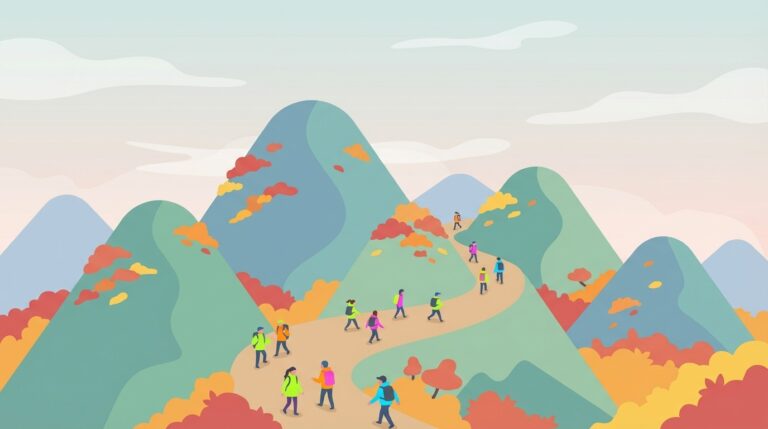
Phase 1: The Reality of “Romantic” Autumn 🍂
안녕하세요! This is your Senior Editor at Daily Hangul.
Imagine this: You’ve watched that scene in a K-Drama where the couple walks hand-in-hand under falling red maple leaves. The OST swells, the wind blows their coats gently, and it’s just the two of them in a sea of red and gold. Romantic, right?
Snap back to reality. It’s October in Korea. You head to Seoraksan or Bukhansan to experience this magic. What do you see?
You don’t see a lonely path. You see a wall of neon-colored hiking jackets. You smell gimbap and sesame oil everywhere. You aren’t walking; you are shuffling in a queue up a mountain slope.
Today, we are going to tackle the Unit: Autumn Foliage Viewing & Hiking Crowds. To survive this intense Korean cultural phenomenon, you need more than just “The leaves are pretty.” You need the vocabulary to navigate the chaos, express your shock at the crowds, and earn the respect of the ajeossi (middle-aged man) hiking next to you.
Let’s get into the real Korean autumn.
Phase 2: Deep Dive — Essential Expressions
Here are the three expressions that will make you sound like a local who has braved the autumn crowds before.
1. 단풍놀이 (Danpung-nori)
- Pronunciation: [Dan-pung-no-ri] Sounds like “Dan-poong-no-ree”
- Meaning:
- Literal: Autumn foliage play/game.
- Real Nuance: Going out to view autumn leaves. The suffix -nori (play) implies it’s not just a visual activity but a full recreational event involving food, travel, and leisure.
- K-Culture Moment: In variety shows like 2 Days & 1 Night, when they say “Let’s go for Danpung-nori,” they aren’t just looking at trees. They are packing lunches, playing games, and making a day trip out of it.
- Editor’s Insight: Use this instead of just “looking at leaves” (단풍을 봐요). It shows you understand the event nature of the season.
- Situation Spectrum:
[🚫 Formal Report] ———— [⚠️ Polite] ———— [✅ Casual/Daily]
(Perfect for friends, family, and travel plans.) - 🤔 Think About It: Why does Korean use the word “play” (nori) for viewing flowers (beotkkot-nori) and leaves (danpung-nori)? Is nature a background for human activity rather than something to observe silently?
2. 발 디딜 틈이 없다 (Bal didil teumi eopda)
- Pronunciation: [Bal di-dil teu-mi eop-da]
- Meaning:
- Literal: There is no crack/gap to set my foot.
- Real Nuance: It is packed! Jam-packed. Shoulder-to-shoulder. Used when a place is so crowded you can’t move.
- K-Culture Moment: You’ll hear this on the news every Chuseok or during peak vacation season at Incheon Airport. Or, when a K-Pop idol appears at a mall event.
- Editor’s Insight: This is a B2/C1 idiom that instantly upgrades your level. Instead of saying “Saram-i neomu manayo” (Too many people), try this.
- Situation Spectrum:
[🚫 None] ———— [⚠️ Semi-Formal] ———— [✅ Everywhere]
(You can use this even in polite conversation to describe a situation.)
3. 인산인해 (Insan-inhae)
- Pronunciation: [In-san-in-hae]
- Meaning:
- Literal: People mountain, people sea.
- Real Nuance: A sea of people. Immense crowds.
- K-Culture Moment: Often seen in subtitles (jagmak) on TV news or documentaries describing festivals or protests.
- Editor’s Insight: This is a Saja-seong-eo (Four-character idiom from Hanja). Using this makes you look very intellectual. It’s a bit dramatic, so it fits the massive crowds at famous mountains perfectly.
- Situation Spectrum:
[🚫 Casual Slang] ———— [⚠️ Daily Chat] ———— [✅ Descriptive/Formal]
(Great for storytelling or writing blogs.)
Phase 3: Textbook vs. Real Life
How do locals really complain about the crowds?
| Situation | 📖 Textbook Korean | 🗣️ Real Korean (In the Wild) | 💡 Why the difference? |
|---|---|---|---|
| Seeing a huge crowd | 사람이 정말 많아요. (There are many people.) |
와, 미쳤다. 사람 반, 물 반이네. (Wow, crazy. It’s half people, half water/nature.) |
Koreans love exaggerating for humor. “Mul-ban gogi-ban” (half water half fish) is the original idiom, adapted here. |
| Moving slowly in a line | 줄을 서서 기다려요. (I am waiting in line.) |
그냥 떠밀려 가고 있어요. (I’m just getting pushed along.) |
Emphasizes the lack of control; the crowd moves you. |
| Describing the traffic | 차가 많이 막혀요. (Traffic is blocked a lot.) |
주차장이 따로 없네. (It’s practically a parking lot.) |
Sarcasm is a key part of Korean bonding over shared suffering. |
💡 Editor’s Note: “Mul-ban saram-ban” (Half water/nature, half people) is a hilarious way to describe a crowded beach or mountain. Try it, and your friends will laugh!
Phase 4: Cultural Deep Dive
4-1. Hiking Fashion: The Runway of the Mountains
Have you noticed? In Europe or the US, people wear leggings or old t-shirts to hike. In Korea, hiking is a fashion show.
* The Gear: Even on a low hill, you will see fully equipped hikers: expensive windbreakers, professional sticks, specialized backpacks, and visors.
* Why? It relates to “Equipment-bal” (장비빨). Koreans take hobbies seriously, and looking the part is half the fun. Don’t feel pressured to buy it, but don’t be surprised if an ajumma asks, “Why are you hiking in jeans?” (Note: Don’t hike in jeans; it’s uncomfortable!).
4-2. The Summit Reward: Makgeolli & Pajeon
For many Koreans, the peak isn’t the goal. The restaurant at the bottom of the mountain is the goal.
* The Trinity: Hiking + Pajeon (Green onion pancake) + Makgeolli (Rice wine).
* Context: After sweating in the crowd, sitting on a plastic chair outdoors and drinking cold Makgeolli is the true definition of “Danpung-nori.”
Phase 5: Immersive Roleplay
Setting: It is Saturday morning at the entrance of Bukhansan National Park. The leaves are blazing red. You are with your Korean friend, Min-ji.
Min-ji: 헐… 입구부터 사람이 장난 아니다. 우리 올라갈 수 있을까?
(Heol… ipgu-buteo saram-i jangnan anida. Uri ollagal su isseulkka?)
(Whoa… the crowd at the entrance is no joke. Can we even go up?)
YOU: (Looking at the endless line of colorful jackets)
___________ [A, B, or C] ___________
Min-ji: 그치? 그냥 맛집이나 갈까? 근처에 도토리묵 잘하는 집 있어.
(Geuchi? Geunyang matjib-ina galkka? Geuncheo-e dotorimuk jalhaneun jip isseo.)
(Right? Should we just go to a famous restaurant? There’s a place nearby good at Acorn Jelly.)
🔀 Your Turn! Choose your response:
- A) “사람이 너무 많아서 발 디딜 틈도 없네. 그냥 먹으러 가자!” (Uses the idiom perfectly. Agreeable.)
- B) “단풍놀이 왔는데 정상은 찍어야지! 가보자.” (Shows determination/passion. Very Korean mindset.)
- C) “왜 이렇게 사람이 많아? 집에 가고 싶어.” (A bit too negative/whiny for a fun outing.)
✅ Best Choice: A — Using “Bal didil teumi eopda” impresses Min-ji, and honestly, skipping the hike for food is a very locally acceptable choice!
Phase 6: 10-Second Shadowing Drill
Practice this sentence to complain naturally about the crowd.
😤 Emotion: Slightly stressed but amazed.
🇰🇷 Sentence: 주말이라서 / 사람이 / 발 디딜 틈이 / 없어요!
Romanization: Jumal-iraseo / saram-i / bal didil teumi / eop-seo-yo!
Meaning: Because it’s the weekend / people / there is no space to step / at all!
Phase 7: K-Culture Mini Glossary
| Korean | Romanization | English | Context |
|---|---|---|---|
| 울긋불긋 | Ulleuk-bulleuk | Colorful / Multi-colored | Specifically used for autumn leaves (reds and yellows mixed). |
| 등산객 | Deung-san-gaek | Hiker / Mountain climber | The people blocking your path. |
| 장관이다 | Jang-gwan-ida | Spectacular / Magnificent | Used when you finally see the view (or the crowd). |
| 야호! | Ya-ho! | Yahoo! | The sound Koreans historically shouted at the summit (though discouraged now for noise pollution). |
Phase 8: Traveler’s Survival Kit (Hiking Edition)
You are stuck on a narrow mountain path. You need to pass, or ask for a photo.
🆘 Survival Phrase #1: Passing Someone
* 🇰🇷 “잠시만요, 지나갈게요!” (Jamsimanyo, jinagal-geyo!)
* 🗣️ Meaning: Excuse me, coming through!
* 💡 Tip: Say this confidently but politely when the line stalls.🆘 Survival Phrase #2: Asking for a Photo
* 🇰🇷 “사진 좀 찍어주시겠어요?” (Sajin jom jjigeo-jusi-gesseoyo?)
* 🗣️ Meaning: Could you please take a photo for me?
* 💡 Tip: Koreans are the best photographers in the world. They will take 10 angles for you.📌 Editor’s Travel Note:
* Map Apps: Google Maps often fails on hiking trails. Download KakaoMap or Naver Map for accurate trail routes.
* Alcohol: Drinking alcohol on the trail is now restricted in many National Parks to prevent accidents. Save the Makgeolli for the restaurants at the base!
Phase 9: Think Deeper — “Nature as a Social Event”
Have you noticed? In many Western cultures, hiking is often a solitary pursuit or done in small, quiet groups to “escape” society. In Korea, Danpung-nori is an extension of society.
Mountains in autumn become huge social gatherings. Companies have workshops there, hiking clubs bring huge banners, and friends share food on the rocks. The “Human Traffic Jam” isn’t just a nuisance; it’s proof of the collective enjoyment of the season.
🧠 Think About It: Does the presence of hundreds of other people ruin the nature for you, or does the shared energy make it more festive? How does your culture view crowded nature spots?
Phase 10: FAQ & Troubleshooting
- Q: Can I wear sneakers (running shoes) to Seoraksan?
- A: Maybe (Sem-bemo). For easy trails, yes. But Korean mountains are often very rocky (granite). Hiking boots with ankle support are safer. You will stand out in sneakers (in a “tourist” way).
- Q: Is it rude to overtake slow hikers?
- A: Not at all. Just say “Meonjeo gagess-seumnida” (I will go first) or simply “Jamsimanyo” (Excuse me) and pass safely.
- ❌ Common Mistake: Calling an older hiker “You” (Dangsin).
- ✅ Fix: Never use Dangsin. Use “Sajeong-nim” (if they look like a pro), “Eomeoni/Abeoji” (very friendly/older), or just implied subjects.
Phase 11: Wrap-up & Mission
Summary: Today we learned Danpung-nori (leaf viewing), the idiom Bal didil teumi eopda (packed crowds), and how to survive the hiking fashion runway.
🚀 Action Mission:
* 🥉 Bronze: Look at a picture of a crowd and say “Wa, bal didil teumi eopda!” out loud.
* 🥈 Silver: Search #단풍놀이 on Instagram. Read the captions and see if you can find “사람 많다” or “힐링” (healing).
* 🥇 Gold: Go to a Korean park (or a park in your country), take a photo of a tree, and post it with the caption: “단풍놀이 왔는데 너무 예뻐요!” (I came for leaf viewing and it’s so pretty!)
Phase 12: Quiz — Survival Check
Situation: You are at a restaurant at the bottom of the mountain. The waiter brings the menu.
Q1. What is the culturally correct order to complete your Danpung-nori experience?
1. Steak and Red Wine
2. Pajeon (Green Onion Pancake) and Makgeolli
3. Sushi and Sake
4. Just water (Dieting)
Q2. Your friend points at the packed trail and says, “Look at the people!” How do you respond in natural Korean?
1. 사람이 있어요. (There are people.)
2. 인파가 장난 아니다! 발 디딜 틈도 없어. (The crowd is no joke! No space to step.)
3. 안녕히 계세요. (Goodbye.)
Answers:
1. 2 (This is the soul of Korean hiking!)
2. 2 (This shows B2 level emotion and vocabulary.)
Frequently Asked Questions (FAQ)
Q: What does "단풍놀이 (Danpung-nori)" mean in Korean and how do you pronounce it?
A: In Korean, "단풍놀이 (Danpung-nori)" is pronounced [Dan-pung-no-ri] and means: Literal: Autumn foliage play/game.
Q: What does "발 디딜 틈이 없다 (Bal didil teumi eopda)" mean in Korean and how do you pronounce it?
A: In Korean, "발 디딜 틈이 없다 (Bal didil teumi eopda)" is pronounced [Bal di-dil teu-mi eop-da] and means: Literal: There is no crack/gap to set my foot.
Q: What does "인산인해 (Insan-inhae)" mean in Korean and how do you pronounce it?
A: In Korean, "인산인해 (Insan-inhae)" is pronounced [In-san-in-hae] and means: Literal: People mountain, people sea.







