

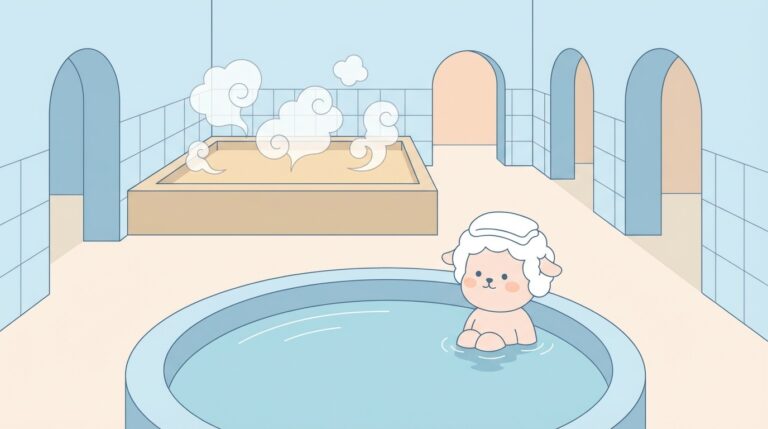
Phase 1: Welcome to the “Ice Age” 🥶
안녕하세요! This is your Daily Hangul Editor.
Picture this: You are watching a Korean variety show like Running Man. The cast members lose a game and receive a “water punishment.” They get dumped into a freezing pool, screaming, “Ahhh!” But then, you see an older Korean actor sitting in that same freezing water, closing his eyes, and sighing with a peaceful smile, “Ah~ Siwonhada (It’s refreshing).”
Wait, what? 🤔
Today, we are stepping into the Naengtang (냉탕 – Cold Bath) inside a Korean Sauna (Jjimjilbang). This is where the real local culture happens. It’s not just about water temperature; it’s about a mindset. If you know what to say here, you aren’t just a tourist; you’re a local.
Ready to take the plunge? Let’s go! 🌊
Phase 2: Deep Dive into Core Expressions 🤿
Here are the top 3 expressions you need to survive the cold shock.
1. 차가워요! (Chagawoyo!)
- Pronunciation: [Cha-ga-wo-yo] Think of the ‘Cha’ in ‘Cha-cha-cha’ + ‘ga’ like ‘garden’ + ‘wo-yo’.
- Meaning: It’s cold! (Physical temperature)
- K-Culture Moment: In K-Dramas, when a lead character gets splashed by a passing car on a rainy day, or touches an iced Americano to their cheek.
- Editor’s Insight: This is your honest, visceral reaction. Use this when your body is shivering!
- Situation Spectrum:
[🚫 Formal Boss] ———— [⚠️ Polite/Standard] ———— [✅ Casual]
- Note: This is the polite (Yo) form, so it’s safe for ⚠️ strangers in the sauna. Drop the ‘yo’ for friends (✅).
- 🤔 Think About It: In English, we just say “It’s cold.” In Korean, we have different words for “cold weather” (chupda) and “cold touch/objects” (chapda/chagapda). Why do you think Korean distinguishes touch from weather?
2. 시원해요 (Siwonhaeyo)
- Pronunciation: [She-won-hae-yo] Sounds a bit like ‘She won’ + ‘Hey’ + ‘Yo’.
- Meaning: It’s refreshing / It’s cool.
- K-Culture Moment: You will hear this everywhere. When an idol drinks a cold soda, when a dad enters a hot bath, or when eating hot clam soup. Yes, Hot = Siwonhada?
- Editor’s Insight: This is the magic word. In the cold bath context, it means the water feels good and wakes you up. It’s about the feeling of relief, not just the temperature.
- Situation Spectrum:
[✅ All Situations]
- This is the ultimate positive reaction word.
- 🤔 Think About It: Koreans say this for hot soup AND cold baths. Can you think of a word in your language that describes a feeling rather than a physical state?
3. 들어갈까요? (Deureogalkkayo?)
- Pronunciation: [Deu-reo-gal-kka-yo?] ‘Deu’ sounds like ‘Deux’ in French + ‘reo’ like ‘run’.
- Meaning: Shall we go in?
- K-Culture Moment: Friends standing at the edge of the pool in a reality show, hesitating before jumping in together.
- Editor’s Insight: Entering the cold bath is a team sport! Use this to encourage your friend who is scared of the cold.
- Situation Spectrum:
[⚠️ Polite Suggestion]
Phase 3: Textbook vs. Real Life 🥊
| Situation | 📖 Textbook Korean | 🗣️ Real Korean | 💡 Why the difference? |
|---|---|---|---|
| Touching cold water | 물이 차갑습니다. (The water is cold.) | 으! 차거! (Eu! Chageo!) | ‘Chageo’ is a spoken shortcut of ‘Chagawo’. It’s faster to say when you are shivering! |
| Feeling refreshed | 기분이 상쾌합니다. (I feel refreshed.) | 아~ 시원하다~ (Ah~ Siwonhada~) | ‘Sang쾌’ is poetic; ‘Siwon’ is physical. The “Ah~” sound is mandatory for the full feeling. |
| Hesitating to enter | 들어갑시다. (Let’s enter.) | 못 들어가겠어… (I can’t go in…) | In reality, people complain/whine before doing something difficult to build tension! |
💡 Bottom Note: In a casual setting, adding specific sounds like “Euh!” (으) or “Ah!” (아) makes you sound 100% more native than just saying the words.
Phase 4: Cultural Deep Dive — The Art of “Nunchi” inside the Bath 🛁
4-1. Non-verbal Communication: The “Heart Splash”
Before entering the Naengtang, you will see Koreans scooping cold water and splashing it on their chest and neck.
– What it says: “I am preparing my body so I don’t faint.”
– Nunchi Tip: Do not jump in (cannonball style)! This is rude. It splashes water on the Ajummas (middle-aged ladies) or Ahjussis who are meditating. Slide in gently like a ninja.
4-2. K-Culture Connection: The “Sauna Talk”
In K-Dramas like Reply 1988, the bathhouse is where secrets are shared. Being naked removes social barriers (literally). If someone speaks to you in the cold bath, they are likely just being friendly.
– Critic’s View: Why is nudity so normalized in Korean friendship? It’s called “Skinship” culture. Sharing a bath means we have nothing to hide from each other.
Phase 5: Immersive Roleplay 🎬
Setting: A Saturday afternoon at a local Jjimjilbang. Steam fills the air. You are standing in front of the Naengtang (18°C) with Min-su, your Korean friend.
Characters:
– YOU: A brave foreigner ready to try the cold bath.
– Min-su: Your playful Korean friend who loves saunas.
(Dialogue Start)
Min-su: 와, 찜질방 덥다. 우리 냉탕 갈까? 🥵
(Wa, jjimjilbang deopda. Uri naengtang galkka?)
(Wow, the sauna is hot. Shall we go to the cold bath?)
YOU: (Looking at the blue water)
_____________________________.
🔀 YOUR CHOICE! How do you reply?
- A) “네, 들어갑시다.” (Ne, deureogapsida.) – Formal & Robot-like
- B) “좋아요! 시원하겠네요!” (Joayo! Siwonhagenneyo!) – Positive & Natural
- C) “으… 너무 차가울 것 같아요.” (Eu… neomu chagaul geot gatayo.) – Honest & Cute
✅ Best Choice: B — It shows enthusiasm and uses the magic word “Siwonhada.”
⚠️ Choice C Analysis: It’s okay, but Min-su might tease you for being weak!
(Assume you chose B)
Min-su: (Splashing water on chest) 준비운동 하고 들어와! 🧘
(Junbiundong hago deureowa!)
(Do warm-up exercises and come in!)
YOU: (Stepping in slowly) 으악! 진짜 차가워요! 🥶
(Euak! Jinjja chagawoyo!)
(Argh! It’s really cold!)
Min-su: 가만히 있으면 괜찮아. 시원하지? 😏
(Gamanhi isseumyeon gwaenchana. Siwonhaji?)
(If you stay still, it’s okay. Refreshing, right?)
(Dialogue End)
Phase 6: 10-Second Shadowing Drill 🗣️
Let’s practice the rhythm! Pay attention to the emotion.
- 😨 Shocked: 으 / 차가워요! (Eu / cha-ga-wo-yo!)
- 😌 Relieved: 아 / 시원하다! (Ah / shi-won-ha-da!)
- 😁 Asking: 같이 / 들어갈까요? (Ga-chi / deu-reo-gal-kka-yo?)
Phase 7: K-Culture Mini Glossary 📚
| Korean | Romanization | English | Context |
|---|---|---|---|
| 냉탕 | Naengtang | Cold Bath | The icy pool (usually 18-20°C). |
| 온탕 | Ontang | Hot Bath | The standard hot pool (38-42°C). |
| 때밀이 | Ttaemiri | Scrub / Scrub Master | The exfoliating scrub service or the person doing it. |
| 양머리 | Yangmeori | Sheep Head | The cute towel hat folded to look like sheep ears (classic Drama trope). |
Phase 8: Traveler’s Survival Kit 🎒
Going to a Korean Sauna for the first time? Don’t panic.
🆘 Survival Expression #1
– 🇰🇷 “여기 수건 있어요?” (Yeogi sugeon isseoyo?)
– 🗣️ Pronunciation: [Yeo-gi soo-geon e-sseo-yo?]
– Meaning: Do you have a towel here?
– Where to use: At the front desk. (Men usually get unlimited towels; women get 2. Don’t ask why… it’s a mystery/debate in Korea!)🆘 Survival Expression #2
– 🇰🇷 “열쇠 어디예요?” (Yeolsoe eodiyeyo?)
– 🗣️ Pronunciation: [Yeol-swe eo-di-ye-yo?]
– Meaning: Where is the key?
– Pro Tip: Your locker key is usually a wristband. Wear it on your ankle in the bath so it doesn’t fall off!📌 Editor’s Travel Note:
Nudity: Yes, you must be fully naked in the wet bath area. No swimsuits allowed! Don’t worry, nobody is looking at you. Everyone is focused on their own relaxation. It’s awkward for 10 seconds, then it’s freedom.
Phase 9: Think Deeper — Language & Sensation 🧠
Why is “Hot” also “Cool”?
In English, “Cool” is about temperature or style. In Korean, “Siwonhada” (시원하다) describes the release of tension.
- When you drink cold water? Tension released -> Siwonhada.
- When you step into hot water? Muscles unknot -> Siwonhada.
- When you get a massage? Pain leaves -> Siwonhada.
It reflects a culture that values relief and catharsis over just physical facts.
💬 Your Turn: Does your language have a word that describes a feeling that doesn’t match the physical reality? (Like “sick” meaning “cool” in slang?) Share in the comments!
Phase 10: Troubleshooting & FAQ 🛠️
Q: Can I swim in the Naengtang (Cold Bath)?
A: Maybe. In huge water parks, yes. In a neighborhood sauna? NO. Splashing or swimming laps is considered rude. It is a place to sit and cool down. If you see kids doing it, they might get scolded by a grandpa!
❌ Common Mistake #1: Bringing your phone into the wet bath area.
✅ Fix: Leave it in your locker! It’s rude (privacy issues) and the humidity will kill your phone.
❌ Common Mistake #2: Keeping your underwear on.
✅ Fix: Be brave! It is more embarrassing to be the only person wearing clothes.
Phase 11: Wrap-up & Action Mission 🚀
One-Liner Summary: Use “Chagawoyo” for the temperature shock, but switch to “Siwonhada” once you enjoy the feeling!
🏆 Action Missions:
– 🥉 Bronze: Stand in a cold shower for 5 seconds and shout “으! 차가워!” (Eu! Chagawo!)
– 🥈 Silver: Watch a K-Drama scene in a sauna (Search “Reply 1988 Sauna Scene” on YouTube) and spot the “Sheep Head” towel.
– 🥇 Gold: Go to a Korean Jjimjilbang (or a spa in your country), step into the cold pool, and whisper “Ah~ Siwonhada.”
What’s your favorite way to relax? Hot sauna or cold plunge? Let me know below! 👇
Phase 12: Interactive Quiz 📝
1. Which reaction is culturally “most Korean” when eating hot spicy soup?
– A) It’s hot! (Tteugeowo!)
– B) It’s refreshing! (Siwonhada!)
– C) It’s cold! (Chagawo!)
2. True or False?
– You should wear a swimsuit in the Jjimjilbang wet bath area. (T / F)
3. Situation Check:
– You see a sign that says “냉탕 (Naengtang).” What temperature is the water?
– A) 40°C (Hot)
– B) 18°C (Cold)
Answers:
1. B (It’s the paradox of relief!)
2. False (Birthday suit only!)
3. B (Naeng = Cold)
Frequently Asked Questions (FAQ)
Q: What does "차가워요! (Chagawoyo!)" mean in Korean and how do you pronounce it?
A: In Korean, "차가워요! (Chagawoyo!)" is pronounced [Cha-ga-wo-yo] and means: It's cold! (Physical temperature)
Q: What does "시원해요 (Siwonhaeyo)" mean in Korean and how do you pronounce it?
A: In Korean, "시원해요 (Siwonhaeyo)" is pronounced [She-won-hae-yo] and means: It’s refreshing / It’s cool.
Q: What does "들어갈까요? (Deureogalkkayo?)" mean in Korean and how do you pronounce it?
A: In Korean, "들어갈까요? (Deureogalkkayo?)" is pronounced [Deu-reo-gal-kka-yo?] and means: Shall we go in?







