

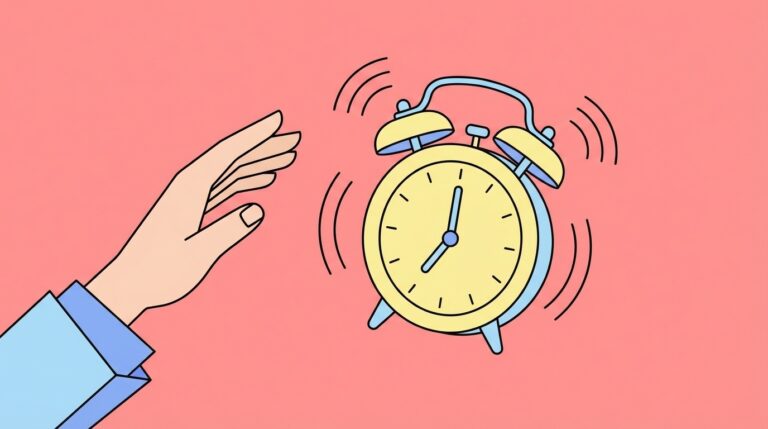
Phase 1: The Panic Moment 😱
Greeting: Hello, Daily Hangul family! It’s your editor here.
K-Culture Cold Open: Picture this typical K-Drama scene: Sunlight streams through the window. The protagonist stretches, looks happy, then glances at their phone. The background music suddenly stops. A scream echoes: “Aaaaaak! 망했다 (Mang-haet-da / I’m doomed)!”
They jump out of bed, toast in mouth, running with one shoe on. Why? Because they overslept on the day of the big interview/date/meeting.
The ‘Why’: We’ve all been there. You set five alarms, but your bed was just too comfortable. In Korea, punctuality is huge. If you’re late without a good explanation, you might be seen as seong-sil-ha-ji an-a (not diligent/sincere). But don’t worry! Knowing the right way to apologize can turn a disaster into a forgiveable mistake.
Transparency: Today’s lesson is based on real messages my students sent me when they missed our morning classes. (Don’t worry, I forgave them! 😉)
Phase 2: Deep Dive into Core Expressions 🤿
Here are the top 3 phrases you need when your alarm clock betrays you.
1. 늦잠 잤어요 (Neut-jam ja-sseo-yo)
- Pronunciation: [Neut-jam ja-sseo-yo]
- Sound Analogy: “Nut” (like a peanut) + “Jam” (strawberry jam). Imagine eating Nut-Jam in bed.
- Meaning: I overslept. (Literal: I slept a late sleep.)
- K-Culture Moment: Used often in variety shows when a cast member is missing for the opening segment. Everyone laughs and says, “Did he eat Nut-Jam again?”
- Editor’s Insight: This is an honest admission. It admits fault. Use this with friends or kind tutors.
- Situation Spectrum:
[🚫 Formal/Boss] ———— [⚠️ Colleagues] ———— [✅ Friends/Casual]- 🤔 Think About It: In English, we say “Over-slept” (too much sleep). In Korean, it’s “Late-sleep” (sleeping until late). Why do you think the focus is on the time rather than the amount?
2. 알람을 못 들었어요 (Allameul mot deureosseoyo)
- Pronunciation: [Al-lam-eul mot deu-reot-seo-yo]
- Sound Analogy: “Mote” rhymes with boat + “Deu” (like French ‘de’).
- Meaning: I couldn’t hear the alarm.
- K-Drama Moment: The classic excuse the main character gives to their strict manager while bowing 90 degrees.
- Editor’s Insight: This shifts the blame slightly to the machine (the alarm). It sounds a bit like an excuse, so use it carefully!
- Situation Spectrum:
[🚫 Strict Boss] ———— [⚠️ Friendly Boss] ———— [✅ Friends]3. 지금 바로 갈게요! (Jigeum baro galgeyo!)
- Pronunciation: [Ji-geum ba-ro gal-ge-yo]
- Sound Analogy: “Ba-ro” sounds like “Borrow”.
- Meaning: I’m coming right now! / I’ll go immediately!
- Editor’s Insight: This is the most important phrase. It shows action. You aren’t just sorry; you are fixing the problem.
- Situation Spectrum:
[✅ All Situations] (Must use!)
Phase 3: Textbook vs. Real Life 🥊
| Situation | 📖 Textbook Korean | 🗣️ Real Life Korean (Texting) | 💡 Why is it different? |
|---|---|---|---|
| Late for a date | 죄송합니다. 늦잠을 잤습니다. (I am sorry. I overslept.) | 헐… 미안 ㅠㅠ 지금 일어났어 (Omg… sorry ㅠㅠ Just woke up) | Friends don’t use formal speech. ‘ㅠㅠ’ (crying eyes) is essential for empathy! |
| 10 mins late | 늦어서 죄송합니다. (Sorry for being late.) | 지금 뛰어가는 중!! 🏃♂️💨 (Running now!!) | Showing urgency is better than a dry apology. |
Bottom Note: Use the Real Life versions with close friends (called chin-gu). Stick to the Textbook version for people older than you.
Phase 4: Cultural Context — The “Korean Time” ⏳
4-1. Non-verbal: The “Dashing” Act
If you are late, you must look like you hurried. Even if you took a taxi, when you arrive, walk fast, breathe a little heavily, and look apologetic. If you walk in slowly with a coffee in your hand? Big mistake. That shows no Nunchi (social sense).
4-2. K-Drama Trope: The Toast Run
We mentioned the “Toast in mouth” scene. In dramas, being late often leads to a “destined encounter” (bumping into a handsome stranger).
Reality Check: In real Seoul, running late usually just means getting stuck in the subway rush hour (Jiok-cheol / Hell-train). There is no handsome stranger, only sweaty elbows.
Phase 5: Immersive Roleplay 🎬
Setting: Saturday, 11:00 AM. A hip cafe in Hongdae. You were supposed to meet your Korean friend, Minji, at 10:30 AM.
Characters:
* YOU: Still in pajamas, hair messy.
* Minji: (30, your close friend, waiting with an iced Americano, slightly annoyed).
The Phone Rings… 📲
Minji: 야! 너 어디야? 왜 안 와? 😠
(Ya! Neo eodiya? Wae an wa?)
(Hey! Where are you? Why aren’t you coming?)
🔀 YOUR TURN! How do you answer?
Option A: “Just 5 minutes away!” (The Lie)
Option B: “Minji… I’m so sorry. I overslept.” (The Honest Truth)
Option C: “Why are you calling so early?” ( The Death Wish)
✅ Best Choice: Option B
* YOU: 민지야… 정말 미안해. 늦잠 잤어. 😭
(Minji-ya… jeongmal mianhae. Neut-jam ja-sseo.)
(Minji… I’m so sorry. I overslept.)
Minji: 뭐? 지금 일어났다고? 진짜 대박이다…
(Mwo? Jigeum ireonatdago? Jinjja daebagida…)
(What? You just woke up? That’s unbelievable/crazy…)
YOU: 알람을 못 들었어 ㅠㅠ 지금 바로 갈게! 맛있는 거 살게!
(Allameul mot deureosseo ㅠㅠ Jigeum baro galge! Masinneun geo salge!)
(I didn’t hear the alarm. I’m coming right now! I’ll buy you something delicious!)
Minji: 알았어. 빨리 와. 커피 녹고 있어.
(Arasseo. Ppalli wa. Keopi nokgo isseo.)
(Okay. Come quickly. The coffee is melting.)
Phase 6: 10-Second Shadowing Drill 🗣️
Repeat this 3 times. Focus on the urgency in your voice!
😟 Apologetic & Urgent:
정말 미안해요! / 지금 / 바로 / 갈게요!
(Jeong-mal mi-an-hae-yo! / Ji-geum / ba-ro / gal-ge-yo!)
I’m so sorry! / I’m coming / right / now!
Phase 7: K-Culture Glossary 📚
| Korean | Romanization | Meaning | Context |
|---|---|---|---|
| 헐 | Heol | OMG / No way | Used when you realize you overslept. |
| 멘붕 | Men-bung | Mental Breakdown | The feeling when you see the time. |
| 쏜다 | Ssonda | To treat/pay | How to apologize: “I’ll treat you!” (Naega ssol-ge!) |
Phase 8: Traveler’s Survival Kit 🎒
Did you oversleep and miss your KTX train or tour bus?
🆘 Survival Expression #1
– 🇰🇷 “다음 기차 언제 있어요?” (Daeum gicha eonje isseoyo?)
– 🗣️ Meaning: When is the next train?
– 📍 Use here: Train station (Seoul Station, Busan Station).🆘 Survival Expression #2
– 🇰🇷 “혹시 기다려 주실 수 있나요?” (Hoksi gidaryeo jusil su innayo?)
– 🗣️ Meaning: Can you possibly wait for me?
– 💡 Pro Tip: Use this with tour guides. They might wait 5 minutes if you are polite!
Phase 9: Think Deeper — “Diligence is Gold” 🧠
Language & Culture:
In Korea, waking up early represents Seong-sil-ham (Diligence/Sincerity). Historically, being an agrarian society, the early riser was the hard worker. Even today, “Miracle Morning” (waking up at 4 or 5 AM for self-development) is a huge trend among young Koreans.
💬 Your Turn: In your country, is oversleeping seen as a simple mistake or a character flaw? Tell me in the comments!
Phase 10: FAQ & Troubleshooting 🛠️
Q: Can I tell my boss “늦잠 잤어요” (I overslept)?
A: NO. 🚫 Unless you have a super chill boss. In Korean work culture, oversleeping is considered unprofessional.
Better Strategy: Say you are not feeling well (mom-i an jo-a-yo) or had a sudden emergency at home. A white lie is often better to maintain professional face.
Q: How late is “too late” in Korea?
A: For friends, 10-15 minutes is usually forgivable (
Frequently Asked Questions (FAQ)
Q: What does "늦잠 잤어요 (Neut-jam ja-sseo-yo)" mean in Korean and how do you pronounce it?
A: In Korean, "늦잠 잤어요 (Neut-jam ja-sseo-yo)" is pronounced [Neut-jam ja-sseo-yo] and means: a key conversational Korean expression covered in this lesson.
Q: What does "알람을 못 들었어요 (Allameul mot deureosseoyo)" mean in Korean and how do you pronounce it?
A: In Korean, "알람을 못 들었어요 (Allameul mot deureosseoyo)" is pronounced [Al-lam-eul mot deu-reot-seo-yo] and means: a key conversational Korean expression covered in this lesson.
Q: What does "지금 바로 갈게요! (Jigeum baro galgeyo!)" mean in Korean and how do you pronounce it?
A: In Korean, "지금 바로 갈게요! (Jigeum baro galgeyo!)" is pronounced [Ji-geum ba-ro gal-ge-yo] and means: a key conversational Korean expression covered in this lesson.







